A quick outline before we get into it
- Why earthworm peptide powder is getting attention
- What makes it commercially interesting across regions
- Where the strongest product-fit opportunities sit
- The real barriers: regulation, claims, culture, and sourcing
- What buyers should check before taking it into a market
- A balanced verdict on global suitability
- FAQs
So, is the answer yes? Well… yes, but not everywhere in the same way
Earthworm peptide powder has real global potential, but it is not a plug-and-play ingredient for every country, every category, or every customer type.
That sounds a bit contradictory at first. If the ingredient has strong functionality, why wouldn’t it fit everywhere? Here’s the thing: global suitability is not only about bioactivity. It’s also about regulation, consumer acceptance, format compatibility, raw material consistency, and how safely a supplier can position the ingredient in commercial language.
From a technical and product-development angle, earthworm-derived proteins and peptides are promising. Research in the files you shared points to high protein levels in earthworms, the release of smaller bioactive peptides after digestion or hydrolysis, and potential activities linked to antioxidant, ACE-inhibitory, immunomodulatory, and thrombolytic-related functions. Those findings are part of why earthworm protein is being discussed as a functional food and health ingredient, not merely a niche raw material.
But commercial success is another beast. A strong ingredient can still stumble if the dossier is thin, the terminology feels unfamiliar to consumers, or the market sees the source species as too novel. That’s why the better question is not “Can it be sold globally?” It’s “In which markets, in which formats, and under which positioning does it make sense?”
Why buyers are even looking at earthworm peptide powder
Let’s start with the commercial appeal.
Earthworm protein has been described in the research as a high-protein resource, often in the rough range of 60% to over 70% depending on material and processing, with a useful amino acid profile and growing interest as an alternative protein and functional ingredient. One study notes that earthworm protein can be prepared at high purity and then hydrolyzed into soluble peptides after simulated gastrointestinal digestion.
That matters for global markets because modern ingredient buyers are not only chasing novelty. They want ingredients that can support one or more of these needs:
- functional positioning
- differentiated storytelling
- compact dosage formats
- compatibility with supplements, health foods, or specialty formulations
- room for premium pricing
Earthworm peptide powder checks several of those boxes. Research in your files identified antioxidant peptides from earthworm proteins after digestion and also reported novel ACE-inhibitory peptides from earthworm protein digestion products. In separate work, earthworm protein autolysates also showed immunomodulatory potential in an animal model.
For a supplier, that creates a useful commercial story: one raw material, multiple possible functional directions. Not a magic ingredient, no. But certainly a versatile one.
The strongest fit is not one market. It’s several very different ones
Honestly, this is where many ingredient discussions go off track. People talk about “global markets” as if the world buys health ingredients for the same reasons. It doesn’t.
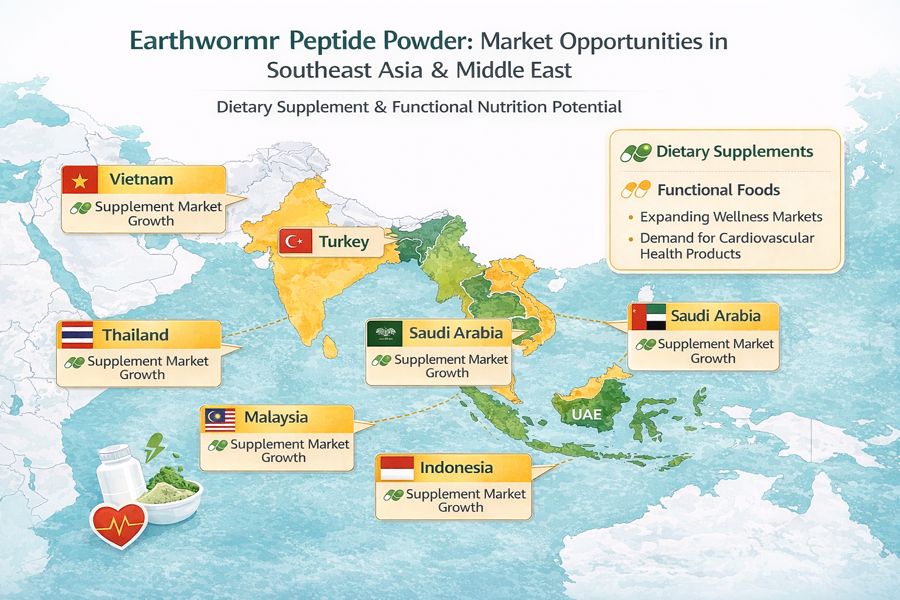
Southeast Asia and Greater China: probably the most natural starting point
In parts of Asia, earthworm-derived materials already carry historical familiarity through traditional use, especially in medical or health-related contexts. The broader review you shared notes long-standing use of earthworms in East Asia and summarizes modern interest in antithrombotic, antioxidant, wound-healing, anti-inflammatory, and other effects.
That existing cultural familiarity lowers one major barrier: consumer hesitation. Buyers in these markets may still care about purity, heavy metals, microbiology, odor, and labeling—of course they do—but they are less likely to react with “Wait, this comes from what?” That changes everything.
For these regions, earthworm peptide powder is more suitable in:
- dietary supplements
- functional health products
- traditional-health-inspired premium formulas
- specialty tablets, capsules, and powders
If positioned carefully, this is likely the easiest commercial runway.
Middle East and selected emerging nutraceutical markets: promising, but education-heavy
These markets often respond well to differentiated functional ingredients, especially when there is a clear B2B value story around innovation, premium wellness, or specialized use. But familiarity is usually lower than in East Asia.
That means suitability depends less on the ingredient’s science alone and more on the supplier’s ability to answer practical questions:
Is it standardized?
Is the source controlled?
Is the process documented?
Can the supplier support compliance files, COA sets, and specification sheets?
Can the product be described in a way that feels credible rather than sensational?
If the answer is yes, the ingredient can find a place—especially in niche, practitioner-led, or specialist supplement channels.
Europe and North America: suitable, but selectively and with more friction
This is where the market opportunity gets interesting, and a little tricky.
From a pure functionality standpoint, earthworm peptide powder could interest innovative supplement brands, raw material distributors, and formulation houses looking for alternative bioactive peptides. The research basis is not empty. It includes evidence for antioxidant peptides, ACE-inhibitory peptides, and broader pharmacological interest in earthworm extracts and bioactive agents.
But from a market-access standpoint, these regions are tougher because they demand more in three areas:
First, regulatory clarity.
Second, claim discipline.
Third, consumer acceptability.
And that third one matters more than people admit. A technically good ingredient can still struggle if the source creates an emotional “no” in mainstream buyers. You know how it goes—some ingredients sound clinical and premium, others sound like a dare.
So in North America and Europe, earthworm peptide powder may be suitable for:
- Ingredient distribution
- white-label niche supplement development
- practitioner or specialty wellness channels
- highly targeted formulations rather than mass retail
Mass-market beverage shelves? Probably not the first stop. Capsule, sachet, or tablet formats? Much more realistic.
The science helps, but suitability depends on the form of the science
This is an important distinction.
Research in the files shows that earthworm proteins can yield peptides with antioxidant activity after simulated digestion, including specific peptide sequences that performed well in radical scavenging and related assays. Research also identified seven novel ACE-inhibitory peptides from earthworm protein digestion products, with two peptides showing especially strong in vitro ACE inhibition. Another study found immunomodulatory effects from earthworm protein autolysates in CTX-induced immunosuppressed mice and screened potential active peptides.
That gives a supplier three good things:
A technical backbone.
A product differentiation story.
A reason for R&D teams to take the ingredient seriously.
But global suitability improves only when those findings are translated into usable commercial tools, such as:
- a stable specification
- batch-to-batch consistency
- clear peptide or protein content benchmarks
- microbial and contaminant controls
- documentation that aligns with destination market needs
Without those, even good research stays stuck in PowerPoint.
Let’s talk about the real barriers, because they’re real
1. Regulatory status is market-specific
This is probably the biggest issue.
Even if an ingredient performs well biologically, that does not mean every country will accept it equally in supplements, foods, or pharmaceutical-adjacent products. Some markets may treat it as a novel food issue. Others may focus on source species, manufacturing controls, or allowable claims.
So, is earthworm peptide powder suitable for global markets? Yes—but only when suppliers treat regulation as a country-by-country exercise, not a universal assumption.
That means buyers should ask for:
- source species identification
- manufacturing flow description
- contamination controls
- heavy metal and microbiology data
- intended use category by market
One production document you shared describes earthworm protein powder manufacturing through selection, separation, washing, hydrolysis, centrifugation, low-temperature drying, milling, sterilization, and packing. That kind of process visibility helps, especially for importers and private-label partners.
2. Consumer acceptance is uneven
This is the quiet deal-breaker.
In some regions, the concept of earthworm-derived peptides will feel novel and functional. In others, it may feel strange, too close to traditional medicine for modern retail, or simply unfamiliar in a way that slows sales.
That does not make the ingredient unviable. It just means format and messaging matter a lot.
For example, “earthworm peptide powder” as a bulk ingredient for B2B use is one thing. A front-label consumer product shouting the source material in a mainstream supermarket is another. Same ingredient. Totally different reaction.
3. Overclaiming can ruin a good ingredient
There’s a temptation with ingredients like this to go too hard on dramatic claims. That would be a mistake.
Yes, the files include evidence related to thrombolytic or fibrinolytic interest around lumbrokinase and earthworm-derived bioactive agents, plus antioxidant, antihypertensive, and immune-related research. But global market suitability improves when suppliers stay precise and restrained.
Serious buyers prefer controlled language. They want supporting data, not miracle copy.
4. Raw material quality can make or break international expansion
You know what? With animal-derived functional ingredients, buyers are often less worried about the headline benefit than about the hidden risks.
Where was it farmed?
What substrate exposure occurred?
How were impurities removed?
How is odor managed?
How stable is the finished powder?
Because earthworms interact closely with their environment, sourcing controls and purification discipline are essential. That is especially true when selling into higher-standard import markets.
Where earthworm peptide powder makes the most sense commercially
The best global opportunities are probably not broad commodity channels. They are targeted, higher-value sectors.
Dietary supplements
This is the most obvious fit. Capsules, tablets, and stick powders can handle a specialized ingredient story more easily than mainstream foods can. Buyers in this space are also more accustomed to bioactive peptides and technical sourcing language.
Nutraceutical ingredient supply
For ingredient distributors and brand formulators, earthworm peptide powder can work as a premium niche raw material, especially when supported by strong test data and a disciplined positioning strategy.
Pharmaceutical support or adjunct-development pipelines
The review in your files highlights significant pharmacological interest in earthworm extract bioactive agents, including lumbrokinase and other components with antithrombotic and related activities. That does not mean every powder is a pharma ingredient, obviously. But it does mean the category has a stronger scientific aura than many novelty proteins.
Functional foods—carefully selected
This is possible, but only in specific markets and product concepts. The opportunity is better in specialist health foods than in mass-market snacks or beverages. One file also discusses innovation potential for earthworm protein peptides in foods, though commercial success here would depend heavily on taste, labeling strategy, and regulatory fit.
What serious buyers should verify before entering a new market
A buyer evaluating earthworm peptide powder for global sale should not stop at “protein content” or “activity.” That’s too shallow.
They should also verify:
- source species and farming control
- manufacturing method and temperature handling
- protein or peptide content specification
- contaminant and micro testing
- digestion or bioactivity data relevant to intended positioning
- country-specific regulatory path
- label language and claims suitability
In other words, the ingredient may be globally promising, but the execution has to be very local. That’s not a weakness. That’s just how good export business works.
The bottom line
Earthworm peptide powder is suitable for global markets—but selectively, strategically, and much more successfully in some regions than others.
Its strongest advantages are functional differentiation, bioactive peptide potential, and relevance for specialized health categories. The research you provided supports real interest in antioxidant, ACE-inhibitory, and immunomodulatory applications, while broader review literature points to a wider pharmacological landscape for earthworm-derived bioactive components.
Its biggest constraints are not only scientific. They are regulatory readiness, buyer education, quality assurance, and consumer perception.
So yes, it can travel. But it won’t travel well on hype alone.
The suppliers who win with this ingredient will be the ones who combine clean processing, careful documentation, realistic claims, and region-specific market strategy. That’s the difference between an interesting raw material and a real global business.
FAQs
1. Is earthworm peptide powder legal for sale in all countries?
No. Earthworm peptide powder is not automatically accepted in every market. Its commercial use depends on local rules for food, supplement, or novel ingredients, plus the quality of the supplier’s documentation and compliance package.
2. Why is earthworm peptide powder considered a promising nutraceutical ingredient?
It is considered promising because studies have reported bioactive peptides from earthworm proteins with antioxidant, ACE-inhibitory, and immunomodulatory potential, which makes it relevant for specialized nutraceutical ingredient development.
3. Which global markets are most suitable for earthworm peptide powder?
Markets with stronger familiarity with earthworm-derived health materials, especially parts of Asia, are generally more accessible first. Other regions may still be attractive, but they usually need more regulatory review and more buyer education.
4. Can earthworm peptide powder be used in functional foods?
It can be considered for functional foods, but suitability depends on local compliance, taste and odor control, label strategy, and consumer acceptance. In many cases, capsules, tablets, and sachets are more practical than mainstream food formats.
5. What should importers check before sourcing earthworm peptide powder for international markets?
Importers should review source species, manufacturing process, contaminant controls, microbiological data, peptide or protein specifications, stability information, and market-specific regulatory fit before purchasing earthworm peptide powder for global distribution.