Quick outline
- Why this question matters for B2B buyers
- What earthworm protein powder actually brings to the table
- Where the science looks promising, and where it’s still early
- Which target markets are the best fit
- Where the fit is weaker or needs more regulatory work
- A practical checklist for suppliers, manufacturers, and brand owners
- FAQs

Let’s be honest: earthworm protein powder is not a mainstream ingredient. Not yet.
That’s exactly why buyers keep circling back to it.
For the right brand, the right formulation team, and the right market, it can feel like a genuinely interesting raw material—high in protein, linked to peptide research, and tied to areas like antioxidant, antihypertensive, and immunomodulatory exploration. But for the wrong market? It can be a hard sell, a regulatory headache, or a formulation concept that looks better in a lab deck than on a finished product label.
So, is earthworm protein powder suitable for your target market?
The real answer is: sometimes yes, sometimes absolutely not. And that’s not a cop-out. It’s the kind of answer serious B2B buyers need.
First, what makes earthworm protein powder commercially interesting?
Earthworm protein has been studied as an edible protein source with a strong nutritional profile. Research in the uploaded materials describes earthworm as containing a large amount of protein—commonly around 60% to over 70% in raw material depending on source and method—and notes a good essential amino acid composition. One study also reported that dried earthworm raw material used in testing contained about 60.34% protein, while extracted earthworm protein reached 96.03% purity after processing.
That matters because buyers are no longer looking at protein as just “protein.” They want story + function + differentiation.
And earthworm protein powder does have a story:
- unconventional but science-linked protein source
- peptide generation after digestion or hydrolysis
- interest in functional-food positioning
- links to cardiovascular, antioxidant, and immune-support research at the ingredient level
In the ACE-inhibitory study, researchers concluded that earthworm protein can yield bioactive peptides after gastrointestinal digestion and positioned it as a potential new protein resource for functional food applications. In the antioxidant study, researchers found antioxidant activity in gastrointestinal digestion products and said the work supports the application of earthworm protein as a food resource in functional foods.
That’s a useful commercial foundation. Not a magic wand—but a foundation.
The science is promising, but the positioning has to stay disciplined
Here’s the thing: promising science is not the same as a finished market claim.
Several of the uploaded studies point in interesting directions:
The antihypertensive work identified seven novel ACE-inhibitory peptides from earthworm protein digestion products, with SSPLWER and RFFGP showing the strongest ACE inhibitory activity among the screened peptides.
The antioxidant work identified 6,030 peptide sequences after purification steps and highlighted AFWYGLPCKL, WPWQMSLY, and GCFRYACGAFY as standout antioxidant peptides. That study explicitly linked the results to possible use of earthworm proteins as antioxidants in health foods.
The immunomodulatory study reported that earthworm protein autolysate had a degree of hydrolysis of 22.38% and soluble peptide content of 77.92%, and in its model it helped address CTX-induced immunosuppression and intestinal inflammation. The authors concluded that earthworm protein autolysate may be a potential source of immunomodulatory peptides.
Put simply, the ingredient has scientific talking points. Real ones.
But there’s a catch. Actually, two catches.
First, a lot of this evidence sits at the level of in vitro screening, simulated digestion, peptide identification, and animal work. Second, the commercial success of an ingredient doesn’t ride on bioactivity alone. It rides on regulatory status, buyer education, sensory acceptance, dosage logic, documentation quality, and formulation practicality.
That’s why earthworm protein powder is not a broad-market ingredient. It’s a select-market ingredient.
So who is the best target market?
1. Dietary supplement brands looking for niche differentiation
This is one of the strongest fits.
Supplement brands are used to novel ingredient narratives. They know how to build a product around an ingredient story, especially when the science supports a functional direction such as cardiovascular wellness, antioxidant support, or advanced protein-derived actives. Earthworm protein powder can be attractive here because it offers something many supplement teams want badly: a reason to not look like every other capsule on the shelf.
That said, the best fit is not mass retail. It’s more likely:
- specialist cardiovascular support concepts
- premium wellness lines
- practitioner-oriented brands
- cross-border or niche e-commerce brands
- ingredient-led launches aimed at educated users
Why? Because this ingredient needs explanation. A lot of it.
If your customers need a five-second pitch, this may be too unusual. If they’re already comfortable with specialized bioactive ingredients, that’s a different story.
2. Nutraceutical ingredient suppliers and B2B formulators
Honestly, this may be the sweetest spot.
Ingredient suppliers and formulation houses can work with earthworm protein powder as a platform ingredient rather than a one-off SKU. They can develop:
- peptide-forward concepts
- cardiovascular support blends
- antioxidant complexes
- functional protein systems
- customized premixes for regional clients
The research base supports that kind of B2B conversation. Not with overblown promises, but with enough substance to justify R&D interest. The ACE-inhibitory, antioxidant, and immunomodulatory directions together create a broader “bioactive protein” narrative than a simple commodity protein pitch ever could.
And B2B buyers tend to ask the right questions anyway: What’s the protein content? What’s the process? What’s the peptide profile? What data supports it? Can it be standardized? Can it be documented?
That’s where this ingredient has a fighting chance.
3. Pharmaceutical ingredient developers
This can be suitable, but only in a much narrower way.
If you’re selling into pharma-related development, earthworm-derived ingredients are more often discussed in relation to specific actives, especially enzyme or peptide fractions, rather than broad protein powder positioning. The review file summarizes earthworm extract research across antithrombotic, antioxidant, anti-inflammatory, wound-healing, and other pharmacological areas, and highlights lumbrokinase in particular for anticoagulant and thrombolytic properties.
That’s useful context, but it also creates a commercial problem: pharma buyers are usually not looking for a vague multifunctional powder. They’re looking for defined, consistent, well-characterized materials with a clear regulatory route.
So if the offer is “earthworm protein powder” in a broad sense, pharma may not be the best first target.
If the offer becomes “standardized earthworm-derived peptide fraction” or a well-documented intermediate with a targeted application, then the conversation gets more serious.
In other words, pharma is possible—but not casual. Not even close.
4. Cosmetics and personal care suppliers
This one’s interesting. A little unexpected, maybe, but interesting.
The broader earthworm extract review notes antioxidant, wound-healing, anti-aging, and anti-inflammatory areas of interest in earthworm-derived bioactives. That does not automatically make earthworm protein powder a plug-and-play cosmetic raw material, but it does open a door.
The better angle for cosmetics is usually extract, peptide, or hydrolysate storytelling, not a blunt protein powder story. Skin-care buyers care about:
- active positioning
- stability
- odor
- color
- compatibility
- clean documentation
- consumer reaction to the ingredient name
And yes, let’s say the quiet part out loud: consumer acceptance can get weird here. Some buyers will find the story innovative. Others will hear “earthworm” and slam the brakes.
So for cosmetics, the ingredient may suit:
- professional or spa-oriented ranges
- science-forward anti-aging concepts
- niche functional skincare
- B2B white-label developers willing to lead with peptide science rather than creature imagery
Mass beauty? Probably not the first stop.
Where the fit gets weaker
This part matters. A lot.
Mainstream consumer packaged foods
Even though the literature discusses earthworm as an edible protein source and functional food candidate, mainstream food products face a bigger hurdle: consumer psychology.
A protein ingredient can be nutritionally sound and still fail because people don’t want to eat it. That’s business, not biochemistry.
Texture, odor, flavor masking, naming strategy, and cultural acceptance all become make-or-break issues. For a sports nutrition or snack brand trying to sell fast through broad retail, earthworm protein powder is likely too niche unless the market already accepts novel animal proteins.
Low-price, high-volume mass markets
This ingredient is not ideal where the sales model depends on easy understanding, low education cost, and rapid scale.
Why? Because the product usually needs explanation, technical files, positioning care, and often a more deliberate customer journey. That is the opposite of a “cheap protein powder for everybody” play.
Markets with unclear or restrictive regulatory pathways
Even when the science looks good, the commercial route can stall if the regulatory side is fuzzy. The uploaded research notes that earthworm protein has been recognized as a new food resource in China since 2009. That helps for China-linked positioning, but it does not automatically solve market access elsewhere.
For global sellers, that means target-market suitability is never just about function. It’s also about:
- local ingredient classification
- allowed claims
- import and customs treatment
- contaminant and heavy metal limits
- species documentation
- manufacturing traceability
A market can love the concept and still reject the paperwork. Painful, but true.
What buyers will quietly judge you on
Here’s a little digression that matters more than some suppliers expect.
Most buyers won’t say, “We rejected this because your story felt messy.” But they’ll do exactly that.
Earthworm protein powder has to be presented with unusual discipline. The production-flow file in your materials describes a process involving selection, separation of worm and impurities, secondary cleaning, washing/hydrolysis, centrifugation and filtration, low-temperature drying, milling, sterilization, and packaging; it also lists earthworm, corn starch, and maltodextrin as production materials in that version.
That means your target-market fit improves dramatically when you can answer these questions cleanly:
What species is used?
What is the protein spec?
Is it plain protein powder, hydrolysate, peptide-rich fraction, or blended finished powder?
Are carriers included?
What is the intended claim territory?
What contaminants are controlled?
What does the sensory profile look like?
What does the regulatory dossier say market by market?
If those answers are weak, even a curious buyer may walk away.
A practical way to decide if the market fit is real
Ask your target segment these five questions:
1. Does the buyer want novelty or familiarity?
If they want familiar, safe, instantly understood ingredients, this is a poor fit.
If they want differentiated science-backed actives, the fit improves.
2. Is the product sold on ingredient story?
If yes, earthworm protein powder can work.
If no, it becomes dead weight.
3. Can the brand support education?
If the brand has room for technical storytelling, white papers, and expert-led content, good.
If it relies on impulse purchase, not so good.
4. Is the application closer to “functional bioactive” than “commodity protein”?
That’s the sweet spot. Earthworm protein powder is more compelling as a functional ingredient than as a bargain protein source.
5. Can the company handle regulatory variation?
This one separates serious operators from hopeful ones.
My take: which target markets are most suitable?
If I rank the fit from strongest to weakest for commercial practicality, it looks like this:
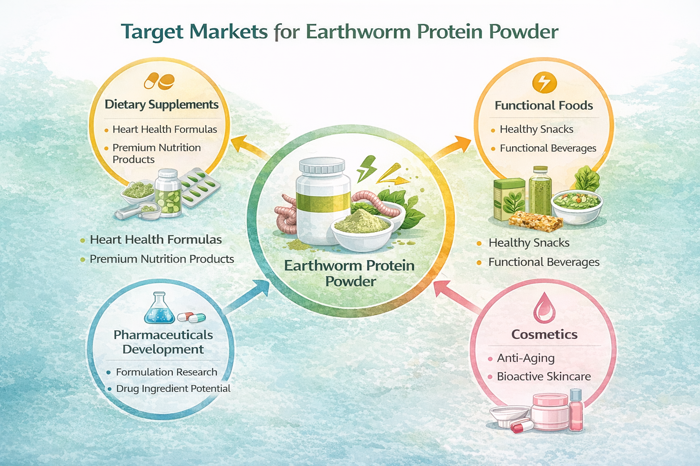
Best fit: nutraceutical ingredient suppliers, specialized supplement manufacturers, functional ingredient developers
Conditional fit: pharmaceutical development partners, advanced cosmetic raw material suppliers
Weak fit: mainstream food brands, broad retail protein products, low-education consumer markets
That’s the clean version.
And maybe that’s the real value of earthworm protein powder: not that it suits every market, but that it can be very attractive in the markets that reward science, specialization, and a strong technical sales story.
It’s a bit like a precision tool. You don’t use it everywhere. But where it fits, it fits well.
Final word
Earthworm protein powder is suitable for your target market only when the market values bioactive potential more than ingredient familiarity.
That makes it a strong candidate for specialized supplement, nutraceutical, and advanced ingredient-development channels. It makes it a much weaker candidate for mass-market food or broad retail concepts.
So don’t ask only, “Is this ingredient good?”
Ask the better question: Is this ingredient believable, sellable, and supportable in the market I’m actually targeting?
That’s where the real answer lives.
FAQs
1. Is earthworm protein powder suitable for dietary supplement brands?
Yes, especially for niche dietary supplement brands focused on cardiovascular support, antioxidant positioning, or advanced functional ingredients. It is usually better suited to specialist or premium supplement concepts than to mass-market wellness products.
2. Can earthworm protein powder be used in nutraceutical ingredient development?
Yes. Earthworm protein powder is well suited to nutraceutical ingredient development because research has linked earthworm-derived protein hydrolysates and peptides with antioxidant, ACE-inhibitory, and immunomodulatory potential. That gives formulators several directions for concept development.
3. Is earthworm protein powder a good fit for pharmaceutical ingredient buyers?
It can be, but usually only when the material is well characterized and supported by technical documentation. Pharmaceutical ingredient buyers often prefer standardized fractions or defined actives over a broad earthworm protein powder concept.
4. What makes earthworm protein powder difficult for mainstream markets?
The biggest barriers are consumer acceptance, regulatory uncertainty in some regions, and the need for strong technical education. Even when the science is promising, unusual ingredients often need more explanation before customers or distributors accept them.
5. What should wholesalers and manufacturers check before marketing earthworm protein powder?
They should check species identity, protein content, carrier use, production method, contaminant controls, claim strategy, and country-specific regulatory status. For wholesalers and manufacturers, those details matter just as much as the bioactive story.