
The fibrin plate assay for lumbrokinase activity is one of the key testing methods used to evaluate fibrinolytic activity in earthworm-derived lumbrokinase ingredients. For B2B buyers, the result on a COA is not just a number. It is connected to the assay method, unit expression, substrate, standard reference, incubation conditions, sample dilution, and calculation model used by the laboratory.
This matters when comparing supplier COA data, third-party sample test results, and lumbrokinase specifications expressed in IU/mg, FU/g, LKU, U, or other activity units. A difference between two test reports does not always mean the material is inactive or unsuitable. It may mean the testing systems are not directly comparable.

Quick Answer
The fibrin plate assay for lumbrokinase activity measures fibrinolytic enzyme performance by observing how a lumbrokinase sample acts on a fibrin-containing plate under controlled laboratory conditions. It is widely used because lumbrokinase is evaluated for fibrin-related enzyme activity in supplement, nutraceutical, enzyme formulation, and research-related applications.
However, activity values such as IU/mg, FU/g, LKU, and U should not be compared without checking the assay method behind the result. Buyers should review the COA, specification sheet, and assay method together before approving samples or bulk orders.
Why This Matters for B2B Buyers
For ingredient buyers, lumbrokinase quality evaluation often starts with a COA. The COA may show activity, appearance, moisture, ash, heavy metals, microbiology, storage, and batch information. But for lumbrokinase, activity data needs extra attention because enzyme activity is method-dependent.
A common B2B situation is this:
The supplier reports lumbrokinase activity in IU/mg by fibrin plate assay. The buyer sends the sample to a third-party lab, and the lab reports a different value in FU/g or another unit system. The buyer may think the product has no activity or that the supplier’s COA is wrong.
That conclusion may be too simple.
Different laboratories may use different substrates, reference standards, incubation times, temperatures, dilution ranges, and calculation methods. These differences can affect the final number. Before rejecting or approving a sample, buyers should ask whether both reports are based on the same assay system.
For a deeper explanation of unit expressions, buyers can also review Lumbrokinase Activity Units. For document comparison, see Lumbrokinase COA vs Specification Sheet and How to Read a Lumbrokinase Specification Sheet.
Technical Explanation: What Is a Fibrin Plate Assay?
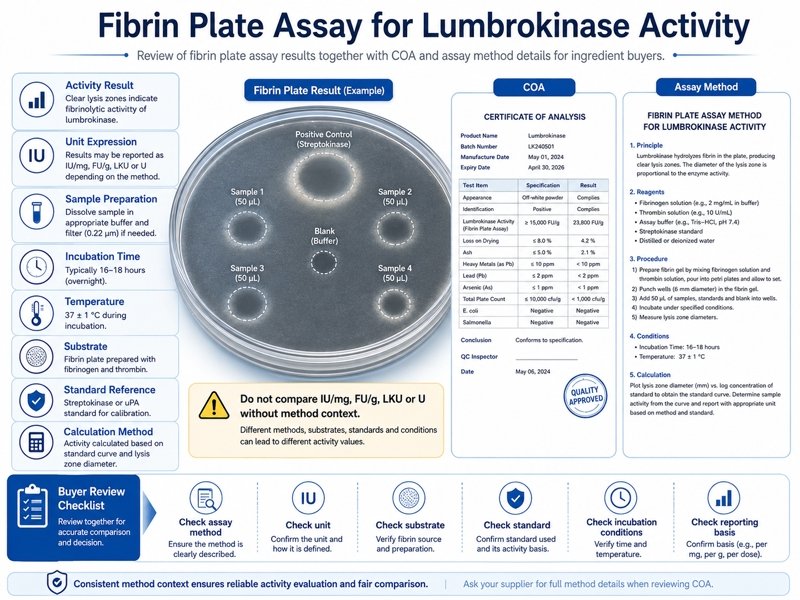
A fibrin plate assay is a laboratory method used to observe fibrinolytic activity. In simple terms, a fibrin-containing gel or plate is prepared, and the lumbrokinase sample is added to the plate. During incubation, the enzyme acts on the fibrin substrate. The resulting clear zone, lysis area, or measured response is then used to calculate activity based on the lab’s chosen standard and calculation method.
For lumbrokinase, this method is relevant because lumbrokinase is an earthworm-derived fibrinolytic enzyme ingredient. It is commonly supplied for dietary supplement, nutraceutical, enzyme formulation, and research-related applications where fibrin-related activity is an important quality parameter.
A fibrin plate assay can help show whether a sample has fibrinolytic enzyme activity under the test conditions. It can also help compare batch consistency when the same lab, same method, same standard, and same reporting unit are used.
However, it should not be treated as a universal number that can be freely converted across all laboratories.
What the Fibrin Plate Assay Can Show
A properly documented fibrin plate assay can help buyers evaluate several practical points:
It can show whether the lumbrokinase sample demonstrates fibrinolytic activity under a defined method.
It can support batch-to-batch comparison when the same assay method is used consistently.
It can provide a quality control basis for COA reporting and specification confirmation.
It can help buyers evaluate whether the supplier’s activity claim is supported by a documented testing method.
It can help formulation teams understand whether the enzyme ingredient meets the intended specification before moving to pilot production or bulk purchasing.
For supplier selection, the assay result is most useful when it is reviewed together with the Lumbrokinase product page, product specification sheet, batch COA, sample evaluation result, storage condition, and shipping history.
What the Fibrin Plate Assay Cannot Prove Alone
The fibrin plate assay is useful, but it has limitations.
It does not automatically prove that two activity values from different labs are equivalent.
It does not guarantee that IU/mg, FU/g, LKU, and U can be converted by a fixed ratio.
It does not replace full quality control review, including moisture, ash, heavy metals, microbiology, appearance, packaging, and storage.
It does not determine final product dosage, labeling, health claims, or market compliance.
It does not replace the buyer’s own finished product evaluation.
This product is supplied as a B2B ingredient. Final formulation suitability, dosage, labeling, health claims, and regulatory compliance should be evaluated by the buyer according to the intended market and finished product use.
Why FU/g and IU/mg Results May Differ
FU/g and IU/mg are both used in the broader fibrinolytic enzyme market, but they are not always based on the same method. A buyer may receive a supplier COA showing IU/mg and then test the sample in a lab using FU/g. The numbers may not match the buyer’s conversion expectation.
This does not always mean the product is inactive.
The difference may come from the assay design, substrate source, reference standard, incubation time, sample preparation, enzyme extraction condition, calculation model, or reporting basis. It may also come from how the third-party lab handles earthworm-derived lumbrokinase compared with other fibrinolytic enzyme systems.
For this reason, buyers should avoid comparing only the headline activity number. The method behind the number is just as important as the number itself.
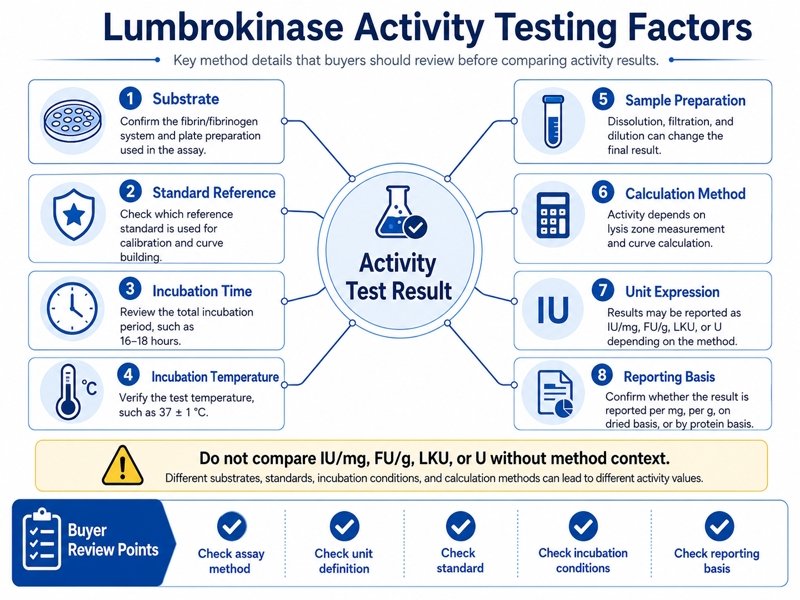
Assay Factors That May Affect Lumbrokinase Activity Results
| Assay Factor | What Buyers Should Check | Why It May Affect the Result |
|---|---|---|
| Substrate | What fibrin, fibrinogen, thrombin, agarose, or plate system is used? | Different substrate systems may respond differently to the same enzyme sample. |
| Standard reference | What standard is used to build the activity curve? | Activity calculation depends on the selected reference material and standard curve. |
| Incubation time | How long is the plate incubated before measurement? | Longer or shorter incubation can change the lysis area or response value. |
| Temperature | What temperature is used during incubation? | Enzyme activity is sensitive to temperature, and results may change under different conditions. |
| Sample dilution | Is the sample diluted within the linear range of the assay? | Too concentrated or too diluted samples may give unreliable results. |
| Sample preparation | How is the powder dissolved, mixed, filtered, or clarified before testing? | Incomplete dissolution, sediment, or inconsistent handling may affect measured activity. |
| Calculation method | How is the lysis zone or response converted into activity? | Different formulas and regression models may produce different final values. |
| Unit expression | Is the result reported as IU/mg, FU/g, LKU, U, or another unit? | Units cannot be compared without understanding the method behind them. |
| Reporting basis | Is the result based on powder weight, protein content, dried basis, or another basis? | The denominator can significantly change the reported number. |
| Lab conditions | Is the method validated for earthworm-derived lumbrokinase? | A method designed for another enzyme system may not match lumbrokinase performance. |
How Buyers Should Review a Lumbrokinase COA
A lumbrokinase COA should not be reviewed as a single activity number. Buyers should check whether the COA includes the assay method and whether the method is consistent with the supplier’s specification sheet.
Key items to review include:
Product name and source
Batch number and manufacturing date
Activity specification and actual result
Assay method and unit expression
Moisture and ash
Heavy metals such as lead, arsenic, cadmium, and mercury
Microbiology, including total plate count, yeast and mold, coliforms, Salmonella, and Staphylococcus aureus
Storage condition and shelf life
Packaging and batch traceability
If the activity result is reported as IU/mg, buyers should ask how the test was performed. If a third-party lab reports FU/g, buyers should ask whether the lab method is directly comparable to the supplier’s method.
For a more document-focused comparison, buyers can review Lumbrokinase COA vs Specification Sheet: What B2B Buyers Should Compare.
Common B2B Dispute Scenario: Supplier COA vs Third-Party Lab Result
A buyer receives a lumbrokinase sample and the supplier COA shows activity by fibrin plate assay in IU/mg. The buyer then sends the sample to a third-party lab. The third-party lab reports a different activity result in FU/g.
Before concluding that the material is inactive, both parties should compare:
Assay method
Activity unit
Substrate system
Reference standard
Sample preparation method
Dilution range
Incubation time and temperature
Calculation method
Whether the test is suitable for earthworm-derived lumbrokinase
Storage and transit conditions before testing
If these details are not aligned, the two results may not be directly comparable. The buyer and supplier should discuss the method first, then decide whether retesting under a mutually agreed method is necessary.
This approach is more practical than focusing only on whether the number is “high” or “low.”
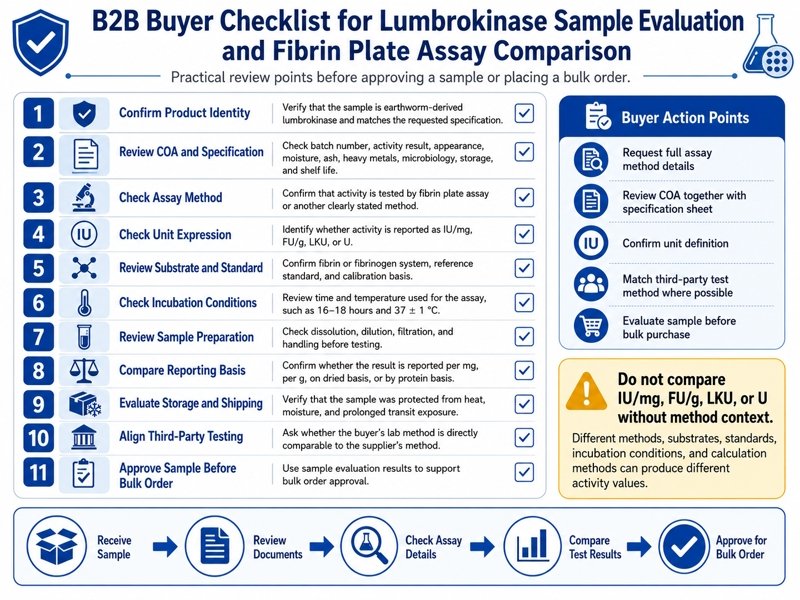
Buyer Checklist for Reviewing Lumbrokinase Assay Data
| Checklist Item | Buyer Question | Why It Matters |
|---|---|---|
| Product identity | Is the sample earthworm-derived lumbrokinase? | Confirms the tested material matches the intended ingredient. |
| Assay method | Is the activity tested by fibrin plate assay or another method? | Activity values depend on the testing method. |
| Unit expression | Is the result shown as IU/mg, FU/g, LKU, U, or another unit? | Different units may not be interchangeable. |
| Standard reference | What standard is used for activity calculation? | The reference standard affects the final result. |
| Substrate details | What fibrin plate system is used? | Substrate differences may change activity response. |
| Sample preparation | How was the powder dissolved and diluted? | Poor sample handling may affect the result. |
| Incubation conditions | What time and temperature were used? | Enzyme reaction conditions influence activity measurement. |
| COA consistency | Does the COA match the specification sheet? | Confirms whether the batch meets the stated specification. |
| Third-party testing | Does the buyer’s lab use a comparable method? | Helps avoid false disputes caused by method differences. |
| Storage and shipping | Was the sample protected from heat and moisture? | Lumbrokinase is enzyme-sensitive and may be affected by handling. |
| Bulk order approval | Has the sample result been reviewed before bulk purchase? | Reduces risk before placing a larger order. |
| Regulatory review | Has the buyer checked local rules for the finished product? | Final product compliance depends on the target market. |
Common Mistakes or Misunderstandings
Mistake 1: Comparing IU/mg and FU/g without method context
IU/mg and FU/g are not always directly convertible. Buyers should check the assay method, standard, and reporting basis before comparing numbers.
Mistake 2: Treating one lab result as absolute
A third-party test is useful, but the result still depends on the lab’s method. If the lab uses a different assay design, the result may differ from the supplier’s COA.
Mistake 3: Ignoring sample handling
Lumbrokinase is an enzyme-sensitive ingredient. Heat, moisture, long customs clearance, repeated opening, or improper storage may affect performance.
Mistake 4: Reviewing activity but ignoring other quality items
Activity is important, but buyers should also review moisture, ash, heavy metals, microbiology, packaging, storage, and shelf life.
Mistake 5: Assuming all fibrinolytic enzyme products are the same
Earthworm-derived lumbrokinase, nattokinase, blended enzyme systems, and other fibrinolytic ingredients may use different assay assumptions. Buyers should confirm product identity and method suitability.
Allworms Supply Notes
Allworms Bio-Tech Co., Ltd supplies earthworm-derived lumbrokinase as a B2B ingredient for supplement, nutraceutical, enzyme formulation, and research-related applications.
COA and specification sheet can be provided for available batches. Lumbrokinase activity should be reviewed together with the assay method and unit expression, especially when comparing IU/mg, FU/g, LKU, U, or third-party lab results.
Buyers can request sample evaluation before bulk orders. A 100 g sample may be available for qualified B2B buyers, with the buyer usually paying international freight. The standard MOQ is usually around 1.5 kg, depending on product specification. Standard lead time is usually 7–15 days after payment. DDP door-to-door shipping may be available for selected destinations.
For sourcing details, please visit the Lumbrokinase product page. For general ordering, sample, MOQ, lead time, and shipping questions, see the full FAQ page.
Buyers who are new to this ingredient may also find What Is Lumbrokinase? Source, Activity and B2B Supply Guide and Lumbrokinase Sample Evaluation: What B2B Buyers Should Check useful before testing a sample.
FAQ
1. What is the fibrin plate assay for lumbrokinase activity?
The fibrin plate assay for lumbrokinase activity is a laboratory method used to evaluate fibrinolytic enzyme activity by observing how a lumbrokinase sample acts on a fibrin-containing plate under controlled conditions. The result depends on the assay method, standard reference, incubation conditions, and calculation method.
2. Can FU/g and IU/mg be directly converted?
Not always. FU/g and IU/mg may be based on different assay systems, substrates, standards, and calculation methods. Buyers should not compare them directly unless the testing basis is clearly confirmed.
3. Why does a supplier COA differ from my third-party lab result?
Differences may come from assay design, unit expression, substrate, sample dilution, incubation time, temperature, standard reference, calculation method, sample handling, or storage conditions. A different result does not automatically mean the product is inactive.
4. What should buyers request before testing a lumbrokinase sample?
Buyers should request the COA, specification sheet, assay method, activity unit explanation, batch information, storage guidance, and sample handling instructions. It is also helpful to confirm whether the buyer’s third-party lab method is suitable for earthworm-derived lumbrokinase.
5. Is lumbrokinase supplied as a finished health product?
No. Allworms supplies lumbrokinase as a B2B ingredient. Finished product formulation, dosage, labeling, claims, and regulatory compliance should be evaluated by the buyer according to the intended market and finished product use.
Need Lumbrokinase COA, Specification Sheet, or Assay Method Details?
Contact us to request lumbrokinase sample evaluation, MOQ, pricing, lead time, and shipping information.