
Moving from a lumbrokinase sample to bulk order is not a single yes-or-no decision.
For supplement brands, nutraceutical companies, ingredient distributors, contract manufacturers, and formulation developers, supplier approval usually passes through several connected stages: inquiry qualification, document review, sample testing, laboratory evaluation, technical clarification, sample approval, actual bulk batch confirmation, and final purchasing authorization.
A sample that passes initial evaluation is important, but it is only one part of the approval process. Buyers also need to understand the activity specification, assay method, batch documentation, available inventory, packaging, lead time, and shipping conditions.
This becomes especially important when several weeks or months pass between sample testing and PO placement, because the original sample batch may no longer be available.
Quick Answer: How Does a Buyer Move from Lumbrokinase Sample to Bulk Order?
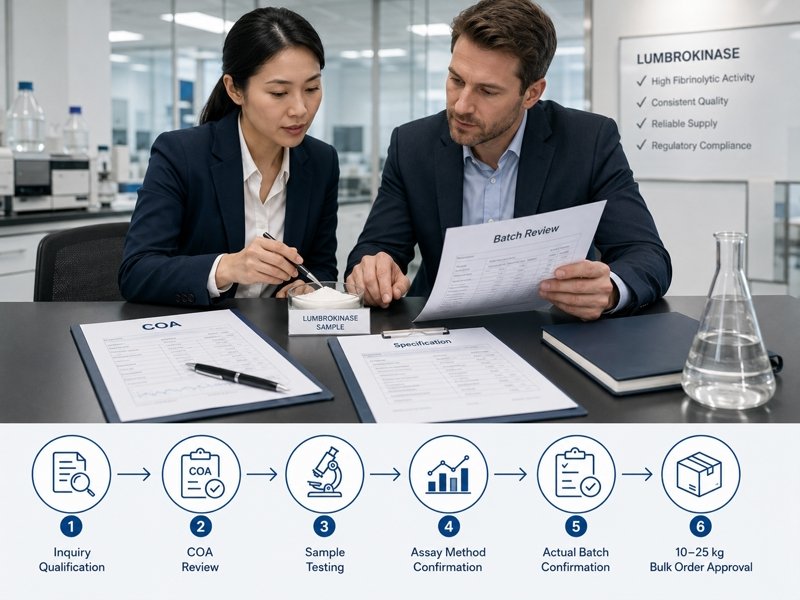
A B2B lumbrokinase sample to bulk order approval process should connect COA and specification review, 100 g sample testing, laboratory evaluation, assay method confirmation, supplier technical communication, sample approval, actual bulk batch identification, and final 10–25 kg order authorization.
The sample batch and bulk batch do not always need to have the same batch number. When the original sample batch is no longer available, the buyer should review the COA of the actual supply batch and confirm sample-to-bulk specification consistency before approving the order.
The key approval question is not simply:
“Is this the same batch I tested?”
The more useful question is:
“Does the actual bulk batch meet the approved specification and purchasing requirements?”
Why This Matters for B2B Buyers
Lumbrokinase is an earthworm-derived fibrinolytic enzyme ingredient used in dietary supplement, nutraceutical, enzyme formulation, and research-related applications.
Unlike purchasing a common commodity powder, approving a lumbrokinase supplier requires the buyer to connect several technical and commercial decisions.
Supplier approval should not be based only on:
- the highest activity number;
- the lowest quotation;
- one acceptable sample;
- one COA;
- one laboratory result; or
- the assumption that sample inventory will remain available indefinitely.
A complete approval process connects technical documentation, sample testing, assay interpretation, supplier communication, actual batch availability, batch COA review, packaging, lead time, and international delivery arrangements.
For technical product positioning and available activity grades, buyers can first review the Lumbrokinase product page before beginning the supplier qualification process.
Lumbrokinase Supplier Approval Workflow: From Sample to Bulk Order
| Approval Stage | Buyer Action | Supplier Support Needed | Approval Decision |
|---|---|---|---|
| Initial inquiry | Define project stage, target specification, quantity, destination, and timeline | Confirm product availability and required information | Is the supplier technically and commercially relevant? |
| COA review | Check representative or available batch data | Provide appropriate COA | Are reported batch results suitable for further evaluation? |
| Specification review | Confirm target requirements and acceptance criteria | Provide specification sheet | Does the product specification match the project requirement? |
| 100 g sample request | Define testing purpose and shipping destination | Arrange sample and supporting documents | Is sample evaluation justified? |
| Sample receipt | Check label, batch number, quantity, packaging, and documents | Provide matching sample documentation | Is sample identity confirmed? |
| Laboratory testing | Conduct internal or third-party evaluation | Provide technical data when needed | Does the result support further evaluation? |
| Assay method confirmation | Compare activity unit and testing basis | Explain assay method and reporting system | Are results reasonably comparable? |
| Discrepancy clarification | Investigate meaningful differences | Respond with technical explanation and records | Is further testing or investigation needed? |
| Sample approval | Combine documents, tests, application fit, and supplier response | Confirm future supply conditions | Can the project move to purchasing preparation? |
| Delay before PO placement | Recheck project timing and inventory status | Confirm whether sample batch remains available | Is the original batch still relevant? |
| Actual batch availability confirmation | Ask which batch will actually be supplied | Identify available bulk batch | Is supply clearly identified? |
| Latest batch COA review | Review the COA linked to the actual supply batch | Provide actual batch COA | Does the supply batch meet the agreed specification? |
| Specification consistency review | Compare actual batch with approved purchasing requirements | Clarify meaningful differences | Is sample-to-bulk specification consistency acceptable? |
| 10–25 kg bulk order approval | Approve order quantity according to project needs | Confirm commercial terms and available quantity | Can purchasing issue the PO? |
| Packaging confirmation | Confirm pack size and shipping configuration | Provide packaging details | Is packaging suitable for receiving and use? |
| Lead time confirmation | Align purchasing and production schedules | Confirm dispatch preparation time | Does timing meet the project plan? |
| Shipping approval | Verify consignee, address, shipping mode, and delivery conditions | Arrange agreed shipping method | Is shipment ready for final authorization? |
Stage 1: Initial Inquiry and Purchase Requirements
A useful supplier approval process starts before the sample is requested.
An inquiry containing only “What is your price per kg?” does not give either side enough information to determine whether the product fits the project.
A more useful initial inquiry should communicate:
- the intended project stage;
- target activity grade or specification;
- preferred activity unit, where relevant;
- expected sample testing method, where known;
- estimated future bulk quantity;
- destination country;
- document requirements; and
- expected purchase timeline.
The supplier should understand whether the buyer is currently at the initial evaluation stage, preparing laboratory testing, conducting pilot formulation, planning a first commercial batch, evaluating distribution potential, or arranging repeat small bulk purchasing.
This qualification stage prevents a common procurement problem: discussing price in detail before confirming whether the product specification and testing basis are suitable.
Approval Gate 1
Before requesting a sample, the buyer should be able to answer:
Is this supplier offering a product grade that is technically relevant to our actual project?
Stage 2: COA and Specification Sheet Review
Before sample authorization, buyers should review the available product documentation.
The purpose at this stage is not to conduct a complete document audit. It is to decide whether the material is suitable enough to justify sample testing.
A specification sheet defines the target product requirements or acceptance criteria. A COA reports results associated with a particular batch.
For a more detailed explanation of these two documents, buyers can review Lumbrokinase COA vs Specification Sheet.
During the supplier approval workflow itself, the focus should remain on a limited set of purchasing questions.
Before sample testing, confirm:
- product name;
- target activity specification;
- assay method, if stated;
- batch information;
- appearance;
- moisture;
- relevant quality parameters;
- microbiology;
- heavy metals, where applicable;
- storage conditions; and
- packaging information.
A buyer does not need to complete the entire supplier qualification program before receiving a sample.
However, basic document review should happen early enough to prevent unnecessary laboratory testing of a material that clearly does not fit the project specification.
Approval Gate 2
Do the available documents support moving this material into sample evaluation?
Stage 3: Requesting a 100 g Lumbrokinase Sample
Once the initial documents and product grade appear relevant, the buyer can move to sample evaluation.
A 100 g sample may support:
- initial product evaluation;
- appearance checking;
- internal laboratory screening;
- third-party laboratory testing;
- formulation evaluation; and
- supplier qualification work.
Allworms may provide a 100 g sample for qualified B2B buyers. The buyer usually pays the international sample freight.
The exact testing program depends on the buyer’s internal quality system, laboratory access, intended application, and purchasing stage.
This article does not treat sample testing as a standalone process. Buyers requiring a detailed sample testing framework can refer to Lumbrokinase Sample Evaluation.
Within the broader supplier approval journey, the sample has one primary function:
To provide technical evidence for deciding whether the supplier should proceed to the next approval stage.
Stage 4: Sample Receipt and Identity Check
Laboratory testing should not begin without confirming what was actually received.
When the package arrives, procurement or quality personnel should check:
- sample label;
- batch number;
- packaging condition;
- sample quantity;
- storage instructions;
- corresponding COA;
- corresponding specification sheet; and
- whether the sample batch information matches the supplied documents.
For example, when the sample label identifies one batch number but the accompanying COA refers to another batch, the mismatch should be clarified before laboratory data are interpreted.
This step is simple, but it is an important control point.
Laboratory results have limited supplier approval value when the tested material cannot be clearly connected to its batch documentation.
Approval Gate 3
Can the buyer clearly connect the physical sample to the correct batch documents?
Stage 5: Laboratory Testing as Part of Supplier Approval
Buyers may evaluate the sample through an internal laboratory, an external third-party laboratory, or a combination of both.
The laboratory program may vary according to purchasing requirements.
The purpose is to generate evidence that supports the supplier approval decision.
For lumbrokinase activity testing, numerical results should be interpreted with care when:
- the supplier and buyer use different assay methods;
- the reported activity units differ;
- test conditions are different;
- sample preparation procedures differ;
- different substrates are used;
- different reference standards are used; or
- calculation methods differ.
These factors do not automatically explain every difference.
They simply mean that a numerical comparison should not be made without understanding how both results were produced.
For buyers who need deeper technical information about a fibrin-based testing approach, the Fibrin Plate Assay for Lumbrokinase Activity provides additional context.
Within supplier approval, laboratory testing should answer a practical purchasing question:
Does the test result, interpreted under a clearly understood method, support continued evaluation of this supplier?
Stage 6: Assay Method Confirmation
When the buyer’s laboratory result differs from the supplier COA, the next step should be structured technical clarification rather than immediate assumption.
The buyer can ask:
- What assay method was used?
- What activity unit was reported?
- What substrate was used?
- What reference standard was used?
- How was the sample prepared?
- What testing conditions were used?
- Is the buyer’s laboratory using the same method or a different method?
Activity units such as IU/mg, FU/g, LKU, or other U-based systems may be connected to different testing procedures and reporting conventions.
Results should not be assumed to be directly interchangeable without understanding the method basis.
At the same time, method difference is only one possible explanation for a discrepancy.
Other possibilities may include:
- sample handling or storage issues;
- sample preparation differences;
- documentation mismatch;
- laboratory variability;
- calculation or reporting errors; or
- a genuine quality issue.
A balanced investigation should consider the available evidence before reaching a purchasing decision.
What If the Buyer’s Lab Result Differs from the Supplier COA?
A practical response process is:
1. Confirm Sample Identity and Batch Number
Verify that the tested material corresponds to the COA under review.
2. Review Storage and Sample Handling
Check whether the material was exposed to conditions that may have affected an enzyme-sensitive ingredient.
3. Compare Activity Units
Confirm whether both laboratories reported results on the same unit basis.
4. Compare Assay Methods
Establish whether the testing principles and procedures are comparable.
5. Compare Sample Preparation
Dilution, extraction, pretreatment, and preparation conditions may affect test comparability.
6. Compare Test Conditions
Review substrate, temperature, incubation time, pH, reference materials, and calculation procedures where relevant.
7. Discuss Results with the Supplier
Share enough technical information for a meaningful response.
8. Consider Repeat or Cross-Laboratory Testing Where Necessary
A repeat test may be appropriate when the discrepancy is commercially significant and the available information does not support a clear conclusion.
9. Classify the Issue
The buyer should determine whether the available evidence suggests:
- a method-related difference;
- a sample-related issue;
- a documentation-related problem; or
- a genuine quality concern.
The process should not automatically blame either the supplier or the laboratory.
Approval Gate 4
Has the buyer reached a technically reasonable understanding of the test result before approving or rejecting the supplier?
Stage 7: Supplier Technical Communication
Supplier approval is not only document collection.
The way a supplier responds during technical evaluation can affect the buyer’s confidence in future cooperation.
A buyer should assess whether the supplier can:
- provide a COA;
- provide a specification sheet;
- explain the assay method;
- respond to activity result questions;
- confirm sample batch details;
- explain what happens when the sample batch is no longer available;
- provide the COA for the actual future bulk batch;
- confirm the activity grade;
- discuss packaging;
- confirm lead time; and
- support shipping planning.
Fast communication alone is not enough.
The useful measure is whether the response helps the buyer reach a clear technical or purchasing decision.
For example, when an activity result differs, a useful supplier response should help identify the assay method, activity unit, batch identity, and relevant testing basis rather than simply stating that the supplier’s result is correct.
Approval Gate 5
Can the supplier support technical clarification and purchasing preparation, not just provide a quotation?
Stage 8: Sample Approval
Sample approval should combine several forms of evidence.
These may include:
- document review;
- laboratory results;
- understanding of the assay method;
- specification suitability;
- supplier technical communication;
- formulation or application suitability; and
- future bulk supply feasibility.
One approved sample does not guarantee that every future batch is automatically approved.
Instead, sample approval establishes an initial technical reference and a supplier evaluation basis.
That distinction becomes important when there is a significant time gap between sample evaluation and actual PO placement.
Stage 9: The Time Gap Between Sample Approval and PO Placement
In real procurement projects, sample approval and PO placement do not always happen immediately one after another.
The buyer may complete laboratory evaluation, but the project can then be delayed by:
- formulation development;
- internal purchasing approval;
- finished-product planning;
- customer confirmation;
- packaging development;
- budget approval;
- regulatory review; or
- inventory planning.
The delay may last several weeks or months.
During that period, the original sample batch may be sold out or allocated to other orders.
This can occur during normal B2B ingredient supply.
Buyers should therefore not assume that sample inventory will be reserved indefinitely unless a specific stock reservation agreement has been made.
Before placing the PO, ask:
- Is the original sample batch still available?
- Which batch will actually be supplied?
- What is the batch number of the actual bulk material?
- Can we review the COA for that batch?
- Does the available batch meet the agreed activity specification?
- Is the assay method consistent with the approved purchasing basis?
- Are there any meaningful differences that require clarification?
This leads to the concept of sample-to-bulk specification consistency.
What Is Sample-to-Bulk Specification Consistency?
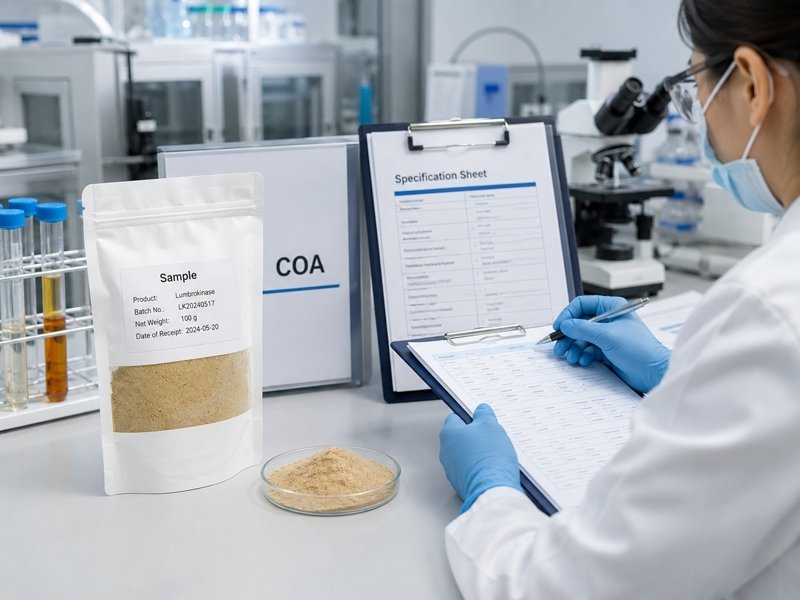
Sample-to-bulk specification consistency does not mean that the sample batch number and bulk batch number must always be identical.
It means that when a newer batch will be supplied, the buyer confirms that the actual bulk batch:
- meets the previously agreed specification;
- matches the agreed activity grade;
- uses the agreed or clearly understood assay method;
- has its own corresponding batch COA;
- meets relevant appearance and quality requirements;
- follows the agreed packaging requirement; and
- is suitable for the buyer’s approved purchasing requirements.
The focus is consistency with the approved purchasing requirement, not automatic batch-number identity.
For buyers managing broader lot-to-lot quality review, Lumbrokinase Batch Consistency provides additional discussion of batch comparison and quality-control considerations.
What If the Sample Batch Is No Longer Available?
When the original tested batch has been sold out, buyers can follow this approval sequence.
1. Confirm Whether the Original Sample Batch Is Still Available
Do not assume.
Ask the supplier to confirm current inventory.
2. Ask Which Batch Will Actually Be Supplied
The order should be connected to a clearly identified supply batch where possible.
3. Request the COA for the Actual Bulk Batch
The original sample COA is historical reference information.
The purchasing decision should also consider the document corresponding to the material that will actually be supplied.
4. Compare the Actual Batch with the Agreed Specification
Check the parameters that matter to the approved purchasing requirement.
5. Confirm Activity Grade and Assay Method
Verify that the activity requirement and testing basis remain consistent with the buyer’s approved criteria.
6. Review Relevant Quality Differences
Not every numerical variation between batches is automatically a failure.
Review differences against the specification and the buyer’s acceptance requirements.
7. Clarify Any Meaningful Deviation
A difference outside the agreed requirement, or a material change affecting formulation or qualification, should be resolved before shipment.
8. Complete Approval According to the Buyer’s Internal Quality Process
The level of re-review depends on:
- the buyer’s internal quality system;
- the agreed specification;
- the degree of difference between batches;
- the importance of the tested parameter; and
- the intended application.
A newer batch does not automatically mean the entire supplier qualification process must restart from zero.
At the same time, a buyer should not approve a bulk order without reviewing the actual batch information simply because an earlier sample was acceptable.
Stage 10: Actual Bulk Batch Review Before Order Approval
When the actual bulk batch differs from the original sample batch, buyers should review:
- actual bulk batch number;
- corresponding batch COA;
- activity result;
- agreed specification;
- assay method;
- appearance;
- relevant quality parameters;
- packaging;
- storage conditions; and
- quantity availability.
The key question is not:
“Is this the same batch number as my sample?”
The better question is:
“Does the actual bulk batch meet the approved specification and purchasing requirements?”
This distinction makes supplier approval both more practical and more controlled.
Requiring the exact original sample batch in every situation may be unrealistic after a long project delay.
Ignoring the identity and COA of the actual supply batch is also poor procurement control.
The approval process should sit between those two extremes.
Approval Gate 6
Has the buyer reviewed the batch that will actually be supplied, rather than relying only on historical sample documents?
Stage 11: 10–25 kg Bulk Order Approval
For some B2B projects, a 10–25 kg purchase may be the next practical step after supplier and sample approval.
This range can be relevant for:
- small supplement brands;
- nutraceutical companies;
- pilot production;
- first commercial batches;
- distributor evaluation;
- controlled market launches; and
- repeat small bulk purchasing.
It should not be treated as a mandatory purchasing quantity for every buyer.
The suitable order quantity depends on:
- project stage;
- formulation requirement;
- activity specification;
- inventory planning;
- supplier conditions; and
- expected future demand.
At this point, purchasing authorization should be based on the complete approval record, not only the original sample result.
The buyer should be able to connect:
Inquiry requirement → document review → sample identity → laboratory result → assay understanding → technical clarification → sample approval → actual batch identification → latest COA review → specification consistency → commercial confirmation.
Only then does the process reach final purchase authorization.
Stage 12: Packaging, Lead Time, Payment, and Shipping Confirmation
Before payment or shipment authorization, buyers should reconfirm the commercial and logistics details connected to the approved material.
Confirm:
- actual bulk batch;
- final quantity;
- packaging format;
- activity specification;
- actual batch COA;
- lead time;
- payment terms;
- consignee information;
- destination address;
- shipping method;
- DHL arrangement, where applicable;
- DDP availability, where applicable;
- customs or local delivery requirements; and
- receiving and storage preparation.
A common purchasing mistake is to treat supplier approval as complete when the laboratory accepts the sample.
For international B2B procurement, the order is not fully controlled until the approved product, actual batch, packaging, destination, and delivery arrangement are connected.
Allworms Supply Notes
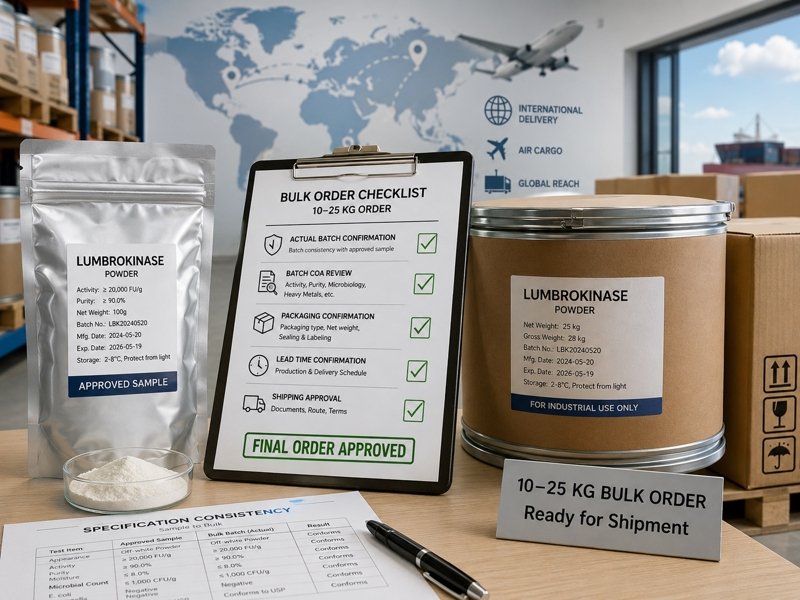
Allworms Bio-Tech Co., Ltd. supplies earthworm-derived lumbrokinase for B2B evaluation and purchasing projects.
For supplier approval planning:
- COA and specification sheets can be provided for available batches.
- A 100 g sample may be available for qualified B2B buyers.
- The buyer usually pays international sample freight.
- Standard MOQ is usually around 1.5 kg, depending on specification, packaging, and destination.
- 10–25 kg small bulk orders may be discussed according to specification, quantity, packaging, and destination.
- Standard lead time is usually 7–15 days after payment.
- DHL shipping may be used for suitable international shipments.
- DDP door-to-door shipping may be available for selected destinations.
- The actual supply batch should be confirmed according to inventory availability and order timing.
This product is supplied as a B2B ingredient. Final formulation suitability, dosage, labeling, health claims, and regulatory compliance should be evaluated by the buyer according to the intended market and finished product use.
When Is a Supplier Ready for Bulk Order Approval?
A lumbrokinase supplier is more ready for bulk order approval when the buyer can confirm all of the following:
- a clear and relevant specification;
- appropriate sample evaluation;
- an understandable assay method;
- responsive technical communication;
- actual bulk batch identification;
- a corresponding bulk batch COA;
- acceptable sample-to-bulk specification consistency;
- workable MOQ;
- realistic lead time;
- confirmed packaging; and
- a practical international shipping arrangement.
No single item should replace the complete approval process.
A high activity number does not replace assay understanding.
A low price does not replace specification review.
One accepted sample does not replace actual supply batch confirmation.
One COA does not replace verification of the batch that will actually be shipped.
For broader questions about samples, MOQ, documentation, and international supply, buyers can also review the FAQ page.
Buyer Checklist: Final Approval Before Purchase Authorization
| Decision Checkpoint | Buyer Question | Required Confirmation |
|---|---|---|
| Product requirement | Have we defined the required activity grade and specification? | Approved purchasing requirement |
| Sample status | Has the sample evaluation been completed? | Internal approval record |
| Testing basis | Do we understand the activity unit and assay method? | Technical clarification |
| Batch status | Is the original sample batch still available? | Inventory confirmation |
| Actual supply batch | Which batch will actually be shipped? | Batch number |
| Batch documentation | Have we reviewed the actual bulk batch COA? | Latest batch COA |
| Consistency | Does the actual batch meet the agreed requirements? | Specification consistency review |
| Commercial terms | Are quantity, MOQ, packaging, and payment terms confirmed? | Final quotation or PI |
| Timing | Is the lead time suitable for the project? | Confirmed preparation schedule |
| Delivery | Are consignee, address, shipping method, and delivery arrangement correct? | Shipment approval |
Common Mistakes in the Lumbrokinase Sample-to-Bulk Approval Process
1. Requesting Price Before Defining the Specification
A quotation has limited value when the required activity grade, testing basis, quantity, and destination have not been clarified.
2. Approving a Supplier from One COA
A COA is useful technical evidence, but supplier approval also requires sample evaluation, communication, actual batch review, and commercial feasibility.
3. Approving a Supplier from One Acceptable Sample Alone
The sample establishes an initial evaluation reference.
It does not automatically approve every future batch without any further review.
4. Assuming Sample Stock Will Remain Available Indefinitely
A long project delay can mean the sample batch is no longer in stock when the PO is finally placed.
5. Assuming the Bulk Order Must Always Use the Same Batch Number as the Sample
The actual requirement should be based on the buyer’s quality process and approved purchasing criteria.
A different batch may be acceptable after appropriate review.
6. Failing to Request the COA for the Actual Bulk Batch
The buyer should know which batch will be supplied and review the document corresponding to that batch.
7. Rejecting a Supplier After One Different Result Without Comparing Methods
A result difference deserves investigation.
Method differences may be relevant, but sample handling, documentation errors, laboratory variability, or genuine quality issues should also be considered.
8. Approving a Sample Without Confirming Future Bulk Specification
The buyer should clarify what specification the supplier intends to provide for future purchasing.
9. Not Confirming Activity Grade Before Payment
The final PO, PI, and batch documentation should clearly reflect the agreed purchasing requirement.
10. Not Confirming Packaging
Packaging format affects receiving, storage, production handling, and inventory control.
11. Confusing Lead Time with Total Delivery Time
Production or preparation lead time and international transit time are separate parts of the purchasing schedule.
12. Not Confirming Consignee and Shipping Details Before Dispatch
Incorrect recipient details can create avoidable delays and delivery problems.
13. Choosing Only by Price
Supplier approval should consider technical documentation, testing, communication, specification consistency, batch transparency, MOQ, lead time, packaging, and delivery feasibility.
FAQ
1. Should Buyers Review a Lumbrokinase COA Before Requesting a Sample?
Yes.
An initial COA review helps the buyer determine whether the available activity grade and quality information are suitable enough to justify sample testing.
The specification sheet should also be reviewed because it defines the target product requirements, while the COA relates to a specific batch.
2. Is a 100 g Sample Enough for Initial Lumbrokinase Supplier Evaluation?
A 100 g sample can support initial appearance review, internal screening, third-party testing, formulation work, or supplier qualification, depending on the buyer’s test program.
Whether it is sufficient for every evaluation requirement depends on the number of tests, sample preparation needs, and the buyer’s laboratory procedures.
3. What Happens If the Sample Batch Is Sold Out Before the Buyer Places a PO?
The buyer should ask which batch is actually available for the bulk order and request the COA for that batch.
The actual batch should then be compared with the agreed specification, activity requirement, assay basis, and relevant purchasing requirements before approval.
4. Does the Bulk Order Need to Use Exactly the Same Batch as the Tested Sample?
Not necessarily.
The original sample batch may no longer be available after a long delay between testing and PO placement.
The buyer should focus on sample-to-bulk specification consistency and review the actual supply batch according to its internal quality process.
5. What Should Buyers Review When a Newer Batch Will Be Supplied?
Buyers should review the actual batch number, corresponding COA, activity result, agreed specification, assay method, appearance, relevant quality parameters, packaging, storage conditions, and quantity availability.
6. What Should Buyers Do If Laboratory Results Differ from the Supplier COA?
First confirm sample identity, batch number, storage, and sample handling.
Then compare activity units, assay methods, sample preparation, substrates, reference standards, test conditions, and calculation methods where relevant.
Technical discussion, repeat testing, or cross-laboratory evaluation may be appropriate depending on the significance of the difference.
7. Why Does the Assay Method Need to Be Confirmed?
Lumbrokinase activity values depend on the testing basis.
Different assay methods, unit systems, substrates, reference materials, testing conditions, and calculations may produce results that should not be compared as though they were generated under identical conditions.
8. What Should Be Reconfirmed Before Approving a 10–25 kg Bulk Order?
The buyer should reconfirm the actual supply batch, activity specification, latest batch COA, specification consistency, quantity, packaging, lead time, payment terms, consignee information, destination address, and shipping arrangement.
9. How Long Is the Standard Lead Time After Payment?
Allworms’ standard lead time is usually 7–15 days after payment.
Actual timing should be confirmed according to activity specification, quantity, inventory status, packaging, and order requirements.
10. Can DHL or DDP Shipping Be Arranged?
DHL may be used for suitable international shipments.
DDP door-to-door shipping may be available for selected destinations.
Buyers should provide the destination, order quantity, and consignee information so that the suitable shipping arrangement can be reviewed before dispatch.
From Lumbrokinase Sample to Bulk Order: Final Approval Principle
A successful lumbrokinase sample to bulk order process does not end when the sample passes a laboratory test.
For real B2B supplier approval, the buyer should connect the original purchasing requirement with document review, sample identity, laboratory evaluation, assay method understanding, technical communication, sample approval, actual batch availability, latest batch COA review, sample-to-bulk specification consistency, and final commercial and shipping confirmation.
The sample and bulk batch may be identical, but they do not always have to be.
What matters is that the material actually being purchased can be identified, documented, reviewed, and confirmed against the buyer’s approved specification and purchasing requirements.
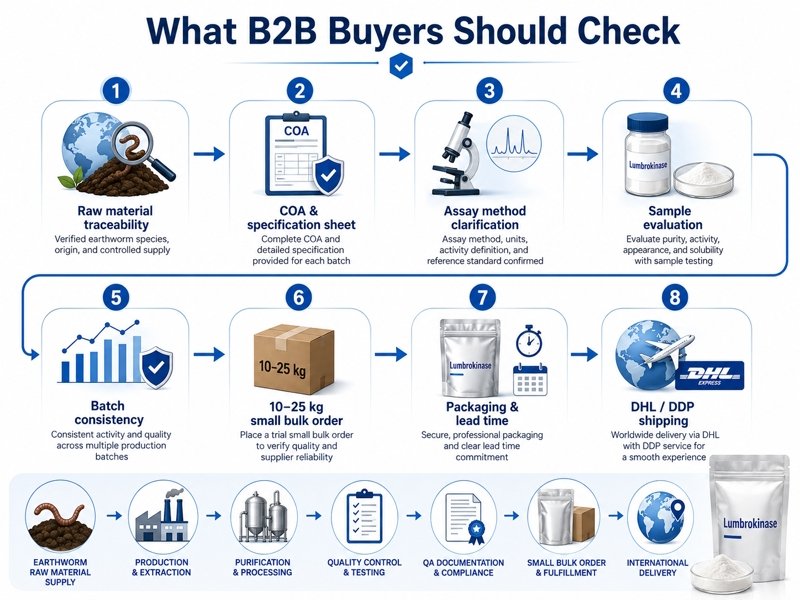
Evaluating a supplier and preparing to move from a lumbrokinase sample to bulk order?
Share your target activity specification, testing method if applicable, current sample testing status, intended order quantity, destination, and document requirements.
Allworms can discuss COA review, sample evaluation, actual batch availability, activity specification, bulk order conditions, lead time, and shipping arrangements for your approval process.