
Earthworm-derived ingredients can serve very different roles in supplement, nutraceutical, functional food, enzyme formulation and ingredient-development projects. The three main product categories supplied by Allworms—Earthworm Protein Powder, Earthworm Peptide Powder and Lumbrokinase—share an earthworm raw-material basis, but they should not be evaluated, formulated or purchased as interchangeable materials.
Earthworm Protein Powder is selected mainly for its protein-rich composition. Earthworm Peptide Powder is produced through enzymatic hydrolysis and positioned as a stable peptide ingredient rather than an active enzyme. Lumbrokinase is evaluated as an earthworm-derived fibrinolytic enzyme ingredient, with activity grade and assay method forming part of the purchasing specification.
The correct choice therefore depends on the ingredient’s intended role, not simply its source or product name.
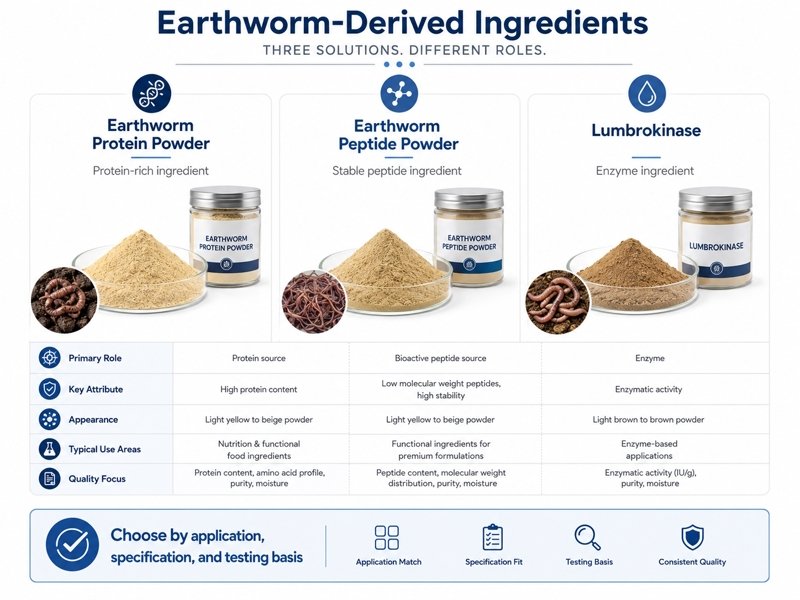
Quick Answer: Which Earthworm-Derived Ingredient Should Buyers Choose?
Earthworm Protein Powder is a protein-rich earthworm-derived ingredient. Earthworm Peptide Powder is a stable peptide ingredient produced through enzymatic hydrolysis and is not positioned as an active enzyme product. Lumbrokinase is an earthworm-derived fibrinolytic enzyme ingredient.
B2B buyers should choose among these earthworm-derived ingredients according to the intended application, formulation role, required specification, COA focus, sample evaluation plan, target market and supplier documentation requirements.
Why This Comparison Matters for B2B Buyers
A purchasing team may receive three quotations from an earthworm ingredient supplier and see similar descriptions such as “earthworm extract,” “earthworm protein” or “earthworm peptide.” However, these labels do not confirm that the products have the same composition, function or testing basis.
Selecting the wrong category can create several problems:
- A formulation team may request peptide powder while expecting enzyme activity.
- A buyer may compare lumbrokinase quotations only by protein percentage.
- A laboratory may apply an enzyme assay to a protein or peptide ingredient.
- A purchasing team may request a COA without confirming which product or batch the document covers.
- A distributor may promote all earthworm-derived ingredients for the same formulation purpose.
A clearer purchasing process starts by defining the required ingredient role before discussing specification, price or order quantity.
Understanding the Relationship Between the Three Products
The three products begin with an earthworm-derived raw-material base, but their production logic and finished-product positioning are different.
Earthworm Protein Powder is processed to provide a protein-rich powdered ingredient. Protein content, general composition and contaminant control are central to its evaluation.
Earthworm Peptide Powder is produced by breaking down earthworm protein through controlled enzymatic hydrolysis, followed by filtration, concentration, spray drying and pulverization. The hydrolysis process creates peptide-rich material, but the finished powder is not positioned as an active enzyme ingredient. Its peptide composition, supporting protein value and formulation properties are more relevant than fibrinolytic activity.
Lumbrokinase is produced and controlled as an enzyme ingredient. Its commercial specification includes an enzyme activity requirement determined under a defined assay method. It should not be presented mainly as a nutritional protein powder.
This distinction creates three separate purchasing questions:
- Does the buyer need a protein-rich ingredient?
- Does the buyer need a stable hydrolyzed peptide ingredient?
- Does the buyer need a fibrinolytic enzyme ingredient with defined activity?
Earthworm Ingredient Comparison Table
| Product | Ingredient Type | Production Logic | Key Specification Focus | Typical B2B Use | Buyer Should Check |
|---|---|---|---|---|---|
| Earthworm Protein Powder | Protein-rich earthworm-derived ingredient | Selection, cleaning, processing, filtration, drying, milling and packaging | Protein content, amino acid information if available, moisture, ash, heavy metals and microbiology | Nutritional formulations, functional ingredient concepts, animal nutrition and product development | COA, specification sheet, appearance, odor, protein basis, storage and formulation suitability |
| Earthworm Peptide Powder | Stable peptide-rich ingredient | Enzymatic hydrolysis, filtration, concentration, spray drying and pulverization | Peptide content, supporting protein content, molecular weight information if available, solubility, moisture, ash, heavy metals and microbiology | Peptide formulations, selected nutraceutical products, functional food concepts and ingredient development | Hydrolysis-based positioning, peptide specification, formulation compatibility, COA and sample behavior |
| Lumbrokinase | Earthworm-derived fibrinolytic enzyme ingredient | Controlled extraction, filtration, freeze drying, pulverization and activity testing | Activity grade, activity unit, assay method, moisture, microbiology, heavy metals and batch documentation | Dietary supplements, nutraceutical enzyme systems, enzyme formulations and research-related applications | Activity result, assay basis, COA, specification alignment, sample testing and handling conditions |
The table should be used as a first-stage filter. It does not replace product-specific evaluation or finished-formulation testing.
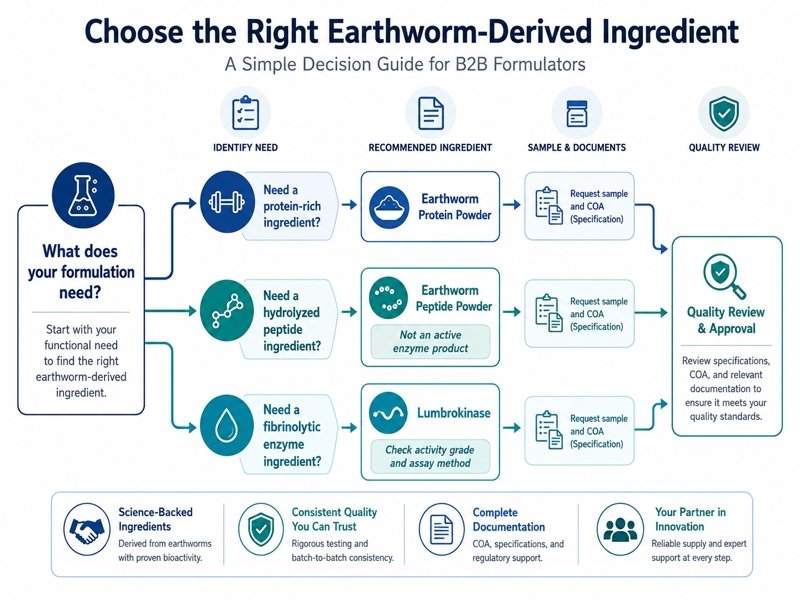
How to Choose the Right Earthworm-Derived Ingredient
Choose Earthworm Protein Powder for a Protein-Rich Ingredient Role
Earthworm Protein Powder may be more relevant when the project begins with a protein-related requirement.
The purchasing team should define:
- Target protein content
- Intended nutritional or functional role
- Required amino acid information, if applicable
- Finished-product format
- Heavy metal and microbiological requirements
- Target-market regulatory position
Protein content is an important indicator, but the highest percentage is not automatically the best purchasing choice. Formulation behavior, odor, appearance, processing conditions, document completeness and market suitability also influence the decision.
Buyers requiring detailed product information can continue to the Earthworm Protein Powder product page or review What Is Earthworm Protein Powder for a more focused product explanation.
Choose Earthworm Peptide Powder for a Hydrolyzed Peptide Ingredient
Earthworm Peptide Powder may be more relevant when the buyer wants a peptide-rich material produced through enzymatic hydrolysis.
The finished powder is a stable peptide ingredient. It should not be described or purchased as lumbrokinase, and it should not be expected to provide a lumbrokinase activity result.
Relevant purchasing criteria may include:
- Peptide content
- Supporting protein content
- Hydrolysis and drying process
- Molecular weight information, where available
- Solubility under the buyer’s formulation conditions
- Taste, odor and appearance
- Moisture, ash, heavy metals and microbiology
Molecular weight distribution may matter for certain formulation projects, but no range should be assumed unless it appears in the supplier’s specification or supporting test documentation. Solubility should also be evaluated together with processing temperature, pH, flavor system and finished-product format.
Further information can be found on the Earthworm Peptide Powder product page and in What Is Earthworm Peptide Powder.
Choose Lumbrokinase for an Enzyme Ingredient Requirement
Lumbrokinase may be relevant when the formulation requires an earthworm-derived fibrinolytic enzyme ingredient.
Unlike protein and peptide powders, lumbrokinase purchasing commonly involves an activity specification. Buyers may encounter IU/mg, FU/g, LKU or U, depending on the assay system and market practice.
These units should not be treated as automatically interchangeable. Numerical results can vary because laboratories may use different substrates, standards, incubation conditions and calculation methods. A buyer should therefore compare the activity result together with the assay method and reporting basis.
The highest activity number is not necessarily the best option for every formulation. The appropriate grade should reflect the formulation target, dosage strategy, assay basis, processing conditions, budget and applicable market requirements.
For product-specific information, buyers can review the Lumbrokinase product page.
Which Product Fits Which Buyer?
| Buyer Scenario | More Relevant Starting Point | Main Decision Question |
|---|---|---|
| Supplement brand comparing new ingredient concepts | Any of the three, depending on formulation role | Is the concept protein-based, peptide-based or enzyme-based? |
| Functional food developer | Protein or peptide powder | Does the formulation require nutritional protein or a hydrolyzed peptide ingredient? |
| Enzyme supplement formulator | Lumbrokinase | What activity grade and assay basis are required? |
| Ingredient distributor | Product category depends on customer base | Which specifications and documents will downstream buyers request? |
| Contract manufacturer | Product specified by brand or formulation team | Can the ingredient meet processing, documentation and quality requirements? |
| Purchasing team | Product selected after technical confirmation | Does the available batch match the approved specification? |
| Buyer beginning with sample evaluation | Any product | Is the sample test plan appropriate for that product type? |
One useful procurement improvement is to separate technical approval from commercial approval. The formulation or quality team should first define the correct product category and specification. The purchasing team can then compare MOQ, packaging, lead time and shipping on a consistent basis.

Documents Buyers Should Review Before Choosing
A specification sheet defines the target product requirements. A COA reports actual test results for a specific production batch.
For Earthworm Protein Powder, COA review may focus on protein content, moisture, ash, heavy metals, microbiology, appearance and batch information.
For Earthworm Peptide Powder, review may focus on peptide content, supporting protein content, molecular weight information if available, solubility if listed, moisture, ash, heavy metals, microbiology and batch information.
For Lumbrokinase, review may focus on enzyme activity, activity unit, assay method, batch number, moisture, microbiology, heavy metals if listed and alignment with the agreed specification.
Buyers should also confirm whether the COA applies to an actual available batch or is provided only as a reference document. Additional supplier information may include production-process descriptions, packaging details, storage instructions and test-method information.
General documentation questions are addressed on the FAQ page.
Sample Evaluation Should Match the Product Type
Each ingredient requires a different sample approval plan.
For Earthworm Protein Powder, evaluation may include appearance, odor, protein-related documents, COA review, basic formulation trials and buyer-specific quality checks.
For Earthworm Peptide Powder, evaluation may include appearance, solubility where relevant, peptide and protein specification review, COA review, taste considerations and compatibility with the proposed formulation.
For Lumbrokinase, evaluation may include COA review, activity specification, assay method confirmation, laboratory testing and communication about how activity results will be interpreted.
The same analytical method should not be applied to all three ingredients. Lumbrokinase enzyme activity units and fibrin plate testing do not apply to Earthworm Protein Powder or Earthworm Peptide Powder.
A useful additional step is to define sample acceptance criteria before testing. Without written acceptance criteria, two teams may test the same sample but reach different purchasing conclusions.
Buyer Decision Checklist
| Decision Point | Questions to Confirm |
|---|---|
| Ingredient role | Does the project require protein, peptide or enzyme functionality? |
| Finished-product format | Will the ingredient be used in capsules, tablets, powders, beverages, foods or research formulations? |
| Core specification | Is the main requirement protein content, peptide content or enzyme activity? |
| Testing basis | Which methods and acceptance limits will the buyer use? |
| Document package | Are COA, specification sheet, process information and batch details required? |
| Sample plan | What will be tested, by whom and against which acceptance criteria? |
| Market requirements | What ingredient, labeling and regulatory requirements apply in the target country? |
| Commercial conditions | What quantity, packaging, MOQ and lead time are suitable? |
| Logistics | What storage, moisture protection, destination and customs arrangements are needed? |
| Bulk approval | Does the actual bulk-batch COA meet the agreed purchasing specification? |
Common Mistakes When Comparing Earthworm-Derived Ingredients
Treating Peptide Powder as Lumbrokinase
Enzymatic hydrolysis is used to produce Earthworm Peptide Powder, but this does not make the finished powder an active lumbrokinase ingredient.
Comparing Every Product by Protein Percentage
Protein content is central to Earthworm Protein Powder and may be a supporting parameter for peptide powder. It is not the main commercial basis for evaluating lumbrokinase.
Applying Enzyme Units to Protein or Peptide Powder
IU/mg, FU/g, LKU, U and fibrin plate assay results should be discussed only in relation to lumbrokinase.
Requesting a Price Before Defining the Product
A useful quotation requires the product type, specification, quantity, packaging, destination, document needs and shipping preference. Lumbrokinase quotations may also depend on activity grade.
Assuming an Approved Sample Covers Every Future Batch
Sample approval supports supplier evaluation, but it does not guarantee every future batch. Buyers should confirm sample-to-bulk specification consistency and review the COA for the actual purchasing batch.
If the original sample batch is no longer available after a long delay before purchase, the buyer should evaluate whether the available bulk batch meets the agreed specification. The sample and bulk order do not always need the same batch number.
Assuming All Earthworm Ingredients Have the Same Handling Needs
All three products should be protected through sealed packaging, moisture control and suitable warehouse handling. Lumbrokinase may require additional attention because enzyme activity can be influenced by handling and environmental conditions.
Allworms Supply Notes
Allworms supplies Earthworm Protein Powder, Earthworm Peptide Powder and Lumbrokinase for B2B ingredient evaluation and purchasing.
COAs and specification sheets can be provided for available batches. Sample support may be available for qualified buyers, while MOQ, packaging and lead time depend on the selected product, specification, quantity and production schedule.
Before bulk purchase, buyers should confirm the actual available batch, corresponding COA, packaging arrangement, lead time and shipping requirements. International delivery planning may also depend on destination, customs requirements and selected transportation method.
FAQ
1. What is the main difference between Earthworm Protein Powder, Earthworm Peptide Powder and Lumbrokinase?
Earthworm Protein Powder is a protein-rich ingredient. Earthworm Peptide Powder is a stable hydrolyzed peptide ingredient. Lumbrokinase is an earthworm-derived fibrinolytic enzyme ingredient evaluated partly through enzyme activity.
2. Is Earthworm Peptide Powder the same as Lumbrokinase?
No. Earthworm Peptide Powder is produced through enzymatic hydrolysis, but the finished powder is not positioned as an active enzyme product and should not be assumed to have lumbrokinase activity.
3. Which product is evaluated using enzyme activity?
Lumbrokinase. Its evaluation may include an activity grade, activity unit and assay method. Enzyme activity units should not be applied to Earthworm Protein Powder or Earthworm Peptide Powder.
4. Can buyers use the same sample test for all three products?
No. Protein powder testing should focus on protein-related and general quality parameters. Peptide powder testing may include peptide specifications and formulation behavior. Lumbrokinase testing may require activity and assay-method review.
5. How should buyers decide which product to request a quotation for?
Buyers should provide the intended application, required ingredient role, target specification, sample needs, target market, destination country, expected quantity and document requirements. This allows the supplier to recommend the relevant product rather than provide a general quotation.
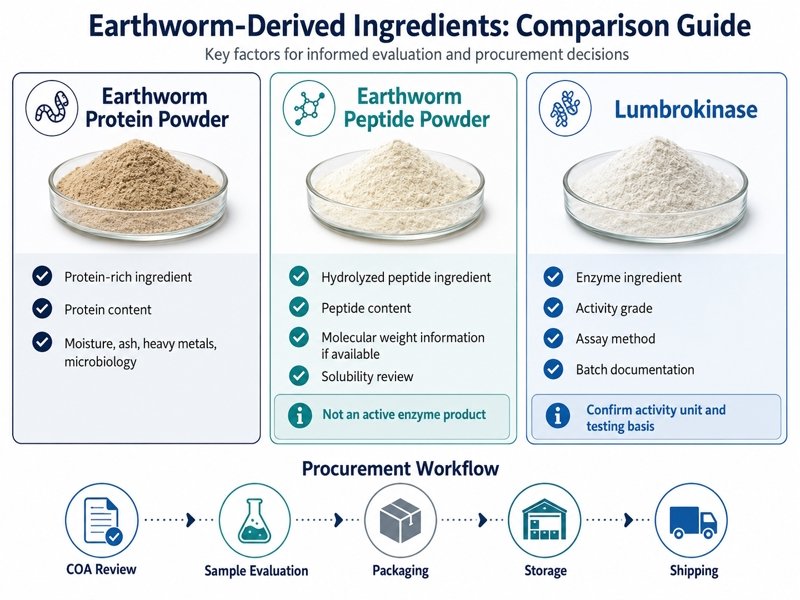
Choose The Right Earthworm-Derived Ingredient for Your B2B Application
Contact Allworms for product comparison, samples, specifications, and quotation