
A Certificate of Analysis is one of the first documents requested when sourcing lumbrokinase powder, but it does not answer every purchasing, quality, packaging or supplier-approval question.
Supplement brands, nutraceutical companies, contract manufacturers, distributors and formulation teams may also need a Specification Sheet, Product Information, packaging details, storage guidance, country-of-origin information and batch-specific records. The required document set may change depending on whether the buyer is reviewing a quotation, evaluating a sample, approving a supplier or preparing a small bulk order.
Understanding the purpose of each document helps buyers avoid comparing unrelated batches, overlooking packaging limitations or approving a material without sufficient handling information. A structured document request also allows the supplier to prepare information relevant to the buyer’s actual specification, quantity, destination and approval procedure.
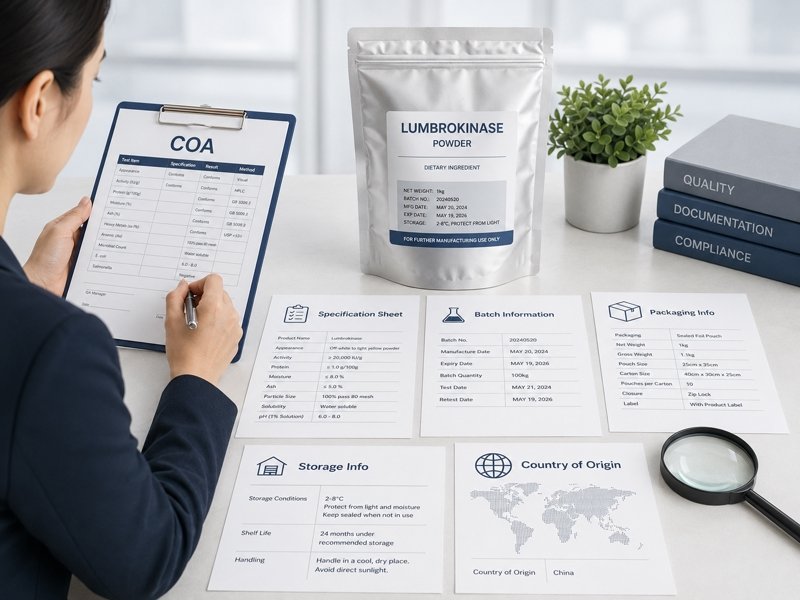
Quick Answer: Which Lumbrokinase Supplier Documents Should Buyers Request?
B2B buyers should request more than a COA when evaluating a lumbrokinase supplier. Useful lumbrokinase supplier documents may include a Specification Sheet, Product Information, packaging and storage information, country of origin, batch information, an assay method explanation when activity is important, and documents for the actual bulk batch before shipment.
Each document answers a different sourcing question. Buyers should confirm which batch each document refers to and should not assume that the sample batch, available stock batch and final bulk order batch are always identical.
Why This Matters for B2B Buyers
Supplier documentation is not simply paperwork collected after an order is placed. It supports several purchasing decisions:
- Whether the material matches the buyer’s target specification
- Whether the activity value is reported on an understood assay basis
- Whether the packaging suits warehouse and production handling
- Whether the sample document matches the material being tested
- Whether the final bulk batch meets the approved purchasing conditions
- Whether country-of-origin and shipment information satisfy internal review procedures
A small supplement brand may need a basic document package before testing a 100 g sample. A contract manufacturer may require additional information before creating a new raw-material record. A distributor may need country-of-origin, packaging and batch details for its customer file.
The document request should therefore match the stage of the project rather than follow a single fixed checklist for every inquiry.
Why a COA Alone Is Not Enough
A COA reports the test results for a specific batch. It may include the product name, batch number, activity result, assay method, manufacturing date, expiry or retest date, and selected quality parameters.
However, a COA does not always provide a complete description of the supplier’s standard product requirements, packaging configuration, storage responsibilities or general product positioning. It may also relate to a sample batch or currently available batch rather than the batch that will eventually be supplied under a purchase order.
The COA remains essential, but it is one part of a broader lumbrokinase supplier documentation package.
Buyers who need a more detailed explanation of the distinction can review Lumbrokinase COA vs Specification Sheet rather than treating these two documents as interchangeable.
1. Lumbrokinase Specification Sheet
A Specification Sheet defines the expected or agreed requirements for the product. Unlike a batch-specific COA, it normally describes the product-level limits or characteristics that the supplier intends to provide.
A lumbrokinase Specification Sheet may include:
- Product name
- Ingredient source
- Appearance
- Activity specification
- Activity unit
- Assay method reference
- Packaging format
- Storage conditions
- Shelf life or retest information, when available
- Other supplier-defined quality parameters
The buyer should compare the batch COA against the Specification Sheet to determine whether the reported batch results meet the expected requirements.
This comparison becomes especially important when a quotation includes a specific activity grade. The activity value and unit should be clearly identified, and the document should not be interpreted independently from the stated testing basis.
The Specification Sheet can also become part of the buyer’s purchasing agreement. If a buyer has special requirements, these should be discussed before the sample or purchase order rather than assumed from a general product document.
2. Product Information
Product Information helps the buyer understand what the ingredient is and how the supplier positions it.
For lumbrokinase, this document may include:
- General product description
- Earthworm source
- Ingredient category
- Powder form and appearance
- Manufacturing-process summary
- General application categories
- Storage note
- Available document version or revision date
Lumbrokinase should be described as an earthworm-derived fibrinolytic enzyme ingredient considered for dietary supplement, nutraceutical, enzyme formulation and research-related applications.
Product Information should not be treated as evidence that a finished product can make a particular health claim. Final formulation suitability, dosage, labeling and regulatory positioning remain the responsibility of the finished-product company according to its intended market.
Buyers seeking broader product and supply information can also review the Lumbrokinase product page before requesting batch-specific documents.
Check the Document Version
One practical point is often overlooked: buyers should check whether the Product Information and Specification Sheet have revision dates or version numbers.
A document created for an earlier specification or packaging format may no longer describe the currently available material. Recording the document version in the supplier-approval file can reduce confusion during later reorders.
3. Packaging Information
Packaging information affects more than freight calculation. It can influence receiving, warehouse handling, sampling, production planning and exposure after the package is opened.
Buyers may need to confirm:
- Standard pack size
- Inner packaging material
- Whether the inner bag is sealed
- Outer carton, drum or shipping container
- Label information
- Number of inner units per outer package
- Availability of smaller sealed units
- Custom packaging feasibility, when required
For small brands and buyers purchasing approximately 10–25 kg, the packaging format can materially affect internal handling.
For example, several smaller sealed units may allow the buyer to open only the quantity needed for a production run. One large container may require repeated opening, sampling and resealing. Repeated opening can increase exposure to warehouse humidity and may create additional contamination-control requirements.
Packaging format should therefore be confirmed before the quotation or purchase order, especially when the buyer has specific warehouse, sampling or production procedures.
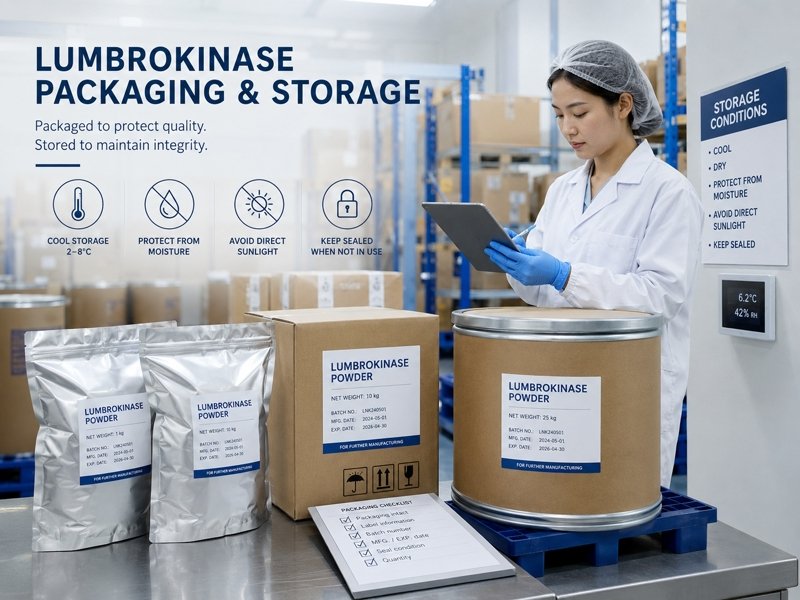
4. Storage Information
Lumbrokinase is an enzyme-sensitive material, so storage guidance should be reviewed before the product arrives.
Supplier storage information may recommend:
- Storage in a cool, dry place
- Protection from moisture
- Avoidance of prolonged heat and humidity exposure
- Protection from direct sunlight
- Keeping the package sealed when not in use
- Suitable handling after the inner package is opened
This does not mean that every brief temperature fluctuation automatically destroys the product. The more practical concern is prolonged or uncontrolled exposure to heat, humidity, moisture or unsuitable warehouse conditions.
After delivery, the buyer becomes responsible for warehouse control, package resealing, internal transfer and production-room handling. The supplier’s storage statement should therefore be shared with warehouse and manufacturing personnel rather than kept only in the purchasing file.
Where a project includes international transport or storage planning, International Shipping and Storage of Lumbrokinase can provide more detailed handling considerations.
5. Country of Origin
Country-of-origin information may be requested for:
- Import review
- Internal supplier registration
- Purchasing records
- Customer documentation
- Customs preparation
- Distributor review
- Contract-manufacturer raw-material approval
The country of origin may appear on the COA, Product Information, commercial invoice or another supplier statement, depending on the documentation system.
Buyers should confirm this information before completing internal approval, particularly when the purchasing entity, importer and finished-product manufacturer are located in different countries.
Import requirements vary by destination. Buyers should confirm applicable requirements with their local import, customs or compliance teams. Supplier information can support the review, but it should not be treated as legal advice regarding import eligibility.
6. Batch Information
Batch information connects the document to the physical material.
Buyers should check:
- Batch number
- Manufacturing date, if available
- Expiry or retest date, if available
- Whether the batch is the sample batch
- Whether it represents currently available stock
- Whether it is the actual bulk order batch
- Whether the related COA and packaging labels show matching information
A common mistake is assuming that every document supplied during an inquiry refers to the same batch.
A buyer may receive a sample from one batch, review a quotation several weeks later and place the purchase order after the original batch has been sold. In this situation, the final bulk shipment may legitimately have a different batch number.
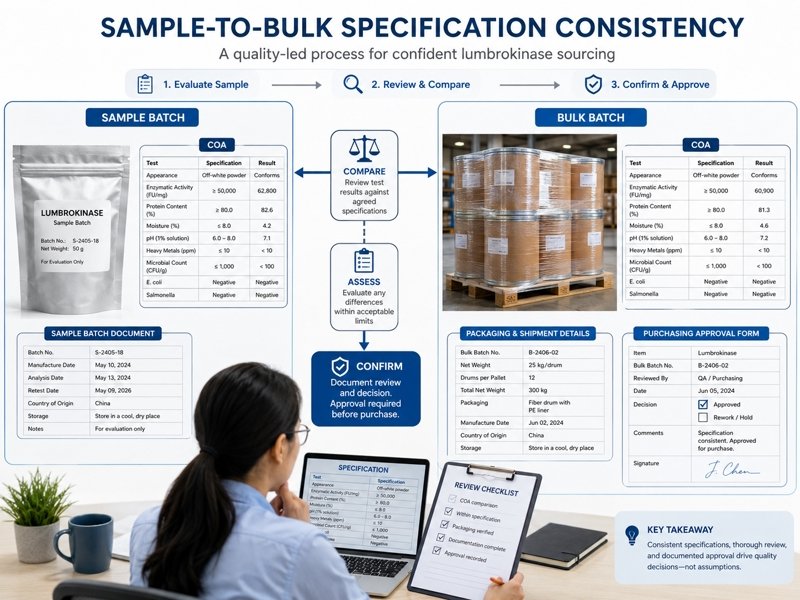
The correct objective is sample-to-bulk specification consistency, not necessarily identical batch numbers.
If the original sample batch is no longer available, the buyer should request the COA and batch information for the actual bulk batch. The buyer should then confirm that it meets the agreed:
- Specification
- Activity grade
- Assay basis
- Packaging requirement
- Purchasing conditions
An approved sample does not automatically guarantee every future batch. Buyers can review Lumbrokinase Sample to Bulk Order for a more detailed approval workflow.
Match Documents to Physical Labels
Before shipment or receiving, QA teams can compare the batch number and product name shown on the COA with the labels on the inner packaging.
This simple document-to-label check helps prevent situations in which the correct COA is available but has been attached to the wrong receiving record.
7. Assay Method Explanation When Needed
An assay method explanation is not necessary for every routine document request. It becomes relevant when activity is a key approval criterion or when the buyer is comparing results from different laboratories.
Lumbrokinase activity may be expressed as IU/mg, FU/g, LKU, U or another reporting format. These values should be reviewed together with the assay context, which may include:
- Substrate
- Reference standard
- Sample preparation
- Dilution
- Incubation time
- Incubation temperature
- Calculation method
- Reporting basis
- Laboratory protocol
Activity units from different methods are not automatically interchangeable. Buyers should not apply a fixed FU/g-to-IU/mg conversion without a validated method relationship.
The highest activity number is also not automatically the most suitable purchasing choice. The specification should match the buyer’s formulation, testing system and commercial requirements.
8. Sample and Available-Batch Documents
Before testing a sample, the buyer should ask whether the COA belongs to:
- The exact sample being supplied
- A representative recent batch
- The currently available stock batch
- A general reference batch
The supplier should identify this clearly.
When possible, receiving the document for the actual sample batch creates a cleaner evaluation record. If only a representative document is initially available, the buyer should understand that a new batch-specific COA may be required before bulk approval.
The same principle applies to available stock. A buyer requesting a quotation should confirm whether the batch document represents stock reserved for the order or stock that remains subject to availability.
9. Shipping or Export-Related Information
Some buyers need basic shipment information before approving an order or preparing a landed-cost review.
Relevant details may include:
- Destination country and postal code
- Shipping method
- Suitability for DHL or another courier
- Requested DDP service, when available
- International shipment packaging
- Documents required before dispatch
- Customs-clearance responsibility
- Importer responsibility when DDP is not used
A shipping quote cannot be prepared accurately without the destination, quantity and packaging information.
DDP door-to-door shipping may be available for selected destinations, but availability should be confirmed for the specific shipment. When another shipping term is used, the buyer should clarify who is responsible for import procedures, duties, taxes and local clearance.
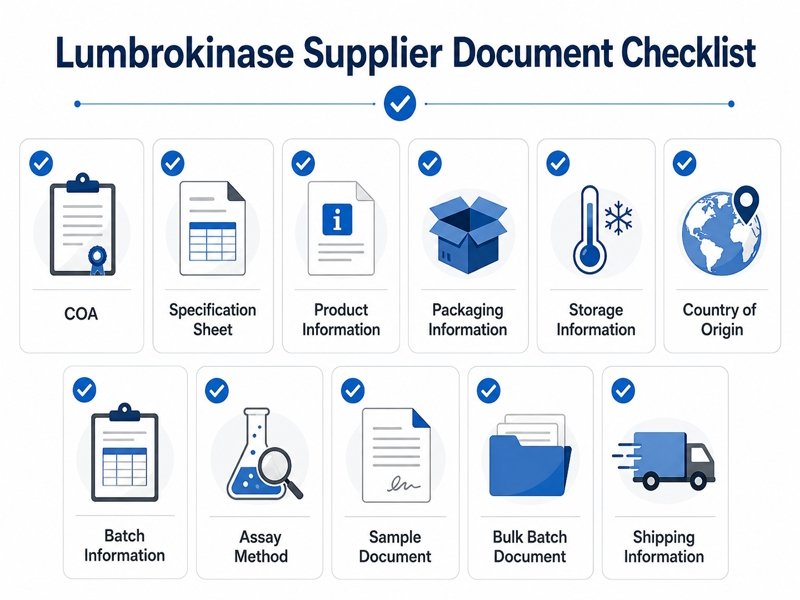
Lumbrokinase Supplier Document Checklist
| Document | What It Helps Confirm | When Buyers Should Request It |
|---|---|---|
| COA | Actual results and identity of a specific batch | Before sample approval and again for the actual bulk batch |
| Specification Sheet | Expected product requirements and agreed limits | During supplier evaluation and before quotation approval |
| Product Information | Ingredient identity, source, positioning and general description | Early sourcing and internal product review |
| Packaging Information | Pack size, inner packaging, sealing, labels and handling format | Before quotation, PO approval and warehouse planning |
| Storage Information | Recommended protection from moisture, heat, humidity and light | Before receiving and internal handling |
| Country of Origin | Origin information for purchasing, import and supplier files | Before supplier registration or import review |
| Batch Information | Which physical batch the document represents | For samples, available stock and bulk shipments |
| Assay Method Explanation | Basis of the activity value and unit | When activity is a key approval requirement |
| Sample Document | Whether the sample is supported by a matching or representative document | Before sample testing |
| Actual Bulk Batch Document | Whether the shipment meets the agreed specification | Before dispatch or final bulk release |
| Shipping Information | Delivery method, destination requirements and responsibility | Before confirming freight and order terms |
Common Buyer Mistakes
Relying Only on the COA
The COA does not always include sufficient product, packaging, storage or order-handling information.
Requesting a COA Without Identifying the Batch
A document is less useful when the buyer does not know whether it belongs to the sample, available stock or actual order.
Not Requesting the Specification Sheet
Without a Specification Sheet, the buyer may have no clear product-level standard against which to compare the batch COA.
Confirming Packaging Too Late
Packaging can affect quotation, warehouse handling, sample withdrawal and exposure after opening. It should be confirmed before the PO.
Ignoring Storage Guidance
Purchasing and QA teams should communicate storage requirements to warehouse and manufacturing personnel.
Assuming Sample and Bulk Batches Are Always the Same
The sample batch may no longer be available when the PO is placed. The actual bulk batch should be reviewed separately.
Not Requesting the Actual Bulk Batch COA
A sample COA should not automatically be used to release a later bulk shipment from another batch.
Comparing Activity Without Method Context
The activity unit, assay method and reporting basis should be reviewed together.
Requesting Freight Without Destination Details
Suppliers need the destination, quantity, packaging and requested shipping term to assess DHL or DDP options.
Confirming Country of Origin After Supplier Approval
Country-of-origin requirements should be checked early when they form part of the buyer’s internal registration or import procedure.
Allworms Supply Notes
Allworms supports overseas B2B sourcing of earthworm-derived lumbrokinase powder. COA, Specification Sheet and relevant available-batch information can be provided according to the inquiry and order stage.
A 100 g sample may be available for qualified B2B buyers, with international freight usually paid by the buyer. The standard MOQ is generally around 1.5 kg, depending on specification, packaging and destination. Orders of approximately 10–25 kg may also be discussed for sample-to-production transition or small bulk purchasing.
Standard lead time is usually 7–15 days after payment. DHL shipping may be used for suitable international shipments, and DDP service may be available for selected destinations.
Buyers should provide their required activity grade, quantity, packaging preference, document list and delivery destination so the correct document package can be prepared. Additional questions are also addressed on the FAQ page.
FAQ
1. Is a COA enough to approve a lumbrokinase supplier?
Not always. A COA confirms the reported results for a particular batch, but buyers may also need a Specification Sheet, Product Information, packaging details, storage guidance, country of origin and batch clarification.
2. Should the sample COA and bulk-order COA have the same batch number?
Only when the exact sample batch remains available and is used for the bulk order. A different batch number can be acceptable if the actual bulk batch meets the agreed specification, activity grade, assay basis, packaging requirement and purchasing conditions.
3. When should buyers request packaging information?
Packaging information should be requested before quotation or PO approval. It may affect freight, warehouse handling, production sampling, repeated opening and moisture-exposure control.
4. Is an assay method document always required?
No. It is most useful when enzyme activity is central to supplier approval, third-party testing or comparison between suppliers. The activity value should be reviewed in the context of the method and reporting basis.
5. Which documents should be reviewed before shipment?
Buyers should review the actual bulk batch COA, batch number, agreed Specification Sheet, packaging details, labels, storage guidance and required shipping or export information before dispatch.
Request The Right Lumbrokinase Supplier Documents For Your Activity Grade, Quantity, Packaging And Destination.
Contact Allworms for available-batch COA, Specification Sheet, batch, storage and shipping information.