
Evaluating lumbrokinase supplier reliability becomes critical when a buyer moves beyond an initial inquiry and prepares to approve a sample, issue a purchase order or purchase a 10–25 kg small bulk quantity. At this stage, a product description and general quotation are no longer enough.
Supplement brands, ingredient distributors, contract manufacturers, purchasing teams and QA departments need evidence that the supplier can support the intended transaction. This includes confirming the supplier’s business role, the actual available batch, relevant batch documents, activity and assay information, packaging readiness, realistic delivery timing and sample-to-bulk specification consistency.
The objective is not to eliminate every sourcing uncertainty. It is to identify avoidable risks before payment and establish clear order conditions that both parties can follow.
Quick Answer: How Can Buyers Evaluate Lumbrokinase Supplier Reliability?
Lumbrokinase buyers can evaluate supplier reliability before placing an order by checking supplier identity, production-side support, batch documents, sample availability, actual stock, production capability, activity and assay communication, packaging, storage and shipping readiness.
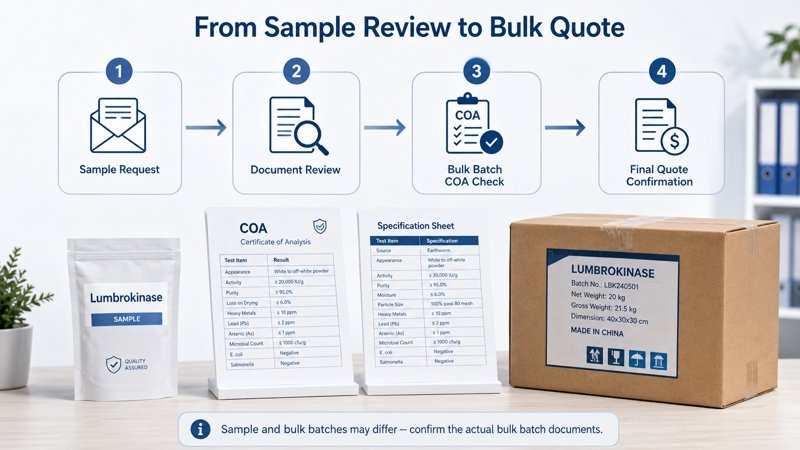
Buyers should also confirm sample-to-bulk specification consistency. If the approved sample batch is no longer available, the COA for the actual bulk batch should be reviewed against the agreed specification, activity grade, assay basis, packaging requirement and purchasing conditions before order approval.
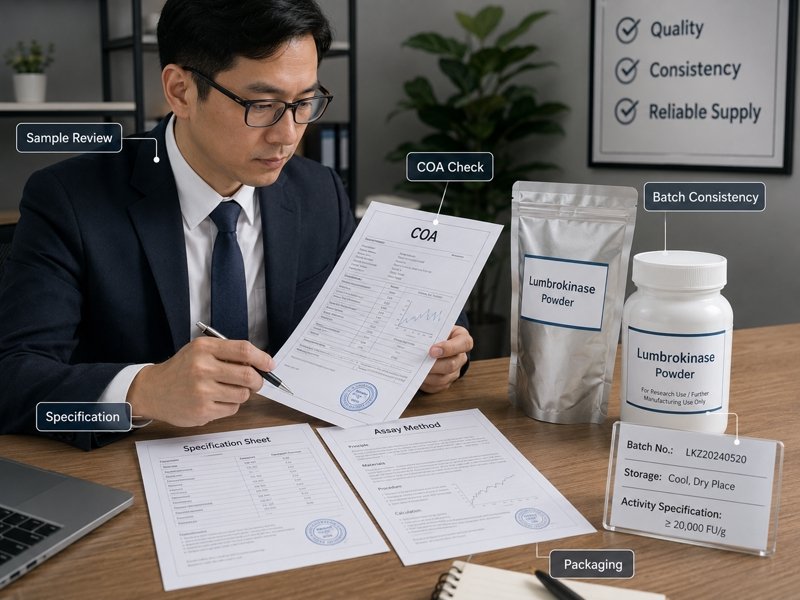
Why Supplier Reliability Matters Before Placing an Order
Supplier reliability has a different meaning at the order stage than at the initial supplier-search stage. A fast reply or attractive quotation may help begin a conversation, but it does not by itself show whether the supplier is ready to complete the order correctly.
Once a buyer is preparing a trial or small bulk purchase, practical questions become more important:
- Does the COA refer to the sample, current stock or an earlier production batch?
- Is the quoted activity based on a clearly stated unit and assay method?
- Has the available quantity actually been confirmed?
- Can the supplier meet the stated packaging and delivery requirements?
- What happens if the approved sample batch is unavailable when the PO is placed?
- Can similar documentation and communication be provided for repeat orders?
Without these confirmations, buyers may encounter mismatched batch documents, unclear activity reporting, unconfirmed stock, unexpected lead times or packaging details that are discovered only after payment.
A structured lumbrokinase supplier risk assessment therefore examines whether the supplier’s information remains consistent as the transaction moves from inquiry to sample, quotation, PO, payment and dispatch.
1. Verify the Supplier’s Identity and Business Role
A buyer should understand who is providing the quotation and how that company connects to production, documentation and export support.
A lumbrokinase B2B supplier may operate as a manufacturer, trading company, distributor, export sales entity or part of a broader manufacturer-side supply system. None of these structures is automatically unreliable. The important question is whether the supplier explains its role accurately and can obtain the information needed to support the order.
Before placing a PO, buyers can ask:
- Which entity produces or releases the material?
- Which entity issues the quotation and commercial invoice?
- Who provides the COA and specification sheet?
- Who confirms batch availability and production timing?
- Which company is responsible for international sales and shipment coordination?
- Can technical or production-side questions be communicated to the relevant team?
This check is especially useful when the company name on a quotation differs from the manufacturing or document-issuing entity. The supplier should be able to explain the relationship without vague or conflicting statements.
For a fuller explanation of different business structures, buyers can review Lumbrokinase Manufacturer vs Trading Company.
Allworms is part of the manufacturer-side earthworm-derived ingredient supply system and supports overseas market development and international sales. Its role includes coordinating buyer requirements, batch information, documents and international order communication with the production side.
2. Match Batch Documents to the Actual Transaction
Receiving a COA is not the same as confirming the intended order batch.
A reliable supplier should explain whether a document refers to:
- The sample batch
- An available stock batch
- A representative historical batch
- The proposed bulk order batch
- A newly produced batch that will be available later
Before PO approval, the buyer should check the batch number and confirm how it relates to the material being purchased. Depending on availability and the supplier’s document system, relevant information may include the COA, specification sheet, manufacturing date, expiry or retest date, and packaging information.
The purpose is not to request every possible document for every small order. It is to establish document traceability appropriate to the buyer’s QA process.
For example, a historical COA may be useful during an early inquiry to understand the typical testing format. However, it should not automatically be treated as the COA for current stock. Before purchasing, the buyer should ask whether an available-batch COA can be supplied or when the actual order-batch document will be issued.
Buyers requiring a broader document checklist can continue to Lumbrokinase Supplier Documents Beyond the COA rather than turning this reliability review into a detailed COA analysis.
3. Assess Sample Support and Evaluation Readiness
Sample support can reveal how prepared a supplier is to support a real evaluation process.
Buyers should confirm:
- Whether a sample is currently available
- The sample quantity
- Who is responsible for international freight
- Which specification and activity grade the sample represents
- Whether batch documents are available for the sample
- Whether the sample batch is also available for a later commercial order
- How a later bulk batch will be reviewed if the original batch is sold out
A sample should not be presented simply as an unlabeled powder detached from the intended purchasing specification. The supplier should be able to identify what is being sent and explain which document accompanies it.
For qualified B2B buyers, a 100 g lumbrokinase sample may be available from Allworms, while the buyer usually pays the international sample freight. Availability, activity grade, destination and document requirements should be confirmed before dispatch.
Sample support alone does not prove overall supplier reliability. It becomes useful evidence when the sample identity, documents and later bulk-order process are communicated consistently.
4. Confirm Sample-to-Bulk Specification Consistency
Sample approval is not only a judgment about whether the tested material appears suitable. It should establish the specification against which the eventual bulk order will be reviewed.
The sample batch and final bulk order batch may not always be identical. This is common when testing takes several weeks, internal approval is delayed or the requested quantity exceeds the remaining stock from the sample batch.
Buyers should therefore record the approved requirements, including:
- Product specification
- Activity grade and reporting unit
- Assay basis or agreed method context
- Appearance and relevant quality parameters
- Required packaging
- Document requirements
- Commercial purchasing conditions
If the original sample batch is no longer available, the buyer should review the COA for the actual bulk batch and confirm that it meets these agreed conditions before accepting the order.
This does not mean that the sample and bulk material must always carry the same batch number. It also does not mean that one approved sample guarantees every future production batch. Reliable sample-to-bulk specification consistency depends on comparing each proposed order batch with the agreed purchasing specification.
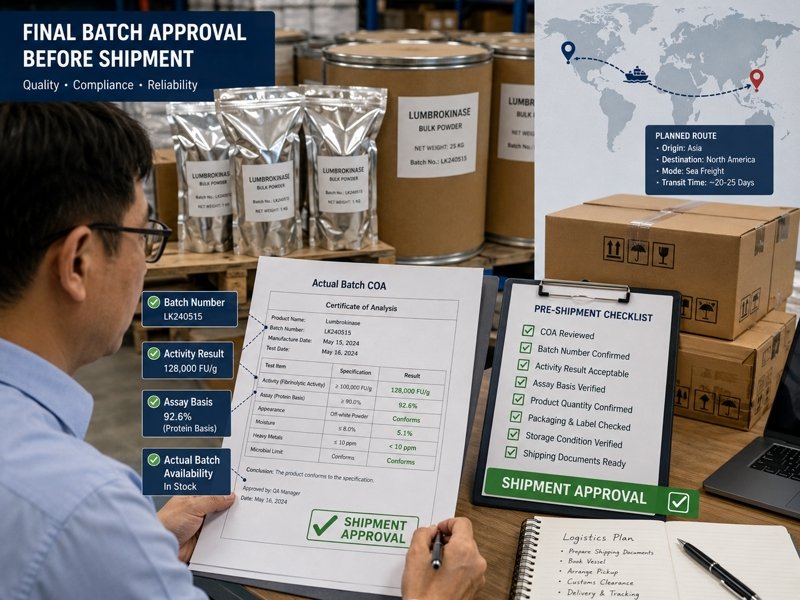
5. Evaluate Production Capability and Order Capacity
Production capability should be assessed in relation to the buyer’s actual order, not only through a general factory-capacity statement.
A supplier may be able to support a 1.5 kg trial order from stock but require production planning for a 10–25 kg small bulk order. Another batch may be available immediately but only in a specific activity grade or pack size.
Before issuing a PO, buyers should request clear answers to four questions:
- Is the required quantity currently available?
- If not, what is the realistic production lead time?
- Is the requested packaging ready for that quantity?
- Can similar quantities be supported for expected repeat orders?
This approach distinguishes current stock from general production capacity. It also helps purchasing teams identify whether the quoted lead time starts after payment, after production confirmation or after final packaging approval.
Allworms’ standard MOQ is usually around 1.5 kg, depending on specification, packaging and destination. Trial quantities and 10–25 kg small bulk orders may be discussed according to available stock and production arrangements. Standard lead time is usually 7–15 days after payment, but the actual timing should be confirmed for each order.
6. Review Activity and Assay Communication
Reliable lumbrokinase suppliers should communicate activity requirements without treating the reported number as self-explanatory.
When IU/mg, FU/g, LKU or U appears in a quotation, specification or laboratory report, the unit should be reviewed with the assay method and reporting basis. Relevant method context may include:
- Substrate
- Reference standard
- Sample preparation and dilution
- Incubation time and temperature
- Calculation method
- Laboratory protocol
- Dry-weight, product-weight or other reporting basis
There is no universal fixed conversion between FU/g and IU/mg that can be applied without considering these conditions. A higher reported number also does not automatically make one material more suitable for a buyer’s formulation.
If the buyer plans third-party testing, the supplier should be informed before sample approval. Differences between supplier and buyer results may reflect laboratory methods rather than automatically proving that one result is incorrect.
Supplier reliability is shown by the ability to discuss these limitations clearly, provide available method information and avoid promising equivalence that has not been established.
7. Confirm Packaging, Storage and Shipping Readiness
Before payment or dispatch, the supplier should confirm how the material will be packed, protected and shipped.
The order-readiness review should cover:
- Pack size and number of packages
- Sealed inner packaging
- Moisture protection
- Recommended storage conditions
- Shipping method and expected transit arrangement
- Destination country and complete recipient information
- Availability of DHL or another suitable courier
- DDP availability for the selected destination, if requested
- Customs or import responsibilities that require buyer preparation
Lumbrokinase is an enzyme-sensitive material that should be protected from prolonged or uncontrolled exposure to heat, humidity, moisture and direct sunlight. Suitable packaging and transport planning help reduce avoidable quality risk, although a short temperature fluctuation should not automatically be interpreted as product failure.
DHL may be used for suitable international shipments, while DDP door-to-door shipping may be available for selected destinations. These options should be confirmed for the actual quantity and destination rather than assumed from a previous shipment.
8. Observe Communication Consistency
Responsiveness is useful, but reliability requires more than replying quickly.
During supplier verification, buyers should observe whether the supplier:
- Gives consistent answers when a question is revisited
- Confirms specification, quantity and destination before final quotation
- Distinguishes current stock from future production
- Answers batch-number questions directly
- Explains technical or logistical limitations
- Provides realistic rather than automatic lead times
- Follows up on missing sample or document requirements
- Confirms recipient and delivery details before shipment
One practical test is to compare the inquiry, quotation, sample documents and draft order terms. Activity grade, quantity, packaging, lead time and shipping responsibility should not change without explanation.
Good communication also includes documenting important confirmations in writing. A short written order summary can prevent misunderstandings that might otherwise remain hidden across several separate emails or messages.
9. Consider Long-Term Cooperation Stability
A reliable lumbrokinase supplier should be evaluated for the next order as well as the current one.
For repeat small bulk purchasing, buyers should look for stable practices in document presentation, batch communication, packaging and order confirmation. The supplier should also be willing to explain changes when a new batch, revised lead time or different packaging arrangement applies.
Long-term stability does not mean that every batch, delivery time or stock position will remain unchanged. It means that changes are communicated clearly and that each repeat order can be assessed against the previously agreed specification and purchasing requirements.
Buyers serving growing brands may also ask how the supplier would handle a move from a 1.5 kg trial order to 10–25 kg purchases. Lumbrokinase Supplier for Small Supplement Brands provides further context for this purchasing stage.
Lumbrokinase Supplier Reliability Checklist Before Placing an Order
| Reliability Area | What Buyers Should Check | Why It Reduces Purchasing Risk |
|---|---|---|
| Supplier identity | Legal sales entity and its role in the supply system | Clarifies contractual and commercial responsibility |
| Production-side support | Access to production, QA or technical information | Reduces dependence on unsupported sales statements |
| Available batch confirmation | Batch number, quantity and stock status | Prevents ordering against unconfirmed inventory |
| COA | Whether it matches the sample or proposed order batch | Improves batch traceability |
| Specification sheet | Agreed product and quality requirements | Creates a reference for order approval |
| Sample support | Quantity, freight responsibility and sample identity | Makes testing relevant to the intended purchase |
| Sample-to-bulk consistency | Review process if the bulk batch differs from the sample | Prevents unsupported assumptions after sample approval |
| Activity and assay communication | Unit, method context and reporting basis | Reduces misinterpretation of activity results |
| Packaging | Pack size, sealing and moisture protection | Confirms material-handling readiness |
| Storage | Recommended conditions and handling information | Helps protect an enzyme-sensitive ingredient |
| Shipping readiness | Method, destination, recipient and customs arrangement | Reduces dispatch and clearance delays |
| Lead time | Stock versus production timing | Supports realistic purchasing schedules |
| Repeat supply support | Future batch and quantity planning | Helps evaluate longer-term purchasing stability |
| Communication quality | Consistent, documented and limitation-aware answers | Identifies gaps before payment |
Common Buyer Mistakes During Supplier Approval
Common mistakes include:
- Selecting a supplier primarily because it offered the lowest price
- Treating any COA as sufficient without checking its batch number
- Failing to confirm the actual available batch before issuing the PO
- Assuming the sample and bulk order must always share one batch number
- Assuming an approved sample guarantees every future batch
- Comparing activity values without considering the unit and assay method
- Ignoring packaging, storage and moisture-protection details
- Evaluating current stock without considering repeat-order support
- Placing a PO before confirming the destination and shipping method
- Treating fast responses as proof of technical and operational reliability
The better approach is to connect identity, documentation, physical batch availability and order execution into one approval process.
FAQ
1. What is the strongest sign of lumbrokinase supplier reliability?
No single document proves reliability. Strong evidence comes from consistent information across supplier identity, batch availability, COA, specification, sample support, activity communication, packaging and order terms.
2. Must the sample and bulk order have the same batch number?
No. The sample batch may be unavailable by the time the PO is placed. In that situation, buyers should review the actual bulk-batch COA and confirm sample-to-bulk specification consistency against the agreed requirements.
3. Is a COA enough to approve a lumbrokinase supplier?
Usually not by itself. Buyers should confirm which batch the COA represents and review it with the specification sheet, activity and assay context, available stock, packaging and purchasing conditions.
4. How should a buyer assess an export sales entity connected to production?
The buyer should check whether the entity clearly explains its role, can access production-side information, provides appropriate documents, confirms actual batches and coordinates international order requirements consistently.
5. What should be confirmed immediately before payment?
Confirm the product, activity grade, quantity, actual batch or production arrangement, packaging, documents, lead time, payment terms, shipping method, destination and final recipient information. Additional purchasing questions may be checked through the FAQ page.
Evaluate Lumbrokinase Supplier Reliability with Allworms
Review the available batch, required documents, activity and assay basis, sample-to-bulk specification consistency, packaging and delivery plan before approving your order.
Contact Allworms through the Lumbrokinase product page to discuss a sample, 1.5 kg trial order or 10–25 kg small bulk requirement.
This product is supplied as a B2B ingredient. Final formulation suitability, dosage, labeling, health claims and regulatory compliance should be evaluated by the buyer according to the intended market and finished-product use.

Review Lumbrokinase Supplier Reliability Before Ordering
Discuss Samples, Trial Orders and 10–25 kg Requirements with Allworms