For B2B buyers, the quality evaluation of an earthworm-derived ingredient should begin before extraction, hydrolysis or enzyme processing. Earthworm breeding and raw material control provide the upstream foundation for understanding where production inputs come from, how they are selected and handled, and whether those inputs can be connected to finished production batches.
This matters when sourcing Earthworm Protein Powder, Earthworm Peptide Powder or Lumbrokinase because these products follow different downstream processes but share an important procurement question: how well does the supplier understand and control its starting material?
A controlled breeding and raw-material system does not guarantee finished-product quality by itself. Buyers should combine upstream evaluation with specification requirements, available-batch COA review, sample evaluation and appropriate finished-product testing.
Quick Answer: Why Do Earthworm Breeding and Raw Material Control Matter?
Earthworm breeding and raw material control matter because the quality management of earthworm-derived ingredients starts before extraction or processing.
B2B buyers should evaluate how a supplier manages earthworm source, breeding environment, raw material screening, cleaning, handling, batch separation, traceability and documentation before comparing finished Earthworm Protein Powder, Earthworm Peptide Powder or Lumbrokinase.
Upstream control supports traceability and supplier reliability, while the specification sheet, COA and actual-batch information remain necessary for evaluating the finished ingredient.
Why Raw Material Control Matters for Earthworm-Derived Ingredients
When purchasing a powdered ingredient, it is easy to focus on the numbers on the COA: protein content, moisture, microbiology or, for Lumbrokinase, enzyme activity.
Those results are important, but they represent the downstream end of a longer supply chain.
For earthworm-derived ingredients, buyers should also consider:
- Where the earthworm raw material originates.
- Whether the supplier manages or has visibility into the breeding source.
- How material is collected and transferred for processing.
- Whether unsuitable material is removed before production.
- How cleaning and pre-processing handling are managed.
- Whether individual production inputs and finished batches can be identified.
- How records connect the upstream material with downstream quality documentation.
This upstream visibility becomes especially relevant when qualifying a long-term earthworm ingredient supplier rather than simply purchasing a one-time sample.
It can also reveal something that a single COA cannot: whether the supplier has a repeatable system for managing material before the laboratory testing stage.
Earthworm Breeding Base and Source Control
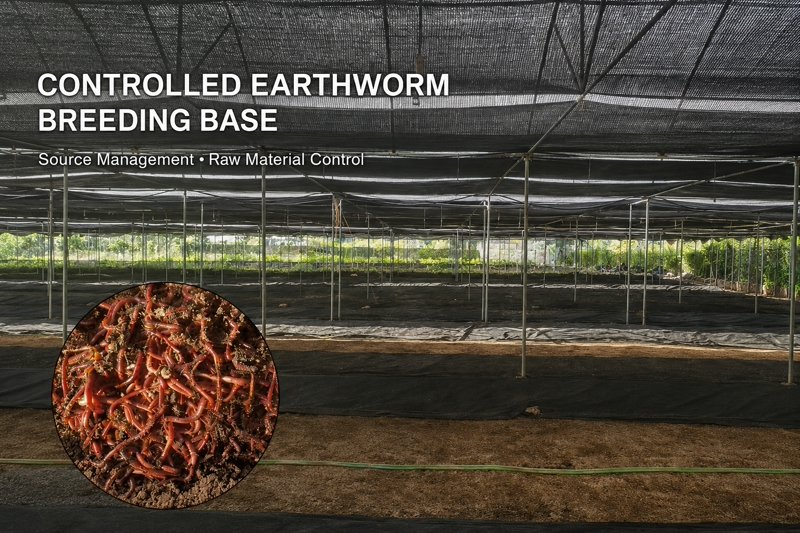
A controlled earthworm breeding base gives procurement and quality teams a clearer starting point for supplier evaluation.
Buyers do not need to assume that owning or managing a breeding base automatically means the finished ingredient is better. Instead, the important question is whether the supplier can explain how the breeding operation fits into its raw material control system.
Useful questions include:
- What is the source of the earthworms used for production?
- Where is the breeding base located?
- Is species information available?
- How are breeding and harvesting managed?
- How is collected material identified before processing?
- What happens between harvesting and production?
- Can raw material origin be linked with receiving or production records?
For an ongoing supply program, source continuity can be as important as source identity. A buyer may therefore ask whether routine production normally uses the same breeding system and what happens if an alternative raw material source becomes necessary.
That last question introduces an important but often overlooked supplier-evaluation criterion: change control. Buyers should understand whether a significant change in raw material source would be identified and managed rather than treated as an invisible purchasing substitution.
Raw Material Selection Before Processing
Harvesting should not automatically mean release into production.
A more useful procurement question is: What has to happen before an earthworm raw material lot becomes an accepted production input?
The workflow may include selection, removal of unsuitable material, cleaning, temporary handling or storage, batch identification and controlled transfer into production.
Buyers can ask how a supplier handles:
- material that does not meet its receiving or selection criteria;
- separation between accepted and unsuitable material;
- identification of different incoming or collected lots;
- time and handling conditions between collection and processing;
- authorization or confirmation before material enters production.
This introduces another useful concept for supplier audits: an input-release checkpoint. Even when a supplier uses its own breeding source, buyers should understand what separates “harvested material” from “material accepted for production.”
That distinction is more meaningful than simply asking whether the manufacturer owns a breeding base.
Cleaning, Handling and Pre-Processing Control
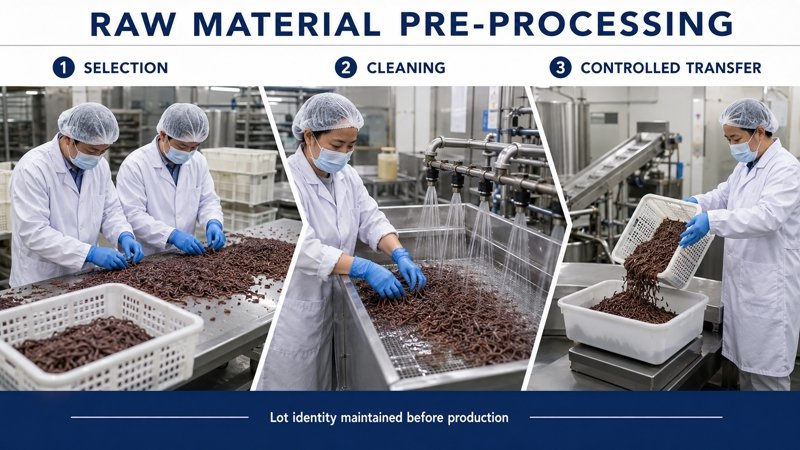
Earthworm raw material must pass through upstream handling before it becomes a protein, peptide or enzyme ingredient.
At this stage, B2B quality teams may want to understand how the supplier addresses foreign matter, cleanliness, uncontrolled moisture exposure, microbial risk, odor management and cross-contamination risks.
The objective is not to assume that cleaning sterilizes the raw material or guarantees the final product. Cleaning and controlled handling are individual parts of a broader production and quality system.
Another useful evaluation point is maximum or typical pre-processing hold time. Buyers can ask whether collected and cleaned material is processed promptly or temporarily stored, and whether the supplier controls the conditions during that interval.
For traceability purposes, raw material identity should also remain clear during transfer. Losing lot identity between collection, cleaning and production weakens the connection between upstream records and the eventual finished batch.
Traceability from Raw Material to Finished Ingredient
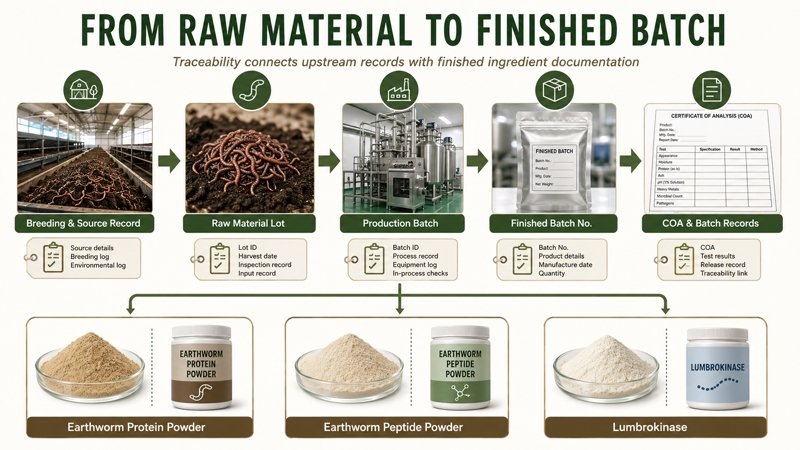
Earthworm ingredient traceability can be understood as a chain of connected records rather than a single certificate.
A practical traceability path may include:
Raw material source → breeding/collection record → receiving or input record → production batch → finished batch number → COA → packaging and storage information
The exact documents and record structure vary by manufacturer, but buyers should look for continuity between these stages.
Traceability becomes particularly useful when investigating a specification deviation or comparing repeat orders. Instead of knowing only that a batch failed or changed, the supplier has a better basis for examining whether the difference relates to raw material, processing, storage or another production factor.
For buyers conducting supplier qualification, it can therefore be useful to ask not only “Do you have traceability?” but also:
“If I give you a finished-product batch number, how far upstream can that batch be traced?”
That question is more informative than a simple yes/no traceability checklist.
How Raw Material Control Supports Different Earthworm-Derived Ingredients
The same upstream control principles can support different products, but the finished-product evaluation criteria should not be mixed.
| Ingredient | Role of Raw Material Control | Finished-Ingredient Checks |
|---|---|---|
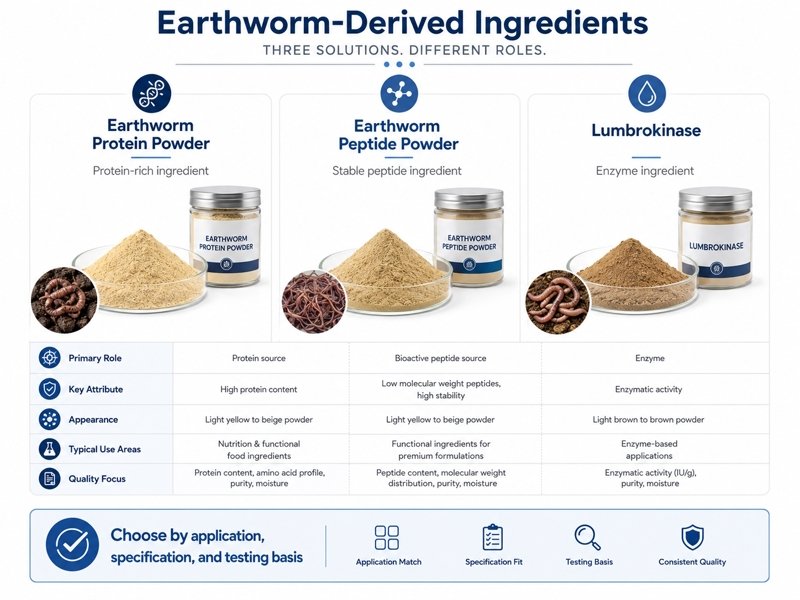
| Earthworm Protein Powder | Supports controlled input for protein ingredient production | Protein content, amino acid information if available, moisture, ash, heavy metals, microbiology, appearance, odor, COA and specification |
| Earthworm Peptide Powder | Supports consistent input for enzymatic hydrolysis and peptide processing | Peptide content, protein as a supporting parameter, molecular-weight information if available, solubility where relevant, moisture, ash, heavy metals, microbiology and documentation |
| Lumbrokinase | Supports controlled starting material for enzyme ingredient processing | Activity grade, stated activity unit, assay basis, COA, specification, sample testing and batch documentation |
Earthworm Protein Powder is a protein-rich ingredient. Buyers evaluating it can review the Earthworm Protein Powder product page for product-specific information.
Earthworm Peptide Powder is produced through enzymatic hydrolysis and positioned as a stable peptide ingredient—not as an active fibrinolytic enzyme product. Peptide-focused buyers can continue to the Earthworm Peptide Powder product page.
Lumbrokinase is an earthworm-derived fibrinolytic enzyme ingredient. Activity specifications such as IU/mg, FU/g, LKU or U relate to Lumbrokinase, not to the protein or peptide powders. Because activity units depend on assay methods and laboratory conditions, fixed conversions between different activity systems should not be assumed. Product-specific requirements are covered on the Lumbrokinase product page.
Raw Material Control vs. Finished Product Testing
Upstream control and finished-product testing answer different questions.
| Control Area | What It Checks | Why Buyers Should Care | Related Confirmation |
|---|---|---|---|
| Breeding base control | Raw material source and management | Establishes upstream visibility | Source or breeding information |
| Raw material selection | Suitability before processing | Helps exclude unsuitable inputs | Selection/receiving process |
| Cleaning and handling | Pre-processing material management | Addresses foreign matter and handling risks | Process information |
| Batch separation | Material identity | Supports traceability | Lot/batch records |
| Production input control | Material entering manufacture | Connects source with production | Production records |
| Finished specification | Target product requirements | Defines what buyers expect to purchase | Specification sheet |
| Finished batch testing | Actual results for one batch | Supports batch-specific evaluation | COA |
| Packaging and storage | Post-production protection | Helps maintain product condition | Packaging/storage information |
A specification sheet defines the target requirements for a product. A COA reports actual test results for a specific finished batch.
Neither replaces upstream raw material control, and upstream control does not replace finished-batch testing.
Buyer Checklist: Evaluating Earthworm Raw Material Control
Before approving an earthworm-derived ingredient supplier, consider asking:
- Can you explain the origin of the earthworm raw material?
- Do you manage or have access to a controlled earthworm breeding base?
- How is material selected and unsuitable material excluded?
- What cleaning and handling steps occur before processing?
- How is material identified during temporary storage and transfer?
- Are separate raw material or production lots kept traceable?
- What happens if the normal raw material source changes?
- Can a finished batch number be connected with upstream production information?
- Can you provide the specification sheet and COA for the available finished batch?
- How do raw material controls connect with your finished-product quality system?
For buyers still determining which ingredient fits their project, Earthworm-Derived Ingredients: How to Choose Between Protein Powder, Peptide Powder and Lumbrokinase provides the next product-selection step.
Sample-to-Bulk Purchasing: Keep Traceability in Context
A successful sample is useful evidence, but it does not guarantee every future production batch.
For Earthworm Protein Powder and Earthworm Peptide Powder, buyers should confirm sample-to-bulk specification consistency against the agreed requirements. For Lumbrokinase, this should also include the agreed activity grade and assay basis where relevant.
If the original sample batch is no longer available when a PO is eventually placed, the buyer should review the COA for the actual available bulk batch and confirm that it meets the agreed specification, formulation requirements and internal quality criteria.
The goal is specification consistency—not necessarily identical sample and bulk batch numbers.
Common Mistakes When Evaluating Earthworm Ingredient Suppliers
One common mistake is comparing suppliers only by price or one headline specification.
Other problems include:
- Ignoring the origin and handling of the earthworm raw material.
- Treating all three earthworm-derived ingredients as if their processes were identical.
- Confusing Earthworm Peptide Powder with Lumbrokinase.
- Applying enzyme activity units to Earthworm Protein Powder or Peptide Powder.
- Reviewing a COA without considering upstream traceability.
- Assuming higher protein, peptide or enzyme activity numbers automatically mean better suitability.
- Ignoring what happens when raw material sources or production batches change.
- Requesting a quotation without first identifying the intended ingredient and application.
Supplier evaluation should connect upstream controls, finished specifications and the buyer’s actual formulation and purchasing requirements.
How Allworms Supports Earthworm Raw Material Control and B2B Sourcing
Allworms Bio-Tech Co., Ltd. is part of the manufacturer-side earthworm-derived ingredient supply system, with involvement in earthworm raw material supply and overseas market development. The supply system connects earthworm breeding and raw material sourcing with production of Earthworm Protein Powder, Earthworm Peptide Powder and Lumbrokinase.
For international B2B projects, Allworms can support product information, COA and specification sheet communication for available batches, sample discussions, packaging requirements and export supply coordination.
Buyers with additional questions about products, orders or documentation can also review the FAQ page.
FAQ
1. Why does earthworm breeding matter for earthworm-derived ingredients?
It gives buyers visibility into the upstream raw material source and helps them evaluate supplier control and traceability. It does not replace finished-product testing.
2. What should buyers ask about earthworm raw material control?
Ask about source, breeding management, selection criteria, cleaning, pre-processing handling, lot identification, storage or transfer conditions, traceability and management of unsuitable materials.
3. Does raw material control replace COA testing?
No. Raw material control manages upstream inputs, while the finished-batch COA provides actual test results for a specific batch.
4. How does traceability support supplier evaluation?
Traceability helps connect finished ingredients with production and upstream records, giving purchasing and quality teams more information when assessing repeat batches or investigating deviations.
5. Are the three Allworms ingredients intended for the same application?
No. Earthworm Protein Powder is a protein-rich ingredient, Earthworm Peptide Powder is a peptide ingredient produced through enzymatic hydrolysis, and Lumbrokinase is a fibrinolytic enzyme ingredient. Selection should depend on the intended formulation and target market.
6. Is Earthworm Peptide Powder the same as Lumbrokinase?
No. Earthworm Peptide Powder is not positioned as an active enzyme product and should not be evaluated using Lumbrokinase activity units.
7. What documents should buyers review before purchasing?
Depending on the product and project, buyers should review the specification sheet, available-batch COA, relevant product information, packaging and storage information, and any traceability information required by their quality system.
8. Should buyers ask about the breeding base before requesting a sample?
For serious supplier qualification, it can be useful. Understanding the raw material source gives context to the sample, while the sample itself allows formulation or quality evaluation of the finished ingredient.
9. How does raw material control support sample-to-bulk consistency?
It creates a controlled upstream framework, but consistency still needs to be confirmed against the agreed finished-product specification and actual bulk-batch documentation.
Strengthen Your Sourcing with Controlled Raw Materials
Discuss Your Earthworm Ingredient Requirements with Allworms
This product range is supplied as B2B ingredients. Final formulation suitability, dosage, labeling, health claims, and regulatory compliance should be evaluated by the buyer according to the intended market and finished-product use.