
A previous successful purchase can make a lumbrokinase repeat order appear straightforward. However, repeat-order approval should involve more than copying the last purchase order and asking the supplier to ship the same product again.
The available batch, production schedule, packaging plan and delivery information may have changed since the previous order. The buyer’s internal receiving procedures, inventory requirements or formulation schedule may also be different.
A structured lumbrokinase repeat order approval process helps purchasing and QA teams verify that the new order still matches the approved product requirements. For supplement brands, nutraceutical companies, ingredient distributors and contract manufacturers, this process reduces preventable discrepancies without requiring the supplier to repeat the complete first-order qualification process.
Quick Answer: Lumbrokinase Repeat Order Approval
Lumbrokinase repeat order approval should include reconfirming the product specification, activity requirement, assay basis, current batch documents, COA, packaging, storage, quantity, lead time, shipping details and purchasing conditions before placing a new PO.
Buyers should review information for the actual repeat-order batch rather than relying only on documents from a previous shipment. A successful earlier order supports supplier continuity, but it does not automatically approve every future batch or delivery arrangement.
Why Repeat-Order Reconfirmation Matters
The purpose of repeat-order approval is not to restart supplier selection. The buyer has already evaluated the product, completed a previous purchase and gained practical experience with the supplier.
Instead, the purpose is to confirm continuity between three sets of information:
- The requirements approved during the previous order
- The buyer’s current purchasing and operational requirements
- The supplier’s current batch, production and delivery information
These details can remain consistent while still requiring reconfirmation. For example, a supplier may continue using the same agreed specification, but the repeat shipment will normally have a new batch number and new batch-specific results.
Buyers preparing their first commercial order after sample testing can refer to Lumbrokinase Sample to Bulk Order. An existing customer, however, should use a shorter change-control approach: identify what remains the same, determine what has changed and document the final approval before issuing the next PO.
1. Confirm the Product Specification Again
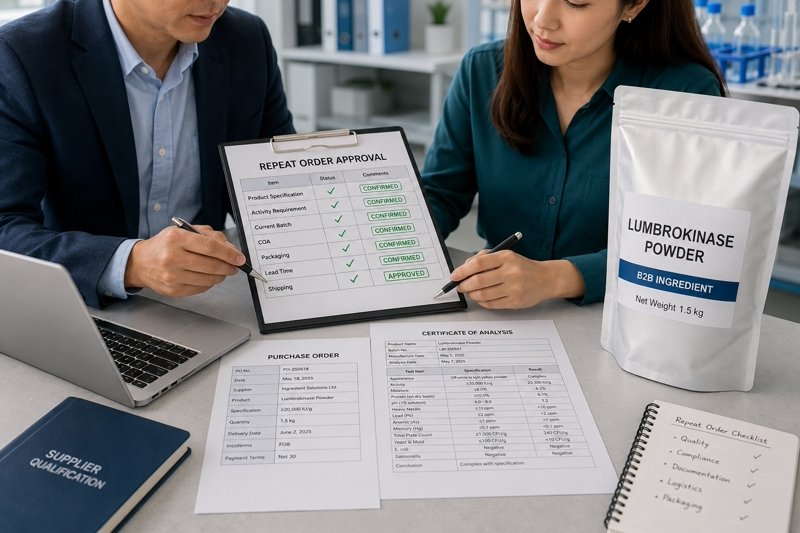
The repeat-order request should clearly state the product being reordered. Avoid relying only on wording such as “same as last time,” especially when purchasing and production personnel may not be the same people who managed the previous order.
Reconfirm:
- Product name and powder form
- Agreed activity specification
- Activity unit and assay basis
- Pack size and packaging format
- Storage requirements
- Any buyer-specific labeling or handling instructions
For lumbrokinase, the activity requirement should be written together with the applicable unit and test basis. A number stated without its unit or assay context may not provide sufficient purchasing control because IU/mg, U/g, FU/g and other reporting systems are not automatically interchangeable.
The buyer can use the previous PO, approved specification sheet and internal material code as reference points. If the company uses revision-controlled purchasing specifications, the PO should identify the current revision rather than attaching an uncontrolled copy from an old email.
A previous successful order does not mean the specification should be assumed unchanged forever. It means the previous approved requirements provide the baseline for confirming the next order.
2. Confirm the Current Batch Information
Current batch confirmation is central to lumbrokinase repeat order approval. The buyer should ask which batch is available or expected to be allocated to the order.
Relevant information may include:
- Current batch number
- Manufacturing date, if available
- Expiry or retest information, if applicable
- Available quantity from that batch
- Whether the material comes from the previous or a new production cycle
- Whether more than one batch would be needed to complete the order
A repeat order does not need to carry the same batch number as the previous shipment. In many cases, using a new batch is normal. The important point is that the buyer knows which batch will be shipped and receives the corresponding documentation.
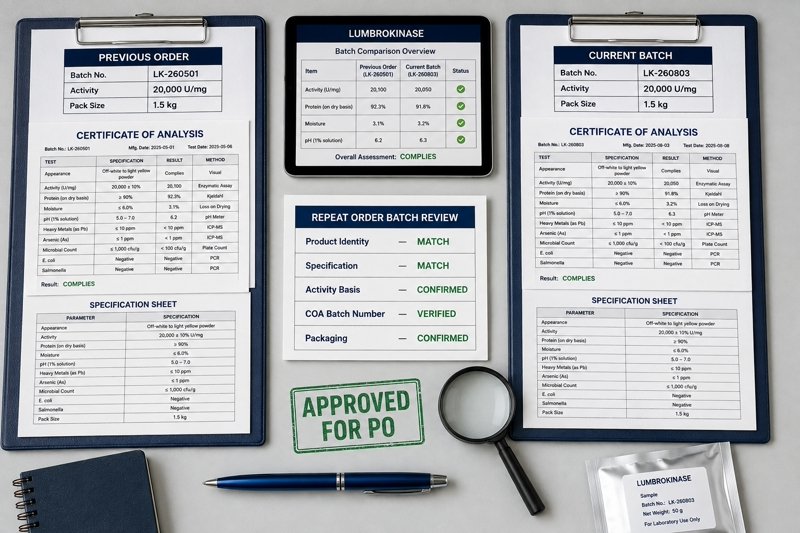
Buyers should also consider sample-to-bulk specification consistency. If an earlier sample and the first commercial order were approved against a defined specification, the repeat batch should continue to meet that agreed specification. This does not require every numerical result to be identical. Normal batch results can vary within the approved acceptance limits.
For a more detailed discussion of acceptable batch-to-batch review, see Lumbrokinase Batch Consistency: From Sample Testing to Bulk Order Approval.
A practical decision point is whether the repeat quantity can be supplied from one batch. If the supplier proposes multiple batches, the buyer should decide whether separate COAs, batch identification and internal release records will be required.
3. Review the COA and Specification Sheet Before Reordering
The repeat-order document review can be more focused than an initial qualification review, but it should not be skipped.
Before approving the purchase, confirm that:
- The COA corresponds to the batch intended for shipment
- The reported results meet the agreed requirements
- The lumbrokinase activity basis remains clear
- The product and batch identification are consistent across documents
- The Specification Sheet has not been revised unexpectedly
- Any agreed buyer-specific requirements remain recorded
The distinction is simple:
- A COA reports results for an actual production batch.
- A Specification Sheet defines the agreed product requirements and acceptance limits.
A previous COA describes the previous batch. It should not be treated as the batch document for a new shipment.
If the actual shipment batch has not yet been produced, the supplier may initially provide the current specification and explain when the final batch COA will become available. The buyer should then define whether the final COA must be reviewed before shipment or may be included with the shipping documents.
Buyers who need a wider documentation package can review Lumbrokinase Supplier Documents Beyond the COA.
4. Confirm Packaging and Handling Requirements
Packaging requirements may change even when the product specification remains the same. A repeat order is therefore a useful control point for confirming how the material should be packed, labeled and handled.
Review:
- Individual pack size
- Number of bags or containers
- Sealing method
- Product and batch labeling
- Carton or outer packaging
- Storage instructions
- Warehouse receiving requirements
- Any internal lot-label or pallet-label requirements
For example, a buyer may have changed warehouses, introduced barcode receiving or decided that smaller sealed packs are preferable for production handling. These changes should be communicated before the supplier prepares the order.
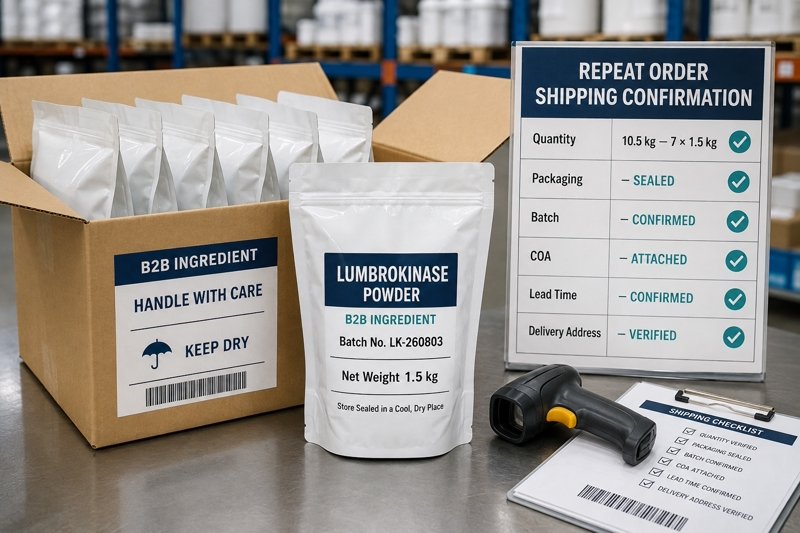
The buyer should also verify whether the ordered quantity can be supplied in complete standard packs. This can prevent last-minute repacking, unnecessary exposure of the powder or a discrepancy between the PO quantity and the final packed quantity.
5. Confirm Quantity and Order Planning
A lumbrokinase repeat purchase may be another trial order, a production replenishment order or the beginning of a regular supply schedule. The supplier should understand which situation applies.
Confirm:
- Exact purchase quantity
- Whether partial shipment is acceptable
- Whether the order is for trial production or regular supply
- Target receiving date
- Expected future order frequency, if known
- Whether inventory should be reserved for a later order
Small bulk buyers may continue ordering 10–25 kg for successive production batches. Even at these quantities, availability and scheduling should be discussed clearly.
One useful reorder consideration is inventory coverage. Instead of confirming only the immediate quantity, the buyer can compare current stock, expected production use and likely supplier lead time. This helps determine whether the next order should cover one production run or provide a reasonable supply buffer.
Forecast information does not need to be a binding commitment. A practical indication such as “approximately 10 kg every two months” can still help the supplier discuss future availability.
6. Confirm the Current Lead Time
The lead time achieved for the first order does not guarantee identical timing for every future purchase. Stock status, production scheduling, packaging preparation and international delivery conditions may be different.
Before issuing the PO, reconfirm:
- Whether the required specification is currently available
- Whether the full quantity can be allocated
- Whether new production is required
- Estimated preparation or production time
- Expected shipping arrangement
- Any known scheduling constraints
Allworms’ standard lead time is generally 7–15 days after payment, depending on the product specification, quantity and current availability. The confirmed schedule for the actual order should take priority over a general lead-time statement.
For repeat buyers with planned formulation dates, the relevant question is not only “What is the lead time?” but also “By what date must the PO and payment be completed to support the required receiving date?”
7. Confirm Shipping Details Again
Shipping information should be verified for every repeat order, even when the buyer expects delivery to the same location.
Reconfirm:
- Legal consignee or receiving company
- Contact person and telephone number
- Complete delivery address
- Destination country and postal code
- Preferred shipping method
- DHL or other courier availability, if applicable
- DDP availability for the destination, if applicable
- Customs or import information requested by the logistics provider
An address copied from the previous commercial invoice may no longer be correct. The buyer may have changed warehouses, appointed a different customs contact or introduced specific delivery-hour requirements.
The final shipping details should be confirmed before dispatch documents and labels are prepared. For selected destinations, Allworms may support DDP door-to-door delivery, subject to the destination, quantity and current shipping conditions.
8. Review Supplier Communication Before Approval
Repeat-order reliability includes the supplier’s ability to manage updated information efficiently. This review should be factual and related to the current transaction.
Check whether the supplier:
- Responds consistently to reorder questions
- Identifies the proposed shipment batch clearly
- Provides current batch documents
- Confirms any changed information before shipment
- Records packaging and labeling instructions accurately
- Provides a clear final order summary
- Supports QA or purchasing questions when clarification is needed
A useful control is a pre-PO confirmation message summarizing the product, specification, activity basis, quantity, packaging, batch status, lead time, shipping destination and payment terms. Both parties can then correct discrepancies before the PO is issued.
Lumbrokinase Repeat Order Approval Checklist
| Item to Reconfirm | Why It Matters | Buyer Action |
|---|---|---|
| Product specification | Keeps the new purchase aligned with the previously approved material | State the product, grade and current specification revision |
| Activity requirement | Prevents ordering the wrong activity level | Write the required value and acceptance basis |
| Assay basis | Activity results depend on the stated method and reporting system | Confirm the unit and applicable assay information |
| Current batch | The repeat shipment may use a different production batch | Request the proposed batch number and availability |
| COA | The previous COA does not represent the new batch | Review the COA for the actual shipment batch |
| Specification Sheet | Confirms the continuing agreed requirements | Verify that the current version remains acceptable |
| Packaging | Pack sizes or receiving needs may have changed | Confirm bag size, sealing, labels and outer packaging |
| Storage | Supports correct warehouse handling | Reconfirm storage instructions and receiving controls |
| Quantity | Affects batch allocation, packing and scheduling | State the exact quantity and whether partial shipment is acceptable |
| Lead time | Previous delivery timing may not apply | Request the current preparation and shipment estimate |
| Shipping | Incorrect old details can delay delivery | Verify the consignee, address, contact and shipping method |
| Payment details | Terms or bank instructions must be correctly recorded | Confirm payment terms and verify instructions through the established contact |
| Final order confirmation | Provides one agreed record before the PO | Match the final summary against the PO before approval |
Common Lumbrokinase Repeat Order Mistakes
Common mistakes include:
- Assuming the previous COA applies to the new shipment
- Not checking whether the required batch or quantity is currently available
- Assuming the original sample batch and repeat-order batch must be the same
- Skipping specification confirmation because the first order was successful
- Overlooking revised pack sizes or labeling requirements
- Assuming the previous lead time remains unchanged
- Reusing an old delivery address without verification
- Approving a reorder based only on price
- Failing to specify whether multiple batches are acceptable
- Not assigning responsibility for final COA approval
Price remains an important commercial factor, but repeat-order approval should also cover material identity, batch documentation, operational fit and delivery readiness.
Allworms Supply Notes for Repeat Buyers
Allworms supplies lumbrokinase as a B2B ingredient and supports sample evaluation, trial purchases, small bulk orders and repeat purchasing. The standard MOQ is generally around 1.5 kg, depending on the required specification and current availability. Small bulk orders of approximately 10–25 kg can also be discussed.
For repeat-order planning, buyers can provide the previous order reference, required activity specification, quantity, pack size, destination and requested delivery timing. Allworms can then confirm current availability, batch information, applicable documents, preparation time and shipping options.
Current product information is available on the Lumbrokinase product page, while general purchasing and product questions are covered on the FAQ page.
FAQ
Does a previously approved lumbrokinase order automatically approve the next batch?
No. Previous approval provides a useful purchasing baseline, but the buyer should still confirm that the new batch meets the agreed specification and that its batch-specific COA is acceptable.
Must a repeat order come from the same batch as the previous order?
No. Repeat orders commonly come from new production batches. The buyer should confirm the actual batch intended for shipment and review its corresponding documents.
Should repeat buyers request another sample before every order?
Not necessarily. The decision depends on the buyer’s QA procedure, specification changes, batch information, intended application and risk controls. Routine repeat batches may be approved through document review, while significant changes may justify additional evaluation.
When should the final COA be approved?
Ideally, the buyer and supplier should agree on this before the PO is finalized. If the shipment batch already exists, the COA may be reviewed before ordering. If production is pending, final COA approval may occur before shipment.
What information should be included in a lumbrokinase reorder request?
Include the previous order reference, product specification, activity requirement and assay basis, quantity, packaging, current batch request, required documents, delivery address, target timing and shipping preference.