
Lumbrokinase incoming quality control begins when a commercial shipment reaches the buyer’s receiving location. At this point, supplier evaluation, sample testing, document review, and bulk-order approval have already taken place. The immediate objective is different: confirm that the material physically delivered corresponds to the approved order and is acceptable for internal release.
For supplement brands, nutraceutical companies, ingredient distributors, contract manufacturers, and QA teams, this requires a structured receiving inspection. Shipment condition, package integrity, identity, quantity, batch traceability, documents, and agreed specifications should all be checked before the material enters production, formulation, repacking, distribution, or research-related use.
A practical workflow is:
RECEIVE → INSPECT → VERIFY → COMPARE → TEST IF REQUIRED → RELEASE OR HOLD → STORE → RECORD
Quick Answer: What Should Buyers Check After Lumbrokinase Arrives?
After receiving lumbrokinase, buyers should confirm that the shipment condition, package count, product identity, quantity, batch number, COA, specification, activity basis, packaging, and storage instructions match the approved purchase conditions.
The package label and COA batch number should correspond. Buyers should also review sample-to-bulk specification consistency and perform additional incoming testing when required by their internal QA procedure. The material should remain on hold until any significant discrepancy has been resolved.
Incoming Quality Control Is Different From Supplier Qualification
Incoming inspection is one stage within a longer purchasing and quality-control process. It should not be confused with the evaluations completed before the order was placed.
- Supplier qualification: Can the supplier meet the buyer’s technical, documentation, service, and supply requirements?
- Sample evaluation: Does the evaluated sample meet the buyer’s preliminary acceptance criteria?
- Bulk order approval: Does the proposed commercial order meet the agreed specification and purchasing conditions?
- Incoming quality control: Does the material that physically arrived correspond to the approved order, actual batch documents, and agreed specification?
Incoming QC therefore focuses on the shipment in front of the receiving team. It verifies that the approved purchasing decision has been correctly fulfilled before material release.
Buyers still reviewing general product specifications can consult the Lumbrokinase product page before reaching this post-delivery stage.
Step 1: Inspect the Shipment Before Opening
The receiving team should begin with the unopened shipment. Check the number of cartons or outer packages against the packing information and look for visible evidence of transport damage.
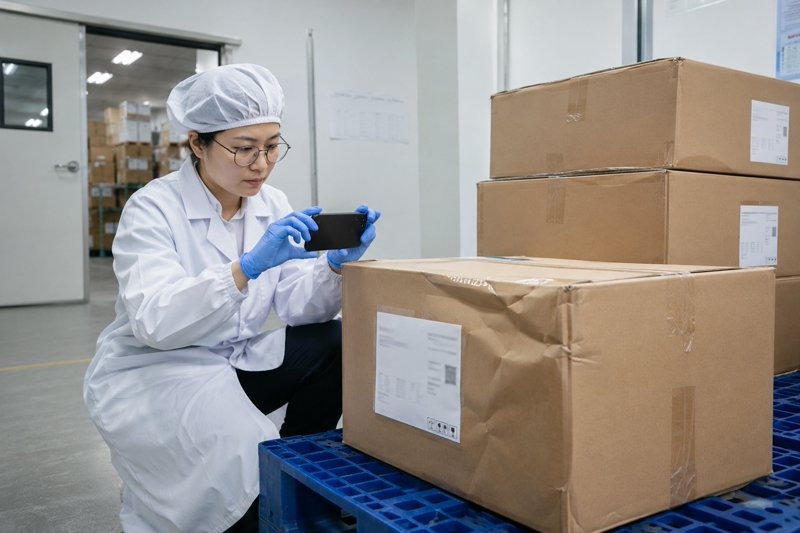
Relevant observations include:
- Crushed or deformed cartons
- Punctures or tears
- Broken outer seals
- Leakage
- Visible water exposure
- Unusual moisture
- Damaged or unreadable shipping labels
- Signs of serious mishandling
If damage is visible, photograph the unopened shipment before opening or moving it. Capture the complete shipment, shipping labels, package count, damaged areas, outer carton condition, and any visible moisture or leakage.
Record the delivery date and, where possible, the carrier reference. These records can support communication with the supplier or carrier and help distinguish transport damage from a product-quality issue.
A damaged outer carton does not automatically mean the ingredient has failed. The inner packaging may remain intact. However, the condition should be documented and evaluated before the material is accepted.
Step 2: Verify Product Identity and Delivered Quantity
Compare the received shipment with the purchase order, packing list, invoice, and supplier’s final confirmation.
Verify:
- Product name
- Product form
- Ordered quantity
- Delivered quantity
- Number of packages
- Net weight or pack size
- Package identification
- Batch or lot number
For example, if the PO specifies several individually sealed bags, the receiving record should show both the total quantity and the number of bags received. A correct total carton count does not prove that the expected number of inner packages is present.
Quantity shortages, extra packages, mixed products, or unexpected pack sizes should be recorded before the shipment is released. The receiving team should avoid altering labels or discarding packaging until the discrepancy has been reviewed.
Step 3: Check Packaging Integrity
After documenting the outer shipment, inspect the actual ingredient packages under suitable receiving conditions.
Confirm that:
- The inner package is sealed
- The closure is intact
- No powder is leaking
- There is no obvious moisture intrusion
- There is no visible foreign material or unusual contamination
- The label is readable
- The batch number is present
- The package weight or size matches the order where listed
Lumbrokinase is an enzyme-sensitive ingredient. It should be protected from prolonged exposure to heat, humidity, moisture, direct sunlight, and unsuitable storage conditions. An intact, correctly sealed inner package helps protect the powder during transport and warehouse handling.
A short temperature fluctuation does not automatically establish that the product has lost activity. If exposure is suspected, the buyer should consider the available transport information, package condition, duration of exposure, supplier guidance, and whether additional testing is appropriate.
Step 4: Match the Batch Number Across the Shipment and Documents
Batch matching is central to lumbrokinase batch verification.
Compare the batch or lot number shown on:
- The ingredient package label
- The batch COA
- The packing list or shipment record, if included
- Pre-shipment batch information
- Other batch-specific documents where applicable
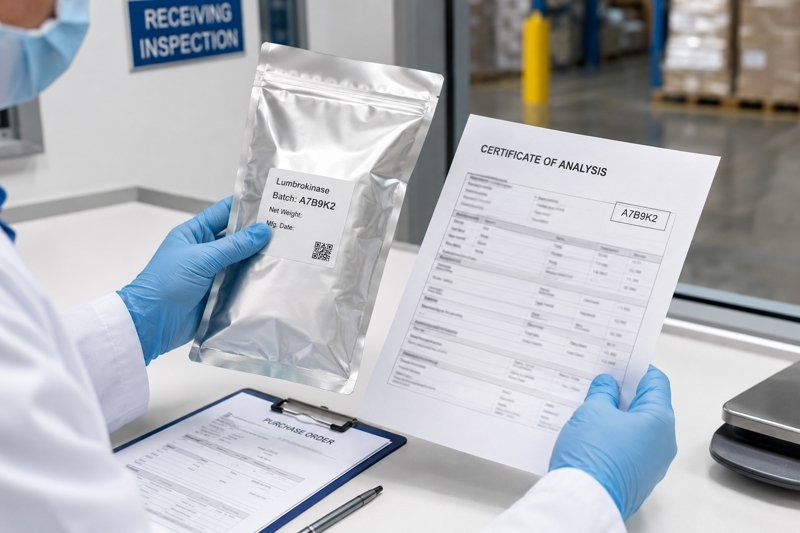
This comparison establishes batch traceability—the documented connection between the physical material and its associated quality records.
A COA should not simply be filed because it accompanied the shipment. The receiving or QA team must confirm that it applies to the batch actually delivered. An old sample COA, representative COA, or COA for another activity grade cannot establish acceptance of the received material.
For a detailed explanation of individual COA fields, see Lumbrokinase COA Review for Small Supplement Brands.
If batch identifiers do not match, place the affected material on hold and ask the supplier to clarify the discrepancy before internal release.
Step 5: Compare the Actual Batch COA With the Agreed Specification
Incoming COA verification should answer one operational question:
Does the batch that arrived meet the specification approved before ordering?
Depending on the agreed purchasing specification, the buyer may verify:
- Product identity
- Appearance
- Activity result
- Activity unit
- Assay basis
- Moisture
- Ash
- Heavy metals
- Microbiology
- Manufacturing date, if listed
- Expiry or retest date, if listed
- Other agreed quality parameters
Only parameters that apply to the actual specification and buyer’s acceptance procedure should be used. Buyers should not introduce unrelated limits from another product or supplier after delivery.
The distinction between the documents remains important:
- The Specification Sheet defines the expected or agreed requirements.
- The COA reports results for a specific tested batch.
A shipment can therefore have the correct product name and quantity but still require clarification if its batch COA does not meet the agreed specification.
Step 6: Check Sample-to-Bulk Specification Consistency
Incoming QC is where sample-to-bulk specification consistency becomes operational. The receiving team is no longer evaluating a proposed order—it is confirming the actual delivered batch.
Compare the bulk material and its documents with the approved purchasing basis, including:
- Agreed specification
- Activity grade
- Activity unit and assay basis
- Appearance, where relevant
- Packaging format
- Storage requirements
- Other written purchasing conditions
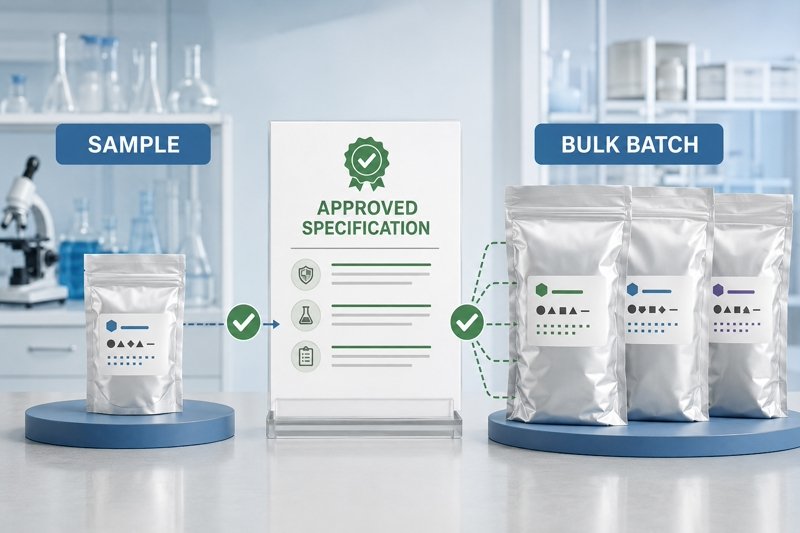
The sample batch and commercial batch may have different batch numbers. If several weeks or months passed between sample evaluation and PO placement, the original sample batch may have been allocated, sold, or replaced by a newer available batch.
Different batch numbers do not automatically indicate inconsistency. Likewise, acceptable sample and bulk COA values do not have to be numerically identical. Actual results may vary while remaining within the same approved limits.
The correct acceptance principle is:
Specification consistency, not identical batch numbers or identical numerical results.
The Lumbrokinase Batch Consistency: From Sample Testing to Bulk Order Approval guide explains the earlier purchasing stage in more detail. At receiving, the buyer should apply that approved specification to the material that has arrived.
Step 7: Decide Whether Incoming Laboratory Testing Is Needed
Not every buyer must repeat every COA test after every delivery. The appropriate incoming testing level depends on the buyer’s quality system and the risk associated with the shipment.
Factors may include:
- Internal QA requirements
- Supplier qualification status
- Intended finished-product requirements
- Previous supplier and batch history
- Whether the delivered batch is new
- Document discrepancies
- Packaging damage
- Unusual appearance
- Third-party verification requirements
Possible approaches include:
- Document-only release under an approved procedure
- Identity or appearance verification
- Selected parameter testing
- Activity testing
- Broader internal or third-party testing when required
The selected approach should be defined by the buyer rather than improvised after the shipment arrives. Incoming testing supplements document and package inspection; it does not require automatic duplication of the supplier’s entire COA.
If Activity Is Retested, Confirm the Assay Method First
When incoming activity testing is performed, compare more than the reported number. Review the activity unit together with the assay method, substrate, reference standard, sample preparation, incubation conditions, calculation method, and reporting basis.
IU/mg, FU/g, LKU, and U can represent different testing and reporting systems. They should not be converted through an assumed fixed ratio.
If a buyer’s or third-party laboratory result differs from the supplier COA, first confirm that both results refer to the same batch and examine the methods and reporting bases. A numerical difference alone does not establish that the batch has failed.
Step 8: Use a Release, Hold, or Escalate Decision
A practical receiving QC disposition can use three outcomes.
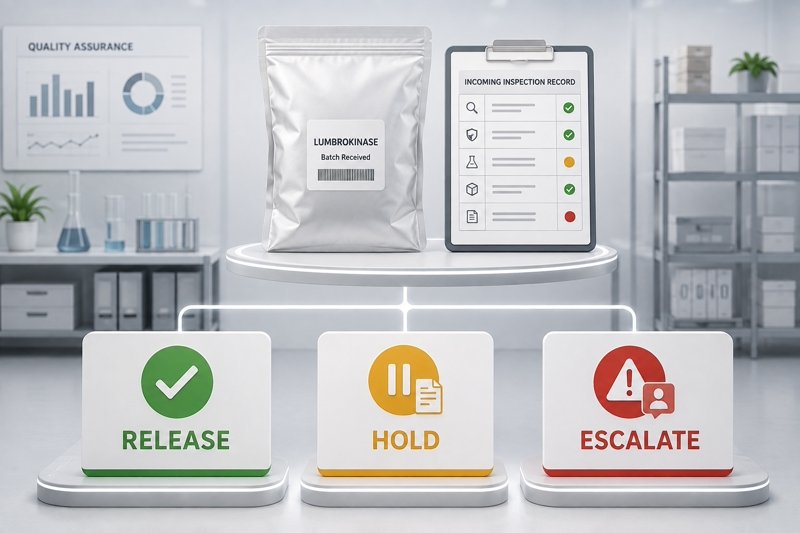
Release
Release the material when the shipment, packaging, identity, quantity, batch information, documents, and applicable specifications are acceptable under the buyer’s internal procedure.
Hold
Place the material on hold when a discrepancy requires clarification, a document is missing, or additional testing must be completed. Held material should be physically or electronically identified to prevent unintended use.
Escalate
Escalate when there is a significant product mismatch, damaged inner packaging, missing or incorrect batch documentation, suspected contamination, or an unresolved specification issue. The case may require communication with the supplier, carrier, purchasing team, or internal quality management.
Record the reason for every disposition. This model supports operational decisions but does not replace the buyer’s approved QA procedures.
Step 9: Store the Accepted Batch Correctly
After release, move the accepted batch into appropriate storage without unnecessary delay.
Keep the packaging sealed, protect it from moisture and direct sunlight, and avoid prolonged heat or humidity. Follow the supplier’s stated storage instructions and record the warehouse or storage location where required by the buyer’s traceability system.
Any opened package should be handled according to the buyer’s internal controls for resealing, identification, and remaining quantity.
Keep Incoming QC Records for Repeat Orders
Incoming records turn each shipment into useful evidence for future purchasing decisions.
Useful records may include:
- Supplier and product name
- Receiving date
- Delivered quantity
- Package count
- Batch number
- COA reference
- Packaging condition
- Inspection findings
- Additional test results
- Release or hold decision
- Deviations
- Supplier or carrier communication
- Storage location
These records allow buyers to compare future batches, identify recurring packaging or documentation issues, and support Lumbrokinase Repeat Order Approval: What Buyers Should Reconfirm Before Reordering.
Lumbrokinase Incoming Quality Control Checklist
| Checkpoint | What Buyers Should Verify | Action if There Is a Discrepancy |
|---|---|---|
| Shipment condition | Outer cartons, visible damage, water exposure, leakage, and handling condition | Photograph before opening and record carrier details |
| Package count | Received cartons and inner packages match shipping information | Record the shortage or excess and notify purchasing |
| Product identity | Product name and powder form match the PO | Segregate the shipment and confirm with the supplier |
| Quantity | Total weight and pack sizes match the order | Document the difference before acceptance |
| Packaging integrity | Inner seals, closures, bags, and containers are intact | Hold affected packages for assessment |
| Label | Product and handling information is readable | Request corrected or verified identification |
| Batch number | Label, COA, and shipment records use corresponding identifiers | Hold until traceability is clarified |
| COA match | COA belongs to the delivered batch and grade | Request the correct batch-specific COA |
| Specification match | Actual results meet the approved requirements | Review the deviation before release |
| Activity and assay basis | Result, unit, and testing basis correspond to the agreement | Clarify method differences or arrange testing |
| Sample-to-bulk consistency | Bulk batch follows the approved specification and conditions | Review the actual batch rather than relying on the sample COA |
| Storage condition | Shipment condition and supplier instructions support proper handling | Assess exposure and obtain supplier guidance |
| Additional testing | Testing follows the buyer’s approved risk-based procedure | Keep material on hold pending results |
| Release/hold decision | Final disposition and responsible reviewer are documented | Escalate unresolved or significant issues |
| Receiving record | Inspection evidence, deviations, communications, and location are retained | Complete the record before closing receipt |
Common Incoming QC Mistakes
Common errors include:
- Inspecting only the outer carton
- Failing to match the package batch number with the COA
- Assuming any supplier COA applies to the shipment
- Relying on an old sample COA instead of the bulk-batch COA
- Treating different sample and bulk batch numbers as automatic inconsistency
- Expecting identical numerical results across acceptable batches
- Retesting activity without checking the assay method
- Releasing material before resolving a document discrepancy
- Failing to photograph transport damage before opening
- Discarding labels or packaging before investigating a discrepancy
- Failing to retain receiving records for repeat-order comparison
Allworms Supply Notes
Allworms can provide a specification sheet and COA for available lumbrokinase batches. Batch information supplied for order confirmation should correspond to the actual commercial shipment, and buyers may request current packaging and storage information for their receiving procedure.
A 100 g sample may be available for qualified B2B buyers before bulk purchasing. Sample approval should still be followed by verification of the documents and specification for the actual delivered batch.
General documentation and purchasing information is available on the Allworms FAQ page.
FAQ
1. What should buyers check when a lumbrokinase bulk order arrives?
Check shipment condition, package count, identity, quantity, packaging integrity, labels, batch numbers, COA correspondence, specification compliance, activity basis, and storage instructions before release.
2. Should the COA batch number match the delivered batch?
Yes. The COA used for incoming acceptance should correspond to the batch number on the material received. A mismatch should be clarified before use.
3. Does the bulk batch need to be the same batch as the approved sample?
No. The original sample batch may no longer be available. The delivered bulk batch should meet the same agreed specification, activity grade, assay basis, packaging requirements, and purchasing conditions.
4. Should buyers retest lumbrokinase after every delivery?
Not necessarily. Testing frequency and scope depend on the buyer’s QA procedure, supplier status, batch history, intended use, document review, and identified risks.
5. What if incoming activity testing differs from the supplier COA?
Confirm batch identity and compare the assay method, substrate, standard, sample preparation, incubation conditions, calculation, unit, and reporting basis before concluding that the batch fails.
6. What should buyers do if packaging is damaged?
Photograph the unopened shipment and affected areas, inspect the inner packaging, document the damage, segregate affected material, and contact the supplier or carrier when necessary.
7. When should a received batch be placed on hold?
Use hold status when documentation is missing, batch numbers do not match, packaging requires assessment, test results are pending, or another discrepancy must be resolved before use.
8. What incoming QC records should buyers keep for repeat orders?
Keep the receiving date, quantity, package count, batch number, COA reference, packaging observations, test results, disposition, deviations, communications, and storage location.
Verify Your Lumbrokinase Shipment Before Release
Contact Allworms for the current batch COA, specification sheet, packaging details, storage guidance, and sample support
This product is supplied as a B2B ingredient. Passing incoming quality control does not establish clinical safety, therapeutic efficacy, or finished-product regulatory compliance. Final formulation suitability, dosage, labeling, health claims, and regulatory compliance should be evaluated by the buyer according to the intended market and finished-product use.