

Selecting Lumbrokinase powder for a capsule product involves more than choosing an activity number. Before formulation begins, product developers need to connect the raw-material specification and assay context with the practical requirements of blending, encapsulation, packaging and subsequent scale-up.
A sound development process reviews technical documents, tests a representative sample in the intended formula and sets criteria for pilot evaluation. It sits within Formulation Considerations When Using Lumbrokinase.
1. Start With the Intended Capsule Product Requirements
The team should define the proposed product before judging a raw material. This means translating its concept into technical screening questions, not selecting a consumer dose from supplier documents.
Useful starting questions include the intended capsule format and process, other formula components, required activity and assay information, internal acceptance criteria, expected handling conditions and the finished-product testing plan.
The finished formula target, label declaration and consumer-use instructions remain the responsibility of the product developer within its own scientific, quality and regulatory framework.
2. Review the Lumbrokinase Ingredient Specification
The raw-material specification is the first technical gate. It should clearly identify the ingredient and state the parameters against which a batch will be released. Product developers should review the proposed specification before committing time to capsule trials so that sample observations can be assessed against an agreed reference.
Allworms currently expresses its commercial Lumbrokinase activity as:
- Fibrinolytic Activity: ≥1,000,000 U/g
- Assay Method: Fibrin Plate Assay
The activity value and assay method belong together. A number without its method and calculation basis is not a complete basis for comparison. Results from different unit systems or methods are not necessarily interchangeable.
Beyond activity, the team should review identity, appearance, relevant physical information, microbiological and contaminant limits, storage conditions and shelf-life information, as applicable. The goal is to know what material is being evaluated and which specification will apply if development advances.
For the current commercial description and available technical support, see the Lumbrokinase Powder product page.
3. Evaluate Powder Characteristics Relevant to Capsule Development
A compliant material may still require formulation adjustments. An activity assay cannot answer practical powder questions.
The team should observe appearance and consistency, then assess handling under its process conditions. Relevant variables may include particle-size distribution, bulk density, flow behavior, moisture response, blend uniformity and behavior alongside other components.
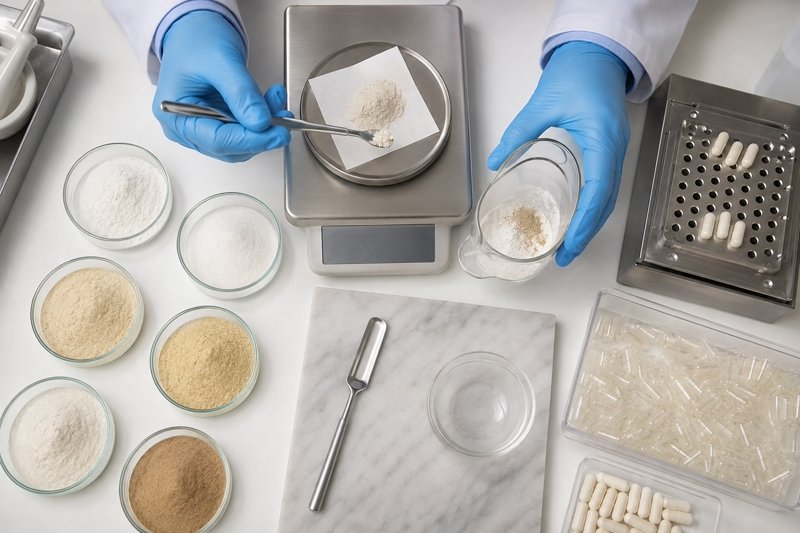
These are evaluation variables, not assumed Allworms product claims. Verified numerical values for particle size, bulk density, flowability, hygroscopicity, compressibility or excipient compatibility should not be inferred where they have not been supplied. If any variable is critical to the filling process, the buyer should measure it or request appropriate data before defining acceptance criteria.
The team should record the temperature, humidity and duration of open handling during trials, including exposure during dispensing, blending or equipment delays. Packaging development should consider the proposed distribution and storage conditions.
Compatibility with other formulation components must be tested rather than presumed. An ingredient combination that appears reasonable on paper does not establish blend performance, activity behavior or finished-product stability.
4. Connect Raw-Material Activity With the Capsule Formula
Two different quantities are involved in capsule development:
- The mass of Lumbrokinase powder introduced into the formulation.
- The fibrinolytic activity measured for the raw material under a specified assay.
They are related but not interchangeable. A raw-material activity result does not establish a clinical dose, finished-product claim or activity result for a capsule containing that material.
The product developer must establish and verify its own formula target, considering the raw-material specification, its selected inclusion level, manufacturing variation, analytical methods and regulatory requirements. Allworms’ U/g result should not be converted into FU, IU, LKU or another system without a scientifically justified common basis.
Teams comparing market conventions can use Lumbrokinase Activity Units: IU/mg, FU/g, LKU and U Explained for additional context, while keeping the capsule project anchored to its defined method and acceptance criteria.
5. Review Assay and Batch Documentation
Before formulation work, documentation should preserve traceability and support interpretation. A practical document set may include:

- The current ingredient specification sheet.
- A COA for the representative sample batch.
- Fibrinolytic activity information and the stated unit.
- Assay-method information sufficient for technical review.
- Batch identification and relevant dates.
- Storage and handling information.
- Other documents required by the developer’s procedure.
The specification defines requirements; the COA reports results for the supplied batch. The sample batch number should match the development record.
If the developer or a third-party laboratory plans to retest activity, both parties should align on the intended method, sample preparation, reporting basis and comparison criteria in advance. A result produced under a different method may answer a useful internal question, but it should not automatically be treated as a direct replication of the supplier’s COA result.
This is the documentation needed to support capsule development; it is not a substitute for the company’s full QA approval procedure.
6. Test a Representative Sample in the Intended Capsule Formulation
Specification compliance does not establish suitability for a buyer’s formula, equipment or process. That requires representative sample testing.
The sample should be evaluated in a formula and process that reflect the proposed product. The team should document dispensing, incorporation, handling or blending issues, necessary formula adjustments and performance against predefined criteria.
The test plan should be proportionate to the project. Depending on the formula and internal requirements, the team may need to examine blend behavior, capsule-filling consistency, capsule appearance, analytical sampling, packaging compatibility or other relevant quality attributes. These outcomes must be determined experimentally; no universal filling performance or excipient compatibility should be assumed.
If a problem occurs, the team should distinguish raw-material questions from formulation or process issues. Sampling, blend design, equipment settings, environmental exposure and analytical variability may all require review.
For the broader sample-stage checks that sit outside capsule processing, refer to Lumbrokinase Sample Evaluation: What B2B Buyers Should Check.
7. Move From Formulation Testing Toward Pilot Evaluation
Successful bench work is not final commercial approval. A small trial may not reproduce the blend volume, handling time, equipment behavior, sampling or exposure of a larger run.
Pilot evaluation determines whether the proposed formula and process remain workable closer to production scale. The team should carry forward the material identity, batch documents, formula version, process observations and analytical plan from bench development.
The purpose here is continuity: the pilot should test whether the working formulation can progress toward scale, not restart the project with undocumented changes. The exact pilot protocol, sample size and release plan should be established by the manufacturer and product owner according to their quality system.

8. Consider Batch Consistency Before Commercial Production
Before commercial production, the buyer should clarify which specification will govern supply and which material characteristics proved critical during development.
The development record should connect four stages:
Representative raw-material sample → Capsule formulation testing → Pilot evaluation → Commercial ingredient supply
Not every observation must become a supplier specification. However, the buyer should distinguish formal release criteria from buyer-specific process observations. If a powder variable becomes critical, the buyer should decide how it will be monitored or controlled rather than assuming every compliant batch will behave identically.
For initial or changed commercial batches, the buyer may apply appropriate incoming checks before releasing the material to production. Changes in the raw-material specification, assay basis, manufacturing information or other development-critical characteristics should trigger review under the buyer’s change-control procedure.
9. Practical Lumbrokinase Capsule Formulation Workflow
| Development Step | Buyer-Side Decision |
|---|---|
| Define capsule-product requirements | Establish the dosage-form concept, process assumptions and internal criteria. |
| Review the ingredient specification | Confirm identity, activity expression, assay method and other relevant requirements. |
| Review batch and assay documents | Ensure the representative sample is traceable and its activity result can be interpreted correctly. |
| Obtain a representative sample | Use material linked to a batch COA and the proposed commercial specification. |
| Evaluate the intended formulation | Observe handling, blend and capsule-development variables under relevant conditions. |
| Conduct appropriate testing | Compare results with the team’s predefined formulation criteria and investigate deviations. |
| Progress to pilot evaluation | Check whether bench results remain applicable at a representative scale. |
| Confirm commercial-batch expectations | Align formal specifications, critical process observations and incoming review. |
| Proceed toward formula approval | Complete the product owner’s quality, analytical and regulatory decisions. |
This workflow helps keep responsibility clear: the ingredient supplier documents the raw material, while the product developer determines the finished formula, process, testing plan, label position and regulatory suitability. Additional sourcing and technical questions are addressed on the Allworms Lumbrokinase FAQ page.
FAQ
1. What Should Formulators Check Before Using Lumbrokinase Powder in Capsules?
Review the capsule requirements, ingredient identity, activity specification, assay method, batch COA, storage information and relevant powder variables. Then test a representative sample in the proposed formulation and process.
2. Does the Activity Specification Alone Establish Capsule Suitability?
No. Activity is an important raw-material criterion, but capsule suitability also depends on documentation, handling behavior, formulation interactions, process conditions and the developer’s test results.
3. Why Does the Assay Method Matter During Capsule Ingredient Evaluation?
The method provides the context for interpreting the activity value. Results generated using different assay procedures, units or calculation bases should not automatically be compared or converted.
4. Should Lumbrokinase Be Tested With the Other Ingredients in the Intended Formula?
Yes. Compatibility and processing behavior should be evaluated in the actual proposed blend rather than assumed from the raw-material specification. The test design and acceptance criteria are the product developer’s responsibility.
5. Which Documents Should Accompany a Formulation Sample?
At minimum, developers will typically need the relevant specification sheet, a COA linked to the sample batch, activity and assay-method information, batch identification and applicable storage guidance. Additional documents depend on internal QA requirements.
6. Why Is Pilot Evaluation Useful After Successful Bench Testing?
A pilot run introduces conditions closer to manufacturing scale, including different blend volume, handling time, equipment behavior and sampling demands. It helps determine whether the bench formulation can progress toward commercial approval.
7. Can Allworms’ U/g Activity Be Directly Compared With Nattokinase FU?
No direct equivalence should be assumed. Different ingredients, assays, units and calculation systems may be involved. Comparisons require a justified common analytical basis.
8. Should Later Lumbrokinase Batches Be Reviewed After the Formula Is Approved?
Yes. Commercial batches should be checked against the agreed raw-material specification and the buyer’s incoming-control requirements. Changes affecting development-critical characteristics should be reviewed before production use.
Review The Lumbrokinase Specification And Assay Documentation For Your Capsule Project
Request a representative sample to evaluate in your intended formulation.
Review The Lumbrokinase Specification And Assay Documentation For Your Capsule Project
Request a representative sample to evaluate in your intended formulation