
What to Do When Your Lumbrokinase Test Result Differs From the Supplier COA
The supplier Certificate of Analysis reports one Lumbrokinase activity result, but your independent laboratory reports another. This numerical difference deserves attention, but it does not automatically prove that the supplier result is incorrect, the laboratory made an error or the batch has failed.
Before reaching a quality conclusion, determine whether the two results were produced from the same material using comparable assay methods, activity units, reporting bases and test conditions.
The first question should therefore be:
Are we actually comparing the same measurement?
A numerical difference is a signal to investigate. True nonconformance can only be assessed after technical comparability has been established.

Three Situations QA Must Keep Separate
A structured investigation begins by distinguishing three situations:
- Result difference: Two reports show different numerical results.
- Method or reporting difference: The results were generated or expressed differently and may not be directly comparable.
- True nonconformance: Comparable evidence indicates that the material does not meet an agreed acceptance requirement.
Moving directly from the first situation to the third can lead to an unsupported batch decision. QA should first investigate whether the discrepancy can be explained by sample identity, methodology, units, reporting basis or other controlled variables.
1. Confirm the Batch and Sample Identity
Before comparing laboratory methods, verify that both reports apply to the same material.
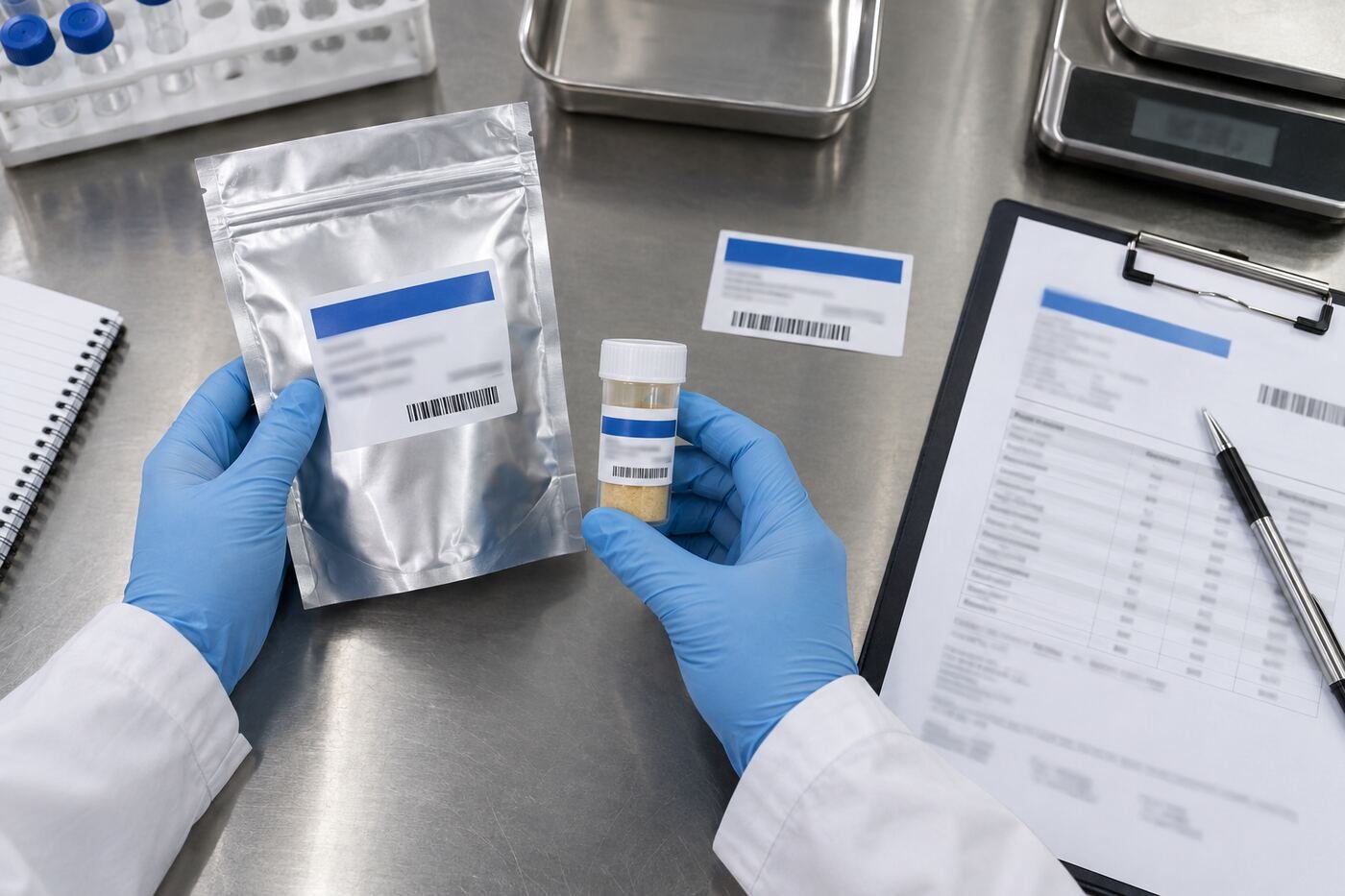
Check:
- Product name
- Supplier name
- Batch or lot number
- Batch number shown on the supplier COA
- Independent laboratory sample identification
- Sampling date, if relevant
- Container or package from which the sample was taken
- Whether the material was repacked or subdivided
- Whether the tested portion came from the commercial batch under review
A technically precise laboratory comparison has little value if the supplier tested one batch while the independent laboratory received another.
Repacking and subdivision also matter. A sample removed from its original package may have a different storage and handling history from the supplier’s retained sample. This does not establish that the material changed, but it introduces a variable that should be documented.
For current product identity, specification and documentation context, QA teams can review the Lumbrokinase Powder Supplier page.
2. Compare the Assay Methods
Once sample identity is confirmed, compare the methods used by the supplier laboratory and the independent laboratory.
Allworms currently expresses its standard commercial specification as:
- Fibrinolytic Activity: ≥1,000,000 U/g
- Assay Method: Fibrin Plate Assay
If the independent laboratory used a different assay system, its result may not measure activity on the same technical basis as the supplier COA. Even when both reports mention a fibrin-related method, QA should not assume that the procedures are identical.
Ask both laboratories to identify the method used and provide enough information to determine whether the methods are the same or sufficiently comparable. The objective is not to decide immediately which method is better. It is to understand what each result represents.
Companies can reduce this uncertainty in future testing by establishing requirements before sending the sample, as explained in How Supplement Companies Should Brief a Laboratory Before Testing Lumbrokinase.
3. Compare the Activity Units
Two activity numbers cannot be compared reliably merely because they appear under an “Activity” heading.
Lumbrokinase documents may use expressions such as:
- U/g
- U/mg
- IU/mg
- FU/g
- LKU
These units should not be treated as interchangeable. A result reported in U/g cannot automatically be converted into IU/mg, FU/g or LKU without a validated common basis for the actual methods involved.
If the supplier COA and independent report use different activity systems, do not begin by asking which number is higher. Ask:
- How is each unit defined?
- Which assay generated each result?
- What quantity of material is used as the reporting basis?
- Are the calculations based on the same measurement system?
- Has equivalence between the methods been scientifically established?
If the answer to the last question is unknown, a direct numerical comparison may not be justified. The dedicated Lumbrokinase Activity Units: IU/mg, FU/g, LKU and U Explained guide provides additional context without implying a fixed conversion.
4. Check the Sample and Reporting Basis
Even apparently similar activity units can conceal a different reporting basis.
Determine whether the results are expressed:
- Per gram of product
- Per milligram of product
- Per milligram of protein
- On an as-is basis
- On a dry basis
- On another laboratory-defined basis
For example, a result normalized to dry material may differ from a result calculated using the sample as received. A protein-basis result represents something different from activity per gram of the complete powder.
QA should not attempt to normalize the figures unless the relevant definitions, moisture information and calculation basis have been confirmed. Instead, ask each laboratory to state clearly what denominator and sample condition were used.
5. Review Sample Preparation and Test Conditions
When the method names and units appear similar, examine how the laboratories prepared and tested their samples.

Relevant troubleshooting questions may cover:
- How was the powder reconstituted or extracted?
- What dilution approach was used?
- What substrate and reagent system was applied?
- What pH conditions were used?
- At what temperature was the analysis performed?
- What incubation period was applied?
- How was the test response interpreted?
- How was the final activity calculated?
- Were any report qualifiers or limitations recorded?
These factors should be treated as investigation points, not assumed causes. Without the underlying laboratory records, QA should not state that a particular dilution, temperature or calculation step produced the discrepancy.
Lumbrokinase Discrepancy-Troubleshooting Table
| What to Compare | Key Question | Possible Significance |
|---|---|---|
| Batch/sample identity | Do both results apply to the same product, batch and representative material? | A sample mismatch prevents a valid batch comparison. |
| Assay method | Did both laboratories use the same or a demonstrably comparable method? | Different methods may generate results that cannot be compared directly. |
| Activity unit | Are both results expressed in the same defined activity system? | Similar-looking numbers may represent different measurements. |
| Reporting basis | Are results reported per gram, per milligram, on a dry basis, as-is or by protein content? | Different normalization bases can create substantial numerical differences. |
| Sample preparation | Were extraction, reconstitution and dilution procedures comparable? | Preparation differences may affect the measured response. |
| Test conditions | Were relevant reagent, pH, temperature, incubation and calculation conditions aligned? | Method conditions may influence assay output. |
| Handling/storage | Did the tested samples have comparable storage and exposure histories? | Different histories introduce variables requiring investigation. |
| Supplier COA | Does the COA identify the correct batch, activity result and assay method? | Missing or mismatched information may prevent verification. |
| Product specification | Does the independent result meet the agreed acceptance requirement? | COA disagreement and specification failure are different questions. |
| Laboratory documentation | Can both laboratories explain their methods, units and reporting bases? | Adequate information is needed to assess comparability. |
6. Review Sample Handling and Storage
If the methods, units and reporting bases appear aligned, review the history of the independent sample.
Ask whether:
- The material was stored according to the stated conditions
- The package remained properly sealed
- The powder was exposed to moisture
- The sample experienced unsuitable heat or environmental conditions
- There was prolonged handling before analysis
- The sample was opened repeatedly
- The supplier and independent tests were conducted at substantially different times
Differences in sample history do not prove that activity was lost. They identify potential variables that may need further examination.
The condition of the remaining material can also be relevant. Record whether the package seal was intact and whether there were observable changes in the powder. Such observations support the investigation but should not replace comparable activity testing.
7. Distinguish the Supplier COA From the Product Specification
A product specification and a COA perform different functions:
- Specification: Defines the agreed acceptance requirements.
- COA: Reports results for a particular batch.
QA therefore needs to answer two separate questions:
A. Does the independent result differ from the supplier COA result?
B. Does the independent result fall outside the agreed product specification?
A laboratory result can differ numerically from the supplier COA while still meeting the specification. Conversely, a result may require investigation against the specification even when the numerical difference from the COA appears small.
The magnitude of the difference alone is not sufficient. The decision depends on method comparability, defined acceptance requirements and the buyer’s quality procedures. For a focused explanation of the two documents, see Lumbrokinase COA vs Specification Sheet: What B2B Buyers Should Compare.
8. Request Information From Both Laboratories
If the discrepancy remains unexplained, request enough information to establish what each laboratory measured.
From the supplier or supplier laboratory, request:
- Test method identification
- Activity-unit definition
- Reporting basis
- Relevant method or calculation information where available
- Batch and sample identification
- Any applicable report notes
From the independent laboratory, request:
- Method identification
- Activity unit and reporting basis
- Sample-preparation approach
- Relevant test conditions
- Calculation or reporting explanation
- Report qualifiers or observations
The goal is not to force the laboratories to produce matching numbers. It is to determine whether their results can legitimately be compared.
Broader answers concerning Allworms documentation, specifications and activity testing are available on the Allworms FAQ page.
9. Decide Whether Retesting Is Justified
Retesting may be appropriate when:
- Sample or batch identity remains uncertain
- Method alignment was not established before testing
- A possible technical or reporting error requires confirmation
- A properly stored retained sample is available
- The result is near an agreed acceptance boundary
- A second test using a clearly defined comparable method is necessary
Retesting should answer a defined technical question. It should not be repeated merely until a preferred result is obtained.
Before retesting, document the method, activity unit, reporting basis, sample identity and intended acceptance decision. This makes the new result more useful than simply generating another number.
10. Determine Whether the Evidence Supports Nonconformance
The investigation may lead to several conclusions:
- The results are not directly comparable because the methods or units differ.
- A reporting-basis or normalization difference explains the numerical discrepancy.
- Sample identity, handling or storage requires further investigation.
- The information is insufficient and laboratory clarification is needed.
- Comparable retesting confirms a meaningful difference.
- Comparable evidence indicates that the material does not meet the agreed specification.
Only after comparability has been established should QA decide whether to accept the batch, request clarification, conduct additional testing, open a supplier-quality investigation or treat the material as potentially nonconforming under the buyer’s quality system.
Practical Investigation Workflow

Follow this sequence:
Confirm batch and sample identity → Compare assay methods → Compare activity units → Compare reporting bases → Review sample preparation and test conditions → Review handling and storage → Compare the independent result with the specification → Request laboratory clarification → Retest if justified → Determine whether the evidence supports true nonconformance.
This workflow replaces the unsupported assumption that a different number automatically means a failed product.
FAQ
Why can an independent Lumbrokinase result differ from the supplier COA?
Possible variables include sample identity, assay method, activity unit, reporting basis, sample preparation, test conditions and sample handling. The cause should be investigated from the available documentation rather than assumed.
Does a different result automatically mean the batch failed?
No. A different number establishes a discrepancy, not necessarily nonconformance. QA must determine whether the results are comparable and whether the independent result fails the agreed specification.
Should both laboratories use the same assay method?
Using the same defined method generally creates a clearer comparison. If different methods are used, their comparability must be established before the results are interpreted as equivalent measurements.
Can U/g and IU/mg results be compared directly?
Not automatically. They may involve different methods, unit definitions and weight bases. Direct conversion requires a scientifically validated common basis for the methods involved.
What should QA check first when the results do not match?
Start with product, batch and sample identity. Confirm that the supplier COA and independent report actually refer to the same batch and corresponding material.
Can sample storage explain a lower result?
Storage history may be a relevant variable, but a difference in storage conditions does not prove degradation. Review the evidence and use comparable testing where clarification is necessary.
When is retesting appropriate?
Retesting may be justified when sample identity, method alignment or a possible technical issue requires clarification, especially when a retained representative sample is available.
When should QA open a supplier-quality investigation?
That decision depends on the buyer’s quality system. It may be appropriate when comparable evidence indicates an unexplained meaningful difference or failure against an agreed acceptance requirement.

Review Your Lumbrokinase Test Discrepancy?
Contact Allworms to compare the COA, specification and assay information.