Earthworm Protein Powder is an earthworm-derived protein ingredient prepared from selected earthworm raw materials through controlled processing, drying, milling, and powder preparation. For B2B buyers, however, understanding what earthworm protein is requires more than reading a general product definition.
Supplement brands, nutraceutical companies, functional ingredient distributors, formulation teams, and purchasing departments must also evaluate the available protein specification, batch documentation, sample suitability, packaging, minimum order quantity, storage requirements, lead time, and international shipping arrangements.
This guide explains what Earthworm Protein Powder is from a practical sourcing perspective. It also identifies the information buyers should confirm before approving a sample, comparing suppliers, or placing a trial or bulk order.
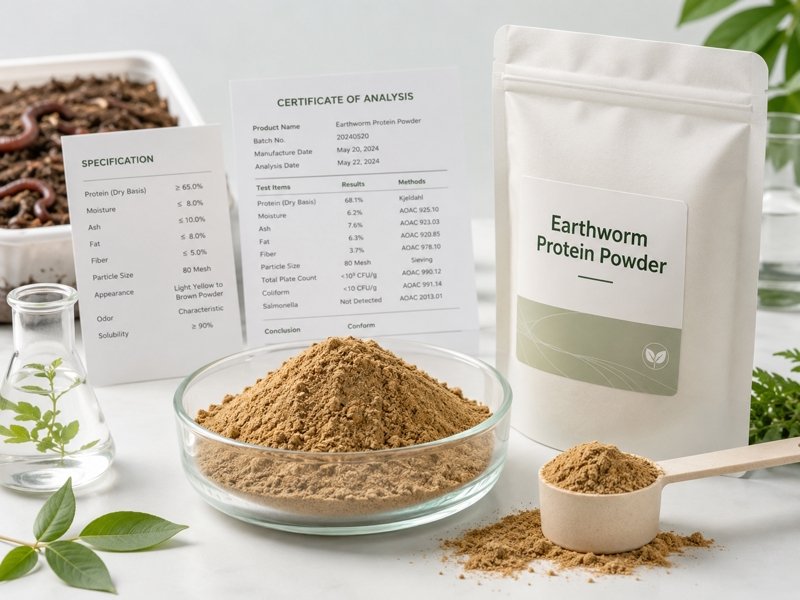
Quick Answer: What Is Earthworm Protein?
Earthworm Protein Powder is an earthworm-derived protein ingredient used for B2B dietary supplement, nutraceutical, food ingredient, animal nutrition, and formulation-development applications.
Before purchasing, buyers should review protein content, amino acid information when available, the specification sheet, batch COA, sample suitability, packaging, MOQ, storage conditions, lead time, shipping arrangements, and supplier documentation.
What Is Earthworm Protein Powder?
Earthworm Protein Powder is a protein-rich powder produced from selected earthworm raw materials through a controlled manufacturing process.
Depending on the manufacturer and product specification, processing may include raw material selection, cleaning, freezing, grinding, controlled hydrolysis, filtration, drying, pulverization, sieving, and packaging. Buyers should request the supplier’s actual process description rather than assuming that all earthworm protein powders are manufactured in the same way.
From a B2B perspective, the product should be evaluated as an ingredient rather than as a general concept. Its commercial suitability depends on measurable characteristics such as:
- Protein content
- Appearance and odor
- Moisture and ash
- Heavy metals
- Microbiological limits
- Packaging and storage
- Batch documentation
- Formulation compatibility
Buyers requiring current product information can first review the Earthworm Protein Powder product page and then request the documents for the available batch.
How Earthworm Protein Powder Differs from Other Earthworm-Derived Ingredients
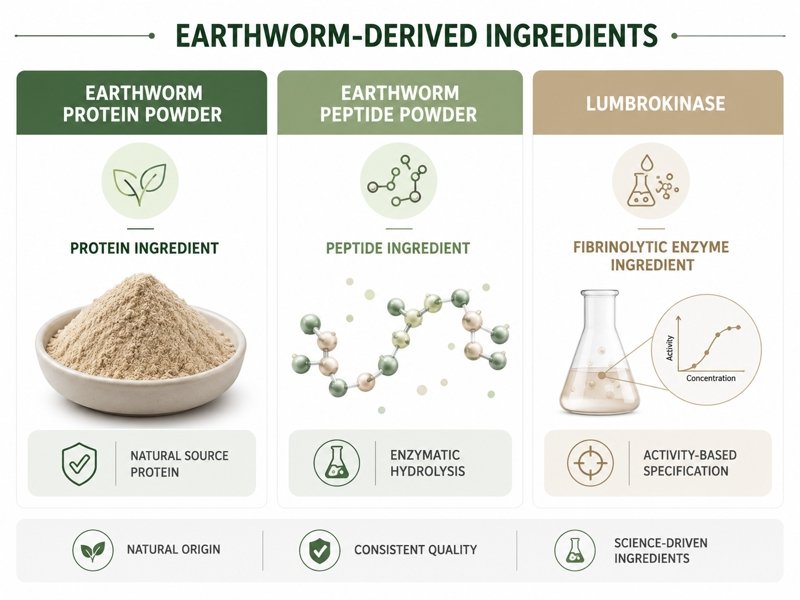
Earthworm Protein Powder should not be treated as an interchangeable name for every earthworm-derived ingredient.
Earthworm Protein Powder is positioned as a protein ingredient. Buyers normally focus on protein content, amino acid information, moisture, ash, contaminants, microbiology, and formulation suitability.
Earthworm Peptide Powder is produced through enzymatic hydrolysis, filtration, concentration, spray drying, and powder preparation. It is positioned as a peptide-rich ingredient. Although enzymes are used during processing, the finished powder is not positioned as an active enzyme ingredient.
Lumbrokinase is an earthworm-derived fibrinolytic enzyme ingredient. It is evaluated primarily through activity specification, assay method, activity units, stability, and enzyme-related quality controls.
This distinction matters when requesting quotations and samples. A request for “earthworm powder” without identifying whether the buyer needs protein, peptides, or an active enzyme can result in an unsuitable offer.
For a broader product distinction, buyers can read the Earthworm-Derived Ingredients Comparison before selecting an ingredient category.
Why B2B Buyers Source Earthworm Protein Powder
Earthworm Protein Powder may be considered when a company is evaluating differentiated animal-derived proteins or developing a specialized ingredient portfolio.
Common B2B purchasing scenarios include:
- Dietary supplement ingredient evaluation
- Nutraceutical formulation development
- Functional food research
- Alternative protein ingredient exploration
- Animal nutrition product development
- Distributor product-line expansion
- Laboratory or pilot formulation testing
- Trial production
- Small bulk purchasing
- Research-related ingredient evaluation
The intended application should be explained to the supplier early. A buyer developing capsules may have different priorities from a company testing a beverage, powder blend, nutrition bar, or animal nutrition product.
Application details also help the supplier determine which documents, packaging format, sample quantity, and specification information are relevant.
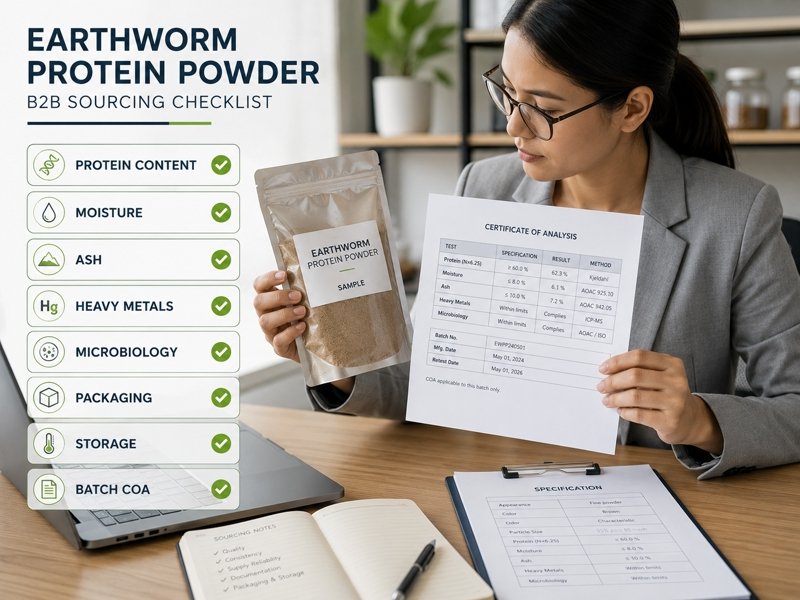
Earthworm Protein Powder Specification Items for B2B Buyers
A product name alone does not provide enough information for purchasing approval. Buyers should ask what specification is currently offered and whether the available batch is tested against that specification.
| Specification Item | What Buyers Should Check | Why It Matters |
|---|---|---|
| Protein content | Minimum specification, test result, test method, and whether the value is reported on an as-is or dry basis | Protein percentage is a primary commercial parameter, but values may not be comparable when test bases differ |
| Amino acid profile | Whether a full or partial amino acid profile is available and whether it represents a batch or general reference data | Useful for formulation review and ingredient positioning |
| Appearance | Expected color, powder condition, and acceptable batch variation | Helps buyers assess identity and physical consistency |
| Odor | Normal sensory description and whether odor control is required in the intended formulation | Earthworm-derived ingredients may require flavor-masking or formulation testing |
| Moisture | Maximum specification and actual batch result | Higher moisture may affect powder handling, storage, and product stability |
| Ash | Maximum or typical value and batch result | Provides information about total mineral residue and general composition |
| Heavy metals | Lead, arsenic, cadmium, mercury, applicable limits, and test results | Required for safety review and market-specific compliance assessment |
| Microbiology | Total plate count, yeasts and moulds, coliforms, Salmonella, and other required organisms | Important for supplier qualification and finished-product risk assessment |
| Packaging | Inner bag material, net weight, outer carton or drum, sealing method, and customization options | Affects storage, handling, sampling, and trial production |
| Storage | Temperature, humidity, light protection, resealing, and handling after opening | Helps reduce moisture exposure and avoid preventable product deterioration |
| Shelf life or retest date | Manufacturing date, expiry or retest date, and supporting storage conditions | Allows buyers to plan inventory and production |
| Available batch documentation | COA, specification sheet, batch number, manufacturing date, and available supporting reports | Confirms whether the commercial offer is supported by identifiable documents |
Protein content should not be reviewed in isolation. Two powders with similar protein percentages may differ in moisture, ash, sensory properties, microbiological quality, documentation, and processing consistency.
COA and Specification Sheet Review
A specification sheet and a Certificate of Analysis serve different purchasing functions.
The specification sheet defines the supplier’s target requirements or acceptable limits for the product. It may state the minimum protein content, appearance, moisture limit, ash limit, heavy metal limits, microbiological requirements, storage conditions, and shelf life.
The COA reports the actual test results for a specific production batch. It should normally identify the product name and batch number and may include:
- Protein content
- Moisture
- Ash
- Heavy metals
- Microbiology
- Manufacturing date
- Expiry or retest date
- Test methods where provided
Buyers should compare the COA results against the specification rather than reviewing either document alone. They should also confirm whether the COA belongs to the sample batch, the available bulk batch, or only a historical reference batch.
A more detailed document-review procedure is available in the Earthworm Protein Powder COA Review article.
Sample Evaluation Before a Bulk Purchase
A sample helps the buyer determine whether the available Earthworm Protein Powder is suitable for the intended formulation and quality system.
A practical sample assessment may include:
- Visual review of color and powder condition
- Odor evaluation
- Dispersion or solubility observation where relevant
- Review of protein content and other batch results
- Small-scale formulation testing
- Flavor-masking assessment
- Packaging and resealing observation
- Internal quality review
- Third-party laboratory testing when required
- Comparison between the sample documents and supplier specification
Sample evaluation should be based on the intended finished product. A powder that is acceptable for capsules may not behave the same way in a beverage or dry-mix formulation.
Buyers should record the sample batch number and ask whether the same batch will be available for the intended order. When the bulk batch will be different, the buyer should define which parameters require reconfirmation before shipment.
MOQ and Small Bulk Purchasing
The minimum order quantity for Earthworm Protein Powder should be confirmed early in the sourcing process.
MOQ may vary according to:
- Product specification
- Available inventory
- Standard packaging
- Sample or trial-order requirements
- Customized packaging
- Production scheduling
- Destination country
- Shipping method
Order quantity affects more than the unit quotation. It can also influence packaging configuration, document preparation, production planning, delivery schedule, and freight cost.
A useful inquiry should therefore include the expected quantity. “Please send your best price” is less effective than specifying that the buyer needs a sample, a small formulation trial, a pilot order, or a planned bulk quantity.
For Allworms orders, the standard MOQ is usually around 1.5 kg, depending on the product specification and available batch conditions.
Packaging and Storage Review
Packaging should be reviewed before purchase rather than after the order has been produced.
Buyers should ask:
- What is the standard net weight per inner bag?
- What material is used for the inner packaging?
- Is an outer carton or fiber drum provided?
- Can the packaging be adjusted for trial production?
- Is the package suitable for repeated internal sampling?
- How should opened material be resealed?
- What storage conditions are stated on the product documents?
Earthworm Protein Powder should generally be stored sealed in a cool, dry environment and protected from moisture, high humidity, direct sunlight, and unnecessary repeated opening.
For formulation teams, smaller inner packaging may reduce repeated exposure during pilot production. For distributors, larger packaging may be more efficient, but repacking procedures and contamination controls should be evaluated separately.
Buyers should avoid assuming that a sealed bulk package can be repeatedly opened without affecting handling conditions.
Lead Time and International Shipping
Lead time should be confirmed together with inventory status.
The buyer should ask whether the required specification is in stock, scheduled for production, or subject to document confirmation. The timeline may include:
- Sample preparation
- Sample dispatch
- Buyer testing
- Production scheduling
- Bulk packaging
- Document preparation
- Export handling
- International transit
- Customs or import procedures
Allworms’ standard lead time is usually 7–15 days after payment, depending on stock, specification, quantity, packaging, and production conditions.
For international orders, the buyer should provide the destination country and postal code when requesting freight information. DDP door-to-door shipping may be available for selected destinations, but availability depends on the product, quantity, destination, and current logistics conditions.
Buyers should also identify any import documents, product descriptions, labeling requirements, or consignee information required before shipment.
Supplier Questions Buyers Should Ask
A structured supplier inquiry can reduce repeated communication and make quotation comparison more meaningful.
Before approving a supplier, buyers should ask:
- What Earthworm Protein Powder specification is currently available?
- What minimum protein content is offered?
- What test method is used for protein?
- Is an amino acid profile available?
- Can you provide the current specification sheet and batch COA?
- Does the COA belong to the sample batch or available bulk batch?
- What are the moisture and ash results?
- Which heavy metals and microbiological items are tested?
- What sample support is available?
- What is the MOQ for the required specification?
- What packaging format is standard?
- Can smaller packaging be supplied for pilot production?
- What is the estimated lead time?
- What shipping methods are available for the destination?
- Can you support a small bulk order before regular purchasing?
The buyer should also explain the intended application, target market, expected quantity, testing plan, and document requirements. This allows the supplier to prepare a more relevant response.
Common Buyer Mistakes
Treating the Product as Only a General Concept
Understanding the definition of earthworm protein is not enough. Commercial approval depends on the actual specification, documents, sample, and batch.
Focusing Only on Protein Content
Protein percentage is important, but moisture, ash, amino acid information, sensory properties, heavy metals, and microbiology may also affect suitability.
Ignoring the Protein Test Basis
Buyers should ask about the test method and whether the protein result is reported on an as-is or dry basis. Values calculated on different bases should not be compared as though they are identical.
Failing to Match the COA to a Batch
A COA without a clear batch relationship provides limited purchasing value. Confirm whether it represents the sample, available inventory, or a historical batch.
Assuming Sample and Bulk Material Are Automatically Identical
The sample and commercial order may come from different batches. Buyers should establish which parameters must be reconfirmed before bulk approval.
Requesting Price Without Quantity or Destination
Quotation and shipping costs depend on quantity, packaging, destination, and delivery method.
Ignoring Odor and Formulation Compatibility
An acceptable analytical specification does not guarantee suitability in every dosage form. Sensory and small-scale formulation checks may still be necessary.
Confusing Protein Powder with Peptide Powder or Lumbrokinase
These ingredients have different positioning, manufacturing objectives, specifications, and quality-review priorities.
Relying on Unsupported Health Claims
Ingredient purchasing decisions should be based on specification, documentation, safety evaluation, formulation testing, and applicable regulations—not guaranteed medical or nutritional outcomes.
Allworms Supply Notes
Allworms is part of the manufacturer-side earthworm-derived ingredient supply system and supports overseas market development and international sales. The company operates an earthworm breeding base in Conghua, Guangzhou, and works within a production system focused on earthworm-derived ingredients.
For available Earthworm Protein Powder batches, a COA and specification sheet can be provided. Qualified B2B buyers may also discuss sample evaluation before moving to a trial or bulk order.
Sample support, MOQ, packaging, lead time, and international shipping options depend on the required specification, quantity, destination, document requirements, and available batch conditions.
For general purchasing, documentation, logistics, and product questions, buyers can also review the FAQ page before submitting an inquiry.
Buyer Checklist: Before Ordering Earthworm Protein Powder
| Purchasing Stage | Buyer Action |
|---|---|
| Product identification | Confirm that the required ingredient is Earthworm Protein Powder, not peptide powder or lumbrokinase |
| Application review | Explain the intended dosage form, formulation, target market, and development stage |
| Specification review | Confirm protein, amino acid information, moisture, ash, contaminants, microbiology, and sensory description |
| Document review | Compare the specification sheet with the batch COA |
| Sample evaluation | Record the batch number and perform relevant formulation or laboratory testing |
| Commercial preparation | Confirm quantity, MOQ, packaging, lead time, payment terms, and destination |
| Pre-shipment confirmation | Request the actual available-batch documents and verify packaging and shipping information |
FAQ
1. What is Earthworm Protein Powder?
Earthworm Protein Powder is an earthworm-derived protein ingredient produced from selected earthworm raw materials through controlled processing, drying, milling, and powder preparation. It is evaluated for B2B supplement, nutraceutical, food ingredient, animal nutrition, and formulation applications.
2. What should B2B buyers check before sourcing it?
Buyers should review protein content, test method, amino acid information where available, appearance, odor, moisture, ash, heavy metals, microbiology, COA, specification sheet, sample suitability, MOQ, packaging, storage, lead time, and shipping arrangements.
3. Is Earthworm Protein Powder the same as Earthworm Peptide Powder?
No. Earthworm Protein Powder is positioned as a protein ingredient. Earthworm Peptide Powder is produced through enzymatic hydrolysis and is positioned as a peptide-rich, non-active-enzyme ingredient.
4. Is Earthworm Protein Powder the same as lumbrokinase?
No. Lumbrokinase is an earthworm-derived fibrinolytic enzyme ingredient evaluated according to enzyme activity and assay method. Earthworm Protein Powder is evaluated mainly as a protein-rich ingredient.
5. Why should buyers review both the COA and specification sheet?
The specification sheet states the product’s target requirements, while the COA reports actual results for a specific batch. Reviewing both helps buyers determine whether the batch meets the stated requirements.
6. Can buyers request a sample before a bulk order?
Sample support may be available for qualified B2B buyers. The buyer should explain the intended application, testing requirements, destination, and expected order quantity.
7. What MOQ should buyers confirm?
Allworms’ standard MOQ is usually around 1.5 kg, depending on specification and batch conditions. Buyers should confirm the current MOQ together with packaging, quantity, and destination.
8. What documents should buyers request?
Buyers should request the current specification sheet, batch COA, product description, packaging information, storage guidance, manufacturing and expiry or retest information, and any additional test reports required for their market.

Request Earthworm Protein Powder Specifications and Batch Documents
Contact Allworms for Samples, MOQ, Lead Time and Shipping Options