
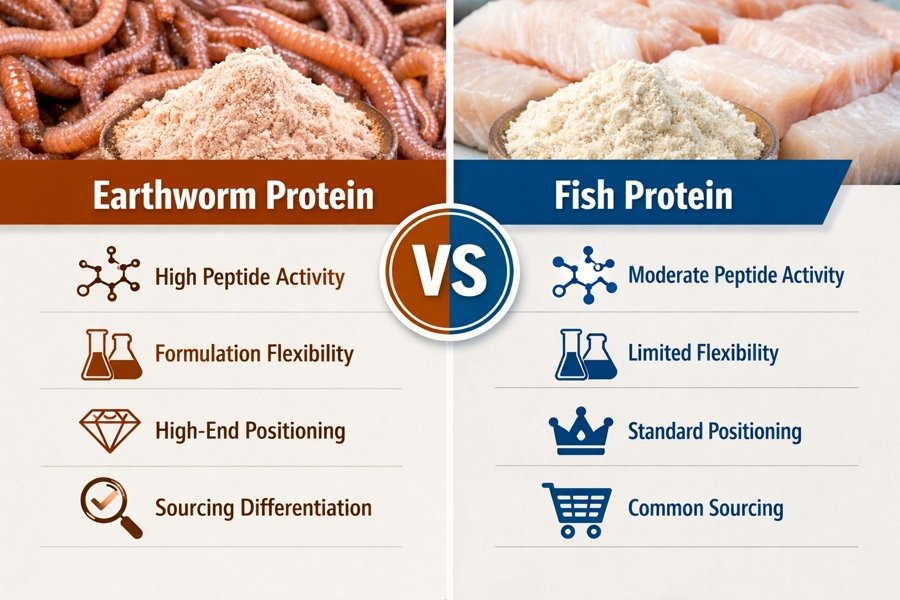
Not all protein stories are equal
For brands, “better” rarely means only higher protein on a spec sheet. It means better for the job.
That’s the whole trick, honestly.
Fish protein has a familiar halo. Buyers know it. Consumers have seen it before. It fits neatly into sports nutrition, senior nutrition, recovery products, and mainstream protein blends. Safe territory.
Earthworm protein powder is different. It is not the easy option. But easy is not always premium. Sometimes easy becomes crowded, noisy, and price-led. And that’s where earthworm protein starts to get interesting.
Research describes earthworm protein as a high-protein raw material, notes protein levels commonly around 56–66% dry weight, and even states its essential amino acid composition is better than fish, milk, and soybean meal in total essential amino acids. The same paper also frames earthworm protein as a high-quality animal-derived protein with potential in health foods.
So, which is better for B2B brands?
Here’s the real answer: fish protein is better for broad acceptance; earthworm protein powder is better for sharp differentiation.
And if you’re selling premium, differentiated, high-margin products, that distinction matters a lot.
Fish protein: the familiar workhorse
Let’s give fish protein its due first.
Fish protein is the ingredient equivalent of a well-made white shirt. It works in plenty of settings. It’s recognizable, versatile, and much easier to explain to procurement teams, formulators, and end customers.
For many brands, fish protein offers three clear advantages.
First, it is easier to commercialize. Buyers already understand the category. That lowers education cost.
Second, it often fits neatly into established product frames—protein powders, meal support, recovery beverages, healthy aging formulas, and clinical nutrition concepts.
Third, it usually carries less psychological resistance in end-user marketing. That matters more than some suppliers admit.
So yes, fish protein is often the practical choice.
But practical has a downside. It tends to compete in a crowded lane. When many ingredients sound similar, the conversation slips fast toward price, solubility, flavor masking, and minimum order quantity. Important things, sure—but not exactly the stuff premium brand dreams are made of.
Earthworm protein powder: strange at first, memorable later
Earthworm protein powder does not win because it feels conventional. It wins because it doesn’t.
That sounds contradictory, but let me explain.
Premium brands do not always need the safest ingredient story. They need the most defensible one. They need a reason buyers remember them after one trade show meeting, one supplier shortlist, one category review.
Earthworm protein has that edge.
Fish protein cannot easily copy:
Earthworm protein is described as a rich protein source, often in the 60% to 70% range, with good essential amino acid composition and potential as a new food resource in China. Research also points to value beyond basic nutrition: antioxidant peptides were identified from gastrointestinal digestion products, with several peptides showing strong activity and potential application in health foods. Another study identified seven novel ACE inhibitory peptides from earthworm protein digestion products, with two peptides showing notable activity, which supports a cardiovascular-health positioning direction. A separate study on earthworm protein autolysates also reported immunomodulatory potential in a mouse model, suggesting the category story can extend beyond simple protein replacement.
That’s the big difference.
Fish protein usually enters the room as nutrition.
Earthworm protein powder can enter as nutrition plus bioactive potential plus novelty plus premium story.
And for B2B brands, that changes everything.

So… which one is actually better?
If your brand wants mass appeal, fish protein is usually better
No need to overcomplicate it.
If your customer base is conservative, mainstream, or highly price-sensitive, fish protein is easier to move. It needs less explanation. It fits existing label language more naturally. It will likely face less consumer hesitation.
This is especially true for:
- standard protein blends
- entry-level functional foods
- conventional recovery formulas
- broad retail channels
In those cases, fish protein is the smoother sell.
If your brand wants premium positioning, earthworm protein powder is often better
Now we get to the fun part.
If your goal is to build a premium, science-led, niche-health, or innovation-driven product line, earthworm protein powder has more room to create distance from the pack.
Why?
Because premium positioning is rarely built on being the most familiar. It is built on being the most specific.
Earthworm protein can be positioned around:
- advanced peptide nutrition
- targeted health support
- emerging bioactive ingredient innovation
- cross-category use in nutraceutical, pharma-adjacent, and specialized wellness products
- sustainability conversations around alternative proteins
The ACE-inhibitory peptide work and antioxidant peptide work in the files are especially useful here, because they give the ingredient a more technical, science-backed feel than a plain protein claim would.
That matters. Premium buyers love a good story, yes—but they love a good story with a mechanism even more.
Don’t sell earthworm protein as “another protein”
That would be a mistake.
A big one.
If a supplier positions earthworm protein powder as a direct commodity substitute for fish protein, they weaken its best commercial feature. They force buyers to compare it on the wrong battlefield: price per kilo, flavor familiarity, and category comfort.
That is not where earthworm protein shines.
A smarter position is this:
Fish protein is a protein ingredient. Earthworm protein powder is a functional protein platform.
See the difference?
One is mainly nutritional. The other can be framed as nutritional, technical, and concept-driven.
That is how premium product managers think. Not just “What does it contain?” but “What kind of product architecture can I build around it?”
The premium angle buyers care about most
B2B buyers usually pretend they only care about specs. They do care about specs. Of course they do. But when they choose a premium ingredient, they are also buying three invisible assets.
1. Margin story
Premium products need more than efficacy. They need room for markup.
Earthworm protein powder gives brands a way to justify a higher-value narrative because it combines alternative protein language with peptide science and specialized wellness positioning. The antioxidant, antihypertensive-peptide, and immunomodulatory directions in the uploaded studies help create that layered value story.
Fish protein can do many things. But in brand language, it often sounds more familiar and less proprietary.
2. Shelf differentiation
A premium buyer does not want to launch the fiftieth product that sounds like the other forty-nine.
Earthworm protein powder is memorable. It sparks curiosity. It feels novel. In some markets, that’s a hurdle. In premium channels, it can be an asset—provided the messaging is calm, scientific, and clean.
Not sensational. Not weird-for-the-sake-of-weird. Just precise.
3. Innovation credibility
When a product concept includes identified peptides, digestion-derived actives, or process-based enrichment, it feels more advanced. Your files make that possible. The research does not present earthworm protein merely as bulk protein; it repeatedly links it to peptide generation through digestion or autolysis and to measurable bioactivities.
That gives formulators and sales teams something solid to talk about.
A more honest comparison table—without the table
Let’s keep it simple.
Choose fish protein when you need:
mainstream acceptance, easier flavor communication, lower education cost, and broad-category usability.
Choose earthworm protein powder when you need:
scientific differentiation, premium storytelling, peptide-focused positioning, and a stronger innovation signal.
Choose a blend strategy when you need both:
consumer familiarity from fish protein and formulation distinction from earthworm-derived peptides or protein fractions.
That last option is underrated, by the way.
A brand does not always need to pick a single hero ingredient. Sometimes the smartest move is to use fish protein as the “comfortable front door” and earthworm protein or peptide fractions as the “high-value backstory.”
That can soften resistance while keeping the premium edge.
But what about processing and supply confidence?
This part matters. A lot.
Premium buyers will not touch a differentiated ingredient unless the processing story feels controlled.
A process flow from raw earthworm selection and impurity separation to mechanical cleaning/hydrolysis, centrifugal filtration, low-temperature drying, pulverizing, sterilization, and final packaging.
That gives suppliers a far stronger narrative than vague “natural extraction” language.
And it helps answer the questions buyers always ask:
How is it cleaned?
How is it standardized?
How is microbial safety managed?
How do you preserve activity while keeping batch consistency?
Fish protein buyers ask these questions too, of course. But with earthworm protein, the need for process transparency is even higher. Which, oddly enough, can become an advantage. When you answer those concerns well, you build trust fast.
The formulation angle: where earthworm protein can punch above its weight
Here’s a subtle point that matters for premium brands.
Earthworm protein may not always win on simple “protein familiarity.” But it can win on functional architecture.
Because the category is associated with antioxidant peptides, ACE inhibitory peptides, and immunomodulatory peptides, suppliers can frame it for:
- cardiovascular support concepts
- active aging formulas
- recovery and resilience products
- high-end functional nutrition
- specialized tablets, capsules, sachets, and peptide blends
Earthworm protein peptides in innovative food applications such as health foods, drinks, protein bars, and fortified products, though those commercial claims should be used carefully and matched to regulatory rules in the target market.
That “carefully” matters. Really matters.
Premium positioning works best when claims are disciplined. Don’t overpromise. Don’t make the ingredient sound like magic dust. Buyers trust restraint.
How brands should message each ingredient
For fish protein
Keep the message clean and practical:
high-quality animal protein, digestibility, familiar category fit, broad formulation flexibility.
For earthworm protein powder
Use a more layered message:
next-generation functional protein, peptide-rich innovation, differentiated active nutrition, premium health ingredient with emerging research support.
Notice what’s missing there—hype.
That’s deliberate.
With earthworm protein, serious buyers respond better to measured confidence than dramatic claims.
A smart premium positioning formula
If you’re building a message for earthworm protein powder, this formula works well:
Alternative protein credibility + peptide science + controlled processing + niche premium application
That’s the sweet spot.
Something like this, in plain English:
Earthworm protein powder is not being positioned as a low-cost bulk protein. It is being positioned as a differentiated functional protein ingredient with peptide-generation potential, supported by emerging research in antioxidant, ACE-inhibitory, and immunomodulatory directions, and backed by controlled processing from cleaning through low-temperature drying and sterilization.
That sounds premium because it is specific.
So, what should brands do?
Here’s the practical conclusion.
If the brand wants volume, familiarity, and a shorter sales cycle, fish protein is usually the better choice.
If the brand wants distinction, premium pricing logic, and a more technical health-ingredient identity, earthworm protein powder is usually the better choice.
If the brand wants both acceptance and novelty, a dual-ingredient strategy may be the smartest route.
That’s the real answer. Not sexy, maybe. But true.
Because “better” depends on the lane you want to own.
Fish protein helps you enter the market.
Earthworm protein powder can help you stand apart in it.
FAQs
1. Is earthworm protein powder better than fish protein for premium nutraceutical brands?
For many premium nutraceutical brands, yes. Earthworm protein powder can support a more specialized positioning because it is linked to peptide-based research directions such as antioxidant, ACE-inhibitory, and immunomodulatory activity, while fish protein is usually framed more as a familiar nutrition ingredient.
2. When should a buyer choose fish protein instead of earthworm protein powder?
A buyer should usually choose fish protein when mainstream consumer acceptance, faster commercialization, and lower education cost matter more than ingredient novelty or technical differentiation.
3. Can earthworm protein powder be positioned for cardiovascular health products?
It can be positioned in that direction carefully, especially because uploaded research identified novel ACE inhibitory peptides from earthworm protein digestion products. Any final marketing language still needs to match local regulatory rules.
4. What makes earthworm protein powder attractive to ingredient distributors and wholesalers?
Its appeal comes from category differentiation, peptide-rich innovation, premium-margin potential, and a stronger technical story than many standard protein ingredients. Controlled production steps such as cleaning, filtration, low-temperature drying, sterilization, and packaging also help reassure buyers.
5. Is earthworm protein powder only for dietary supplements?
No. Based on your materials, it can also be discussed for broader functional food and health-product development, though the exact application depends on local rules, dosage form, formulation compatibility, and buyer strategy.