
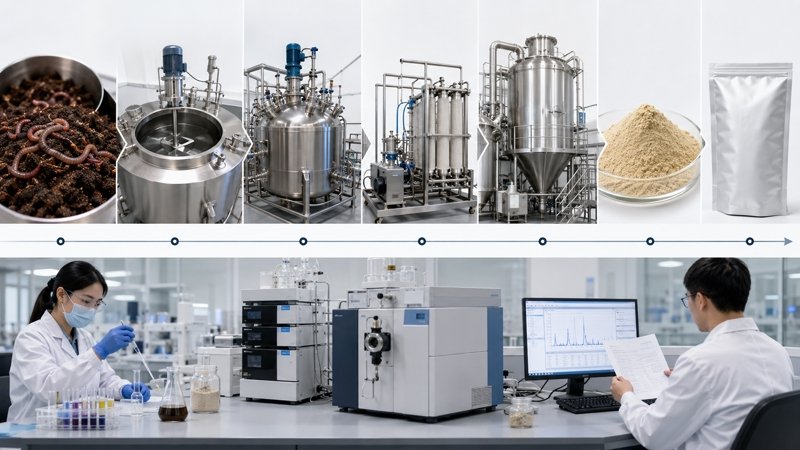
For B2B buyers, understanding earthworm peptide powder production methods is not simply a matter of learning how the ingredient is manufactured. The production route can help purchasing and QA teams assess peptide content, molecular weight-related characteristics, physical behavior, specification consistency, and the supplier’s ability to support repeat orders.
Raw material control, enzymatic hydrolysis, filtration, drying, moisture management, packaging, and batch testing are connected stages. Weak control at one stage may appear later as variation in composition, powder condition, solubility, or COA results.
Supplement brands, functional food manufacturers, contract manufacturers, and ingredient distributors should therefore connect production information with the specification sheet, current batch COA, sample results, and intended formulation. The practical question is not whether a supplier has an impressive process description, but whether that process supports acceptable and repeatable purchasing outcomes.
Quick Answer
Earthworm peptide powder production methods matter because enzymatic hydrolysis, process control, filtration, drying, and moisture management may influence peptide content, molecular weight-related characteristics, solubility, physical quality, and batch consistency. Buyers should evaluate these production-quality connections through the specification sheet, current batch COA, sample testing, formulation trials, and confirmation of the actual bulk batch rather than relying on a manufacturing description alone.
Why Production Methods Matter for B2B Buyers
Production information helps buyers understand whether a supplier can convert biological raw material into a commercially manageable ingredient with defined specifications and supporting documents.
This matters during:
- Supplier qualification and internal QA review
- Initial sample selection
- Formulation and pilot-production testing
- Comparison of competing specifications
- Repeat purchase planning
- Investigation of unexpected batch variation
- Approval of the actual bulk order
A production flowchart alone cannot prove quality. However, it can show where important characteristics are created or controlled. For example, hydrolysis is relevant to the peptide profile, filtration affects physical characteristics, drying affects the final powder condition, and packaging helps manage exposure to moisture during storage and transportation.
Buyers can review general manufacturing and supply information on the Earthworm Peptide Powder product page, then request documents for the specification and batch under consideration.
From Earthworm-Derived Protein Material to Peptide Ingredient
The basic earthworm peptide powder manufacturing process can be summarized as:
Earthworm-derived protein material → preprocessing → enzymatic hydrolysis → filtration or separation → concentration and drying → powder handling → packaging → batch testing
Preprocessing prepares the selected raw material for controlled processing. Enzymatic hydrolysis then breaks larger protein material into peptide-related fractions. Filtration or separation removes unsuitable material before the product is concentrated and dried into powder.
This process produces a peptide ingredient. Although enzymes are used during hydrolysis, the finished Earthworm Peptide Powder is not positioned as an active enzyme ingredient. It is not lumbrokinase and should not be evaluated through fibrinolytic enzyme activity grades.
Enzymatic Hydrolysis and Peptide Quality
Enzymatic hydrolysis is central to earthworm peptide powder production because it influences how the original protein material is converted into peptide-related components.
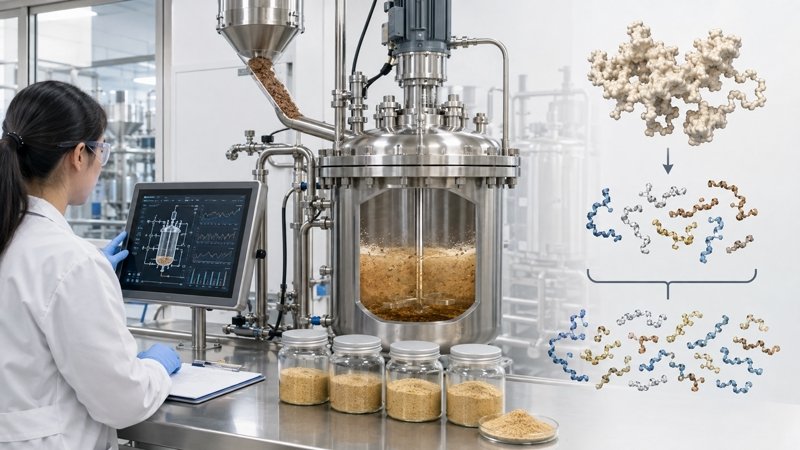
The degree of hydrolysis can be discussed as a process-control concept describing the extent to which protein structures have been broken down. Buyers do not necessarily need a supplier’s confidential enzyme formula, exact processing time, or proprietary operating parameters. They do need evidence that the process is controlled sufficiently to support the agreed product specification.
Hydrolysis-related evaluation may include:
- Peptide content
- Protein content as supporting composition information
- Molecular weight information, when required and available
- Solubility and dispersibility under the buyer’s test conditions
- Variation between production batches
Higher peptide content does not automatically mean that a powder is better for every application. Similarly, a lower molecular weight profile is not universally preferable. The suitable result depends on the formulation, testing method, labeling plan, processing conditions, and buyer acceptance criteria.
Peptide content and protein content should also be interpreted carefully. They describe related but different aspects of composition and may be tested using different methods. Buyers should confirm how each parameter is defined in the specification instead of assuming the numbers are interchangeable.
Production Control Points Buyers Should Ask About
Reasonable supplier evaluation questions include:
- What general production method is used?
- Is enzymatic hydrolysis a controlled stage of the process?
- What in-process quality controls are used?
- Is peptide content included in the product specification?
- Is protein content reported as supporting composition information?
- Can molecular weight information be provided if the application requires it?
- Are moisture, ash, heavy metals, and microbiology tested?
- Are the specification sheet and COA available before sample approval?
- How does the supplier manage batch consistency?
- What packaging and storage conditions are recommended?
- Can the COA for the actual available bulk batch be reviewed before purchase?
- What production or batch documents can be provided for supplier qualification?
These questions focus on commercially relevant evidence without requiring disclosure of confidential enzyme combinations or proprietary processing parameters. Additional general sourcing answers are available on the FAQ page.
Drying, Moisture Control, and Powder Quality
After hydrolysis and separation, the liquid material must be converted into a powder that can be packaged, shipped, stored, and used in manufacturing. Spray drying may be used for Earthworm Peptide Powder, depending on the supplier’s production system.
Drying conditions and subsequent powder handling may influence moisture level, particle condition, flow, clumping tendency, and handling during weighing or blending. These characteristics can affect operational convenience even when the main composition results meet specification.
Buyers should review moisture as a supporting quality parameter in both the specification sheet and batch COA. They should also confirm:
- Packaging material and closure
- Unit weight and outer carton arrangement
- Recommended storage conditions
- Protection from humidity after opening
- Warehouse handling requirements
- Whether partially used packages can be resealed adequately
A satisfactory moisture result at production does not eliminate the need for suitable packaging, shipping, and storage.
Filtration, Separation, and Physical Quality
Filtration or separation removes unwanted material after hydrolysis and helps prepare the liquid for concentration and drying. Depending on the raw material and process, these stages may influence clarity, uniformity, odor, visible residue, insoluble matter, and formulation behavior.
These characteristics cannot be judged reliably from the production description alone. During sample evaluation, buyers may examine:
- Color and general appearance
- Characteristic odor
- Powder uniformity
- Visible particles or agglomerates
- Behavior when mixed into the intended medium
- Sedimentation over a defined observation period
- Compatibility with other formula components
Testing should use a documented procedure. Water temperature, powder concentration, mixing sequence, agitation time, pH, and observation time can all change the result. The Earthworm Peptide Powder Sample Evaluation guide provides a broader framework for connecting physical observations with documents and formulation requirements.
Production Methods and Molecular Weight Information
Hydrolysis control can influence the characteristics of the peptide profile. Molecular weight information, when available, may help a technical team understand how the protein material has been converted and whether the profile is relevant to the intended formulation.
However, molecular weight should not become a single-pass supplier approval criterion. Buyers should consider it together with:
- Peptide and protein content
- Test method and reporting format
- Solubility or dispersibility results
- Physical sample observations
- Batch COA
- Application requirements
A supplier should not be rejected merely because it does not place a molecular weight statement on a standard COA. If this information is essential, the buyer should specify the required data, method, and acceptance approach before ordering. See Molecular Weight in Earthworm Peptide Powder: What B2B Buyers Should Know for a more detailed review.
Production Methods and Solubility or Dispersibility
Hydrolysis profile, filtration, drying, particle characteristics, moisture, and storage may all contribute to how Earthworm Peptide Powder behaves when mixed into a formulation.
Production method alone cannot guarantee complete dissolution or acceptable dispersibility. In practice, an earthworm-derived peptide powder may not dissolve completely under every test condition. Buyers should define what acceptable behavior means for their particular capsule, tablet, powder blend, or liquid-related application.
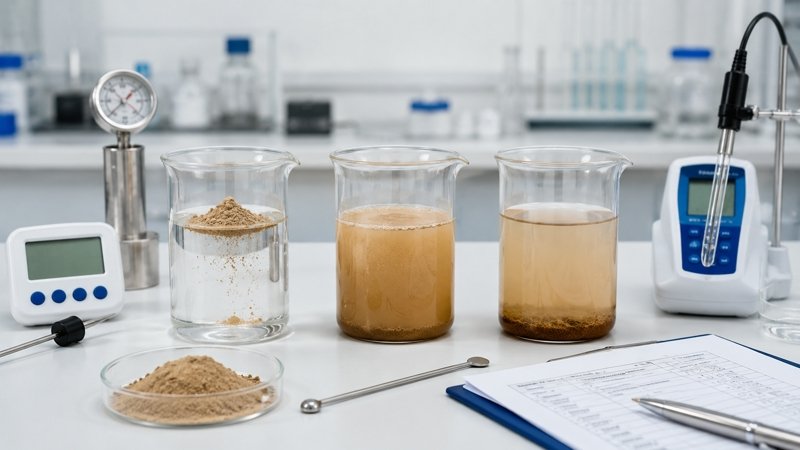
A controlled bench test should record the concentration, liquid, temperature, pH, mixing method, mixing time, visible residue, and sediment after standing. Better apparent solubility should not be interpreted as stronger biological performance or improved absorption.
For suitable testing variables, refer to Earthworm Peptide Powder Solubility and Dispersibility.
Batch Consistency and Supplier Quality Control
Controlled production should support batch consistency, but biological ingredients should not be expected to return identical numerical results in every batch.
The more useful question is whether each batch:
- Meets the agreed specification.
- Satisfies the buyer’s internal acceptance criteria.
- Has a COA linked to the supplied batch.
- Performs acceptably in the intended formulation.
- Remains within any agreed purchasing requirements.
Buyers should review peptide content, protein content, moisture, ash, heavy metals, microbiology, and molecular weight information when required and available. Physical observations and formulation performance should also be recorded.
For long-term purchasing, buyers can create a simple batch trend sheet rather than comparing only one previous COA. Recording batch number, test date, key results, appearance, odor, dispersibility, and internal disposition can reveal gradual changes while avoiding the unrealistic expectation of identical results.
From Sample Approval to Bulk Order
Sample approval is an important qualification stage, but it is not an unconditional approval of every future shipment.
The decision should connect:
- Product specification
- COA for the sample or available batch
- Internal sample test results
- Formulation suitability
- Buyer acceptance limits
- Packaging and storage requirements
- MOQ, lead time, and shipping conditions
The sample and final bulk shipment may not carry the same batch number. If there is a long interval between sample evaluation and PO placement, the original sample batch may no longer be available.
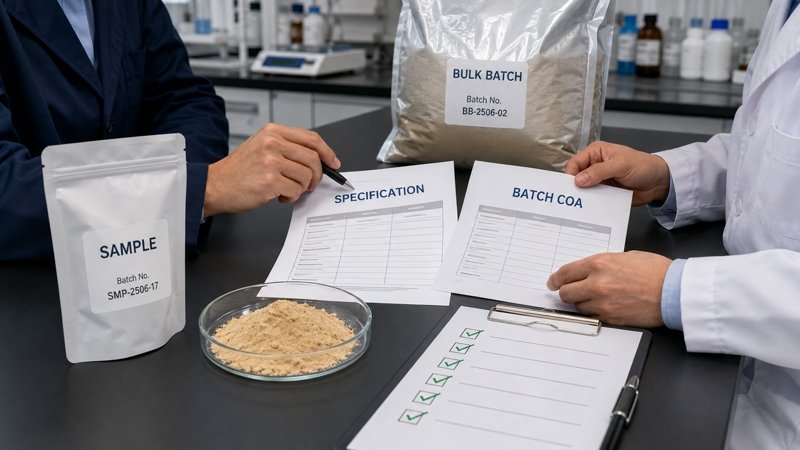
When a different batch will be supplied, the buyer should review its COA and confirm that it meets the agreed specification, documentation requirements, packaging conditions, and purchase terms. For a critical application, the buyer may also request a pre-shipment sample from the actual bulk batch when commercially practical.
Earthworm Peptide Powder Production Quality Review Checklist
| Production / Quality Area | What Buyers Should Check | Why It Matters |
|---|---|---|
| Raw material control | Source, selection controls, and traceability information | Upstream variation can affect composition and consistency |
| Enzymatic hydrolysis | Controlled use of hydrolysis and relevant in-process checks | Influences peptide-profile development |
| Peptide content | Specification, result, and test method | Supports composition and purchasing review |
| Protein content | Agreed limit and reporting basis | Provides complementary composition information |
| Molecular weight information | Availability, method, and reporting format if required | Helps characterize the hydrolysis result |
| Filtration or separation | General process stage and physical sample quality | May affect uniformity and insoluble matter |
| Drying process | General method and powder-handling controls | Relevant to the final powder condition |
| Moisture | Specification and batch result | Supports storage and clumping-risk review |
| Ash | Specification and batch result | Helps assess overall composition consistency |
| Heavy metals | Required elements, limits, and batch results | Supports safety and market review |
| Microbiology | Required organisms, counts, and limits | Important for ingredient acceptance |
| Solubility or dispersibility | Buyer test method and observed behavior | Confirms application-specific performance |
| Specification sheet | Current version and agreed acceptance limits | Defines the purchasing standard |
| Batch COA | Batch number and actual test results | Confirms the status of the supplied batch |
| Sample evaluation | Documents, physical checks, and formulation testing | Connects specification with actual use |
| Batch consistency | Compliance and trend review across batches | Supports repeat purchasing |
| Packaging | Material, closure, unit size, and labeling | Protects the powder during distribution |
| Storage | Temperature, humidity, sealing, and warehouse handling | Helps maintain the received condition |
| Bulk order confirmation | Actual batch, COA, quantity, lead time, and shipping | Reduces sample-to-bulk purchasing risk |
Common Buyer Mistakes
Common errors include:
- Asking about the production method without reviewing the COA
- Assuming enzymatic hydrolysis makes the finished powder an active enzyme
- Confusing Earthworm Peptide Powder with lumbrokinase
- Comparing suppliers only by peptide content
- Assuming lower molecular weight is always better
- Ignoring moisture, heavy metals, or microbiology
- Treating dispersibility as proof of biological performance
- Approving a bulk order only because an earlier sample passed
- Failing to review the COA for the actual available batch
- Expecting every production batch to show identical numbers
- Requesting confidential process details instead of relevant quality evidence
Allworms Supply Notes
Allworms supports overseas B2B buyers with Earthworm Peptide Powder specification review, batch COA support, sample evaluation, and bulk supply discussions. Available-batch documents can be provided for buyer review.
Buyers may discuss peptide content, molecular weight information when available, packaging, the standard MOQ of approximately 1.5 kg, usual lead time of 7–15 days after payment, and shipping options according to the intended application, order quantity, destination, and documentation requirements.
This product is supplied as a B2B ingredient. Final formulation suitability, dosage, labeling, health claims, and regulatory compliance should be evaluated by the buyer according to the intended market and finished product use.
FAQ
1. How is Earthworm Peptide Powder produced?
It is produced from earthworm-derived protein material through preprocessing, enzymatic hydrolysis, filtration or separation, concentration, drying, powder handling, packaging, and batch testing.
2. Why is enzymatic hydrolysis important?
Hydrolysis converts larger protein material into peptide-related fractions. Its control may influence peptide content, peptide-profile characteristics, and consistency.
3. Does enzymatic hydrolysis make it an active enzyme ingredient?
No. Enzymes are used during production, but the finished Earthworm Peptide Powder is positioned as a peptide ingredient, not an active enzyme product.
4. How can production affect peptide content?
Raw material composition, hydrolysis control, separation, concentration, and final powder handling may contribute to the reported composition. Buyers should verify the result through the specification and batch COA.
5. Can production affect molecular weight information?
Yes. Hydrolysis conditions may influence peptide-profile characteristics. Molecular weight data should nevertheless be reviewed with composition, test method, solubility, and application needs.
6. Can production methods affect solubility and dispersibility?
They may contribute, but test conditions and formulation components also matter. Actual sample testing is necessary, and complete dissolution should not be assumed.
7. What documents should buyers request?
Buyers should request the current specification sheet, batch COA, product information, packaging and storage guidance, and any required molecular weight or production-quality information available.
8. How should buyers review batch consistency?
Check whether each batch meets the agreed specification, review trends across COAs, and compare physical or formulation results where relevant. Exact numerical duplication is not required.
9. Is Earthworm Peptide Powder the same as lumbrokinase?
No. Earthworm Peptide Powder is a peptide ingredient. Lumbrokinase is an active fibrinolytic enzyme ingredient evaluated using enzyme activity specifications and assay methods.
10. Should buyers test a sample before placing a bulk order?
Yes. A sample can help evaluate physical quality and formulation suitability. Buyers should still review the COA for the actual bulk batch if it differs from the approved sample batch.
Request Earthworm Peptide Powder Quality Documents And Sample Support
Contact Allworms for packaging, lead time, and shipping options
One comment on “Production Methods of Earthworm Peptide Powder and Their Impact on Quality: A B2B Buyer Guide”
Comments are closed.