
Amino Acid Profile of Earthworm Protein Powder Explained
An amino-acid report may appear straightforward: it lists individual amino acids followed by numerical results. For an R&D or formulation team, however, interpreting those numbers requires more than identifying the highest and lowest values.
Units, reporting basis, sample identity, test context, and protein content can all affect how the results should be understood. Without this information, two apparently different amino-acid profiles may not be directly comparable.
Amino-acid data can support the technical evaluation of Earthworm Protein Powder, but it should be treated as one part of ingredient characterization—not as a complete measure of quality or formulation suitability. Buyers beginning their review can consult the Earthworm Protein Powder product page for current product and supply information.

Quick Answer: What Does an Earthworm Protein Amino Acid Profile Tell Buyers?
An amino-acid profile describes the individual amino acids identified or quantified in a protein-containing sample. Depending on the report, the results may be expressed per 100 grams of material, in milligrams per gram, as percentages, or on another defined basis.
For technical buyers, the profile may help:
- Characterize the composition of the tested material
- Compare candidate protein ingredients
- Review differences between samples or suppliers
- Support internal R&D documentation
- Determine whether the composition is relevant to a formulation objective
The profile does not independently establish overall ingredient quality, regulatory suitability, physical powder performance, bioavailability, or finished-product efficacy.
Why R&D Teams Review Amino-Acid Data
Protein content provides a broad measurement of the amount of protein present. Amino-acid analysis offers a more detailed view of the individual amino acids represented in the sample.
R&D teams may use this information when they need to document the composition of an unfamiliar protein ingredient or compare it with another candidate material. The data may also help them identify whether two samples have broadly similar compositional patterns.
This review should begin with a defined technical question. Is the team characterizing the ingredient, comparing alternative materials, documenting a proposed formula, or investigating a difference between samples? The intended use determines which parts of the report deserve the most attention.
Amino-acid composition may also be relevant when assessing possible product formats, but it does not define all potential applications. For broader application context, see How Is Earthworm Protein Used in the Health Industry?.
How to Read an Earthworm Protein Powder Amino-Acid Profile
Start by confirming what material was tested. The report should identify the sample as Earthworm Protein Powder and, where applicable, connect it to a batch or sample number.
Next, review the report systematically:
- Identify every amino acid listed.
- Record the result and unit exactly as reported.
- determine whether the values use an as-is or dry basis.
- Check whether the laboratory provides method or calculation information.
- Confirm whether the report represents an actual batch or reference data.
- Review the protein-content result separately.
- Compare values only after confirming that the analytical bases are compatible.
Essential and non-essential amino acids may be grouped separately in some reports. These categories can make a long table easier to navigate, but they do not change the need to verify the analytical context.
Do not add values from an unverified source to fill gaps in the table. A blank, untested, or unreported result should remain distinct from a value reported as zero or below a laboratory’s detection or quantification limit.
Check the Units and Reporting Basis Before Comparing Results
The reporting basis is one of the most important parts of amino-acid data interpretation.

Results might be expressed as:
- Grams per 100 grams of material
- Milligrams per gram
- Percentage
- Grams per 100 grams of protein
- Dry-basis values
- As-is values
- Another laboratory-defined basis
These expressions do not necessarily describe the same denominator. For example, a result calculated per 100 grams of finished powder should not be compared directly with a result calculated per 100 grams of protein.
Moisture also matters. A dry-basis result mathematically excludes the sample’s moisture, while an as-is result describes the material in its tested condition. The numerical values can therefore differ even if the underlying samples have similar composition.
Before comparing reports, buyers should confirm:
- Whether the units match
- Whether the denominator matches
- Whether both results use the same moisture basis
- Whether any conversion has been performed
- Whether the laboratory explains rounding or calculation conventions
If conversion is necessary, the required information and formula should be documented. Buyers should not assume that two percentages or two similarly formatted tables use an identical calculation basis.
Test Method Context Matters
Amino-acid analysis commonly involves sample preparation, separation, measurement, and laboratory-specific calculation and reporting procedures. Differences in analytical treatment can affect how particular amino acids are recovered, distinguished, or reported.
A buyer does not always need a full laboratory protocol, but should request enough context to determine whether a comparison is reasonable. Useful information may include the named test method, the reporting convention, and relevant explanatory notes supplied by the laboratory.
If two reports were produced using different methods, differences in individual results should not automatically be treated as evidence of a material-quality problem. The buyer may first need clarification from the laboratories or supplier.
No specific instrument, hydrolysis condition, laboratory standard, detection limit, or calculation procedure should be attributed to an Allworms amino-acid report unless that information appears in the verified document.
Protein Content and Amino-Acid Profile Are Not the Same Measurement
Protein content and amino-acid profile answer different analytical questions.
Protein testing provides an overall protein result according to the method used. Amino-acid analysis reports separate values for identified or quantified amino acids. One result should not be treated as a substitute for the other.
Adding all reported amino-acid values may not reproduce the declared protein percentage. Possible reasons include differences in methods, reporting bases, sample preparation, moisture correction, amino acids included in the calculation, and laboratory conventions.
The appropriate review is therefore not simply:
Do the amino-acid values add up to the protein result?
Instead, buyers should ask:
- What does each test measure?
- Are both results expressed on the same basis?
- Were they generated from the same sample?
- Does the laboratory define how totals were calculated?
- Is the apparent difference technically significant?
How Should Buyers Compare Amino-Acid Profiles Between Ingredients or Suppliers?

A valid comparison requires more than placing two tables side by side. Before interpreting individual differences, confirm:
- The materials are the same ingredient type
- The samples are adequately identified
- Units and reporting bases match
- Dry-basis and as-is results are not mixed
- Analytical methods or contexts are reasonably comparable
- Protein-content context is available where relevant
- Both documents represent comparable types of data
- The comparison relates to the intended formulation objective
A larger value for one amino acid does not automatically indicate better raw-material quality. It also does not establish better absorption, processing behavior, or finished-product performance.
If reports use incompatible bases, the buyer should request clarified or normalized data rather than rank suppliers using the original numbers.
Batch Data vs General Reference Information
Amino-acid information may represent:
- An identified commercial batch
- A representative historical batch
- General product information
- A technical literature reference
These document types serve different purposes.
Batch-specific data describes the tested sample only. Representative data may help with preliminary characterization, but it does not guarantee that every future batch will produce identical values. Literature data may provide background context, yet it should not be presented as the result of a supplier’s commercial material.
When amino-acid data will influence ingredient approval, buyers should identify the document type and decide whether their procedure requires batch-specific testing. Guidance on reviewing batch documentation is available in the Earthworm Protein Powder COA Review Guide.
How Amino-Acid Data Supports Formulation Evaluation
An amino-acid profile may support ingredient characterization, formula documentation, candidate-material comparison, and an internal nutritional or compositional assessment where relevant.
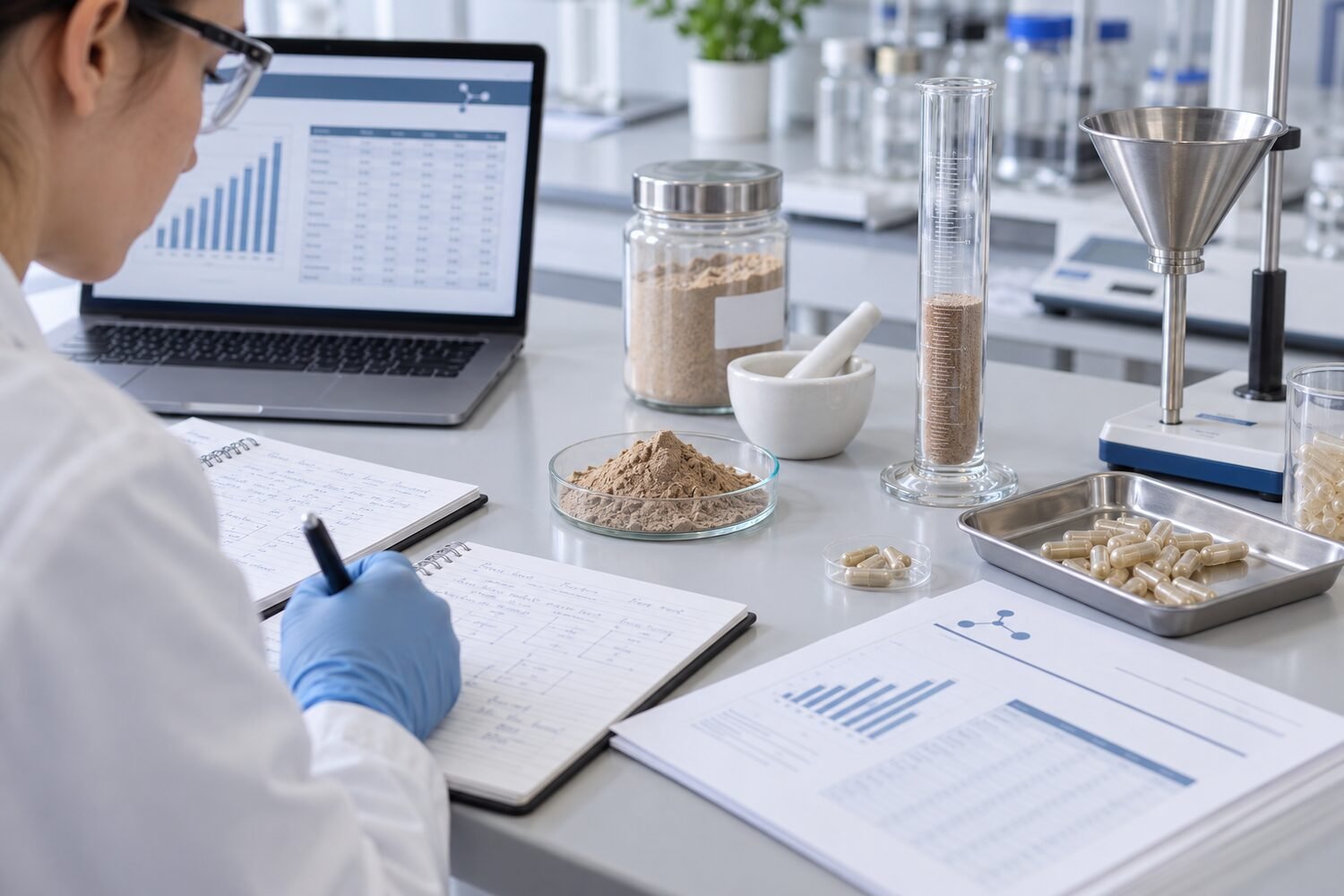
It does not predict how the powder will behave during manufacturing. Amino-acid results do not establish:
- Powder flow
- Bulk density
- Compressibility
- Capsule-filling consistency
- Tablet performance
- Sensory acceptability
- Compatibility with other ingredients
- Finished-product stability
These properties require separate document review and practical testing. Teams developing solid dosage forms should use the dedicated Earthworm Protein Powder for Capsule and Tablet Formulations guide rather than attempting to infer physical performance from amino-acid composition.
What an Amino-Acid Profile Cannot Tell You
An amino-acid profile alone cannot establish:
- Overall ingredient quality
- Conformity with the complete product specification
- Microbiological acceptability
- Heavy-metal compliance
- Shelf life or storage stability
- Supplier reliability
- Clinical efficacy
- Digestibility or bioavailability
- Suitability for a particular finished product
The profile should be reviewed alongside the specification, protein result, routine safety and quality parameters, physical-property information, batch documentation, and formulation-test results required by the buyer.
A Practical Amino-Acid Data Review Checklist
| Review Item | What to Check | Why It Matters |
|---|---|---|
| Sample/batch identity | Product name, sample code, and batch number | Connects the data to the material being evaluated |
| Amino-acid name | Exact name and any grouping used | Prevents incorrect matching between reports |
| Reported value | Result, qualifier, and rounding | Preserves the laboratory’s actual finding |
| Unit | g/100 g, mg/g, percentage, or other unit | Determines how the number should be read |
| Reporting basis | As-is, dry basis, per material, or per protein | Establishes whether comparisons are valid |
| Test method/context | Method name and laboratory notes, if available | Helps explain methodological differences |
| Protein-content context | Protein result, basis, and sample identity | Supports interpretation without equating the tests |
| Comparison basis | Same ingredient, units, basis, and data type | Prevents misleading supplier rankings |
| Intended formulation use | The R&D question the data must support | Keeps the analysis relevant to the decision |
Questions R&D Teams Should Ask
Before approving amino-acid information for internal use, ask:
- Does this report apply to the sample or batch under evaluation?
- What unit and denominator are used?
- Are the values reported as-is or on a dry basis?
- Is the analytical method or test context identified?
- Are unreported, zero, and below-limit results clearly distinguished?
- Is the protein result based on the same sample?
- Is the data batch-specific, representative, or literature-based?
- Can competing reports be compared without conversion?
- What additional physical or formulation testing is still required?
For general questions about available specifications, documents, samples, and product evaluation, consult the Allworms FAQ page.
FAQ
1. What does an Earthworm Protein Powder amino-acid profile show?
It shows the individual amino acids identified or quantified in a tested sample and their reported values. The units, reporting basis, sample identity, and analytical context are required to interpret those values correctly.
2. Is an amino-acid profile the same as protein content?
No. Protein content reports an overall protein measurement, while an amino-acid profile reports individual amino acids. The two tests provide related but different compositional information.
3. Can reports from two suppliers be compared directly?
Only when the materials, units, reporting bases, sample types, and analytical contexts are sufficiently comparable. If these conditions differ, the original numerical values may require clarification or valid normalization.
4. Why does the reporting basis matter?
The basis defines what quantity the result refers to. A value per 100 grams of powder is not equivalent to a value per 100 grams of protein, and an as-is result may differ from a dry-basis result.
5. Should buyers request batch-specific amino-acid data?
That depends on their approval procedure and how the data will be used. Batch-specific results may be appropriate when amino-acid composition is part of the material-approval criteria. General reference data may be sufficient for an early review but should be identified as such.
6. Does a higher individual amino-acid value indicate better quality?
Not by itself. Its relevance depends on the formulation objective, reporting basis, test context, and other quality information. A higher result does not independently establish superior quality or performance.
7. Can an amino-acid profile determine capsule or tablet suitability?
No. It does not establish flow, density, compressibility, filling behavior, tablet performance, sensory characteristics, or stability. Those properties require separate formulation evaluation.
8. What else should R&D teams review?
Teams may also need protein content, physical characteristics, moisture, ash, heavy metals, microbiology, storage information, batch documentation, and application-specific test results.
Conclusion
An Earthworm Protein Powder amino-acid profile can provide valuable compositional information, but its numerical values must be read within their analytical context. Units, reporting basis, method information, and sample identity should be confirmed before comparing ingredients or suppliers.
Amino-acid data is one component of ingredient characterization. Final formulation approval should also consider the broader technical documentation and practical performance information required for the intended product.
Review our Earthworm Protein Powder technical information?
Discuss your sample and document requirements with Allworms.