
Earthworm Protein Powder for Capsule and Tablet Formulations: What Developers Should Evaluate

A developer considering Earthworm Protein Powder for a capsule or tablet needs more information than protein content alone. An analytical specification may establish whether the material meets defined chemical and microbiological requirements, but it does not show how the powder will flow, blend, fill a capsule or respond to tablet compression.
These practical characteristics can affect capsule-size selection, excipient requirements, equipment performance and consistency during manufacturing. They may also influence the appearance and sensory profile of the finished product.
Before approving Earthworm Protein Powder for solid dosage development, formulators should therefore evaluate the actual material in the intended formula and process. Any physical property not supported by current data—including bulk density, particle-size distribution, flowability or compressibility—should be measured rather than assumed.
Quick Answer: Is Earthworm Protein Powder Suitable for Capsules and Tablets?
Earthworm Protein Powder may be evaluated for capsule and tablet formulations, but suitability cannot be confirmed from the product name or protein value alone.
Approval should be based on the requirements of the intended product, including target fill quantity, dosage-form dimensions, other ingredients, manufacturing equipment and finished-product expectations. The evaluation normally progresses from document review to sample testing, bench formulation and, where appropriate, a pilot batch.
Capsules and tablets may both be potential formats, but they present different technical questions. A powder that can be filled into a capsule does not necessarily have the compressibility or blend properties required for a robust tablet.
For a broader discussion of potential commercial formats, see How Is Earthworm Protein Used in the Health Industry?. The present article focuses only on the next question: whether a particular powder works in a specific capsule or tablet formulation.
Why Solid Dosage Formulation Requires More Than a COA
A Certificate of Analysis normally reports whether a batch meets selected analytical requirements. Depending on the applicable specification, these may include protein, moisture, ash, heavy metals, microbiological parameters and appearance.
These results are important, but they do not fully describe manufacturing behavior. A conforming ingredient may still:
- Occupy more capsule volume than anticipated
- Flow inconsistently through a hopper or feeder
- Segregate from other ingredients during blending or transfer
- Form agglomerates under particular humidity conditions
- Produce an unacceptable color or odor in the finished product
- Require additional formulation work before tablet compression
Analytical conformity and formulation suitability are therefore connected but separate approval questions. The COA helps establish batch quality against defined limits; formulation trials show whether the ingredient is compatible with the proposed product and process.
Physical Characteristics Developers Should Evaluate
Physical assessment should begin with direct examination of a representative sample. Developers should record its color, odor, texture, visible uniformity and any tendency to form lumps or agglomerates.
These observations should be made systematically. “Powder-like” is not a sufficiently precise description for formulation development. The team should note whether the sample appears fine or coarse, loose or cohesive, uniform or variable. If particle characteristics are important to the formula, they should be measured using an appropriate method rather than estimated visually.
Moisture also deserves attention from a processing perspective. Moisture level may influence cohesion, caking, flow, compatibility with moisture-sensitive ingredients and behavior during storage or transfer. A reported moisture result does not automatically predict performance under the humidity conditions of the development laboratory or manufacturing facility.
Developers should also observe how the material behaves during weighing, scooping, sieving and transfer. Dust generation, adhesion to contact surfaces, agglomeration and incomplete discharge from containers can all become relevant when the process moves beyond a small laboratory sample.
Why Bulk Density Matters for Capsule Development
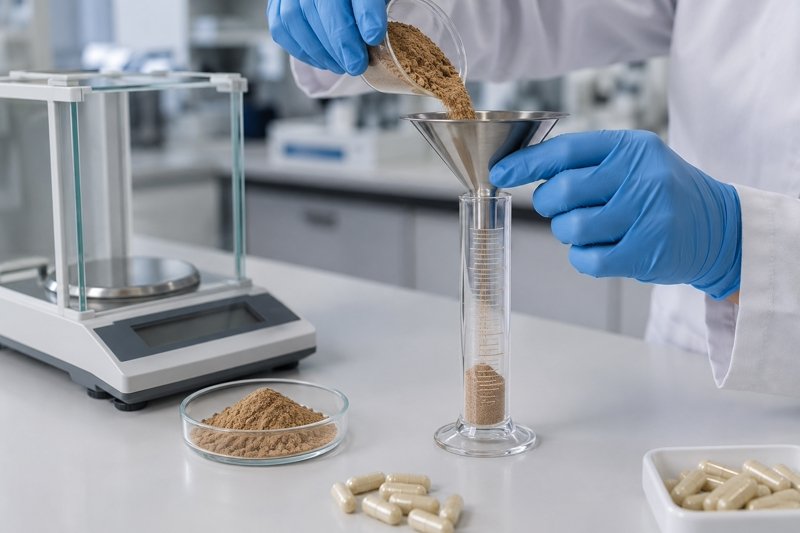
Bulk density connects ingredient weight to the volume it occupies. That relationship is especially important when developing a capsule.
A target ingredient quantity may not fit into the initially selected capsule if the powder occupies a relatively large volume. Conversely, a denser material may use less capsule volume but still require formulation work to achieve consistent filling and acceptable blend behavior.
Bulk density can therefore influence:
- Preliminary capsule-size selection
- Available space for other ingredients and excipients
- The number of capsules required by the product design
- Filling-machine setup
- Expected fill-volume variation
- Feasibility of the proposed formula
Tapped density may also be useful when the development team needs to understand how the powder consolidates under movement or vibration.
Allworms should not provide a bulk-density value unless it has been measured for the relevant material using a defined procedure. When verified data are unavailable, the formulator should request a representative sample and measure bulk and, if relevant, tapped density under documented conditions.
Capsule size should be finalized only after evaluating the complete blend. The density of Earthworm Protein Powder alone may differ from the density and filling behavior of the finished formulation.
Powder Flow, Blending and Capsule-Filling Performance
Reliable capsule filling depends on more than nominal capsule volume. The powder or finished blend must move through the selected equipment with sufficient consistency to support the intended fill-weight controls.
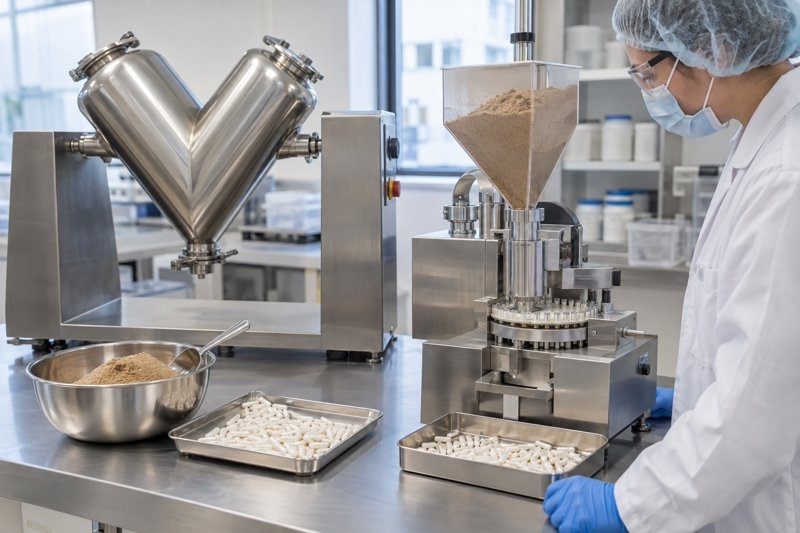
During development, formulators should examine:
- Flow from the storage or feed container
- Transfer through funnels, hoppers or feeding systems
- Adhesion to equipment surfaces
- Formation or breakup of agglomerates
- Distribution within the finished blend
- Fill-weight variation during a representative run
- Material remaining in the equipment after filling
If Earthworm Protein Powder is combined with ingredients that differ substantially in particle size or density, segregation may occur during blending, transport or vibration. Blend uniformity should therefore be tested using the actual formula and a sampling plan appropriate to the development stage.
Flow agents or other excipients may be considered as part of formulation development, but their selection and quantity should be established experimentally. There is no universal excipient system that can be recommended for every Earthworm Protein Powder capsule formulation.
What Changes When the Product Is Developed as a Tablet?
Tablet development introduces additional requirements beyond moving a powder consistently into a capsule shell.
The full blend must form tablets with acceptable physical integrity and performance. Earthworm Protein Powder should not be assumed to possess adequate compressibility or compactability without testing. The formulator may need to evaluate the contribution of binders, fillers, disintegrants, lubricants and other processing aids.
Relevant development observations include:
- Blend feeding and die filling
- Powder response to compression
- Tablet weight consistency
- Evidence of sticking, picking or capping
- Tablet hardness and friability
- Disintegration performance
- Lubricant sensitivity
- Appearance after compression
- Performance under the proposed coating process, if applicable
These characteristics belong to the finished tablet formulation rather than to Earthworm Protein Powder alone. Results can change when ingredient proportions, excipients, tooling, compression force, equipment speed or environmental conditions change.
A successful capsule trial consequently cannot serve as evidence of tablet suitability. Tablet approval requires its own formulation and process evaluation.
Sensory Properties and Finished-Product Design
Color and odor may matter even when consumers do not directly taste the powder. Earthworm Protein Powder can have an ingredient-specific appearance and odor, and developers should assess the current sample rather than assume that these characteristics are neutral.
Color may affect the visual appearance of an uncoated tablet or become visible through a transparent or lightly colored capsule shell. Odor may become noticeable when a bottle is opened, particularly if the product contains a relatively large quantity of powder or is packaged with other characteristic ingredients.
The sensory evaluation may influence:
- Capsule shell color and opacity
- Tablet coating decisions
- Selection of compatible accompanying ingredients
- Packaging configuration
- Finished-product sensory acceptance criteria
- Labeling and product-positioning decisions
Masking performance should not be promised before testing. A coating, opaque capsule or additional ingredient may reduce sensory exposure, but its effectiveness depends on the complete product design.
Excipient and Formula Compatibility
Passing an analytical specification does not demonstrate compatibility with every formulation component.
Developers may need to examine Earthworm Protein Powder alongside fillers, binders, flow agents, lubricants, disintegrants and other active or nutritional ingredients. The evaluation should consider both immediate processing behavior and changes observed during the planned development period.
Potential incompatibility may appear as:
- Increased agglomeration or reduced flow
- Separation within the blend
- Changes in color or odor
- Adhesion to filling or compression equipment
- Poor tablet integrity
- Altered disintegration behavior
- Greater sensitivity to environmental moisture
The most relevant test is not whether Earthworm Protein Powder behaves well in isolation, but whether the complete formula performs acceptably under the intended manufacturing and packaging conditions.
Sample Testing Before Formulation Approval
Dosage-form-specific sample testing should reproduce the intended use as closely as practical. The development team can begin by recording appearance and odor, measuring density where required and examining handling during weighing, transfer and blending.
For a capsule project, testing should then move into preliminary capsule-size calculations, preparation of the complete blend and a filling trial. For a tablet project, the team should evaluate blend feeding and experimental compression using the planned excipient system.
Results should be recorded against project-specific acceptance criteria. A general “sample approved” note provides little support if the formulation later encounters flow or scale-up problems.
For broader guidance covering sample identity, documentation and sample-to-bulk approval, consult Earthworm Protein Powder Sample Evaluation: What B2B Buyers Should Check.
From Bench Trial to Pilot Production
A bench trial helps identify obvious compatibility issues, but small-scale manual handling may conceal problems that emerge on production equipment.
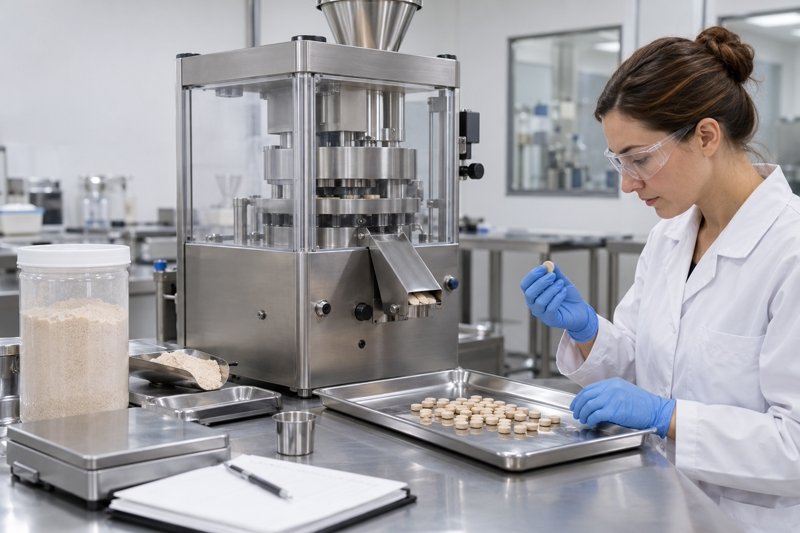
A practical development sequence is:
Ingredient review → Sample evaluation → Bench formulation → Pilot batch → Production review → Commercial approval
The pilot stage should use equipment and environmental conditions that reasonably represent the intended manufacturing process. The team should monitor powder transfer, blend uniformity, equipment feeding, capsule fill variation or tablet compression behavior, process interruptions and material loss.
The pilot batch should also produce enough finished units for the applicable physical, analytical and stability-related evaluations. A successful laboratory trial supports progression to this stage; it does not guarantee commercial-scale performance.
Once processing conditions have been established, relevant ingredient characteristics should be monitored across future lots. The purpose is not to demand identical numerical results from every natural-material batch, but to prevent changes that could disrupt an approved process. Further guidance is available in Earthworm Protein Powder Batch Consistency: What Buyers Should Check.
A Practical Capsule and Tablet Evaluation Checklist
| Evaluation area | Why it matters | What the developer should verify |
|---|---|---|
| Analytical specification | Establishes basic ingredient requirements | Current specification and relevant batch results |
| Appearance and odor | Can affect shell, coating and product acceptance | Actual sample characteristics and acceptable limits |
| Moisture | May influence handling, caking and compatibility | Batch result and behavior under processing conditions |
| Bulk and tapped density | Connects powder weight, volume and consolidation | Measured data for the relevant sample or blend |
| Powder flow | Affects transfer, feeding and filling consistency | Behavior in the intended equipment |
| Blend behavior | Influences uniformity and segregation risk | Complete-formula performance |
| Capsule filling | Determines practical fill feasibility | Capsule size, fill variation and machine behavior |
| Tablet compression | Determines whether a robust tablet can be produced | Feeding, compression response and tablet performance |
| Excipient compatibility | May change flow, stability and dosage-form quality | Interactions within the actual formula |
| Pilot performance | Tests whether bench results can be scaled | Process consistency and production observations |
| Batch consistency | Supports repeatable manufacturing | Characteristics that affect the established process |
Questions to Ask the Supplier Before Formulation Testing
Before beginning development, ask the supplier:
- Which specification applies to the sample?
- Is a batch-specific COA available?
- What appearance, color, odor and moisture information is documented?
- Are verified bulk-density or particle-characteristic data available?
- If these physical data are unavailable, can sufficient material be supplied for testing?
- Will the commercial order come from the evaluated batch or a different batch?
- What packaging and storage conditions apply before and after opening?
- Can the supplier discuss sample quantities and documentation required for pilot work?
General answers about documents, samples and packaging are also available on the Allworms FAQ Page.
FAQ
Can Earthworm Protein Powder be used in capsules?
It may be evaluated as a capsule ingredient, but suitability should be confirmed using the intended fill quantity, complete formulation, capsule size and filling process. The product name or protein content alone cannot establish capsule performance.
Can it also be evaluated for tablet formulations?
Yes, but tablet development requires separate compression testing. Developers should not assume that a powder suitable for capsule filling will automatically form an acceptable tablet.
Why does bulk density matter for capsule selection?
Bulk density indicates how much volume a given powder weight occupies. It can affect whether the proposed ingredient quantity and accompanying excipients fit within the selected capsule.
Should powder flowability be tested?
Yes, when flow can affect transfer, blending, equipment feeding or fill consistency. If verified flow data are unavailable, developers should evaluate a representative sample and finished blend using methods relevant to their process.
Does meeting the COA guarantee formulation suitability?
No. A COA reports selected analytical results for a batch. It generally does not prove that the material will flow, blend, fill or compress acceptably in a particular formulation and manufacturing system.
Should developers test a sample before choosing a capsule size?
Yes. Preliminary calculations should use measured or verified density information for the relevant powder, and the final decision should consider the volume and filling behavior of the complete blend.
Can the same formulation assumptions be used for every batch?
Not automatically. Future batches should remain within the agreed specification, but developers should also monitor characteristics that could affect an established process, including moisture, sensory properties, density or handling behavior where relevant.
What should be confirmed before pilot production?
Confirm the applicable specification, sample or production-batch identity, formulation composition, measured physical properties, equipment plan, processing conditions, packaging approach and pilot acceptance criteria.
Conclusion
Analytical specifications establish one part of ingredient suitability. Approving an Earthworm Protein Powder capsule or tablet ingredient also requires evidence that the actual powder performs acceptably in the intended formula, equipment and production environment.
Physical characteristics, density, flow, sensory properties, moisture and excipient compatibility should be evaluated before commercial approval. Capsule filling and tablet compression must be treated as different technical tasks, followed by pilot-scale confirmation when the project advances toward production.
Review The Technical Specification Before Starting Formulation Work?
Discuss your sample and formulation-evaluation requirements with Allworms.