
The most useful questions to ask a lumbrokinase supplier begin after the buyer has reviewed the supplier’s website, product description and initial quotation. At this stage, supplement brands, nutraceutical companies, ingredient distributors, contract manufacturers and QA teams need evidence that the supplier can support the actual purchasing process.
A serious supplier evaluation should clarify who is responsible for production and export communication, which documents represent the offered material, how activity is tested, whether the sample and bulk specifications can be connected, and how future orders will be managed.
The purpose is not to obtain the longest possible supplier questionnaire. It is to identify unanswered questions that could cause laboratory disagreements, purchasing delays, unsuitable packaging or unexpected batch differences after an order is approved.
Quick Answer: Questions to Ask a Lumbrokinase Supplier
The best questions to ask a lumbrokinase supplier cover supplier identity, document support, batch information, production capability, sample arrangements, activity testing, packaging, storage, shipping and repeat-order support.
Buyers should pay particular attention to which batch the COA represents, whether the agreed specification will apply to the actual bulk batch, and whether the supplier can explain its assay and reporting basis. Price alone cannot answer these supplier-verification questions.
Why These Questions Matter for B2B Buyers
Lumbrokinase is an earthworm-derived fibrinolytic enzyme ingredient considered for supplement, nutraceutical, enzyme-formulation and research-related applications. Its purchasing requirements differ from those of a generic commodity powder.
A quotation may identify an activity grade and quantity, but it may not answer several approval-critical questions:
- Is the attached COA connected to available inventory?
- Was the sample produced under the same specification offered for bulk supply?
- Which test method supports the reported activity?
- Will the buyer receive documentation for the actual shipment batch?
- Can the supplier support technical clarification if the buyer’s laboratory obtains a different result?
These are not requests for marketing claims. They are controls that help purchasing and QA teams establish a traceable path from inquiry to sample, purchase order and shipment.
Buyers still developing their first small-volume purchasing process may also review Lumbrokinase Supplier for Small Supplement Brands.
1. Questions About Supplier Identity and Business Capability
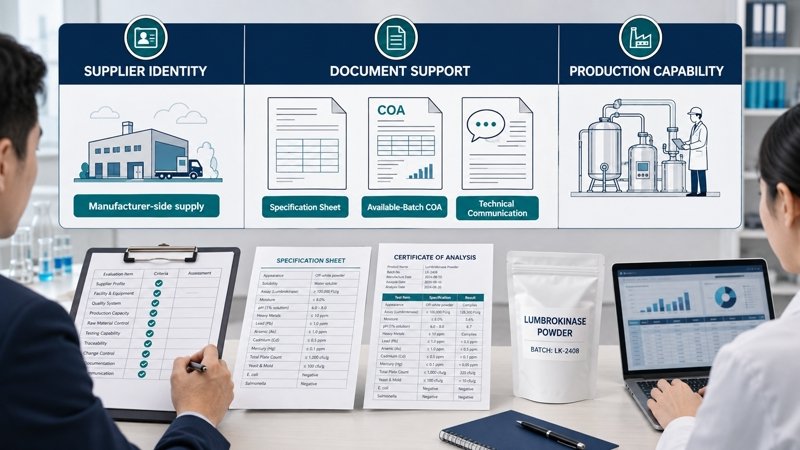
Start by establishing who performs each part of the supply process.
Ask:
- Are you the manufacturer, a manufacturer-side export representative or another supply-chain participant?
- What responsibilities does your company handle?
- Where does production take place?
- Can you explain the general path from raw material control to production, testing, packaging and export?
- Who will answer technical and document questions after the initial inquiry?
- Will the same contact coordinate quotation, sample and order information?
Working with a manufacturer, export entity or trading company can involve different communication structures. None of these structures should be rejected only because of its label. The key is whether the supplier can clearly explain its role, provide reliable documentation and support communication throughout the purchasing process.
Buyers should also notice whether commercial and technical answers remain consistent when different supplier representatives become involved. Contradictory information about the activity grade, packaging or batch availability may indicate an internal communication gap that should be resolved before approval.
Allworms is part of the manufacturer-side earthworm-derived ingredient supply system and supports overseas market development and international sales.
2. Questions About Product Documents
A document request should confirm both completeness and relevance. Ask the supplier:
- Can you provide a current Specification Sheet?
- Is Product Information available?
- Can you provide a COA for the available batch?
- Which batch number does that COA represent?
- Is it an example COA, sample-batch COA or current inventory COA?
- Can you provide packaging, storage and country-of-origin information?
- Will shipment documents identify the actual supplied batch?
The Specification Sheet defines the agreed quality framework, while a COA normally reports results for an identified batch. These documents should use consistent product names, activity descriptions, units and storage conditions.
A useful additional control is a document cross-check: record the product name, specification version, COA batch number and quotation description in one approval file. This creates a “batch identity chain” and helps prevent a general document from being mistaken for evidence about the material being purchased.
For a wider document request framework, see Lumbrokinase Supplier Documents Beyond the COA.
3. Questions About Batch Information and Consistency
Batch questions should form a central part of lumbrokinase supplier evaluation.
Ask:
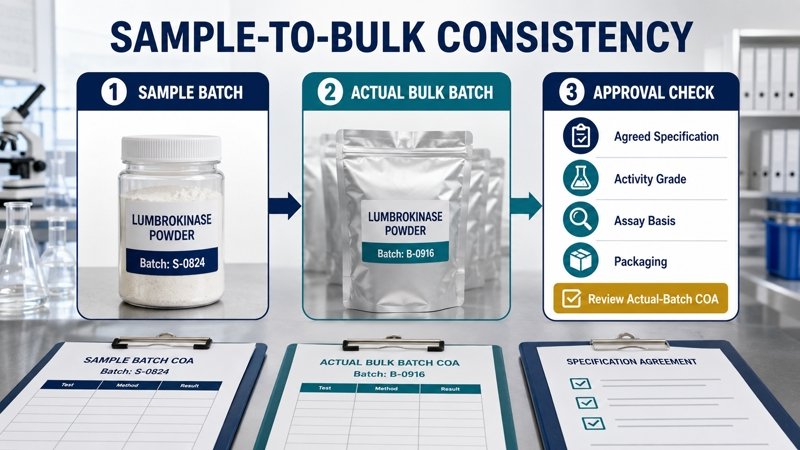
- Is the sample from the same batch as the currently available bulk material?
- If not, was it produced to the same specification and activity grade?
- Will the bulk batch be identified before shipment?
- Can you provide the COA for the actual bulk batch?
- How are results compared between production batches?
- How do you maintain sample-to-bulk specification consistency?
- What happens if the original sample batch is no longer available when the PO is placed?
A sample and bulk order do not always need the same batch number. There may be a substantial interval between sample evaluation and purchase approval, and the sampled inventory may already have been allocated or sold.
If the original batch is unavailable, the buyer should review the actual bulk-batch COA and confirm that it meets the agreed specification, activity grade, assay basis, packaging requirement and purchasing conditions.
Sample approval therefore has a defined boundary: it approves the tested sample under the recorded evaluation conditions. It does not automatically approve every future production batch. For repeat orders, buyers should define which items must remain consistent and which items require renewed review.
4. Questions About Production Capability
Buyers do not need every proprietary processing parameter, but they should understand whether the supplier has a credible production-control system.
Ask:
- What is the general lumbrokinase production flow?
- How are earthworm raw materials selected and controlled?
- Which processing stages are important for maintaining enzyme quality?
- How is batch consistency monitored?
- Can you support sample quantities, trial orders and repeat commercial orders?
- What is the realistic lead time for the requested grade and quantity?
- How are small bulk orders produced or allocated?
- What changes if the requested grade is not currently in stock?
The answers should demonstrate control without requiring disclosure of confidential formulations or process conditions. Buyers should look for a logical connection between raw material handling, controlled processing, batch testing and protected packaging.
Capacity should also be evaluated in relation to the proposed purchase—not through a general statement such as “large production capability.” A better question is whether the supplier can support the buyer’s initial quantity, expected reorder frequency and likely growth without changing the agreed specification without notice.
A broader reliability framework is available in How Lumbrokinase Buyers Evaluate Supplier Reliability Before Placing an Order.
5. Questions About Activity and Assay Method
An activity number is only useful when its testing and reporting basis can be understood.
Ask:
- What activity specification is available?
- Which assay method is used?
- How is activity reported on the Specification Sheet and COA?
- Can the supplier explain the testing basis?
- Is the result reported per milligram, per gram, on a dried basis or on another basis?
- Can the technical team discuss third-party laboratory requirements before sample testing?
- How will a disagreement between supplier and buyer results be investigated?
IU/mg, FU/g, LKU and U should not be compared through an assumed fixed conversion. Buyers should review the assay method, substrate, standard, sample preparation, incubation conditions, calculation method and reporting basis.
One practical approach is to agree on the evaluation protocol before testing begins. The buyer should identify its laboratory, intended method, reporting unit and acceptance criteria. The supplier should then confirm whether its own result is method-comparable or explain why the two results may require separate interpretation.
6. Questions About Sample Support
A reliable supplier should have a defined sample process rather than sending an unidentified powder without supporting information.
Ask:
- Is a sample available for the requested activity grade?
- What quantity can be provided?
- Which batch will be sampled?
- What documents will accompany the sample?
- Who pays the international freight?
- How should the sample be stored after receipt?
- What information should the buyer provide after evaluation?
- If approved, how will the sample requirement be transferred to the bulk-order specification?
A 100 g sample may be available for qualified B2B buyers, and buyers usually cover international sample freight. Before shipment, both parties should record the sample batch, activity grade, test basis and intended evaluation purpose.
The buyer should also define an approval window. If the purchase order is delayed for several months, current inventory and documentation should be rechecked instead of assuming the original sample remains representative of available material.
7. Questions About Packaging, Storage and Shipping
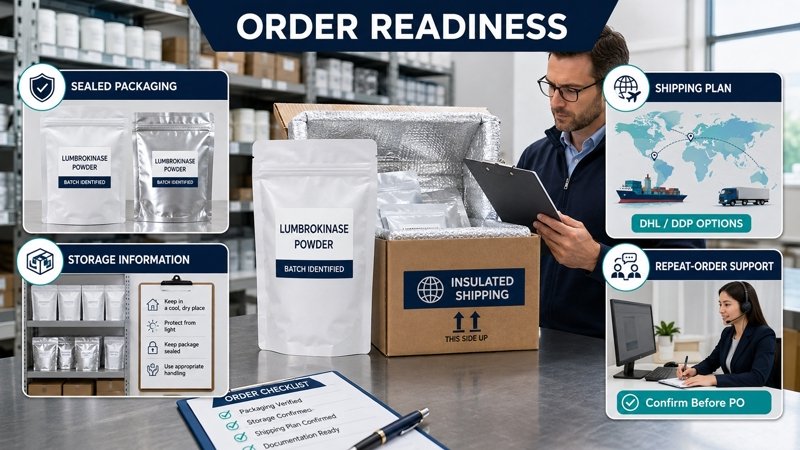
Lumbrokinase is an enzyme-sensitive material, so packaging and logistics readiness should be discussed before order confirmation.
Ask:
- What packaging format and net weight are available?
- Is each package sealed and batch identified?
- What storage conditions are specified?
- How is moisture exposure reduced during packing and handling?
- What shipping routes are available for the destination?
- Can DHL or DDP door-to-door options be discussed?
- What shipping and customs information must the buyer provide?
- Will the final packaging arrangement be confirmed on the quotation or PI?
Short temperature changes do not automatically mean that the product has been destroyed. However, buyers should avoid unnecessary heat, moisture exposure and prolonged unsuitable storage. Supplier instructions should be reviewed together with the buyer’s warehouse and contract manufacturer requirements.
For current activity grades, sample support, MOQ and supply information, visit the Lumbrokinase product page.
8. Questions About Long-Term Cooperation
Supplier approval should consider the second and third orders, not only the first shipment.
Ask:
- Can the supplier support repeat orders under the agreed specification?
- How will future batch documents be communicated?
- Will changes affecting the specification, assay basis or packaging be disclosed?
- Can order volume increase gradually?
- How early should forecasts or repeat-order requirements be shared?
- Who handles technical questions after delivery?
- How are quality questions or document corrections investigated?
No supplier can reasonably guarantee that every future batch will be identical in every measurement. A stronger commitment is to maintain agreed specification limits, use a consistent testing basis, provide batch-specific documentation and communicate material changes before shipment.
Key Questions to Ask a Lumbrokinase Supplier
| Question Category | Questions Buyers Should Ask | Why It Matters |
|---|---|---|
| Supplier identity | What is your role, and where does production occur? | Establishes responsibility and communication channels |
| Documents | Can you provide the Specification Sheet, Product Information and relevant COA? | Confirms whether supplier claims are document-supported |
| Batch information | Which batch does the COA represent? | Connects documents to sample, inventory or shipment |
| Production capability | Can you support the initial order and realistic repeat demand? | Tests practical supply readiness |
| Sample support | Which batch and activity grade will be sampled? | Defines what the buyer is actually evaluating |
| Activity and assay | What method, unit and reporting basis are used? | Prevents misleading numerical comparisons |
| Packaging | Is the package sealed, identified and suitable for the order? | Reduces handling and identification risk |
| Storage | What conditions apply before and after opening? | Supports enzyme-material management |
| Shipping | Can DHL or DDP options be discussed for the destination? | Clarifies logistics responsibility |
| Long-term cooperation | How will future batches, changes and repeat orders be handled? | Tests ongoing supplier support |
Common Buyer Mistakes
Common supplier-approval mistakes include:
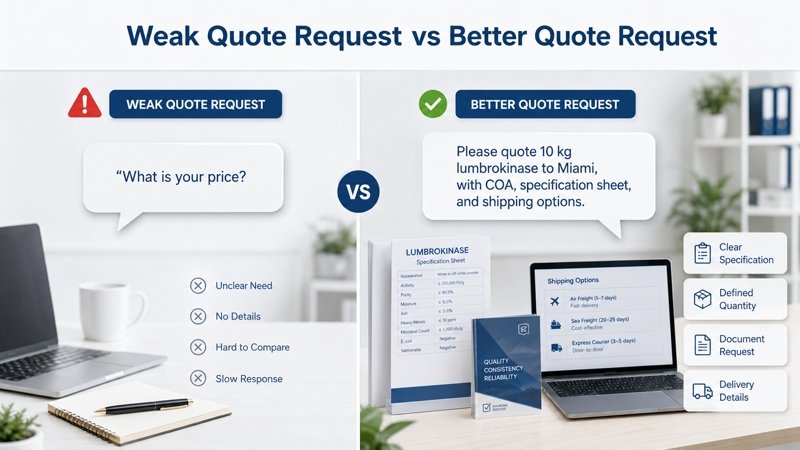
- Asking only about price
- Not asking which batch the COA represents
- Failing to request a Specification Sheet
- Not confirming sample-to-bulk specification consistency
- Assuming sample approval guarantees all future batches
- Ignoring differences between assay methods
- Focusing on the activity number without its reporting basis
- Approving an order before confirming packaging
- Failing to discuss repeat-order expectations
- Leaving technical agreements in scattered emails instead of one approval record
Before issuing a PO, purchasing and QA teams should create a short written approval summary containing the product name, activity grade, assay basis, bulk-batch document requirement, packaging, quantity and destination. This gives both parties a common reference if details change during order preparation.
Allworms Supply Notes
Allworms supports qualified B2B buyers with batch documentation, sample evaluation, trial orders and international order communication. The standard MOQ is usually around 1.5 kg, depending on specification. Standard lead time is generally 7–15 days after payment, subject to inventory, quantity and destination.
A 100 g sample may be available, with international freight normally paid by the buyer. DHL and DDP door-to-door arrangements may be discussed for selected destinations.
Answers to general ordering, documentation and logistics questions are also available on the FAQ page.
FAQ
1. What is the most important question to ask a lumbrokinase supplier?
Ask which batch the provided COA represents and whether the actual order batch will be supplied under the same agreed specification and assay basis. This connects the supplier’s documents to the material being evaluated and purchased.
2. Must the sample and bulk order have the same batch number?
No. The sample batch may be unavailable when the order is placed. In that situation, review the actual bulk-batch COA and reconfirm the agreed activity grade, specification, assay basis and packaging before shipment.
3. How can buyers verify a reported lumbrokinase activity?
Request the activity specification, assay method and reporting basis. If third-party testing is planned, discuss the substrate, standard, sample preparation, incubation conditions, calculation method and unit before comparing results.
4. What documents should be approved before issuing a purchase order?
Buyers should normally approve the relevant Specification Sheet, available-batch or proposed-batch COA, product information, packaging and storage details, origin information, quotation and agreed order conditions.
5. How should buyers evaluate long-term supply ability?
Discuss repeat-order frequency, expected volume changes, future batch documentation, specification consistency, change communication and technical support. Evaluate whether the answers are realistic for the buyer’s planned purchasing pattern.
Verify Your Lumbrokinase Supplier Before Ordering
Discuss Samples, Batches and Order Requirements with Allworms
One comment on “Key Questions to Ask a Lumbrokinase Supplier Before Placing an Order”
Comments are closed.