Not all earthworm protein powder is built the same
Let’s be honest—plenty of suppliers use the same words.
“High quality.” “Premium.” “Pure.” “Professional.” It all sounds nice. But when a buyer is sourcing for dietary supplements, nutraceuticals, pharmaceutical ingredients, or even cosmeceutical applications, those words stop being enough. Fast.
That’s where the phrase pharmaceutical-grade earthworm protein powder starts to matter. Not because it sounds impressive, but because it points to something more demanding: tighter raw material selection, cleaner processing, better-defined composition, stronger contaminant control, and a deeper stack of technical documents.
In other words, this isn’t just about selling protein powder in bulk. It’s about whether the material can hold up under serious formulation, regulatory review, and repeat purchasing.
And that’s the real dividing line.
So, what does “pharmaceutical-grade” really imply?
Strictly speaking, “pharmaceutical-grade” should not be used casually. For professional buyers, it usually implies a material produced with a much higher level of control than ordinary food-grade or feed-grade material. The focus shifts from “is this powder usable?” to “is this batch traceable, consistent, and clean enough for sensitive applications?”
That difference sounds subtle. It isn’t.
A commodity earthworm protein powder may be acceptable for broad, low-spec use. A pharmaceutical-oriented grade, by contrast, is expected to come with more disciplined standards around:
- species and raw material identity
- controlled processing conditions
- microbial and heavy metal management
- batch-to-batch consistency
- technical documentation and release testing
- suitability for downstream R&D, formulation, or higher-value applications
Here’s the thing: buyers in health ingredients and pharma-adjacent categories are rarely paying only for the powder itself. They’re paying for confidence. They’re paying for fewer surprises later.
It starts with the worm—yes, really
You can’t make a cleaner ingredient from a poorly controlled raw material. That’s just chemistry and manufacturing reality.
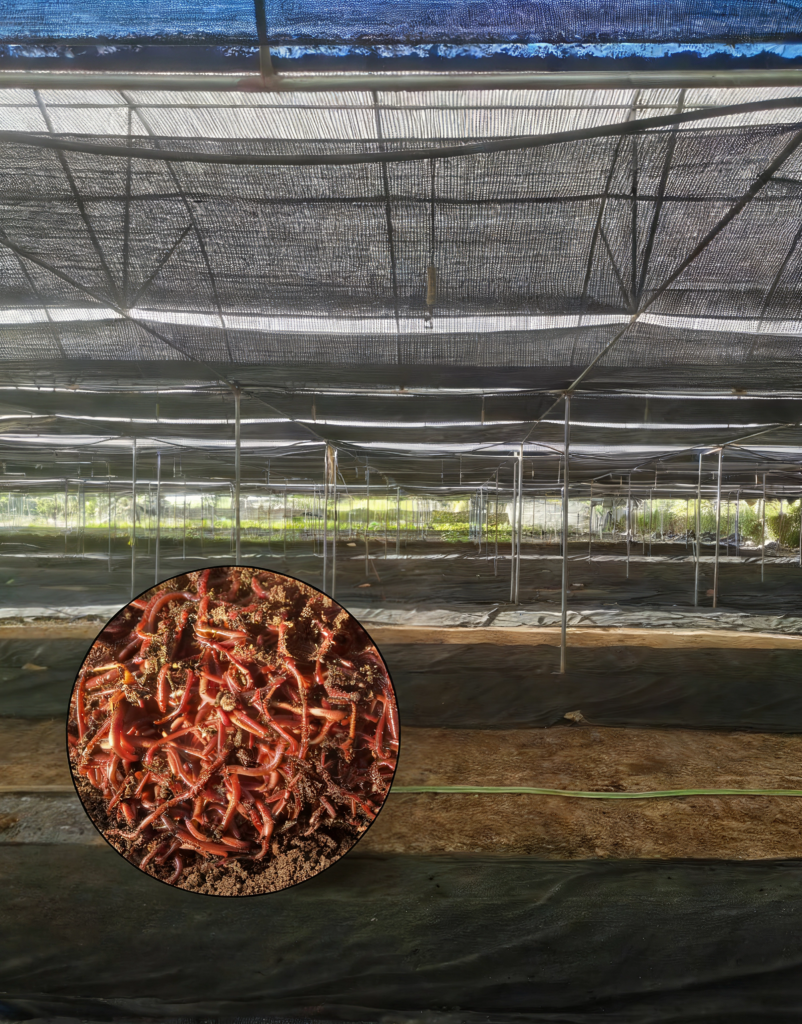
Our raw material is Eisenia fetida and describes a defined production flow from selection and cleaning through filtration, low-temperature drying, milling, sterilization, and packaging. That matters more than it may seem at first glance.
Why? Because source control affects almost everything downstream:
- protein content
- ash and fat levels
- contaminant risk
- odor and color consistency
- microbial burden
- process yield
- final sensory and formulation behavior
Scientific literature also supports that earthworms are protein-rich raw materials. One study reported dried earthworm raw material protein at 60.34% ± 1.12%, while another notes earthworm protein content commonly ranges from 60% to over 70% depending on material and handling.
That’s good news for buyers. But high protein on paper is not the whole story. A better grade is not only about starting rich; it’s about starting clean and controlled.
The process is where the gap gets wider
This is where higher-grade material begins to separate itself from ordinary powder.
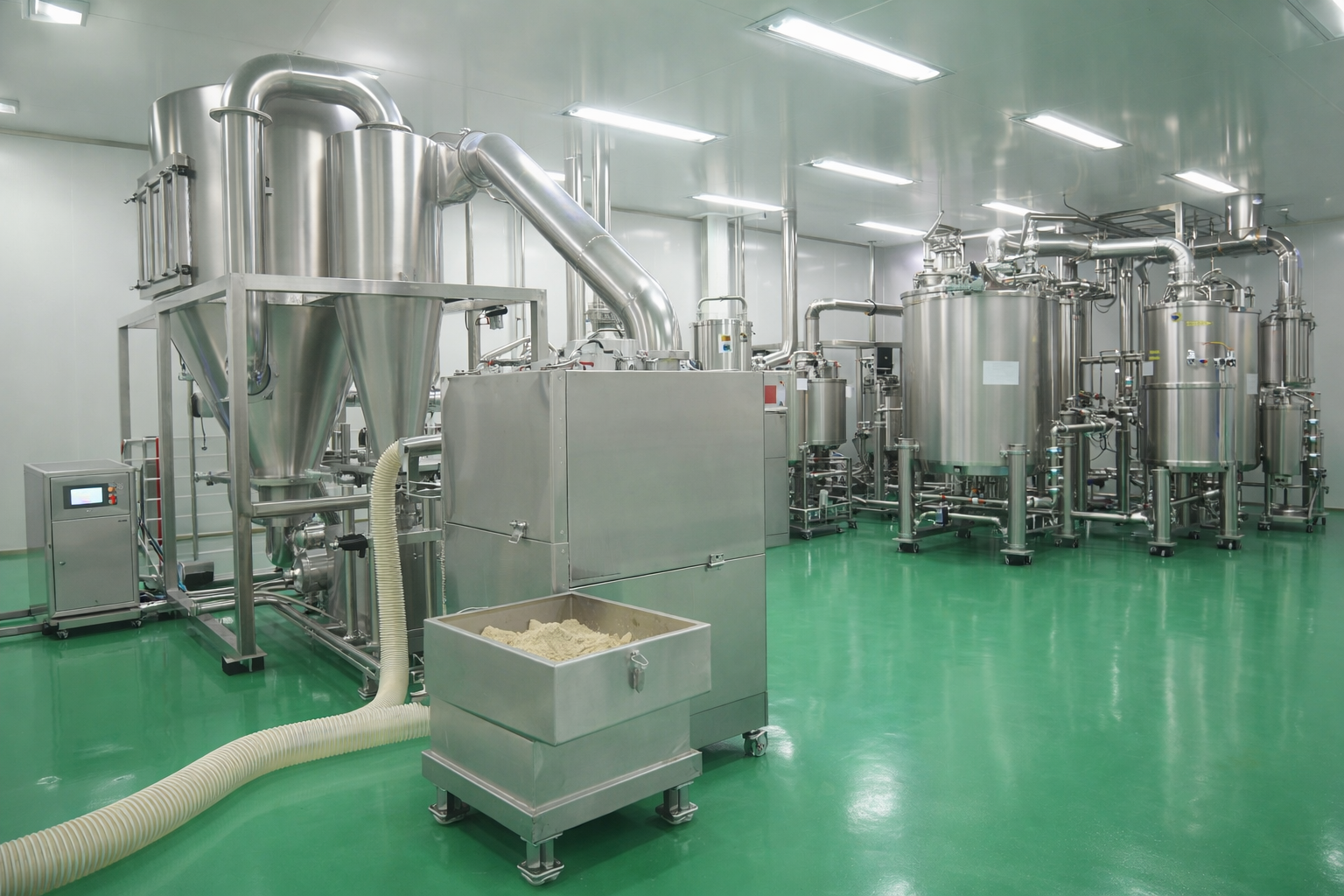
The process flow describes a chain that includes mechanical separation of worms from soil and debris, secondary sorting and cleaning, hydrolysis/cleaning, centrifugal filtration, low-temperature drying, milling, sterilization, and packaging.
Now, compare that to what happens in loosely controlled production environments. If cleaning is inconsistent, soil residue can affect ash content and microbiology. If drying is too aggressive, heat-sensitive fractions may degrade. If filtration is crude, insolubles and off-notes can remain. If sterilization is poorly managed, you may reduce microbes but also damage functionality or sensory quality.
A pharmaceutical-oriented grade usually shows more discipline in a few specific areas:
Cleaner pretreatment and impurity removal
Earthworms are biological raw materials pulled from complex environments. That means pretreatment isn’t some minor housekeeping step. It is central.
Good pretreatment helps reduce:
- soil-derived particulates
- non-protein impurities
- excessive ash
- off-odor contributors
- unwanted microbial load
If a supplier can’t explain its cleaning and separation steps clearly, that’s a red flag. Not a small red flag, either.
Controlled extraction, not rough handling
One of the studies prepared earthworm protein by alkaline extraction and acid precipitation, followed by dialysis and freeze-drying. The resulting earthworm protein reached 96.03% ± 0.77% protein, while fat dropped to 0.98% ± 0.01%.
That’s an important benchmark for buyers. It shows that when the process is properly controlled, the material can be significantly refined beyond raw powder.
And that’s a core distinction: pharmaceutical-grade thinking is about refining variability out of the system.
Low-temperature drying matters more than people think
Drying sounds boring. It isn’t boring when you’re trying to preserve functionality.
Our production flow explicitly mentions low-temperature drying. For functional protein ingredients, that’s often a practical advantage because harsh heat can change protein structure, darken color, worsen odor, and reduce activity in sensitive fractions.
For B2B buyers, this affects more than lab data. It can affect how the ingredient behaves in:
- capsules
- tablets
- sachets
- powdered blends
- functional beverages
- cosmetic actives or topical systems
A material that looks fine in a spec sheet but behaves badly in formulation is, frankly, a headache nobody wants.
Purity is one part of the story; peptide profile is another
This is where the conversation gets interesting.
A lot of buyers still think only in terms of crude protein percentage. But earthworm-derived ingredients can sit across a spectrum: whole powder, protein-enriched powder, extracted protein, hydrolysate, peptide-rich fractions, and enzyme-focused preparations.
That distinction matters because earthworm proteins are not just nutritionally dense—they also generate bioactive peptides after digestion or hydrolysis. Your files include research showing that earthworm protein hydrolysates yielded peptide fractions with antioxidant, ACE-inhibitory, and immunomodulatory activities.
For example:
- one study found extracted earthworm protein at 96.03% protein and showed that simulated gastrointestinal digestion produced soluble peptides with measurable antioxidant activity.
- another identified seven novel ACE inhibitory peptides from earthworm protein digestion products, with two peptides showing particularly strong ACE inhibitory activity.
- a third study reported that earthworm protein autolysates showed immunomodulatory effects in a cyclophosphamide-induced immunosuppressed mouse model.
So yes, protein percentage matters. But for serious applications, buyers often need to ask a second question:
Is this ingredient simply protein-rich, or is it processed in a way that preserves or generates the peptide profile relevant to its intended use?
That’s a much smarter sourcing question.
Safety control is where premium suppliers prove themselves
Honestly, this is the part that decides whether an ingredient is ready for serious markets.
A pharmaceutical-grade earthworm protein powder should not rely on broad promises. It should be supported by actual batch controls—especially because earthworm-derived materials sit closer to the “high scrutiny” end of the ingredient spectrum.
A stronger supplier should be ready to discuss, and ideally document:
- microbiological limits
- heavy metal limits
- pesticide or environmental contaminant risk, where relevant
- residual moisture control
- ash content
- protein assay method
- particle size
- sterilization approach
- storage stability
- traceability back to raw material lot
That’s not overkill. That’s normal due diligence.
Earthworm extracts can contain proteins, peptides, organic compounds, and inorganic elements, including trace metals such as aluminum, barium, mercury, manganese, lead, cadmium, and nickel. This is exactly why contaminant management must be taken seriously. When a raw material naturally comes from a biologically and environmentally exposed source, higher-grade processing and testing are not optional extras—they are central to product credibility.
Documentation is part of the grade
This point gets missed all the time.
Buyers don’t only compare powders. They compare paperwork.
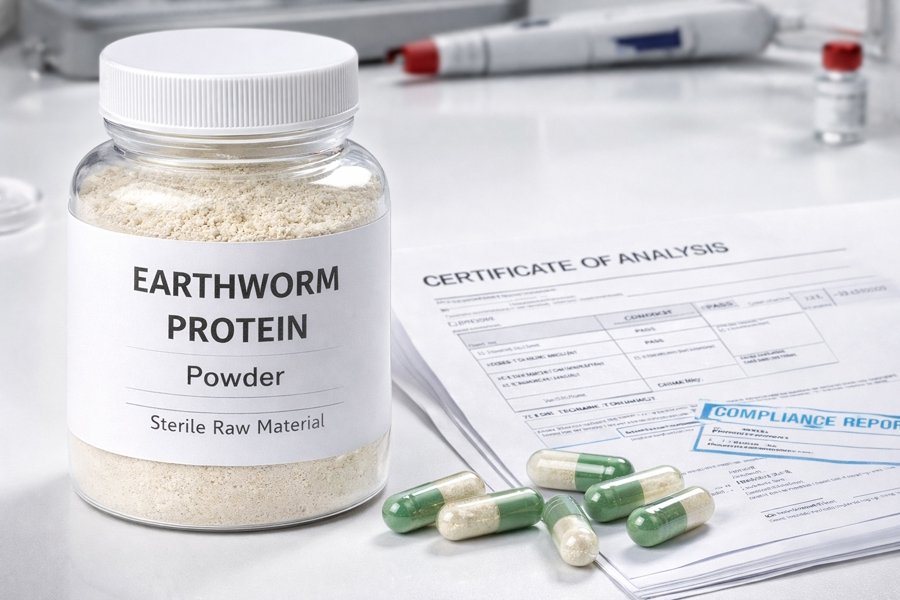
A more pharmaceutical-oriented material usually comes with a stronger documentation package, such as:
- specification sheet
- COA
- TDS
- manufacturing flow summary
- origin and species information
- storage and shelf-life guidance
- test methods
- allergen or non-GMO statements, where applicable
- microbiology and heavy metal reports
- sometimes stability or application-support data
Without that, even a decent material can become difficult to move through procurement, QA, and regulatory review.
And once a customer has to chase a supplier three times for basic documents? Well, trust starts leaking out of the process.
Batch-to-batch consistency is the real commercial test
Here’s a mild contradiction worth explaining: an earthworm protein powder can test well once and still be a poor sourcing choice.
Why? Because one strong batch proves almost nothing if the next three batches drift in color, odor, protein level, microbial load, or flowability.
That’s why pharmaceutical-grade thinking is obsessed with consistency. Not perfection in an abstract sense—consistency in the boring, measurable, commercially valuable sense.
Can the supplier deliver a similar material again and again?
For wholesalers, contract manufacturers, and brand owners, this affects everything:
- formula standardization
- label claims
- sensory performance
- fill weight control
- dissolution or dispersibility
- customer complaints
- production scheduling
A batch that is “close enough” may be fine for a low-spec commodity. It is not fine for premium supplement or pharmaceutical-adjacent use.
Bioactivity claims need discipline, not hype
This is a big one.
The research files do support that earthworm-derived proteins and peptides have shown antioxidant, antihypertensive, fibrinolytic, antimicrobial, wound-healing, and immunomodulatory potential in various in vitro and in vivo models.
But a professional-grade supplier should handle those findings carefully.
That means avoiding the leap from “research suggests potential” to “our bulk powder clinically treats disease.” Serious buyers notice that difference immediately. Regulatory teams notice it even faster.
The better positioning is usually this:
- earthworm protein is a high-protein raw material with a meaningful amino acid profile
- processed earthworm protein can yield peptide fractions of functional interest
- certain extracted or hydrolyzed fractions have shown promising activity in research settings
- the final commercial ingredient should be evaluated according to its actual grade, processing route, and intended market
That wording is more responsible—and, oddly enough, more persuasive.
Why this matters for different B2B buyers
The same powder may look very different depending on who is buying it.
For dietary supplement brands
They need clean specs, stable sensory performance, and strong documentation. A more controlled grade reduces reformulation risk and supports premium positioning.
For nutraceutical ingredient distributors
They need a material that can survive customer audits and technical questions. A better grade means fewer disputes and better repeat business.
For pharmaceutical ingredient or pharma-adjacent buyers
They care deeply about traceability, tighter test standards, and predictable manufacturing. A supplier that cannot explain process controls won’t get far.
For cosmetic and cosmeceutical developers
They often care about peptide positioning, purity, odor, color, and compatibility with other actives. A rough, inconsistent powder is hard to work with here.
For wholesalers and dealers
They need fewer claims and more reliability—stable supply, batch consistency, documentation, and a product that doesn’t create trouble after shipment.
What smart buyers should ask before purchasing
If you’re positioning earthworm protein powder as pharmaceutical-grade, the supplier should be ready for questions like these:
- What species is used, and how is raw material identity controlled?
- Is the product whole powder, extracted protein, hydrolysate, or peptide-rich fraction?
- What is the protein content, and which assay method is used?
- What are the microbiological and heavy metal limits?
- Is low-temperature drying used?
- How are soil residues and non-protein impurities removed?
- What sterilization method is applied?
- What does the batch-to-batch variation look like?
- Which supporting documents are available with each lot?
- Is the product intended for food, supplement, cosmetic, or pharmaceutical-adjacent use in the target market?
Those questions cut through fluff very quickly.
The bottom line
So, what makes pharmaceutical-grade earthworm protein powder different?
Not one thing. A system.
It starts with controlled raw material sourcing. It continues through cleaner separation, better extraction, low-temperature drying, filtration, sterilization, and tighter release testing. It shows up again in documentation, traceability, contaminant control, and batch consistency. And it becomes especially meaningful when the ingredient is being used in higher-value applications where formulation performance and technical credibility both matter.
That’s the difference.
A commodity powder is mostly about availability.
A pharmaceutical-grade earthworm protein powder is about control.
And in B2B ingredient markets, control is usually what turns interest into long-term business.
FAQs
1. What is pharmaceutical-grade earthworm protein powder?
Pharmaceutical-grade earthworm protein powder generally refers to earthworm-derived protein material produced with tighter controls on sourcing, processing, purity, contaminants, and documentation than ordinary commercial-grade powder. For B2B buyers, it usually means stronger traceability and more reliable batch consistency.
2. How is pharmaceutical-grade earthworm protein powder different from standard earthworm powder?
The main difference is not just protein percentage. Pharmaceutical-grade earthworm protein powder usually involves better raw material cleaning, more controlled extraction or filtration, low-temperature drying, stricter microbiological and heavy metal control, and fuller technical documentation for supplement, nutraceutical, or pharma-adjacent use.
3. Why does batch consistency matter when sourcing earthworm protein powder?
Batch consistency matters because changes in color, odor, protein content, moisture, or microbial load can affect formulation, label claims, production efficiency, and customer acceptance. For manufacturers and wholesalers, consistent earthworm protein powder reduces risk across repeat orders.
4. Can earthworm protein powder contain functional peptides?
Yes. Research in your files shows that processed earthworm protein can generate peptide fractions with antioxidant, ACE-inhibitory, and immunomodulatory potential after digestion or hydrolysis. That said, the final activity depends on the specific processing route and grade of the ingredient.
5. What should buyers request from an earthworm protein powder supplier?
Buyers should ask for a specification sheet, COA, species information, manufacturing flow summary, microbiology and heavy metal data, storage conditions, and batch traceability details. These documents help confirm whether the earthworm protein powder is suitable for dietary supplements, nutraceutical formulations, cosmetic use, or pharmaceutical-oriented sourcing.
One comment on “What Makes Pharmaceutical-Grade Earthworm Protein Powder Different?”
Comments are closed.