
How Global Brands Source Lumbrokinase at Scale
Finding a Lumbrokinase supplier and receiving an acceptable sample are only the early stages of commercial sourcing. Before moving into repeat or larger-volume purchasing, supplement brands must determine whether the technical and supply conditions established during evaluation can be carried forward into commercial use.
Lumbrokinase sourcing at scale is therefore not simply a move from a small order to a bigger order. It is a transition from preliminary evaluation to a controlled raw-material supply process built around an agreed specification, assay context, documentation, batch expectations, packaging requirements and supply plan.
A practical commercial progression is:
Supplier Evaluation → Specification Alignment → Sample Evaluation → Supplier Qualification → Commercial Requirements → Commercial Batch → Incoming QC → Ongoing Supply
Different companies may use different approval procedures, but these stages help prevent important technical requirements from being lost when purchasing responsibility moves from R&D or QA to procurement.

1. Scaling Lumbrokinase Sourcing Is More Than Buying More Material
Order quantity alone does not determine whether a Lumbrokinase supply arrangement is commercially ready.
A small representative sample may allow a buyer to examine the powder, review technical documents, conduct laboratory testing and explore formulation suitability. Commercial purchasing introduces additional questions:
- Which specification will apply to the supplied material?
- Will the activity continue to be reported using the agreed assay context?
- What documents will accompany each commercial batch?
- How will the actual bulk batch be reviewed?
- What packaging and storage requirements must be maintained?
- How will production and delivery timing be coordinated?
- What happens if a batch result or document does not match expectations?
These questions turn an ingredient purchase into a repeatable commercial process. The objective is not to demand that every future batch produce an identical result. It is to establish how every supplied batch will be assessed against defined requirements.
2. Complete Supplier Qualification Before Scale-Up
Initial communication, a specification sheet or a satisfactory sample should not automatically be treated as complete supplier qualification.
Before commercial scale-up, the buyer’s relevant teams may need to confirm the supplier and product identity, technical specification, activity assay context, available quality documentation, packaging information, storage requirements and communication responsibilities. The extent of qualification will depend on the buyer’s internal quality system, intended application and target market.
The key commercial-readiness question is:
Can the supplier support the proposed material under a clearly understood and repeatable set of technical and supply conditions?
This is different from simply asking whether the supplier has material available. A commercial relationship requires the buyer and supplier to understand what is being approved, which documents support that approval and which requirements will continue to apply after the sample stage.
Buyers defining their technical purchasing basis can use How Supplement Formulators Should Define a Lumbrokinase Ingredient Specification as a more detailed reference.
3. Align the Commercial Ingredient Specification
The specification used for commercial purchasing should be understood before repeat or larger orders begin.
For Allworms’ current standard material, the commercial activity expression is:
Fibrinolytic Activity: ≥1,000,000 U/g
Assay Method: Fibrin Plate Assay
The activity value should remain connected to its assay method. Buyers should not separate the numerical specification from the analytical context or assume that results reported under different unit systems and methods are interchangeable.
Specification alignment should establish:
- The identity of the material being purchased
- The applicable activity requirement
- The activity unit and assay context
- Relevant physical and quality parameters
- Required batch documentation
- Packaging and storage expectations
- The process used to assess commercial-batch conformity
The purpose is not to reproduce the buyer’s complete internal specification in every purchase discussion. It is to ensure that procurement, QA, R&D and the supplier are referring to the same approved material and requirements.
Current product-level information is available on the Lumbrokinase Powder Supplier page.
4. Manage the Transition From Sample to Commercial Material
The transition from a representative sample to commercial material is one of the most important stages in Lumbrokinase sourcing at scale.
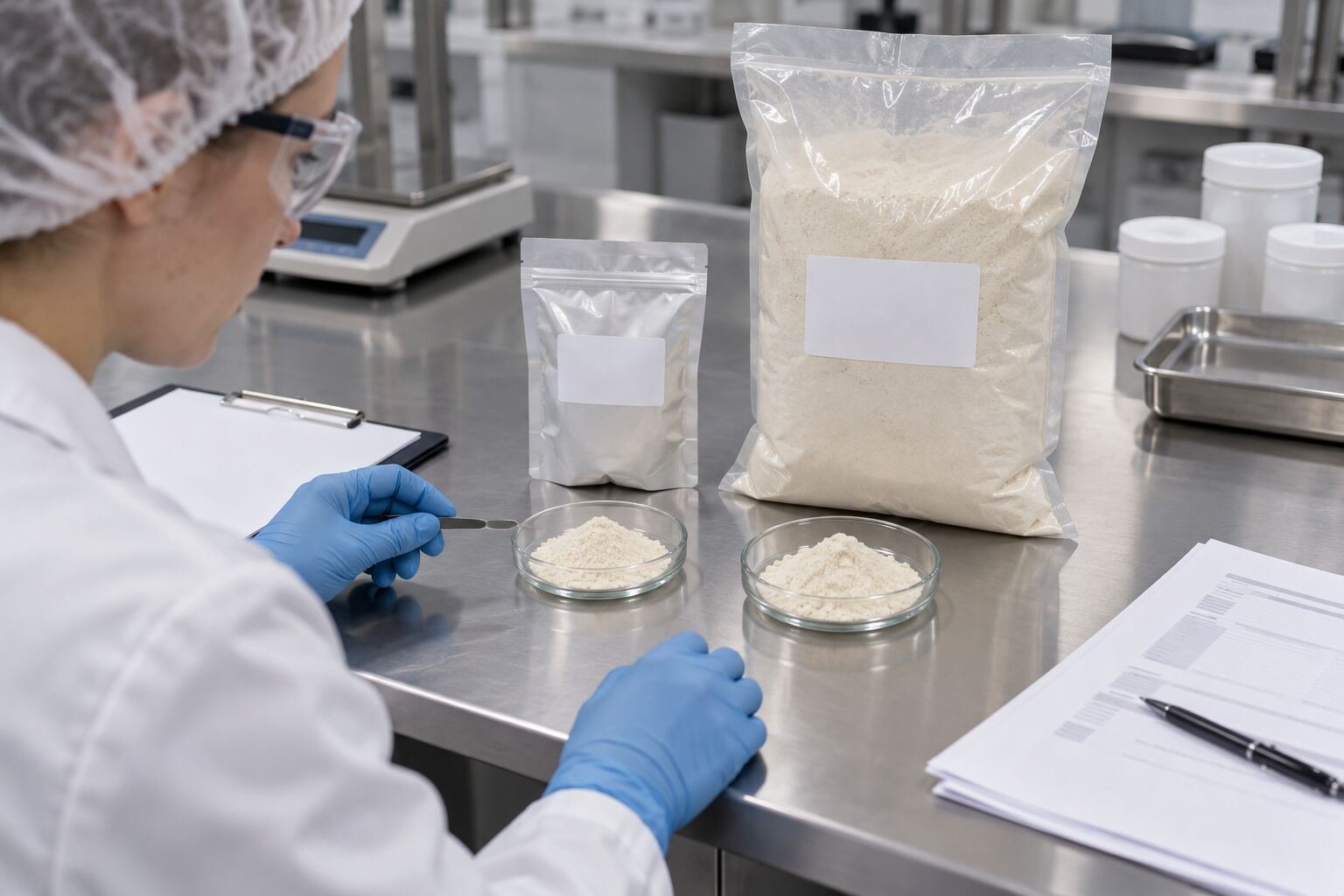
A sample can help a buyer review technical suitability, physical condition, documentation and formulation considerations. However:
Sample approval does not automatically approve every future commercial batch.
The sample and commercial material may also carry different batch numbers, particularly when testing, formulation work and internal approval take several weeks or months. Different batch numbers do not automatically indicate a problem.
The buyer should instead identify which expectations established during sample evaluation must continue into commercial supply. These may include:
- Product identity
- Agreed specification
- Activity and assay context
- Relevant physical characteristics
- Applicable quality parameters
- Required documentation
- Packaging and storage conditions
A sample result should not be interpreted as a promise that every future batch will produce an identical analytical number. Results can vary while remaining conforming. The correct commercial objective is consistent conformance to the agreed specification and buyer requirements.
For the detailed evaluation stage, refer to Lumbrokinase Sample Evaluation: What B2B Buyers Should Check.
5. Define Commercial-Batch Documentation Expectations
Commercial sourcing should replace ad hoc document requests with a repeatable documentation process.

Before purchasing begins, the buyer should determine which documents are required for qualification and which should accompany or be available for each commercial batch. Depending on the buyer’s system, these may include:
- Product specification
- Batch-specific COA
- Activity assay information
- Relevant technical documentation
- Packaging and storage information
- Other applicable supplier-quality documents
The specification defines the requirements for the material. The COA reports results for a particular batch. The two documents have related but different roles.
The buyer should also establish when documents must be reviewed. Some companies review the actual commercial-batch COA before shipment, while others perform their principal acceptance review after receiving the material. That decision belongs to the buyer’s quality system.
What matters is that the process is defined in advance and that the COA used for acceptance corresponds to the commercial batch supplied.
6. Evaluate Batch-to-Batch Consistency for Ongoing Supply
Commercial purchasing introduces a question that cannot be answered through one sample alone:
Can subsequent batches continue to meet the agreed requirements?
Relevant areas may include fibrinolytic activity, assay context, physical characteristics, applicable quality parameters, COA results and consistency of documentation.
Batch consistency does not mean that every analytical value must be numerically identical. Biological raw materials and laboratory measurements may show variation. The commercial standard should be:
Consistent conformance to agreed requirements—not identical numbers across every batch.
If a result falls outside an agreed requirement or differs unexpectedly from previous information, the buyer and supplier should review the affected parameter, method, unit, sample handling, documentation and any appropriate retesting before reaching a conclusion.
7. Plan Packaging, Handling and Commercial Delivery Requirements
Packaging and handling may receive limited attention during early sample evaluation but become more important once commercial material enters receiving, warehousing and production.
Before ordering, buyers may need to confirm:
- Packaging configuration and unit size
- Package labels and batch identification
- Sealing and moisture protection
- Applicable storage requirements
- Shipment preparation requirements
- Delivery destination
- Documents accompanying the shipment
- Receiving and warehouse requirements
These points should support material protection and traceability rather than turn the sourcing process into a general logistics exercise.
Allworms’ standard sealed packaging is 1.5 kg per bag. Buyers with specific warehouse, dispensing or production requirements should communicate them before commercial ordering so feasibility can be reviewed.
8. Build Lead Time Into Supply Planning
Commercial buyers should distinguish between material currently in stock and material requiring order production.

Current Allworms planning guidance is:
- In-stock orders: normally prepared for shipment within approximately three days.
- Order production: normally requires approximately 7–15 days.
These are planning estimates rather than guaranteed universal delivery times. Actual international transit depends on the destination, shipment arrangement and other circumstances.
A practical purchasing sequence is:
Requirement Date → Inventory Position → Production Lead Time → Shipment Preparation → Transit → Receiving and QA Review
Procurement teams should include both supplier lead time and their own incoming review period. Waiting until usable inventory is nearly exhausted can create unnecessary pressure and reduce the time available to resolve documentation or batch questions.
9. Coordinate QA, R&D and Procurement
Lumbrokinase commercial sourcing is cross-functional.
R&D or formulation teams may confirm technical and formulation suitability.
QA/QC teams may confirm the specification, documents, batch-review procedure and acceptance requirements.
Procurement or sourcing teams may confirm quantity, commercial terms, lead time and supply planning.
The supplier should receive one aligned commercial requirement. Conflicting instructions—such as procurement requesting one specification while QA evaluates another—can delay approval and create uncertainty about which material should be supplied.
A short internal handover record can help identify the approved product, specification, assay context, required documents, packaging and responsible contacts before the first commercial order is placed.
10. Establish Expectations for Ongoing Commercial Supply
A commercial supply framework should prevent the technical evaluation from restarting at zero with every purchase.
Before ongoing purchasing, the buyer and supplier should understand:
- Which specification applies
- Which documents are required for each batch
- What QA reviews before acceptance
- How the actual commercial batch is identified
- How technical or supply changes are communicated
- How forecasts and expected quantities are shared
- How production and delivery timing are coordinated
- How discrepancies are investigated
When a commercial shipment arrives, the buyer’s process moves from supplier evaluation into material acceptance. The detailed receiving stage is covered in Lumbrokinase Incoming Quality Control: What Buyers Should Check After Delivery.
Commercial-Scale Lumbrokinase Sourcing Framework
| Scale-Up Stage | What the Buyer Should Confirm | Why It Matters |
|---|---|---|
| Supplier qualification | Product identity, technical capability and applicable documentation | Establishes commercial readiness |
| Specification alignment | Agreed requirements, activity unit and assay context | Creates a common purchasing basis |
| Sample evaluation | Suitability of representative material | Supports technical evaluation |
| Sample-to-bulk transition | Requirements that must continue into commercial supply | Prevents sample approval from being misapplied |
| Commercial documentation | Specification, batch COA and required supporting information | Creates a repeatable review process |
| Batch consistency | Continued conformance rather than identical results | Supports ongoing commercial use |
| Packaging and handling | Configuration, sealing, labeling and storage requirements | Protects material and traceability |
| Lead-time planning | Stock status, production time and requirement date | Reduces supply interruption risk |
| Ongoing supply | Review, communication and discrepancy procedures | Supports repeatable purchasing |
11. Practical Sample-to-Commercial Supply Workflow
A practical workflow is:
- Complete the initial supplier evaluation.
- Align the proposed commercial specification.
- Evaluate a representative sample.
- Complete the buyer’s supplier-qualification process.
- Confirm commercial quantity, packaging and timing requirements.
- Confirm documentation expectations.
- Place an appropriate trial or commercial order.
- Review the actual commercial batch and its documentation.
- Complete incoming QC according to the buyer’s procedure.
- Manage future orders under the established supply framework.
Supplier information supports this process, but final qualification and batch approval remain the buyer’s responsibility. General product, documentation and ordering questions are addressed on the Allworms FAQ page.
FAQs
What should buyers confirm before scaling up Lumbrokinase sourcing?
Buyers should confirm supplier qualification status, the commercial specification, activity and assay context, sample-to-bulk expectations, required documents, packaging, lead time and commercial-batch acceptance process.
Does an approved sample automatically approve future commercial batches?
No. A sample supports technical evaluation, but each commercial batch should be assessed according to the agreed specification and the buyer’s quality procedures.
Must the commercial batch use the same batch number as the sample?
Not necessarily. The sample batch may no longer be available when commercial purchasing begins. The buyer should confirm the actual supplied batch and review its corresponding COA.
Should sample and commercial-batch results be identical?
No. Identical analytical values should not be assumed. The appropriate objective is that the commercial batch conforms to the agreed requirements under the applicable assay and evaluation context.
What documents should support a commercial Lumbrokinase batch?
Requirements vary, but buyers may request a batch-specific COA, applicable product specification, assay information, packaging and storage information, and other documents required by their qualification system.
Why does assay alignment matter during commercial sourcing?
Activity results depend on their analytical context. Keeping the activity specification connected to its assay method helps the buyer and supplier evaluate commercial material against the same understood basis.
How should supplement brands plan Lumbrokinase lead times?
They should work backward from the requirement date and include inventory position, stock or production status, shipment preparation, transit and internal receiving or QA review time.
What should be established before ongoing commercial purchasing?
The buyer and supplier should establish the applicable specification, batch documents, packaging, review responsibilities, change communication, supply timing and discrepancy-handling process.

Prepare Your Lumbrokinase Project For Commercial Supply?
eview the specification, batch requirements and expected quantity with Allworms before scaling up.
One comment on “How Global Brands Source Lumbrokinase at Scale?”
Comments are closed.