

Earthworm peptide powder safety standards are not evaluated through one certificate or a single test result. For B2B buyers, the review should combine product specifications, batch-specific data, contamination controls, supplier quality systems, sample evaluation, and confirmation of the actual bulk batch.
This approach is relevant to supplement brands, nutraceutical companies, food ingredient distributors, formulation teams, purchasing departments, and quality assurance teams. Each buyer must determine whether the ingredient meets its internal requirements and the rules of the destination market.
Earthworm Peptide Powder is produced through enzymatic hydrolysis of earthworm-derived protein material. However, the finished powder is positioned as a peptide ingredient, not as an active enzyme ingredient or fibrinolytic enzyme product. Its safety and quality review should therefore focus on composition, contaminants, microbiology, physical characteristics, documentation, and batch control—not enzyme activity grades.
Quick Answer
B2B buyers should evaluate earthworm peptide powder safety standards by reviewing the specification sheet, batch COA, peptide and protein content, moisture, ash, heavy metals, microbiological results, supplier quality controls, and sample test results. Before approving a bulk order, buyers should also confirm that the documentation applies to the actual available batch and that the material meets the agreed specification, packaging, storage, and purchasing requirements.
Why Safety Standards Matter in B2B Ingredient Sourcing
In B2B procurement, “safety standards” usually refers to ingredient-level contamination control, quality testing, documentation, supplier verification, and batch-release procedures. It does not mean that the ingredient has automatically been approved for every application or market.
A practical safety review helps buyers:
- qualify a new supplier;
- establish internal acceptance criteria;
- identify contamination or documentation risks;
- compare a sample with the offered specification;
- prepare for import or customer documentation requests;
- approve an available bulk batch;
- reduce the risk of receiving material that differs from expectations.
Testing requirements may change according to the destination country, finished product category, intended consumer group, formulation, serving size, labeling, and claims. A supplier’s standard COA can support evaluation, but it does not replace the buyer’s regulatory and finished-product responsibilities.
Before starting the review, buyers may consult the Earthworm Peptide Powder product page for the product’s general positioning, processing method, supply format, and standard documentation.
Key Earthworm Peptide Powder Testing Requirements
An effective testing program separates composition-related indicators from contamination-related indicators and supporting physical characteristics.
Composition-related indicators
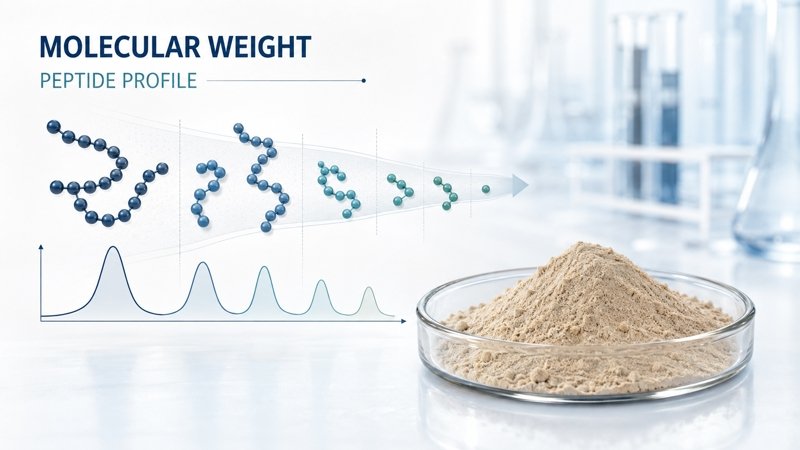
Peptide content and protein content help define what the ingredient contains. Molecular weight information may provide additional insight into the peptide profile when required for a particular formulation or technical evaluation.
Contamination-related indicators
Heavy metals and microbiological parameters help buyers assess contamination control. The appropriate items and limits should be determined according to the buyer’s intended market, application, internal standards, and finished-product requirements.
Supporting quality indicators
Appearance, odor, moisture, ash, solubility, storage conditions, and packaging provide useful information about identity, handling, consistency, and formulation suitability. None of these indicators should be treated as standalone proof of overall quality.
Buyers should compare three points rather than reading each document independently:
- The supplier’s stated specification limits.
- The actual results reported for the relevant batch.
- The buyer’s own acceptance criteria.
Any difference between these three should be clarified before sample or bulk order approval.
Heavy Metals Testing
Heavy metals are commonly reviewed because raw biological materials can be affected by environmental conditions, feed materials, water, soil, processing equipment, or handling practices.
Typical items may include:
- lead;
- arsenic;
- cadmium;
- mercury, when included in the supplier’s documents or requested by the buyer.
The presence of a heavy metals section on a COA is not sufficient by itself. Buyers should check whether the document reports actual results or only acceptance limits, whether the units are clear, and whether the test applies to the relevant batch.
Buyers should review heavy metals data according to the supplier COA, specification sheet, intended application, destination market, and finished-product requirements. Legal limits should not be assumed to be identical across countries or product categories.
If the buyer requires a specific method, reporting limit, test frequency, or third-party laboratory report, this should be communicated before placing the order. Requesting it after production or shipment may create delays or additional testing costs.
Microbiological Testing
Powder ingredients require microbiological control because raw material handling, hydrolysis, concentration, drying, packaging, and storage can all influence microbial risk.
Common microbiological indicators may include:
- total plate count or aerobic plate count;
- yeast and mold;
- coliforms;
- E. coli;
- Salmonella;
- other organisms required by the buyer or listed in the supplier specification.
Buyers should distinguish between quantitative and qualitative results. Plate counts are often reported as a numerical result or as less than a stated value, while pathogens may be reported as absent, negative, or not detected in a defined sample quantity.
The document should clearly identify the organism, result, unit, and acceptance criterion. A vague entry such as “microbiology: passed” provides less information for QA review than itemized results.
Microbiological requirements may vary according to the destination market, finished product format, buyer standards, manufacturing process, and regulatory expectations. Buyers should therefore provide any special limits or organism requirements before sample testing or production.
Moisture and Ash Review
Moisture can affect powder flow, caking, storage behavior, packaging requirements, and microbiological risk. A moisture result within specification supports quality review, but it does not prove stability by itself. Storage conditions, packaging barrier performance, shelf life, and handling after opening also matter.
Ash is generally used as a composition-related reference. Unexpected variation may justify questions about raw material consistency, mineral content, processing, or possible inorganic residue. However, ash alone cannot identify the source of a difference or confirm contamination.
Both parameters are most useful when reviewed across several batches. A single passing result shows that one batch met the stated requirement; a trend of reasonably consistent results provides more information about process control.
Peptide Content, Protein Content, and Molecular Weight
Peptide content is a core purchasing indicator because it helps buyers understand the peptide-related composition of the powder. Protein content provides a broader composition reference and can support comparison between products or batches.
Buyers should confirm:
- which test method is used;
- whether results are reported on an as-is or dry basis;
- whether the same method is used across batches;
- whether the specification states a minimum, range, or typical value;
- whether the batch result meets the agreed requirement.
Molecular weight information, when available, may help buyers understand peptide profile and hydrolysis-related characteristics. It can be useful when a formulation team requires a defined fraction or wants more detail than total peptide content alone provides.
Lower molecular weight is not automatically better. The suitable profile depends on the buyer’s intended formulation, technical objective, process conditions, and acceptance criteria. Buyers requiring a molecular weight distribution should define the requested range, method, and reporting format before testing. The Molecular Weight in Earthworm Peptide Powder: What B2B Buyers Should Know provides a more detailed explanation without treating molecular weight as the sole quality measure.
COA vs Specification Sheet in Safety Testing
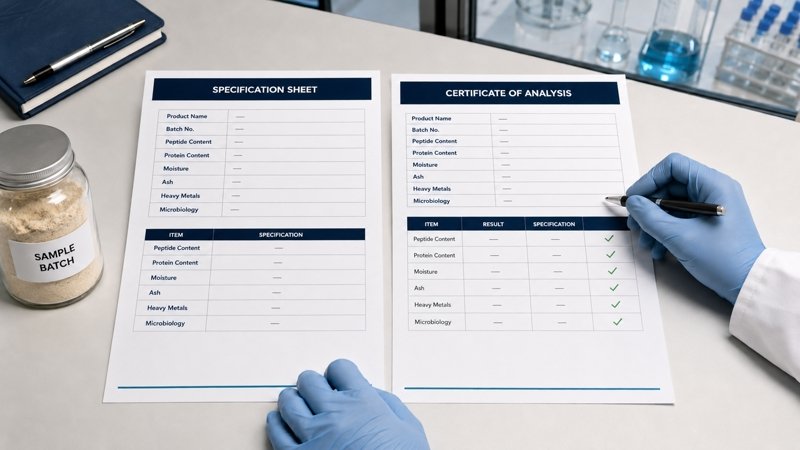
A specification sheet defines the supplier’s target requirements for the product. A Certificate of Analysis reports results for a particular batch. Buyers need both documents because a general target and an actual batch result serve different purposes.
When reviewing an Earthworm Peptide Powder COA, check:
- the correct product name;
- batch or lot number;
- test items and methods, if listed;
- specification limits;
- actual results;
- units of measurement;
- testing or release date, if available;
- responsible supplier or laboratory information;
- whether it covers the sample batch or proposed bulk batch.
Buyers should not ask only whether the supplier “has a COA.” They should determine whether the document is current, batch-specific, internally consistent, and relevant to the material being offered. For a more focused document review procedure, see Earthworm Peptide Powder COA Review.
Supplier Audit Questions for Earthworm Peptide Powder
A supplier audit does not always require an immediate on-site visit. An initial document and process review can reveal whether further verification is necessary.
Useful questions include:
- Can you provide the current specification sheet?
- Can you provide a batch-specific COA?
- Which items are included in routine batch release?
- Are heavy metals and microbiology tested for each batch or at another defined frequency?
- Is peptide content included in the specification and batch documentation?
- Which methods are used for peptide and protein testing?
- Is molecular weight information available if our project requires it?
- Is the sample taken from an available production batch or general sample stock?
- Can you provide the COA for the actual bulk batch before shipment?
- How are batch numbers connected to production and test records?
- How are out-of-specification results handled?
- What packaging and storage conditions are recommended?
- What are the standard MOQ and lead time?
- Which shipping options are available for our destination?
The answers should be documented wherever they affect acceptance criteria or purchasing conditions. Buyers needing general answers about documentation, supply, and product differences can also refer to the FAQ page.
Sample Evaluation and Bulk Batch Approval
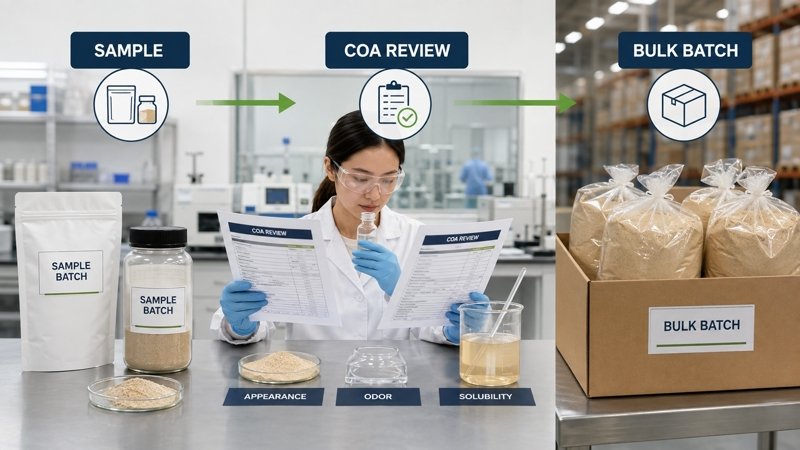
Sample evaluation should connect document review with practical product assessment. Depending on the application, buyers may examine:
- appearance and odor;
- solubility or dispersibility;
- COA and specification conformity;
- internal laboratory results;
- formulation compatibility;
- packaging and labeling;
- available batch status.
A useful additional control is to record the sample’s batch number, receipt date, storage condition, and internal test method. This creates a reference that can be compared with later purchase documents.
The sample batch and final bulk batch may not always have the same batch number. If a long interval passes between sample testing and PO placement, the original batch may have been sold or may no longer be available.
In that situation, the buyer should request the COA for the actual bulk batch and confirm that it meets the agreed specification, testing requirements, packaging requirements, and purchasing conditions. A retained sample from the bulk batch may also be requested when appropriate.
The Earthworm Peptide Powder Sample Evaluation explains the practical sample-review stage in greater detail. Sample approval supports a purchasing decision, but it does not guarantee that every future batch will be identical. Repeat orders still require batch-level review.
Earthworm Peptide Powder Safety and Testing Review Checklist
| Review Area | What Buyers Should Check | Why It Matters |
|---|---|---|
| Specification sheet | Product identity, target limits, methods, storage and shelf life | Defines the agreed product requirements |
| Batch COA | Batch number, actual results, units and release information | Confirms data for a specific batch |
| Peptide content | Result, limit, method and reporting basis | Supports peptide composition review |
| Protein content | Result, specification and testing basis | Provides a broader composition reference |
| Molecular weight | Profile, range and method if required | Supports hydrolysis and formulation evaluation |
| Moisture | Actual result and specification limit | Relates to handling, storage and quality control |
| Ash | Result, limit and batch consistency | Provides a supporting composition indicator |
| Heavy metals | Lead, arsenic, cadmium and mercury if required | Supports contamination risk review |
| Microbiology | Counts, pathogens, units and acceptance limits | Supports microbiological quality assessment |
| Appearance and odor | Color, powder condition and characteristic odor | Helps identify unexpected physical differences |
| Sample testing | Internal results, solubility and formulation compatibility | Connects documents with practical performance |
| Supplier quality control | Release procedure, test frequency and deviation handling | Shows how routine quality is managed |
| Batch documentation | Traceable lot numbers and relevant records | Connects production, testing and shipment |
| Packaging | Material, size, seal, label and moisture protection | Protects the powder during transport and storage |
| Storage | Temperature, humidity and handling instructions | Helps preserve quality after delivery |
| Lead time | Stock status and production schedule | Supports purchasing and production planning |
| Shipping | Method, destination and document requirements | Reduces delivery and import problems |
| Bulk order approval | Actual batch COA and agreed purchase conditions | Prevents approval based only on an earlier sample |
Common Buyer Mistakes
Common procurement errors include:
- requesting only price without defining testing requirements;
- accepting a COA without checking its batch number;
- focusing only on peptide content;
- ignoring heavy metals and microbiology;
- treating moisture and ash as irrelevant;
- assuming supplier documents meet every target market automatically;
- confusing Earthworm Peptide Powder with lumbrokinase;
- requesting enzyme activity testing for a peptide ingredient;
- approving a bulk order without reviewing the available batch;
- assuming one approved sample guarantees future batches;
- failing to confirm packaging and storage requirements.
Earthworm Peptide Powder is produced through enzymatic hydrolysis, but the finished powder is not positioned as an active enzyme ingredient. IU/mg, FU/g, LKU, fibrin plate assays, and enzyme activity grades belong to lumbrokinase-related evaluation rather than standard peptide powder quality testing.
Allworms Supply Notes
Allworms supports overseas B2B buyers with Earthworm Peptide Powder specification review, COA support, sample evaluation, and bulk supply discussions. For available batches, the specification sheet and relevant batch COA can be provided for evaluation.
Sample availability, MOQ, packaging, lead time, and shipping options can be discussed according to the buyer’s quantity, destination, intended application, and document requirements. The standard MOQ is usually around 1.5 kg, while normal lead time is generally 7–15 days after payment, subject to stock and production status.
FAQ
1. What safety standards should buyers check for Earthworm Peptide Powder?
Buyers should review composition, heavy metals, microbiology, moisture, ash, physical characteristics, batch documentation, packaging, and supplier quality controls against their market and application requirements.
2. What should an Earthworm Peptide Powder COA include?
It should identify the product and batch and report relevant actual results, specification limits, units, and available release information.
3. Why are heavy metals important in peptide powder sourcing?
Heavy metals testing supports contamination risk assessment for a biologically derived ingredient. Required items and limits depend on the destination market and finished product.
4. Why is microbiological testing important?
It helps buyers evaluate microbial control across raw material handling, processing, drying, packaging, and storage.
5. Should buyers review moisture and ash?
Yes. They are useful supporting indicators for handling, composition, storage, and batch consistency, although neither proves total product quality alone.
6. Is peptide content enough to judge quality?
No. Peptide content should be reviewed together with protein, contaminants, microbiology, physical characteristics, documentation, and formulation suitability.
7. Should molecular weight be included?
It may be included when relevant to the buyer’s technical requirements. The method and desired reporting format should be agreed in advance.
8. Is Earthworm Peptide Powder the same as lumbrokinase?
No. It is a hydrolyzed peptide ingredient, while lumbrokinase is evaluated as an active fibrinolytic enzyme ingredient.
9. Should buyers test a sample before ordering?
Sample testing is recommended when physical characteristics, solubility, internal laboratory results, or formulation compatibility affect approval.
10. Can one approved sample guarantee future bulk orders?
No. Buyers should review the actual bulk batch documentation because later orders may come from different production batches.
Request the Specification Sheet and Batch COA
Ask About Samples, MOQ, Lead Time and Shipping
This product is supplied as a B2B ingredient. Final formulation suitability, dosage, labeling, health claims, and regulatory compliance should be evaluated by the buyer according to the intended market and finished product use.
2 comments on “Safety Standards and Testing Requirements for Earthworm Peptide Powder: A B2B Buyer Guide”
Comments are closed.