For small trial orders, almost any supplier can look convincing.
Scale is where the truth comes out.
When global brands source earthworm protein powder at scale, they are not only buying a protein ingredient. They are buying process control, batch consistency, traceability, delivery discipline, and a supplier’s ability to support repeat production without chaos. That’s the real game.
Earthworm protein powder has been gaining attention as a high-protein functional ingredient with applications across dietary supplements, nutraceutical formulations, functional foods, and some specialized animal nutrition products. Research in the uploaded files describes earthworm as a protein-rich resource, often in the 60% to 70% range on a dry basis, with a valuable amino acid profile and growing interest as an alternative functional protein source.
But here’s the thing: interest is easy. Reliable bulk sourcing is harder.
If you’re a brand owner, importer, manufacturer, wholesaler, or ingredient distributor, this is what actually matters when sourcing earthworm protein powder at commercial volume.
Why buyers are looking beyond “just another protein”
Earthworm protein powder is not usually sourced as a commodity protein. Buyers are typically looking for something more specialized.
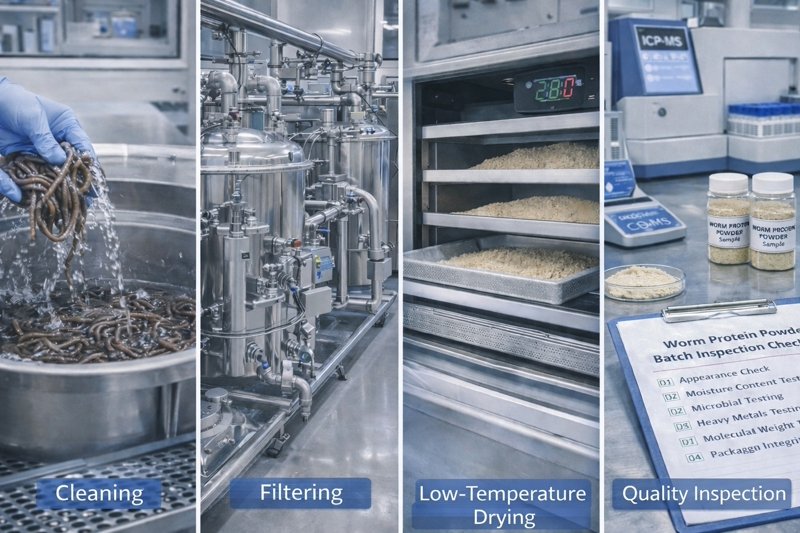
Earthworm protein powder is positioned as a protein-rich ingredient manufactured through a controlled process that includes raw material selection, cleaning, hydrolysis, centrifugal filtration, low-temperature drying, milling, and packaging. It is intended for supplements, nutraceuticals, and functional health product development.
That matters because global buyers today are rarely asking only one question: “What’s your price per kilo?”
They’re asking things like:
- Can this ingredient fit our formulation system?
- Can we get the same spec six months from now?
- Can you support pilot stage, then container-level repeat orders?
- Can your paperwork pass our internal review and customer audit?
- Can your lead time survive a busy season?
Honestly, that’s a smarter way to buy.
A protein ingredient may look fine on a spec sheet. Yet once it moves into capsules, powders, sachets, tablets, or blended formulas, weak sourcing choices start showing up fast: odor variation, moisture drift, poor flowability, unstable color, inconsistent protein values, or delayed replenishment.
That’s why global brands source differently when volume rises.
What “at scale” really means in earthworm protein sourcing
A lot of suppliers say they can do bulk. Fewer can do scale.
There’s a difference.
Bulk means they can sell you more than a sample. Scale means they can keep supplying the same material profile, with predictable documentation and delivery, across multiple production cycles.
In practice, global brands usually look at scale through five lenses:
1. Raw material control starts the whole story
If upstream raw material is unstable, everything downstream gets messy.
Earthworm protein powder starts with screened raw material, followed by separation, secondary cleaning, washing/hydrolysis, centrifugal filtration, low-temperature drying, sterilization, and packaging.
That process flow may sound basic, but for B2B buyers it’s a huge signal.
Why? Because ingredient consistency is built long before the finished powder is packed. If the raw earthworm source is mixed, poorly handled, or inconsistently cleaned, the final powder can vary in odor, ash, microbial load, and protein performance. And no one wants to explain that to a downstream customer.
Global brands therefore tend to prefer suppliers that can explain:
- Raw material origin
- Species used
- Screening and impurity removal steps
- Cleaning and separation controls
- How batches are standardized before drying
You know what? A supplier that cannot clearly explain the front half of the process usually becomes a problem in the back half too.
2. Processing technology matters more than brochures admit
At small order size, buyers often focus on appearance and price.
At scale, they start asking about process.
That’s because the process directly affects protein stability, moisture control, impurity removal, and batch repeatability. Your uploaded production information describes a controlled workflow using cleaning, hydrolysis, centrifugal filtration, low-temperature drying, milling, sterilization, and packaging.
Low-temperature drying, in particular, tends to matter for buyers who care about preserving ingredient quality through processing. Filtration and separation matter for cleanliness and consistency. Sterilization matters for export confidence. These are not flashy talking points, but they are exactly what procurement and QA teams look for.
Think of it like building a clean supply chain from stainless steel, not from marketing copy.
A good supplier should be able to answer, in plain language, how the process is controlled and where the biggest risks sit.
3. Specification consistency beats “best-case” numbers
One pretty COA is not a sourcing strategy.
For earthworm protein powder, a typical spec structure including protein, moisture, ash, selenium, heavy metals, and microbiological indicators such as total aerobic count, Staphylococcus aureus, moulds and yeasts, coliforms, and Salmonella.
That’s important because global buyers do not only evaluate the headline protein number. They care about the whole specification framework.
A supplier may advertise a strong protein value, but if moisture is unstable or micro control is weak, that material can still become a formulation headache or an import risk.
So what do experienced buyers do? They ask for pattern, not snapshots.
They want to see whether the supplier can keep delivering within the same operating window over time. Not once. Repeatedly.
For large-volume sourcing, the better question is not “What is your highest protein batch?” It is “What range do your normal commercial batches stay within, and how do you control drift?”
That question separates traders from actual process owners pretty quickly.
4. Documentation is not a side issue. It is part of the product.
This part gets overlooked until an order is already delayed.
Global brands sourcing at scale usually need more than a spec sheet. They need a documentation package that works for procurement, QA, regulatory review, and customs or import handling.
Depending on market and application, buyers often ask for:
- Specification sheet
- COA
- Micro and heavy metal results
- Production flow summary
- Packaging details
- Shelf life and storage conditions
- Sample-to-bulk consistency explanation
And honestly, this is where many sourcing projects stall. Not because the powder is unusable, but because the paperwork is thin, slow, or inconsistent.
A global brand does not want to keep chasing the supplier for every missing line item. If they have to do that during sampling, imagine what happens during repeat container planning.
5. Supply reliability is what turns a supplier into a partner
This is the unglamorous part. It’s also the part that keeps brands loyal.
At scale, buyers need confidence that the supplier can handle repeat ordering, forecast windows, and production scheduling. The uploaded materials for Allworms repeatedly position the company around consistent quality, scalable production, and reliable global supply.
That kind of positioning only matters if it shows up in execution.
A serious bulk buyer will usually test this in stages:
First, they review documentation.
Then they test samples.
Then they compare sample and pilot lot consistency.
Then they place a controlled commercial order.
Only after that do they consider larger volume planning.
That’s normal. In fact, it’s healthy.
Scaling an ingredient relationship should feel more like qualifying a factory than buying a spot-market raw material.
So how do global brands actually source earthworm protein powder?
Usually, the path looks something like this.
Start with application fit, not just ingredient curiosity
A buyer first asks where the powder will be used: capsules, tablets, powdered blends, solid beverages, compound nutrition products, or specialized feed/nutrition systems.
That determines the spec priorities. A beverage-oriented product may care more about dispersion and sensory management. A tablet buyer may care more about moisture and bulk density. A supplement brand may focus on label story, documentation, and batch consistency.
No serious buyer should skip this step. It’s like choosing tires before knowing whether the vehicle is for a highway truck or a mountain bike.
Then verify the production logic
Next comes process review.
The supplier should be able to explain how raw material is selected, cleaned, processed, filtered, dried, sterilized, and packed. In your uploaded production process file, those steps are clearly laid out, which is useful because it gives buyers a practical framework for technical review.
The more clearly a supplier explains the process, the easier it is for a buyer to trust scale claims.
Then test the paperwork and the sample together
A common mistake is testing only the sample.
But samples can be hand-picked. Smart buyers test whether the sample, spec sheet, and QC documents all tell the same story. If the protein, micro profile, and appearance line up consistently, confidence grows. If they don’t, it’s a warning sign.
Then evaluate commercial reality
This is where buyers ask the questions people sometimes avoid at the start:
- What is your MOQ?
- What is your standard lead time?
- What packaging do you support?
- Can you reserve production for rolling orders?
- Can you keep spec consistency across repeated lots?
- What happens if we scale from trial to regular purchasing?
That’s not being difficult. That’s being professional.
Common mistakes buyers make when sourcing at scale
Let me explain a few traps. They’re common, and they cost real money.
Choosing the cheapest quote too early
A low quote can look attractive until it triggers rework, shipment delay, or inconsistent batches. Then it becomes expensive in all the wrong ways.
Treating samples as proof of scale
A good sample proves only that a supplier can make a good sample.
Scale proof comes from documentation quality, process transparency, and repeat-lot performance.
Ignoring process differences
Two suppliers can both sell “earthworm protein powder,” but if their cleaning, filtration, drying, and sterilization controls are different, the end result can feel like two entirely different ingredients.
Focusing only on protein percentage
Protein content is important, yes. But it is not the whole sourcing decision. Moisture, ash, microbiology, heavy metals, packaging, and storage stability matter too. The uploaded product documents show exactly why spec review should be broader than one headline number.
Underestimating communication speed
A supplier that answers slowly during sampling usually does not become magically fast during a production problem.
That sounds blunt, but it’s true.
What reliable large-scale sourcing looks like
When a global brand finds the right supplier, the relationship starts feeling much simpler.
Specs become easier to compare.
Paperwork arrives faster.
Lead times become more predictable.
Forecast discussions get more realistic.
Product development teams stop worrying about whether the next batch will behave differently.
That’s the goal.
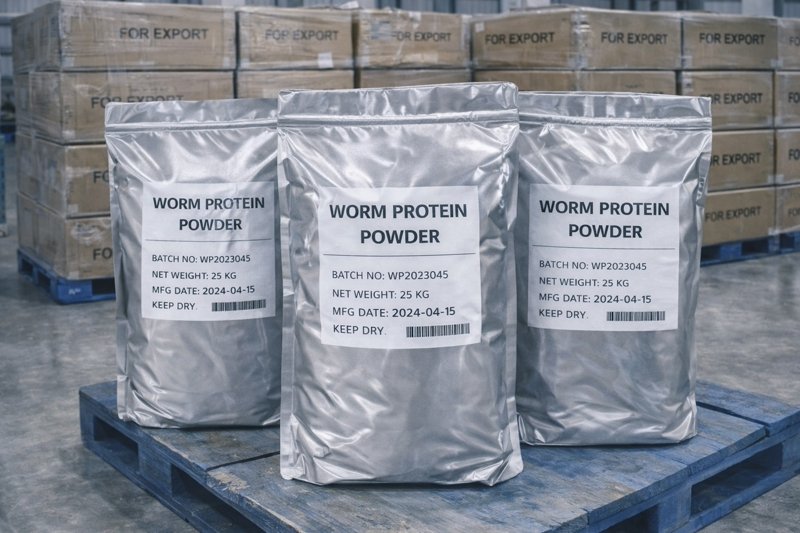
For earthworm protein powder, a supplier worth scaling with should offer more than raw material. They should offer manufacturing logic, stable QC standards, practical export readiness, and the ability to support growth without turning every order into a negotiation marathon.
And for buyers, that means sourcing becomes less reactive and more strategic.
Which is exactly what you want once your brand is no longer “testing the market” and is actually building it.
Final thought
Global brands do not source earthworm protein powder at scale by chasing the loudest supplier.
They source by checking who can keep quality steady, documents clean, process clear, and delivery reliable when the order stops being small and starts becoming serious.
That’s the difference between buying powder and building supply.
And in B2B, that difference is everything.
FAQs
1. What should buyers check first when sourcing earthworm protein powder in bulk?
Start with application fit, core specifications, and production process control. For bulk earthworm protein powder sourcing, the supplier’s raw material selection, cleaning steps, filtration, drying method, and QC framework matter as much as price.
2. Why do global brands ask about manufacturing process before placing large orders?
Because process consistency affects batch stability. A reliable earthworm protein powder manufacturer should be able to explain raw material screening, hydrolysis, centrifugal filtration, low-temperature drying, sterilization, and packaging controls.
3. Is protein content the main factor when choosing an earthworm protein powder supplier?
No. Protein content is important, but experienced buyers also review moisture, ash, microbiological limits, heavy metals, packaging, shelf life, and storage conditions for long-term procurement decisions.
4. How do brands reduce risk when scaling earthworm protein powder purchases?
They usually move step by step: document review, sample evaluation, pilot order, repeat-lot comparison, then larger commercial orders. That approach helps confirm whether the supplier can truly support stable earthworm protein powder bulk supply.
5. What makes a reliable earthworm protein powder supplier for global B2B buyers?
A strong supplier usually combines controlled upstream sourcing, clear specifications, stable QC, export-ready documentation, consistent communication, and the ability to support repeat delivery. In other words, not just product availability, but dependable large-scale earthworm protein powder supply.

Upgrade Your Nutrition Formulation Now
Contact us for bulk earthworm protein supply
One comment on “How Global Brands Source Earthworm Protein Powder at Scale”
Comments are closed.