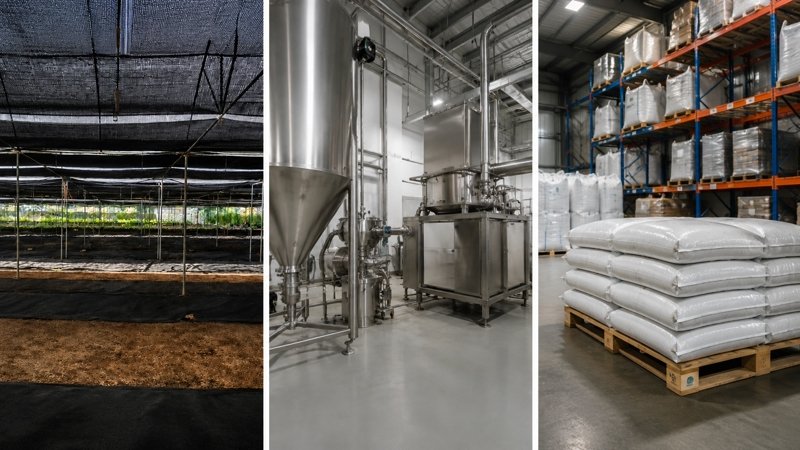
An earthworm protein powder supply chain should be evaluated as a connected system, not as separate claims about farming, manufacturing, or product quality. Before approving a sample, supplier, or bulk purchase, B2B buyers need to understand how the earthworm raw material moves from its source into processing, how the finished powder is identified, and which records connect the physical product with its specification and batch results.
This review is especially important for supplement brands, nutraceutical companies, food ingredient manufacturers, distributors, formulation teams, and purchasing departments working with a specialized ingredient. Supply chain transparency does not guarantee that every batch will be suitable. It does, however, help buyers identify gaps, ask better technical questions, reduce procurement risk, and make a more informed approval decision.
Quick Answer
B2B buyers should evaluate earthworm protein powder supply chain reliability by reviewing farming and raw material control, the connection between raw material supply and factory processing, batch documentation, COA, specification sheet, available batch information, packaging, storage guidance, and supplier communication.
A clear farm-to-factory system helps buyers understand how the ingredient is controlled before sample testing or bulk ordering. Buyers should also confirm which batch was sampled, which batch is currently available, and which batch will fulfill the purchase order.
Why Supply Chain Transparency Matters for Earthworm Protein Powder Buyers
A product name and price per kilogram reveal very little about the supply system behind an ingredient.
Earthworm Protein Powder begins with biological raw material. The reliability of the finished powder can therefore be influenced by upstream sourcing, raw material selection, handling, processing organization, packaging, storage, and batch identification. Buyers do not need access to every confidential production record, but they should receive enough relevant information to assess whether the supplier understands and controls these connections.
Supply chain transparency helps procurement and QA teams review:
- Where the earthworm raw material comes from
- Whether the supplier has a credible manufacturer-side supply connection
- How raw material is selected and transferred into production
- Whether batches can be identified through appropriate records
- How sample and bulk materials are connected to their documents
- Whether packaging and storage requirements are clearly communicated
- How repeat orders will be supported if a previous batch is no longer available
- Which documents may be required for internal approval or import preparation
This information helps reduce uncertainty. It should not be treated as a substitute for sample testing, document verification, receiving inspection, or the buyer’s own regulatory review.
General product formats and purchasing information are available on the Earthworm Protein Powder product page.
What “Farm to Factory” Means for Earthworm Protein Powder
In B2B sourcing, “farm to factory” describes the operational connection between earthworm breeding, raw material preparation, ingredient processing, finished-product release, and commercial supply.
A practical earthworm protein powder farm-to-factory chain may include:
- Earthworm farming or breeding
- Raw material collection and selection
- Cleaning and controlled handling
- Transfer into the production system
- Ingredient-level processing and drying
- Powder preparation
- Quality review and batch identification
- Packaging and storage
- Document preparation
- Sample or bulk-order communication
Buyers should not assume that the phrase “farm to factory” automatically means complete traceability. The supplier should be able to explain how these stages are connected and, where available, provide records that support the explanation.
The central procurement question is not whether a supplier can tell an attractive origin story. It is whether the supplier can connect the offered product with a defined specification, identifiable batch, appropriate documentation, and actual purchasing conditions.
Earthworm Farming and Raw Material Control
Raw material control begins before earthworms enter the production facility. Because farming is a biological activity, buyers may want to understand how the supplier manages raw material source, selection, handling, and delivery into production.
Useful questions include:
- Is the earthworm raw material supplied from a defined breeding base or from multiple sources?
- Which earthworm species or raw material description applies to the offered product?
- How are suitable raw materials selected?
- How are earthworms cleaned and handled before processing?
- How are incoming raw materials organized for production?
- Can the supplier explain its own role in farming, raw material supply, and manufacturing?
- What source or batch information can be provided where available?
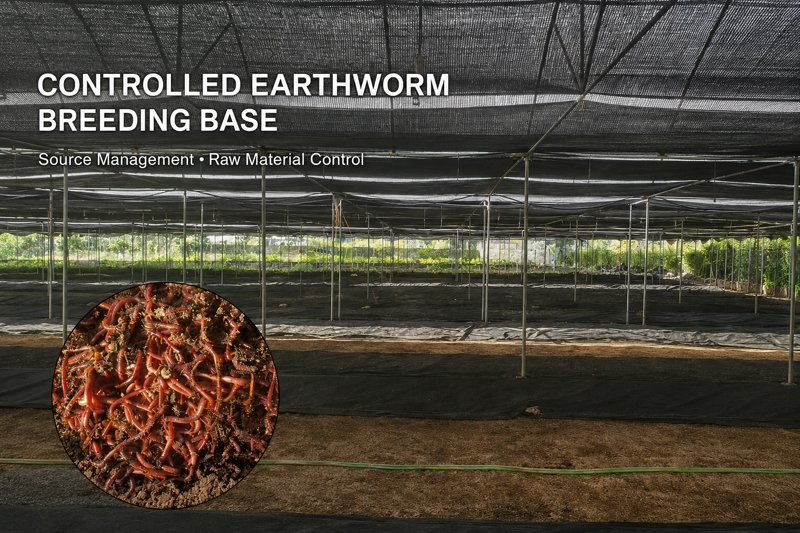
The appropriate level of detail depends on the buyer’s QA program and intended market. A small trial-order buyer may begin with a written explanation and product documents, while a larger or regulated customer may require a more formal supplier questionnaire.
Buyers should avoid interpreting an unsupported “natural source” statement as evidence of control. Source information becomes more useful when it can be connected to manufacturer-side knowledge, raw material handling, production organization, and batch documentation.
From Raw Material to Protein Powder Production
A reliable supplier should be able to explain the general logic of its earthworm protein powder production process without disclosing confidential parameters.
At ingredient level, the connection generally includes raw material selection, cleaning, controlled processing, separation or filtration where applicable, drying, powder preparation, inspection, and packaging. Each stage should lead logically to the next.
During supplier review, buyers can evaluate whether:
- The production description corresponds to Earthworm Protein Powder rather than Earthworm Peptide Powder or Lumbrokinase
- The supplier understands how raw material enters its production system
- The process description is consistent across the website, specification sheet, technical replies, and commercial documents
- The finished powder is assigned a batch identity
- Testing and packaging occur within an organized release process
- Production information is described accurately without unsupported claims
For a wider assessment of manufacturing capability, buyers can refer to How to Choose a Reliable Earthworm Protein Powder Manufacturer. In this supply chain review, manufacturer reliability matters specifically because it connects upstream raw material handling with downstream batch control.
Traceability and Batch Documentation
Traceability is useful only when it connects the material being discussed with identifiable records.
For Earthworm Protein Powder, a basic traceability framework should allow the buyer to connect:
- Product name
- Product grade or specification
- Batch number
- Manufacturing date
- Sample label
- Batch COA
- Applicable specification sheet
- Available inventory information
- Bulk packaging label
- Purchase order and supplier confirmation
A buyer should be able to follow the chain from the offered product to the sample, and from the sample to the batch proposed for commercial supply. Not every company will use the same record format, but the identities should remain clear.
One practical control is to create a “batch identity record” during supplier evaluation. This can be a simple internal file recording the sample batch number, COA date, specification version, sample receipt date, internal test result, and purchasing status. It prevents approval decisions from depending on disconnected email attachments or memory.
Another useful detail is document version control. If the specification sheet changes between sample evaluation and PO placement, the buyer should identify which version governs the order.
COA and Specification Sheet in Supply Chain Review
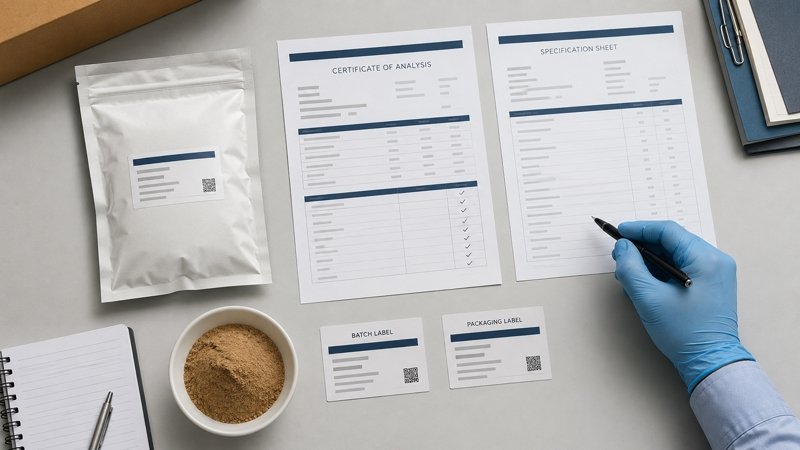
The specification sheet and COA serve different purposes:
- The specification sheet defines the target product requirements.
- The COA reports results or conformity information for a particular batch.
Within an earthworm protein powder traceability review, buyers should confirm that the specification reflects the exact product being offered and that the COA belongs to the sample, available inventory, or actual bulk batch under discussion.
Depending on the agreed scope, relevant fields may include protein content, amino acid profile, moisture, ash, heavy metals, microbiology, appearance, and other defined acceptance criteria. Not every parameter must appear in the same format, but the documents should be internally consistent and suitable for the buyer’s review.
The buyer should check:
- Product name and grade
- Batch number
- Manufacturing date
- Applicable specification version
- Test parameters and limits
- Actual batch results or conformity statements
- Whether the document refers to the material being supplied
A COA supports transparency only when its identity and commercial relevance are clear. A generic or unrelated COA cannot confirm the status of the actual shipment.
Supplier Documents Beyond the COA
A COA does not describe every part of a supply chain. Depending on the buyer’s approval process, supporting information may include:
- Specification sheet
- Product information sheet
- Packaging description
- Storage guidance
- Available batch information
- Sample identification and dispatch details
- Shipping or import documents where applicable
- Written confirmation of the batch allocated to the order
- Supplier questionnaire responses
These materials help establish a documented connection between product identity, batch status, handling requirements, and purchasing terms. The Earthworm Protein Powder Supplier Documents Beyond the COA provides a more detailed document review; for supply chain purposes, buyers should concentrate on whether the documents collectively describe the same material and transaction.
Sample-to-Bulk Specification Consistency
A transparent supply chain should support clear sample-to-bulk communication.
If a buyer evaluates a sample but places a purchase order several weeks or months later, the original sample batch may have been sold or may no longer contain enough inventory for the order. The sample and bulk order therefore do not always need the same batch number.
The practical requirement is sample-to-bulk specification consistency. Before shipment, the buyer should understand:
- Which batch supplied the evaluated sample
- Whether that batch remains available
- Which batch is allocated to the bulk order
- Whether the actual bulk batch meets the agreed specification
- Whether its COA and packaging information have been reviewed
An approved sample does not guarantee that every future batch will be identical or automatically acceptable. When a newer batch will be supplied, the buyer should review its batch-specific information before release. A structured comparison process is explained further in Earthworm Protein Powder Batch Consistency.
Packaging, Storage and Transportation in the Supply Chain
Supply chain management continues after production and testing.
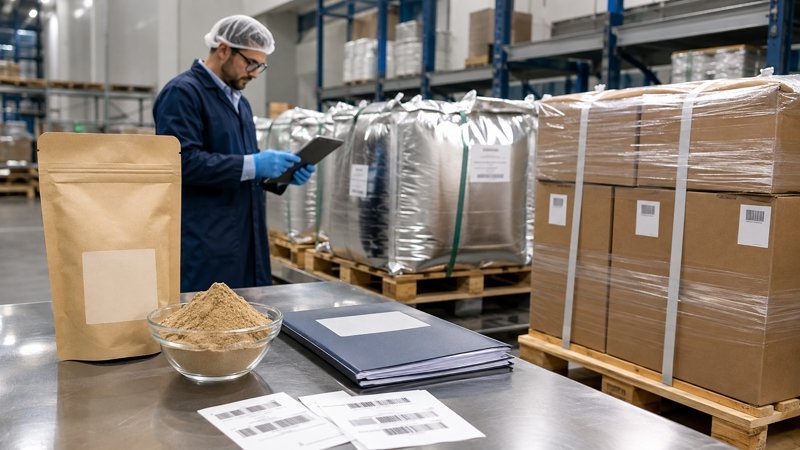
Suitable packaging, storage, and transportation planning help reduce quality risk during shipment and after delivery. Before confirming an order, buyers should check:
- Standard packaging format and net weight
- Inner liner and outer packaging
- Seal condition and moisture protection
- Product name and batch number on the label
- Recommended storage conditions
- Warehouse handling expectations
- Shipping method and expected transit arrangement
- Documents accompanying or corresponding to the shipment
- Receiving inspection requirements
At receipt, the buyer should compare the label, batch number, packaging quantity, COA, and purchase order. Any damaged seal, wet carton, incorrect label, or document mismatch should be recorded before the material is released internally.
E-E-A-T Signals Buyers Can Look For
For B2B sourcing, experience, expertise, authority, and trust are demonstrated through practical evidence rather than promotional language.
Useful signals include:
- Clear positioning of Earthworm Protein Powder as an ingredient
- A credible manufacturer-side connection
- Knowledge of earthworm raw material supply
- A consistent, ingredient-level production explanation
- Availability of COA and specification sheet
- Batch identification and documentation
- Sample support
- Clear packaging and storage guidance
- Accurate answers to technical inquiries
- Consistent information across sales and quality communication
- Willingness to explain limitations without overclaiming
No single signal proves supply chain reliability. Together, however, they help buyers distinguish a document-supported supplier from one relying mainly on general claims.
Supply Chain Questions Buyers Should Ask
Before sample or supplier approval, buyers should ask:
- Where does the earthworm raw material come from?
- How is the raw material selected, cleaned, and handled?
- Can you explain the general production flow?
- Can you provide the current specification sheet?
- Can you provide a COA for an available batch?
- Does the COA correspond to the sample or proposed bulk batch?
- What batch is currently available?
- What packaging format is used?
- What storage conditions are recommended?
- Which documents can be provided before testing or ordering?
- How do you support sample-to-bulk specification consistency?
- How will a newer batch be communicated for repeat orders?
Additional information about samples, MOQ, documentation, and ordering is available on the FAQ page.
Earthworm Protein Powder Supply Chain Evaluation Checklist
| Supply Chain Area | What Buyers Should Check | Why It Matters |
|---|---|---|
| Farming or raw material source | Defined source and supplier’s relationship with the farming system | Helps assess upstream visibility |
| Raw material selection | Selection criteria and applicable species or material description | Supports product identity |
| Raw material handling | Cleaning, handling, and transfer into production | Helps identify contamination or mix-up risks |
| Production connection | How raw material supply connects with the processing facility | Tests manufacturer-side credibility |
| Batch number | Presence on COA, label, and order documents | Connects records with physical material |
| Manufacturing date | Date shown for the relevant batch | Supports batch status and shelf-life review |
| COA | Batch identity and applicable results | Supports review of actual material |
| Specification sheet | Current acceptance requirements and version | Defines the product being purchased |
| Available batch information | Batch and quantity available when the order is planned | Prevents outdated sample assumptions |
| Sample batch confirmation | Sample batch number, label, and related COA | Creates an auditable evaluation reference |
| Packaging | Inner and outer format, sealing, label, and net weight | Protects and identifies the material |
| Storage guidance | Recommended conditions and handling after opening | Supports warehouse control |
| Shipping preparation | Shipping method, labels, and required documents | Reduces transport and import uncertainty |
| Supplier communication | Clear written answers and change notifications | Preserves the purchasing decision trail |
| Repeat order support | New-batch COA and specification confirmation | Supports continuing supplier approval |
Common Buyer Mistakes
Common supply chain evaluation errors include:
- Selecting a supplier mainly by price
- Accepting broad “natural source” claims without supporting information
- Failing to ask where the earthworm raw material comes from
- Reviewing a COA without checking its batch number
- Reviewing the COA and specification sheet separately
- Ignoring the specification version
- Failing to ask which batch is currently available
- Assuming the sample and bulk order must always have the same batch number
- Assuming one approved sample guarantees every future batch
- Ignoring packaging and storage during supplier qualification
- Failing to retain written batch confirmations
- Confusing Earthworm Protein Powder with Earthworm Peptide Powder or Lumbrokinase
- Giving more weight to promotional claims than document clarity
Allworms Supply Notes
Allworms is part of the manufacturer-side earthworm-derived ingredient supply system and supports overseas market development and international sales. Its supply system is connected with earthworm raw material supply and earthworm-derived ingredient production support.
For available Earthworm Protein Powder batches, a COA and specification sheet can be provided. Sample support may be available for qualified B2B buyers.
MOQ, lead time, packaging, and shipping options depend on the required specification, quantity, packaging requirement, destination, and available batch conditions. Buyers should confirm the applicable documents and actual batch information during sample evaluation and again before bulk shipment.
FAQ
1. What does farm-to-factory supply chain mean for Earthworm Protein Powder?
It describes the connection between earthworm farming, raw material selection and handling, ingredient processing, batch identification, testing, packaging, storage, and commercial supply. Buyers should evaluate how the supplier connects these stages rather than relying only on an origin claim.
2. What documents support Earthworm Protein Powder traceability?
The core records commonly include the specification sheet, batch COA, product and batch number, manufacturing date, sample label, packaging label, available batch information, and written order confirmation. Requirements may vary according to the buyer’s QA system and target market.
3. Why is the batch number important in supply chain evaluation?
The batch number connects the physical powder with its COA, manufacturing information, packaging label, sample record, and purchase order. Without a clear batch identity, buyers may be unable to confirm whether reviewed documents belong to the material received.
4. Should buyers review the actual bulk batch before shipment?
Yes. If the bulk material comes from a different batch than the approved sample, the buyer should review the actual bulk batch COA and confirm its compliance with the agreed specification before shipment. The batches do not need identical numbers, but their identities and specification status must be clear.
5. What E-E-A-T signals should buyers look for before supplier approval?
Buyers should look for manufacturer-side supply knowledge, clear raw material and production explanations, batch-specific documentation, accurate technical replies, sample support, packaging and storage guidance, consistent communication, and the ability to explain product limitations without exaggerated claims.
Review The Earthworm Protein Powder Supply Chain Before Approval
Request the COA, specification sheet, batch details, sample support, MOQ and shipping options
This product is supplied as a B2B ingredient. Final formulation suitability, dosage, labeling, claims, and regulatory compliance should be evaluated by the buyer according to the intended market and finished-product use.