Why lead time isn’t “just shipping time”
When buyers ask about lead time for international earthworm protein powder orders, they’re often really asking three things at once:
Will the goods be ready on time?
Will customs clear them smoothly?
And will the batch that arrives match the batch that was quoted?
That’s the real issue. Not just transit days.
For dietary supplement brands, nutraceutical ingredient distributors, pharmaceutical raw material buyers, and health product manufacturers, timing affects everything downstream—production schedules, inventory turns, launch dates, even whether a customer relationship starts smoothly or gets off on the wrong foot. One delayed raw material can jam the whole line. You know how it goes: one “small” delay turns into label rebooking, warehouse reshuffling, and a very uncomfortable email chain.
That’s why international procurement of Earthworm Protein Powder needs to be treated as a supply chain project, not a simple parcel shipment.
So, what’s included in lead time?
Here’s the thing: lead time for earthworm protein powder usually includes more than production.
A complete order cycle often covers:
- raw material scheduling
- manufacturing or batch allocation
- internal quality checks
- COA and supporting document preparation
- packing and export arrangement
- customs handling
- international transit
- destination clearance and final delivery
Some suppliers only quote the factory preparation window. Others quote from payment receipt to dispatch. A few quote door-to-door. That mismatch causes confusion all the time.
So before comparing suppliers, buyers should confirm one basic point: what exactly does “lead time” include? If not, two quotes that look similar may be completely different in practice.
A practical timeline for international earthworm protein powder orders
For many standard B2B orders, the process can be understood in four stages.
1. Order confirmation and spec lock
This is where the deal becomes real.
The supplier confirms product specification, quantity, packaging format, label requirements, destination country, shipping method, and payment status. If the buyer needs a customized protein content range, private label packing, a special particle size, or extra test items, this stage gets longer. Naturally.
For a standard bulk order, this step is often fast. For a custom order, it may take a few extra days because technical and sales teams both need to sign off.
2. Production or stock allocation
If the product is in ready inventory, this can move quickly. If the order needs fresh production, then the clock starts ticking in a more serious way.
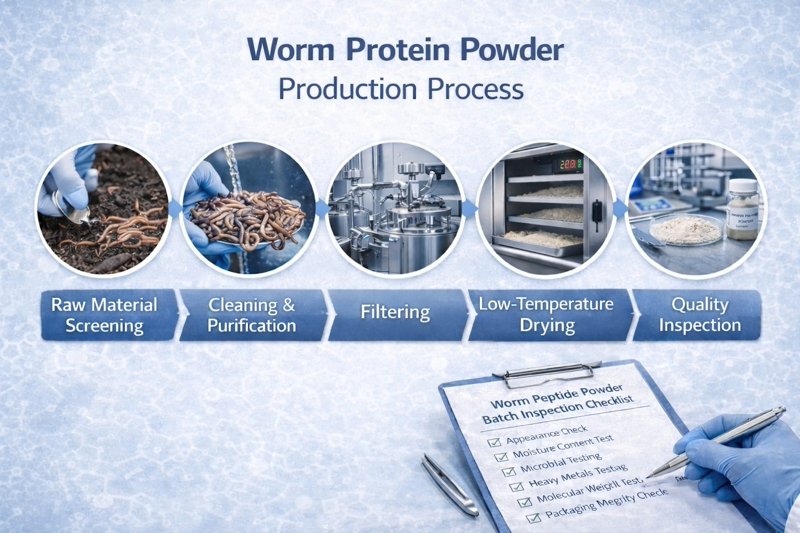
Earthworm protein powder is not a generic commodity like starch or sugar. Serious buyers usually care about source consistency, cleanliness, low-temperature drying, filtration, microbial control, and batch stability. And that means production needs a little discipline. Rushing sounds nice until it creates problems later.
For many international orders, a reasonable factory preparation window is often around 7 to 15 days after payment, assuming standard specifications and no unusual compliance request. That range is commonly used in B2B supply communication for this ingredient category and fits many routine export situations.
3. Testing, documents, and packing
This part is easy to underestimate.
Even if the powder is ready, the shipment may still be waiting on:
- COA finalization
- microbiological or heavy metal result confirmation
- commercial invoice and packing list
- origin-related documents if requested
- outer carton marking
- export booking
- palletization or moisture-protection packing
And honestly, this stage is where “almost ready” shipments tend to sit.
4. International transportation and customs
After dispatch, transit depends on route and shipping mode.
Courier or express air shipments move faster and are often used for samples, trial orders, or urgent small-volume commercial lots. Air freight works well for medium-volume urgent replenishment. Sea freight is more economical for larger bulk shipments, but the full cycle gets longer because port handling, customs, and local delivery add layers.
So when a supplier says, “production is finished,” that’s good news—but it is not the same as “your goods will arrive next week.”
What can extend the lead time?
A few delays are common, and most of them are preventable.
Custom specifications
If you need custom protein content, special mesh size, custom packaging, branded labels, or a non-standard test panel, the lead time will usually stretch. Not dramatically every time, but enough to matter.
Sampling before bulk confirmation
This is a smart step, not a problem. But it adds time.
Many B2B buyers first request a small sample for formulation review, odor assessment, solubility review, or third-party lab testing. That’s normal. In fact, it’s healthy. But it means the first commercial order often starts later than expected because the technical team hasn’t signed off yet.
Country-specific import requirements
Different markets have different expectations for ingredient documentation, declaration language, and product positioning.
A shipment that moves smoothly into one country may face more questions in another if the importer, HS code strategy, or documentation set is not prepared well. That’s why experienced exporters usually ask destination details early, not because they like paperwork, but because paperwork decides speed.
Booking delays and peak freight periods
Even when goods are packed, vessel space or flight space can affect dispatch timing. Seasonal pressure, holiday shutdowns, port congestion, and carrier schedule shifts can all create small gaps that become big ones.
That’s the frustrating part of logistics: the powder may be ready, the paperwork may be ready, and still the shipment isn’t moving yet.
Choosing the right shipping method
The best shipping mode depends on urgency, budget, and order size.

Courier / express
Best for samples, urgent small lots, or initial testing orders.
Fast, simple, and easy to track.
But cost per kilogram is high.
This works well when the buyer wants to move quickly and volume is still modest. For first cooperation, it often makes sense.
Air freight
Good for medium-volume commercial orders that need faster replenishment.
Transit is usually much shorter than sea freight.
Cost is higher, but for valuable functional ingredients, the trade-off can still be worth it.
Many supplement and nutraceutical buyers use air for early-stage market rollout, then shift to sea once monthly demand becomes stable.
Sea freight
Best for larger bulk shipments and cost-sensitive long-term purchasing.
Lower freight cost per unit.
Longer total cycle and more variables at both origin and destination.
Sea freight is often the right move for planned procurement, but only when the buyer builds in enough buffer stock. Trying to use sea freight for a last-minute stock rescue? That’s where headaches begin.
Hybrid model
Some experienced buyers split the order. A small urgent batch goes by air, and the balance follows by sea. It sounds a little contradictory, and in a way it is—but it works.
You pay more on part of the order to protect production continuity, while still controlling overall freight cost. Not glamorous, but very practical.
Packaging and logistics details that matter more than they seem
International buyers don’t just need the product. They need the product to arrive in sellable condition.
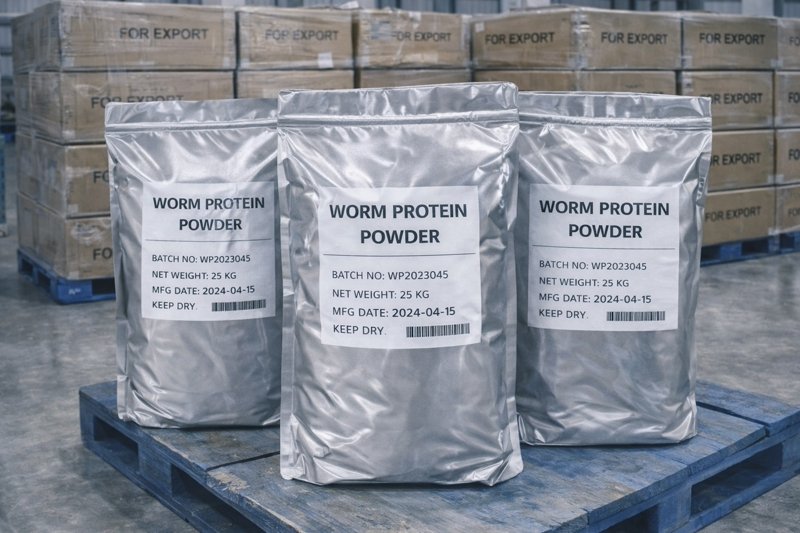
For earthworm protein powder, common concerns include moisture control, odor containment, batch traceability, and packaging strength during long transit. A clean-looking outer carton is nice, sure, but inner protection is what really matters.
Buyers should confirm:
- inner bag material and sealing method
- standard pack size per bag and per carton
- pallet availability
- batch number format
- storage recommendation
- whether packing supports long-distance export handling
This is especially important for buyers supplying dietary supplement applications, nutraceutical ingredient formulations, or other regulated product lines where traceability is part of routine vendor approval.
Documents that help orders move faster
A smooth shipment often depends on boring documents. Not exciting, but true.
Common export support documents may include:
- commercial invoice
- packing list
- COA
- product specification sheet
- other destination-specific compliance support, depending on the market
Serious importers should ask for the document set before the goods are booked, not after the flight has landed. That one habit saves time, again and again.
How good buyers shorten lead time without pressuring the supplier
Honestly, the best way to get faster deliveries is not to keep asking, “Can you ship sooner?”
It’s to make the order easier to execute.
That means:
- confirm the full specification early
- keep packaging requirements clear
- approve sample and test expectations before bulk production
- share destination and consignee details accurately
- align on shipping term and delivery target date from the start
- leave a realistic inventory buffer for repeat orders
The buyers who do this usually get more reliable timelines. Not because they shout louder, but because the supplier can actually plan around them.
And once repeat orders begin, lead time often becomes more stable because raw material planning, packaging preference, and document templates are already in place.
A final word for international buyers
Lead time for international earthworm protein powder orders is never just about how many days a truck or plane needs. It’s about coordination across sourcing, processing, testing, export documents, freight booking, and customs. Miss one link and the whole chain slows down.
So the smart question isn’t only, “How fast can you ship?”
It’s this: “How predictable is your process from batch preparation to final delivery?”
That question tells you much more about a supplier.
And for B2B buyers, predictability is gold. Maybe not flashy, but gold.
FAQs
1. What is the usual lead time for international earthworm protein powder bulk orders?
For standard bulk orders, the factory preparation time is often around 7 to 15 days after payment, while total delivery time depends on whether you ship by courier, air freight, or sea freight, plus destination customs clearance.
2. What factors most often delay earthworm protein powder international shipments?
The most common causes are custom specifications, waiting for final test reports, incomplete shipping documents, freight booking delays, and destination-country import clearance issues.
3. Is air freight better than sea freight for earthworm protein powder orders?
Air freight is usually better for urgent or medium-volume earthworm protein powder orders because it shortens replenishment time. Sea freight is more cost-effective for larger planned purchases where buyers have enough stock buffer.
4. What documents should importers request before shipping earthworm protein powder internationally?
Importers usually should confirm the commercial invoice, packing list, COA, product specification sheet, and any origin or compliance documents needed for the destination market before shipment is dispatched.
5. How can buyers reduce logistics risk when sourcing earthworm protein powder from overseas suppliers?
The best way is to lock specifications early, test samples before bulk purchase, confirm packaging and labeling details, check document readiness in advance, and plan repeat orders before stock becomes urgent.