Brief Outline / Skeleton
- H1: How Global Brands Source Earthworm Peptide Powder at Scale
- Why bulk sourcing is different from buying “just another powder”
- What serious buyers check first: raw material, process, specs, batch stability
- Why molecular weight, peptide content, and active enzymes stability matter
- How global brands assess quality documents, packaging, and logistics
- What makes a supplier suitable for long-term cooperation
- Image suggestions with alt text
- 5 FAQs
Global supplement brands don’t buy earthworm peptide powder the way a small lab buys a test sample.
They ask tougher questions. They look at the process. They compare COAs. They worry about customs, shelf life, batch taste, powder flow, formulation behavior, and whether the second shipment will match the first one.
Honestly, that’s where many sourcing problems begin.
A buyer may receive a nice-looking sample, make a trial capsule or beverage blend, and feel good about it. Then the bulk batch arrives, and suddenly the color is different, the odor is stronger, the peptide profile shifts, or the powder behaves badly in production. Not a small headache. More like a whole factory meeting before lunch.
That’s why global brands source earthworm peptide powder with a system. Not guesswork. Not price-only decisions. A system.
Earthworm peptide powder is a small-molecule bioactive peptide material produced from earthworm protein through controlled enzymatic hydrolysis and spray drying. It is positioned as a stable, non-active Enzymes ingredient for nutraceuticals, functional foods, beverages, powders, and capsule formulations. Allworms’ product as a peptide ingredient with protein content above 65%, peptide content above 30%, low fat, trace elements, and compatibility in complex formulations.
And here’s the thing: for large brands, the product itself matters, but the supplier system matters just as much.
It Starts With One Simple Question: Can This Supplier Repeat the Same Quality?
Bulk sourcing is not a one-time transaction. It’s closer to choosing a production partner.
A global brand may need one batch for pilot production, another batch for stability testing, and later repeated commercial orders. If the ingredient changes every time, the finished product changes too. That affects capsule fill weight, powder blend uniformity, taste masking, beverage clarity, label claims, and customer experience.
For earthworm peptide powder, repeatability usually depends on several points:
- controlled raw material sourcing
- stable hydrolysis process
- peptide molecular profile control
- filtration and purification
- spray drying conditions
- moisture control
- microbial control
- packaging and storage protection
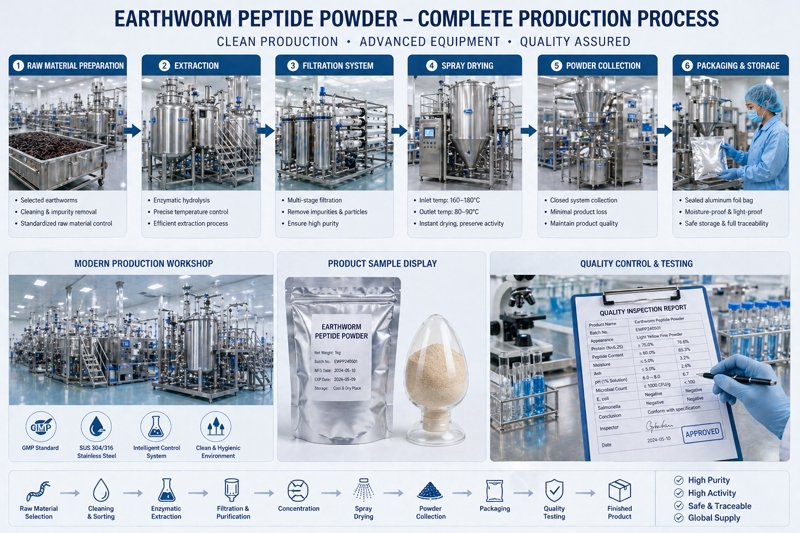
Allworms’ earthworm peptide process includes raw material selection, enzymatic hydrolysis, filtration and purification, spray drying, sterilization, and packaging, with the goal of keeping the peptide profile and performance consistent.
That sounds technical, but the business meaning is simple: global buyers want fewer surprises.
Why Earthworm Peptide Powder Is Not the Same as Lumbrokinase
This point matters because buyers sometimes mix up earthworm peptide powder and lumbrokinase.
They both come from earthworm-derived raw material, yes. But they are not the same kind of ingredient.
Earthworm peptide powder is a stable peptide-based ingredient. It does not rely on active enzyme function. It is commonly used for advanced nutrition systems, functional foods, beverages, capsule formulas, and nutraceutical blends.
Lumbrokinase, by contrast, is an active fibrinolytic enzyme complex. Its value depends heavily on enzyme activity, assay method, and activity retention during processing and shipping.
So when sourcing earthworm peptide powder at scale, global brands usually focus less on enzyme activity and more on:
- peptide content
- protein level
- molecular weight range
- solubility
- moisture
- ash
- heavy metals
- microbiology
- odor and color
- formulation compatibility
You know what? This difference can save a lot of confusion during purchasing. If a buyer expects enzyme activity from a peptide powder, the project may go sideways before it even starts. Allworms’ product description makes this distinction clear: earthworm peptide powder is a non-enzymatic peptide product with no active enzyme content, and spray drying helps improve stability in beverages, powders, and capsules.
For related product comparison, buyers can review Earthworm Peptide Powder and Lumbrokinase Powder.
The First Filter: Raw Material Control
For a small order, buyers may ask only for price and MOQ.
For a brand order, they ask: where does the material come from?
That question is not picky. It’s practical.
Earthworm-derived ingredients depend on raw material quality. Poor raw material control can lead to odor problems, unstable protein levels, inconsistent peptide output, and higher safety risk. Global brands often want to know the species, farming source, cleaning process, and whether the supplier has a stable upstream supply chain.
A strong supplier should explain raw material selection in plain language. No fog. No mystery.
For example, Allworms’ product information lists fresh earthworm sources such as Lumbricus rubellus / Eisenia fetida for earthworm peptide powder and gives basic product characteristics such as light yellow to brown powder, special fishy smell, cool dry storage, two-year shelf life, and 1kg/bag or 10kg/carton packaging.
That kind of detail helps procurement teams compare suppliers more calmly.
The Second Filter: Peptide Profile, Not Just Protein Content
Protein content is important, but peptide ingredients need more than a protein number.
A peptide powder with “high protein” may still perform poorly if the hydrolysis is not well controlled. The real sourcing question is: what kind of peptide profile does the buyer need?
For nutraceutical capsules, a broader peptide profile may be acceptable. For beverages, solubility and taste become more important. For advanced nutrition blends, low molecular weight and absorption positioning may matter more.
Research on earthworm protein digestion shows why peptides attract attention. One study reported that earthworm protein gastrointestinal digestion products showed antioxidant activity and identified thousands of peptide sequences after separation, with several peptides showing strong antioxidant activity. Another study found novel ACE inhibitory peptides from earthworm protein digestion products, including SSPLWER and RFFGP, which showed strong ACE inhibitory activity in vitro.
For brands, this does not mean they should make medical claims casually. They shouldn’t. Regulatory wording must match the target market.
But it does explain why earthworm peptide powder is being explored as a differentiated functional ingredient instead of just another protein powder.
The Third Filter: Non-Enzymatic Stability
Here’s a small contradiction: earthworm peptide powder is made through enzymatic hydrolysis, but the final ingredient should not behave like an enzyme.
That’s not a mistake. It’s actually the point.
During production, enzymes help break down earthworm protein into smaller peptide fractions. After processing, especially after spray drying, the final product is positioned as a stable peptide ingredient without active enzyme content. This matters because active enzymes can be sensitive. They may lose activity, react with other formula components, or create uncertainty during storage.
For global brands, non-active enzymes stability brings comfort. It makes the ingredient easier to use in:
- capsules
- powder sachets
- tablet blends
- functional drinks
- protein beverages
- complex nutraceutical formulas
Allworms states that its earthworm peptide powder is non-active enzymes, with no active enzyme content, and that this helps avoid activity loss during processing while improving formulation stability.
In plain words: it’s easier to build a product around a stable peptide powder than around a sensitive enzyme ingredient.
COA Review: The Paperwork Tells a Story
A professional buyer reads a COA like a customs officer reads a passport.
Not just the name. The details.
For earthworm peptide powder, global brands often check:
Identity and appearance: product name, botanical or animal source, color, odor, and powder form.
Core specification: protein, peptide content, moisture, ash, and sometimes molecular weight distribution.
Safety indicators: arsenic, lead, cadmium, mercury, and pesticide or contaminant risk if required.
Microbiology: aerobic plate count, molds and yeasts, coliforms, Salmonella, Staphylococcus aureus.
Batch information: batch number, production date, expiry date, and testing date.
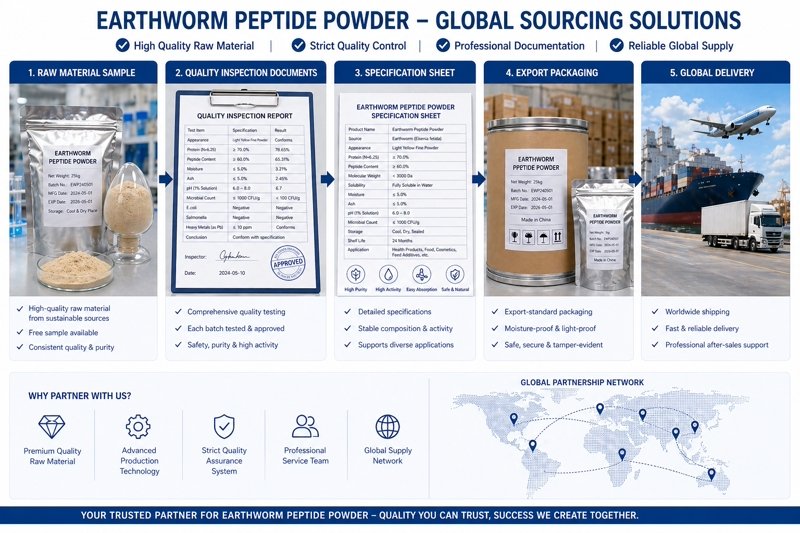
Allworms’ earthworm peptide specification includes protein ≥65, peptide content >30, moisture, ash, selenium, arsenic, cadmium, lead, mercury, aerobic plate count, Staphylococcus aureus, molds and yeasts, coliforms, and Salmonella.
That’s the kind of spec structure B2B buyers expect. Not fancy. Just clear.
Sampling Comes Before Bulk Orders — But Samples Aren’t the Whole Truth
Most global brands start with a sample.
A 10-100g or small pilot quantity can help test odor, color, solubility, flow, taste impact, and formula compatibility. It can also support internal R&D discussion.
But a sample is only the first handshake.
For real sourcing, brands need to ask: will the commercial batch match the sample?
That’s why serious buyers often request:
- sample COA
- recent bulk batch COA
- production process description
- shelf-life statement
- storage conditions
- packaging photos
- available batch quantity
- lead time
A good supplier won’t treat these questions as annoying. They’ll treat them as part of normal B2B cooperation.
Production Capacity: Scale Without Chaos
Scaling is not only about making more powder.
It’s about making more powder without quality drifting.
When a buyer moves from 1kg testing to 25kg, 100kg, or repeated container-level planning, the supplier’s production discipline becomes visible. Can they keep the same drying conditions? Can they control moisture? Can they separate batches clearly? Can they avoid cross-contamination? Can they pack in a way that protects the powder from humidity?
Earthworm peptide powder can be used in dietary supplements, functional foods and beverages, protein drinks, health beverages, powder blends, and advanced nutrition systems. These applications need different handling requirements, so a supplier that understands formulation is more useful than a supplier that only quotes price.
This is where Earthworm Protein Powder and peptide powder sourcing often overlap: both need raw material control, protein quality management, drying control, and batch testing. But peptide powder adds another layer — hydrolysis consistency.
Packaging: Not Glamorous, But It Saves the Product
Nobody gets excited about packaging during the first sales call.
But packaging can protect or ruin the ingredient.
Earthworm peptide powder should be stored in a cool, dry place. Moisture control matters because powders can clump, degrade, smell stronger, or become harder to use in automatic filling systems. For global shipments, packaging also needs to survive warehouses, customs inspections, air freight, sea freight, and local delivery.
Common B2B packaging options include 1kg aluminum foil bags, 10kg cartons, or customized packaging for larger orders. Allworms’ product details list 1kg/bag and 10kg/carton packaging for earthworm peptide powder.
A small note, but an important one: buyers should ask whether the inner bag is moisture-resistant and whether cartons are marked with batch details. It sounds boring. It prevents trouble.
Logistics: The Ingredient Must Arrive as Expected
Global brands source across borders, so logistics becomes part of quality.
A good supplier should be able to discuss:
- express sample shipping
- air freight for urgent orders
- sea freight for bulk orders
- customs declaration documents
- HS code discussion
- storage during transport
- lead time after payment
- destination-side import requirements
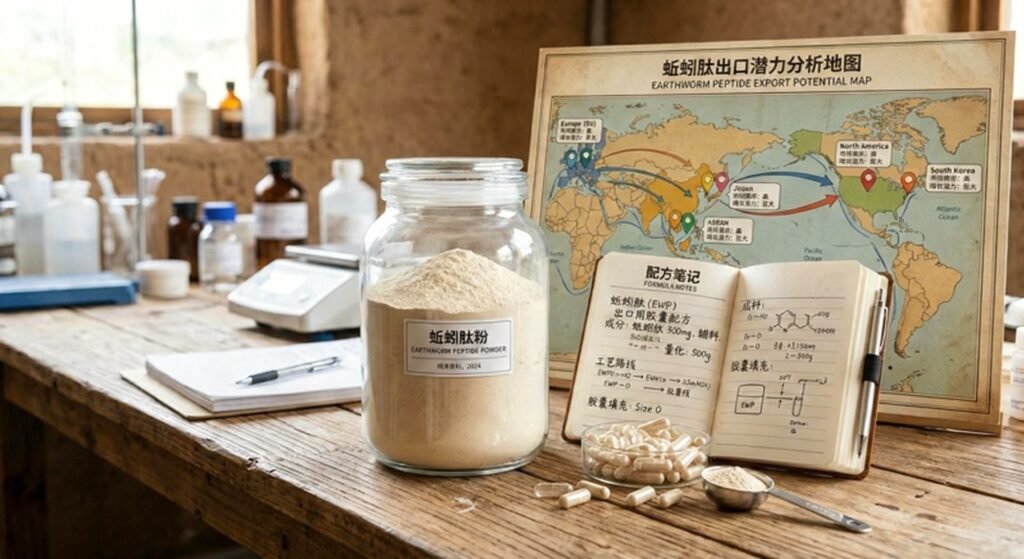
For sensitive markets, buyers should confirm whether earthworm-derived ingredients are accepted under local regulations. In the United States, Europe, Southeast Asia, and the Middle East, the compliance path may differ. Some buyers use earthworm peptide powder for dietary supplements; others use it for functional foods or R&D ingredients. The label language, claims, and documentation should match the market.
No supplier should promise one global answer for every country. That would be too neat — and not very real.
How Big Brands Compare Suppliers
Global brands rarely choose only by unit price.
They usually compare the full picture:
1. Product fit
Does the peptide powder match the intended formula?
2. Quality consistency
Can the supplier provide repeatable specs and batch documents?
3. Technical clarity
Can they explain hydrolysis, spray drying, peptide content, and non-enzymatic status?
4. Supply reliability
Can they support repeated orders without long delays?
5. Communication speed
Can they answer clearly when R&D or purchasing teams ask technical questions?
6. Export experience
Can they handle documents, samples, and shipping details?
Price still matters. Of course it does. But for a global brand, a cheap unstable ingredient is not cheap. It becomes expensive later — in reformulation, rejected batches, customer complaints, and lost launch time.
Why Direct Manufacturer Cooperation Often Works Better
Some buyers purchase through trading companies. That can work for simple raw materials.
But for earthworm peptide powder, direct manufacturer cooperation is often cleaner. The buyer can ask technical questions and get better answers. They can request custom molecular weight ranges. They can discuss moisture control, packaging, sample testing, and repeated batch supply without too many middle layers.
Allworms positions its earthworm peptide powder with advanced hydrolysis and spray drying technology, consistent batch quality, customizable molecular weight, and technical formulation support.
That combination matters because global brands don’t only need powder. They need a supplier who can help them keep production steady.
A Practical Sourcing Checklist for Earthworm Peptide Powder Buyers
Before placing a bulk order, buyers should confirm:
- product name and source
- protein content and peptide content
- molecular weight range, if required
- moisture and ash limits
- heavy metal limits
- microbial test results
- no active enzyme statement
- production process flow
- sample-to-bulk consistency
- packaging format
- shelf life and storage
- lead time
- available customization
- after-sales technical support
This checklist is not overkill. It’s just good sourcing hygiene.
Like checking the tires before a long road trip. Not dramatic, but wise.
Conclusion: Scale Comes From Control, Not Luck
Global brands source earthworm peptide powder at scale by looking beyond the sample bag.
They check raw material control. They review peptide specifications. They ask about non-enzymatic stability. They study COAs. They test formulation behavior. They confirm packaging and logistics. And most of all, they choose suppliers who can repeat quality batch after batch.
Earthworm peptide powder is a promising ingredient for nutraceuticals, functional foods, beverages, and advanced nutrition formulas. But the market will reward suppliers who can make it practical, stable, and commercially reliable.
That’s the quiet truth of large-scale sourcing.
Not hype. Not magic.
Just good science, steady production, and a supplier who answers the hard questions without blinking.
FAQs
1. How do global brands source earthworm peptide powder in bulk?
Global brands usually start with sample testing, then review COA documents, peptide content, protein level, microbial results, heavy metals, production process, packaging, shelf life, and supplier export ability before placing a bulk earthworm peptide powder order.
2. What specifications matter most when buying earthworm peptide powder wholesale?
The most important specifications include protein content, peptide content, molecular weight range, moisture, ash, heavy metals, microbial limits, appearance, odor, storage conditions, and whether the product is a stable non-enzymatic peptide ingredient.
3. Is earthworm peptide powder suitable for beverage formulations?
Yes, earthworm peptide powder can be used in functional beverages and powder drinks, but buyers should test solubility, taste, color, odor, and stability in the final formula before large-scale production.
4. Why is non-enzymatic earthworm peptide powder easier to formulate?
Non-enzymatic earthworm peptide powder contains no active enzyme content, so it is generally more stable during processing and storage. This makes it easier to use in capsules, powders, beverages, and complex nutraceutical blends.
5. What should buyers ask an earthworm peptide powder manufacturer before ordering?
Buyers should ask for product specifications, COA, sample availability, production process, molecular weight options, packaging details, shelf life, storage guidance, lead time, and whether the manufacturer can support repeated bulk supply.
Request Your Earthworm Peptide Sample Today
Contact us for non-active enzymes peptide supply