Outline
- What buyers are really asking when they say “suitable for my market?”
- Where earthworm protein powder looks strongest
- Where the fit is possible, but needs careful positioning
- Where the fit is weak, or at least not the easiest sell
- How to judge market fit before you invest in formulation, branding, or inventory
- Final takeaway
- FAQs

Need the honest answer? Sometimes yes. Sometimes absolutely not. And that’s exactly why this ingredient gets interesting.
Earthworm protein powder sits in a strange, promising corner of the ingredient market. On one hand, it offers high protein content, a good amino acid profile, and a growing body of research around antioxidant, antihypertensive, and immunomodulatory peptide activity after hydrolysis or digestion. On the other hand, it also comes with a very real challenge: market acceptance. A strong ingredient on paper can still stumble badly if the end market isn’t ready for it.
For dietary supplement brands, nutraceutical formulators, pharmaceutical ingredient buyers, wholesalers, and manufacturers, the better question is not “Is it good?” The better question is: “Is it good for this customer, this format, and this claim strategy?”
That’s where the commercial decision lives.
To make this easier, here are a few quick jumps:
Best-fit markets | Middle-ground markets | Weak-fit markets | Buyer checklist
What makes earthworm protein powder commercially interesting?
Let me explain. Buyers are not looking at earthworm protein powder just because it is unusual. They’re looking at it because unusual ingredients can create margin, differentiation, and a stronger technical story.
Research in your uploaded files shows earthworm protein is protein-dense and functionally active. One study reported proteins as the main components of earthworms at roughly 56–66% of dry weight, with essential amino acids and strong nutritional value, while another reported protein content ranging from 60% to more than 70%, with earthworm protein recognized in China as a new food resource since 2009.
That alone gets attention. But the bigger commercial hook is bioactivity.
Studies in your materials identified:
- antioxidant peptides from earthworm protein digestion, including AFWYGLPCKL, WPWQMSLY, and GCFRYACGAFY, with potential application in health foods,
- seven novel ACE-inhibitory peptides, including SSPLWER and RFFGP, linked to antihypertensive potential,
- immunomodulatory peptide potential from earthworm protein autolysates, with the study concluding that autolysis can be a reliable way to prepare peptides.
So yes, there is a story here. A real one. Not just marketing fluff.
Still, a good story is not the same thing as a good market fit.
Where the fit looks strongest
Dietary supplements and nutraceutical brands
This is probably the clearest target market.
Why? Because supplement buyers usually care about three things: function, novelty, and format flexibility. Earthworm protein powder can play into all three.
The science in your files supports positioning around peptide-rich functionality, especially where brands are building cardiovascular support, antioxidant support, or wellness-adjacent formulations. The antihypertensive angle is especially notable: the Food Bioscience paper identified active ACE inhibitory peptides and described earthworm protein as a promising functional food ingredient for hypertension management.
That does not mean a supplier should jump straight to bold disease claims. Of course not. But for B2B buyers creating structure/function style concepts, the ingredient has room.
It also helps that this category is already comfortable with powders, capsules, tablets, sachets, and blended systems. A novel protein ingredient can be worked into:
- peptide capsules
- cardio-health blends
- antioxidant support products
- active nutrition concepts
- premium wellness formulas
And here’s the thing: supplement consumers often tolerate unusual sources better than mainstream food shoppers do, especially when the value proposition feels clinical, targeted, or premium.
For nutraceutical brands chasing differentiation, earthworm protein powder is not a mass-market vanilla whey play. It’s more like a specialty bioactive raw material. That makes a difference.
Functional food developers with a technical audience
This market can work well too, especially when the brand is already operating in “science-forward” or “advanced nutrition” territory.
The uploaded research repeatedly frames earthworm protein as a functional food resource, not just a bulk protein. The antioxidant peptide study specifically says the work contributes to the application of earthworm proteins as antioxidants in health foods, while the ACE peptide study says earthworms not only have nutritional value but can also be used as functional food.
That matters.
A general consumer might hesitate at the ingredient origin. But a niche functional food buyer? They may focus more on peptide functionality, hydrolysis profile, and formulation performance.
That makes earthworm protein powder more suitable for:
- specialty functional powders
- clinical-style nutrition concepts
- targeted healthy aging lines
- cardio-support food concepts
- recovery-oriented blends
It is less suitable for cheerful mass retail snacks with broad family appeal. Same ingredient, very different market logic.
Pharmaceutical ingredient and pharma-adjacent buyers
This is another strong area, with one important caveat: the fit is stronger as a research-backed bioactive ingredient platform than as a simple commodity protein powder.
Your uploaded review on earthworm extract summarizes antithrombotic, antioxidant, anti-inflammatory, antibacterial, antiviral, wound-healing, and antifibrotic activity across various earthworm-derived bioactive agents, including lumbrokinase and related compounds.
That broader pharmacological landscape makes earthworm-derived materials highly relevant to pharma-adjacent buyers, especially those exploring:
- active fractions
- peptide ingredients
- enzyme-linked applications
- cardiovascular support ingredients
- translational research pipelines
The key is positioning. A pharmaceutical buyer usually won’t be impressed by a vague “natural super protein” pitch. They’ll want characterization, process control, impurity control, specification consistency, and a realistic discussion of what is studied at protein level versus peptide level versus enzyme level.
Honestly, that’s not a drawback. It’s a filter. Serious buyers prefer that tone.
Where the fit is possible, but needs care
Manufacturers and private-label producers
For manufacturers, earthworm protein powder can be commercially attractive, but only when the downstream sales story is already defined.
A manufacturer asks practical questions:
Can I source it consistently?
Can I standardize it?
Can I process it?
Can I keep the bioactive story intact?
Can I sell the finished form without endless education costs?
Your production-process file is useful here. It describes a process including selection, separation of earthworms from soil and debris, repeated cleaning, mechanical washing/hydrolysis, centrifugal filtration, low-temperature drying, pulverizing, sterilization, and packaging.
That kind of process language helps reassure B2B buyers that this is not some vague cottage-industry material. It can be discussed as a controlled ingredient process.
Still, manufacturers should pay close attention to:
- odor and sensory impact
- powder fineness and flowability
- compatibility with capsule and tablet systems
- claim substantiation by market
- customer education burden
So yes, manufacturers can do well with it. But only when they are selling to a defined niche, not trying to force it into every customer brief.

Wholesalers and dealers
Wholesalers can move earthworm protein powder effectively when they target specialized channels. That part is crucial.
If the sales network already serves:
- traditional-health buyers
- specialty supplement brands
- functional ingredient traders
- cardiovascular support product developers
- advanced raw-material formulators
then the ingredient has room.
If the network mostly serves generic sports nutrition, mainstream beauty-from-within, or low-cost bulk protein buyers, the fit gets shaky fast.
Why? Because this ingredient is not a simple volume game. It’s a story-plus-science game.
Wholesalers do best when they can package the product with:
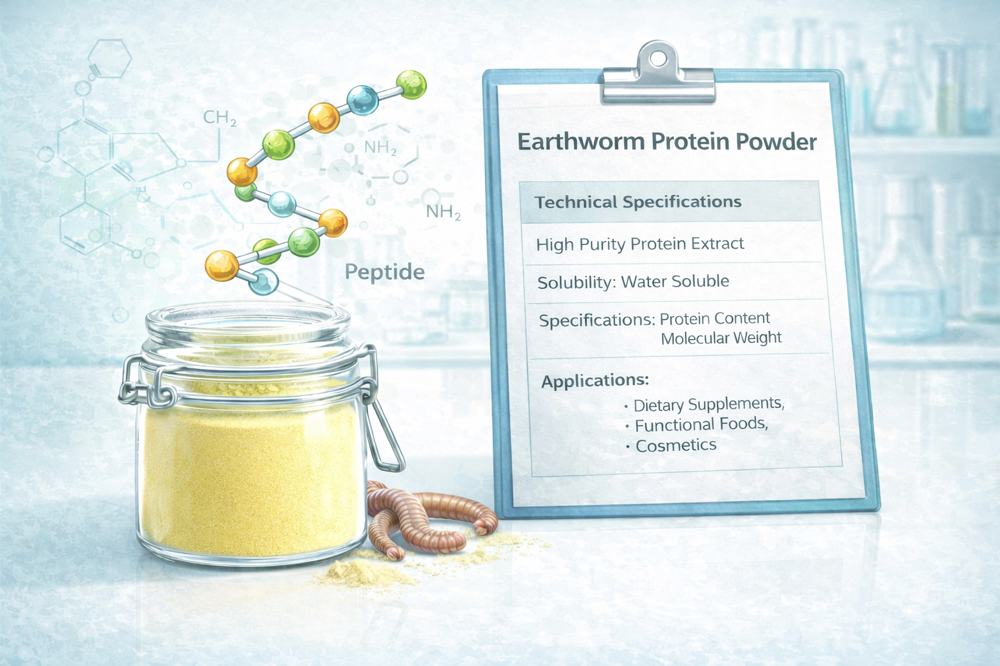
- technical sheets
- purity or composition data
- positioning guidance
- claim boundaries
- application suggestions
Without that, the ingredient can feel too unfamiliar, even if the science is solid.
Where the fit is weaker
Mainstream cosmetics suppliers
This is where buyers should slow down a bit.
Could earthworm-derived bioactives have cosmetic relevance? Maybe, especially in antioxidant, anti-aging, skin-repair, or wound-related research contexts. The review in your files discusses antioxidant, anti-inflammatory, wound-healing, and anti-aging potential in broader earthworm extract literature.
But is earthworm protein powder itself the most natural fit for the mainstream cosmetics supply chain? Not really.
Cosmetic buyers typically want:
- very clean sensory profiles
- elegant INCI-friendly positioning
- easy storytelling
- low consumer resistance
- straightforward regulatory documentation
Earthworm protein powder may face friction on all five.
So for cosmetics suppliers, this is more of a niche innovation ingredient than an easy hero raw material. It may work in specialized biotech-style or high-concept cosmetic development, but it is not the obvious first-choice ingredient for broad cosmetic lines.
That’s not a criticism. It’s just market reality.
The real issue nobody should ignore: acceptance
You know what? This is the piece that often gets skipped.
An ingredient can have excellent peptide science and still fail because the market says, “No thanks.”
Earthworm protein powder has a perception gap. For some regions and buyer groups, it can be seen as novel, sustainable, and functionally rich. For others, it may trigger hesitation around familiarity, taste expectations, or brand image.
That means your target market matters more than usual.
If your customer base values:
- novel bioactives
- evidence-led positioning
- specialist health applications
- sustainable alternative proteins
- premium differentiation
you’ve got something to work with.
If your customer base values:
- instant familiarity
- broad family appeal
- simple taste-first positioning
- mainstream beauty language
- low-education products
the ingredient becomes harder to sell.
That’s the contradiction, and it makes perfect sense once you say it out loud: earthworm protein powder can be highly promising because it is unusual, and harder to commercialize for the exact same reason.
How to judge if it fits your target market
Before launching, a buyer should ask:
1. Are you selling protein, or are you selling function?
If the answer is bulk protein, this is probably not the easiest route. If the answer is peptide-linked function and differentiation, the fit improves a lot.
2. Does your customer accept novel animal-derived ingredients?
Some markets will lean in. Others will step back. Be brutally honest here.
3. Is your product format compatible with a technical story?
Capsules, tablets, sachets, and premium powder blends generally work better than casual everyday food formats.
4. Can you support the ingredient with documentation?
A serious B2B pitch needs more than enthusiasm. It needs composition data, process details, and a disciplined claims strategy.
5. Are you targeting the right segment?
This ingredient usually performs better in specialized health channels than in general retail.
So, is earthworm protein powder suitable for your target market?
Yes—if your target market is specialized, science-aware, and open to novel functional ingredients.
It is especially suitable for:
- dietary supplement brands
- nutraceutical developers
- functional food companies with a technical audience
- pharmaceutical ingredient buyers
- specialized wholesalers and manufacturers serving those segments
It is less suitable for:
- broad mass-market food brands
- generic protein products
- mainstream beauty and cosmetic channels without a very specific innovation angle
That’s the commercial truth of it.
Earthworm protein powder is not for everybody. Frankly, that may be its advantage. In the right hands, it becomes a differentiating ingredient with research-backed peptide potential and a strong technical narrative. In the wrong market, it becomes a hard sell with too much explanation attached.
And in B2B, explanation costs money.
FAQs
1. Is earthworm protein powder a good fit for dietary supplement brands?
Yes, especially for dietary supplement brands looking for novel bioactive protein ingredients with antioxidant, peptide, or cardiovascular support positioning. It tends to fit better in capsules, tablets, and premium wellness blends than in mass-market products.
2. Can nutraceutical manufacturers use earthworm protein powder in functional formulations?
They can, particularly when the goal is to create differentiated nutraceutical formulations around peptide activity rather than simple protein fortification. Research in your files supports antioxidant, ACE-inhibitory, and immunomodulatory potential after hydrolysis or digestion.
3. Is earthworm protein powder suitable for pharmaceutical ingredient development?
It can be suitable for pharmaceutical ingredient development when buyers are interested in characterized bioactive fractions, peptide systems, or research-based functional applications. It is a better fit as a specialized active platform than as a generic protein raw material.
4. Do cosmetics suppliers benefit from using earthworm protein powder?
Usually only in niche cases. Cosmetics suppliers may find some interest in broader earthworm-derived bioactive research, but earthworm protein powder itself is not the easiest mainstream cosmetic ingredient because of sensory, perception, and positioning challenges.
5. What should wholesalers check before buying earthworm protein powder in bulk?
Wholesalers should check processing consistency, specification support, target-channel acceptance, and whether their buyers want a science-led specialty ingredient. Bulk success depends less on raw volume and more on selling to the right specialized customer base.