
For B2B ingredient buyers, lumbrokinase batch consistency is a key quality-control point between sample approval and bulk purchasing. A sample may look acceptable in appearance, activity, COA documentation, and initial formulation testing, but that does not automatically mean every future bulk batch will match the same requirement.
Lumbrokinase is an earthworm-derived fibrinolytic enzyme ingredient used in dietary supplement, nutraceutical, enzyme formulation, and research-related applications. Because it is an enzyme ingredient, buyers should review activity, assay method, unit expression, storage, packaging, and batch documentation carefully before confirming a bulk order. This article explains how buyers can connect sample testing, COA review, specification comparison, supplier communication, and final order approval into one practical purchasing-control process.
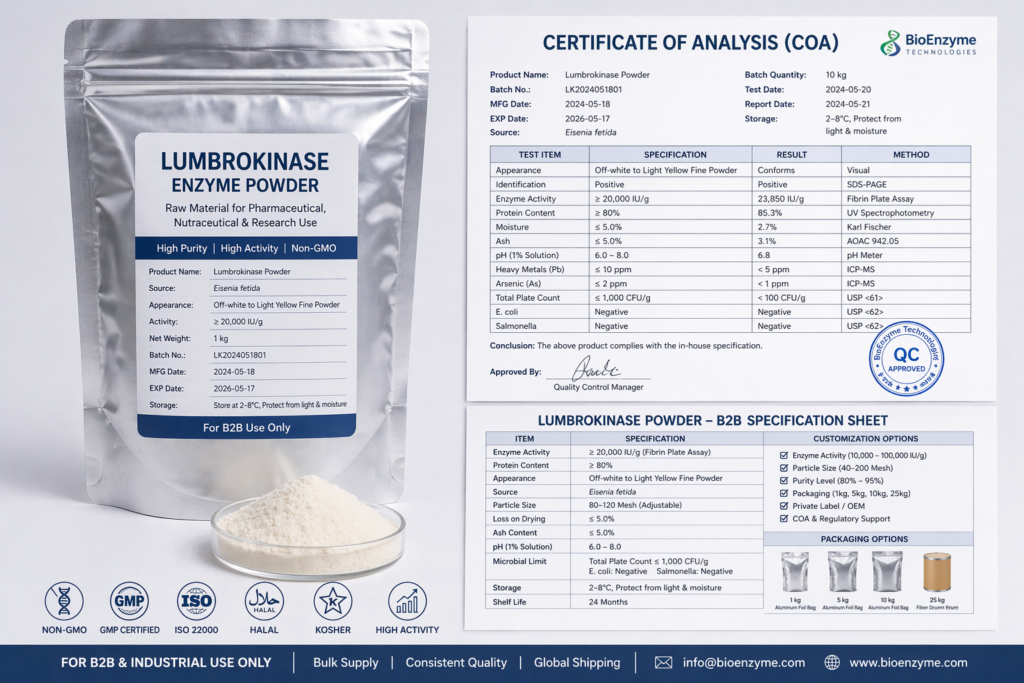
Quick Answer: What Does Lumbrokinase Batch Consistency Mean?
Lumbrokinase batch consistency means that the sample batch and future bulk batch can meet the same agreed specification, activity requirement, assay method, documentation standard, packaging condition, and delivery plan. Buyers should not approve a bulk order only because one sample test result looks acceptable. Before purchasing, they should confirm the COA, specification sheet, activity unit, assay method, batch number, test date, storage condition, and supplier’s repeat supply ability.
Why Lumbrokinase Batch Consistency Matters for B2B Buyers
Approving a lumbrokinase sample is only the first step. The real purchasing risk appears when the buyer moves from a small sample to a paid bulk order.
For enzyme ingredients, batch consistency matters because activity performance is not evaluated only by weight or appearance. Buyers often need to check whether the activity result was tested by the same method, reported in the same unit, and supported by batch-specific documents.
For lumbrokinase buyers, common quality concerns include:
- Whether the bulk batch matches the approved sample specification
- Whether the COA result is batch-specific
- Whether the assay method is clearly stated
- Whether activity is reported in IU/mg, FU/g, LKU, U, or another unit
- Whether the supplier can explain the testing basis
- Whether storage and shipping conditions may affect enzyme stability
- Whether future repeat orders can follow the same quality standard
For a broader first-step review, buyers may also refer to Lumbrokinase Sample Evaluation. For document comparison, Lumbrokinase COA vs Specification Sheet explains how the specification sheet defines the target standard while the COA shows actual batch results.
Technical Explanation: From Sample Testing to Bulk Order Approval
1. Start With Sample Testing, But Do Not Stop There
Sample testing helps the buyer check appearance, solubility, formulation compatibility, COA information, and activity testing direction. However, the sample may come from one batch, while the bulk order may be produced from another batch.
Before placing a bulk order, buyers should ask a direct question:
Can the future bulk batch match the same specification and activity requirement as the approved sample?
This is especially important when the sample is used for internal R&D, pilot production, capsule testing, powder blending, or third-party laboratory evaluation.
2. Review the COA and Specification Sheet Together
A lumbrokinase specification sheet describes the target quality standard. It may include appearance, source, activity requirement, assay method, moisture, ash, heavy metals, microbiology, packaging, storage, and shelf life.
A COA shows the actual test results for a specific batch. It should include batch number, test date or manufacturing date, activity result, assay method, and key quality-control results.
Buyers should not review only one document. The specification sheet answers, “What standard should the product meet?” The COA answers, “What did this batch actually test as?”
For more detail, see Lumbrokinase COA vs Specification Sheet.
3. Confirm the Assay Method Before Comparing Activity
Lumbrokinase activity can be affected by assay method, substrate, incubation condition, laboratory procedure, calculation method, and unit expression. A result reported as IU/mg should not be casually compared with FU/g, LKU, or U unless the assay basis is understood.
The fibrin plate assay is commonly discussed in lumbrokinase activity evaluation because it directly relates to fibrin-related enzymatic activity. However, even when two suppliers both mention fibrin plate testing, the detailed method may still differ.
Before approving a bulk order, buyers should confirm:
- Which assay method was used?
- Was the same method used for the sample and the bulk batch?
- What unit is reported?
- Is the result based on IU/mg, FU/g, LKU, U, or another system?
- Can the supplier explain the testing basis?
For further reading, see Fibrin Plate Assay for Lumbrokinase Activity and Lumbrokinase Activity Units.
4. Compare the Sample Batch and Bulk Batch Carefully
The sample batch and bulk batch do not need to be numerically identical in every item, but they should meet the same agreed specification. Buyers should compare the approved sample COA with the proposed bulk batch COA before shipment whenever possible.
Important comparison points include:
- Product name and source
- Batch number
- Activity result
- Activity unit
- Assay method
- Appearance
- Moisture
- Heavy metals
- Microbiology
- Packaging
- Storage condition
- Manufacturing date or test date
- Shelf life
- Delivery timeline
This helps avoid approving a supplier based on one acceptable sample while receiving a bulk batch with unclear documentation or different testing assumptions.
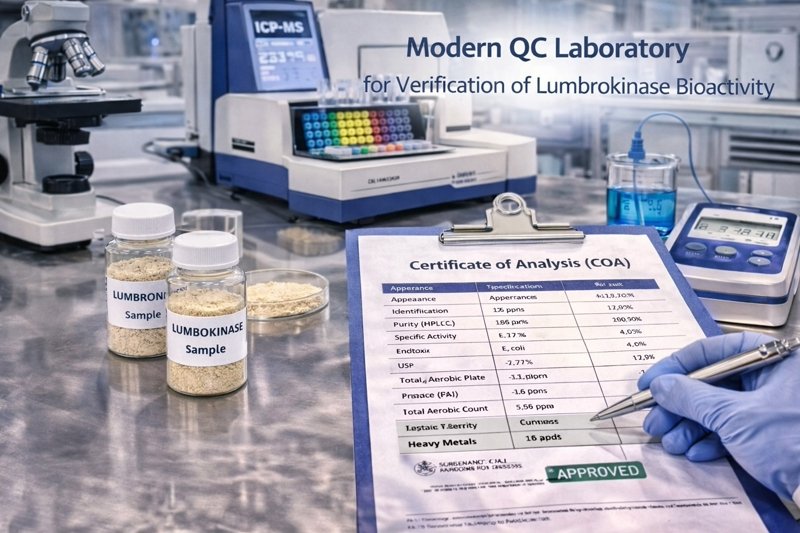
Sample Stage vs Bulk Order Stage
| Review Item | Sample Stage | Bulk Order Stage |
|---|---|---|
| Batch number | Confirm the sample batch number on the COA | Confirm the bulk batch number before shipment |
| COA | Review available sample COA | Request batch-specific COA for the bulk order |
| Specification sheet | Check target product standard | Confirm the bulk order uses the same agreed specification |
| Activity result | Evaluate whether the sample meets the requested activity | Confirm the bulk batch meets the same activity requirement |
| Assay method | Check whether the method is stated clearly | Confirm the same method is used for bulk batch testing |
| Activity unit | Identify IU/mg, FU/g, LKU, U, or other unit | Avoid comparing values across different unit systems without method review |
| Appearance | Check color, odor, powder form, and visible condition | Confirm bulk batch appearance is within specification |
| Moisture | Review sample moisture result | Confirm bulk moisture is controlled for storage stability |
| Heavy metals | Check Pb, As, Cd, Hg or relevant local requirements | Confirm bulk batch results meet the required limits |
| Microbiology | Review total plate count, coliforms, Salmonella, and Staphylococcus aureus where applicable | Confirm bulk batch microbiology meets the agreed standard |
| Packaging | Check sample packaging condition | Confirm bulk packaging size, inner bag, drum, label, and sealing method |
| Storage condition | Confirm cool, dry, sealed storage requirements | Confirm storage instructions and transport handling |
| Lead time | Understand sample dispatch time | Confirm production and delivery time for the bulk quantity |
| Shipping method | Check sample courier route and document requirements | Confirm bulk shipping method, DDP availability, customs documents, and destination requirements |
| Supplier confirmation | Ask basic sample questions | Request written confirmation on specification, batch, COA, packaging, lead time, and repeat supply ability |
Buyer Checklist for Approving a Lumbrokinase Bulk Order After Sample Testing
| Checklist Item | What Buyers Should Confirm |
|---|---|
| Approved sample record | Keep the sample batch number, COA, test result, and internal evaluation notes |
| Bulk batch match | Confirm the bulk batch follows the same agreed lumbrokinase specification |
| COA availability | Request a COA for the available or proposed bulk batch |
| Specification sheet | Compare the bulk order specification with the approved sample standard |
| Activity requirement | Confirm the activity level and acceptable range before purchase |
| Assay method | Confirm whether the same assay method is used for sample and bulk testing |
| Activity unit | Clarify whether results are reported in IU/mg, FU/g, LKU, U, or another unit |
| Appearance | Confirm color and powder condition are consistent with the specification |
| Moisture and ash | Review values related to powder quality and storage condition |
| Heavy metals | Check compliance with the buyer’s target market requirements |
| Microbiology | Confirm microbial indicators meet the required standard |
| Packaging | Confirm bag size, drum/carton packing, label, and sealing details |
| Storage | Confirm cool, dry, sealed storage and handling requirements |
| Lead time | Confirm production or dispatch time before payment |
| Shipping | Confirm shipping method, destination, customs requirements, and DDP possibility |
| Repeat supply | Ask whether the supplier can maintain similar documentation and specification for repeat orders |
| Final confirmation | Confirm all agreed details in writing before bulk order approval |

Common Mistakes or Misunderstandings
Mistake 1: Assuming the Sample Batch and Bulk Batch Will Always Be Identical
A sample may come from an existing batch, while the bulk order may come from a new or different batch. Buyers should confirm whether the bulk batch can match the same specification before payment.
Mistake 2: Comparing Only the Activity Number Without the Assay Method
For lumbrokinase, activity numbers are meaningful only when the method and unit are understood. IU/mg, FU/g, LKU, and U are not always directly interchangeable because assay conditions and calculation methods may differ.
Mistake 3: Ignoring COA Batch Number and Test Date
A COA without a clear batch number or date is difficult to connect to the actual delivered product. Buyers should confirm that the COA belongs to the sample batch or bulk batch being evaluated.
Mistake 4: Not Confirming Whether the Bulk Order Uses the Same Specification
Some buyers approve a sample but do not confirm whether the bulk order is based on the same activity grade, appearance standard, moisture limit, microbiology requirement, and packaging condition.
Mistake 5: Not Confirming Packaging and Storage Conditions
Lumbrokinase is an enzyme ingredient. Packaging, sealing, moisture protection, and storage conditions matter for handling and quality control. Buyers should confirm packaging before shipment, especially for international delivery.
Mistake 6: Approving a Supplier Without Asking About Repeat Order Consistency
One acceptable sample does not prove long-term supply reliability. Buyers should ask whether the supplier can support repeat batches with COA, specification sheet, stable testing approach, and clear lead time.
Mistake 7: Focusing Only on Price
Low price may appear attractive, but missing COA details, unclear assay method, vague activity units, or unstable delivery can create higher purchasing risk. For enzyme ingredients, documentation quality and supplier reliability are part of the real cost.
How Supplier Communication Reduces Bulk Order Risk
Before approving a lumbrokinase bulk order, buyers should ask suppliers practical and direct questions:
- Is the bulk batch from the same batch as the sample, or a new batch?
- Can you provide the COA for the available bulk batch?
- Does the bulk batch follow the same specification as the sample?
- What assay method is used for activity testing?
- What activity unit is used on the COA?
- Can the supplier explain the difference between different activity units if needed?
- What is the standard packaging size?
- What storage condition is recommended?
- What is the lead time after payment?
- Can DDP shipping be arranged to the destination?
- Can future repeat orders follow the same specification and documentation standard?
These questions help buyers compare suppliers more effectively. For more supplier comparison guidance, see How to Compare Lumbrokinase Suppliers When Activity Units Differ.
Allworms Supply Notes
Allworms Bio-Tech Co., Ltd is a manufacturer of earthworm-derived ingredients including lumbrokinase. Buyers can review the Lumbrokinase product page for product-level information, source, activity range, packaging, and supply details.
Allworms can provide COA and specification sheet for available batches. Buyers may request sample evaluation before bulk orders. A 100 g sample may be available for qualified B2B buyers, with international freight usually paid by the buyer.
The standard MOQ is usually around 1.5 kg, depending on product specification. Standard lead time is usually 7–15 days after payment. DDP door-to-door shipping may be available for selected destinations. Bulk order details should be confirmed based on specification, quantity, packaging, and destination.
For buyers still reviewing the basic product background, What Is Lumbrokinase? Source, Activity and B2B Supply Guide provides a broader explanation of source, activity, and B2B supply considerations. For common purchasing questions, buyers may also visit the FAQ page.
This product is supplied as a B2B ingredient. Final formulation suitability, dosage, labeling, health claims, and regulatory compliance should be evaluated by the buyer according to the intended market and finished product use.
FAQ
1. What is lumbrokinase batch consistency?
Lumbrokinase batch consistency means the sample batch and future bulk batch can meet the same agreed specification, activity requirement, assay method, COA documentation, packaging condition, and delivery standard.
2. Is sample approval enough before placing a bulk lumbrokinase order?
No. Sample approval is an important first step, but buyers should also confirm the bulk batch COA, specification sheet, activity result, assay method, activity unit, packaging, storage, lead time, and shipping arrangement before order approval.
3. Why should buyers compare the COA and specification sheet together?
The specification sheet defines the target standard, while the COA shows actual test results for a specific batch. Reviewing both documents helps buyers confirm whether the delivered batch meets the agreed quality requirement.
4. Why do activity units matter for lumbrokinase batch comparison?
Lumbrokinase activity may be reported in IU/mg, FU/g, LKU, U, or other units. These values are not always directly interchangeable because assay methods and laboratory conditions may differ. Buyers should confirm the method before comparing activity numbers.
5. What should buyers ask before approving a lumbrokinase bulk order?
Buyers should ask for batch number, COA, specification sheet, activity result, assay method, activity unit, packaging details, storage condition, lead time, shipping method, and supplier confirmation on repeat order consistency.

Need to Confirm Lumbrokinase Batch Consistency Before Bulk Order Approval?
Contact us to request COA, specification sheet, sample evaluation, MOQ, lead time, pricing, and shipping details.