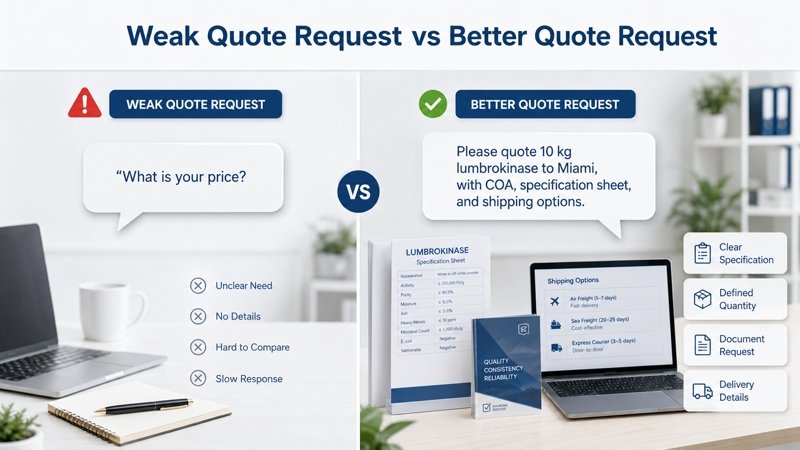
Requesting a useful lumbrokinase quotation requires more than asking for a price per kilogram. A supplier must understand what material the buyer needs, how much is required, where it will be delivered, which documents must be reviewed, and whether the inquiry is for screening, testing, trial production, or an immediate purchase.
A complete request helps the supplier prepare a quotation that reflects the correct specification, packaging, shipping scope, and project stage. It also helps the buyer compare offers on a more consistent basis.
This guide focuses specifically on the information B2B buyers should prepare before contacting a lumbrokinase supplier. It is intended for supplement brands, nutraceutical companies, ingredient distributors, contract manufacturers, purchasing teams, formulation teams, and other commercial ingredient buyers.
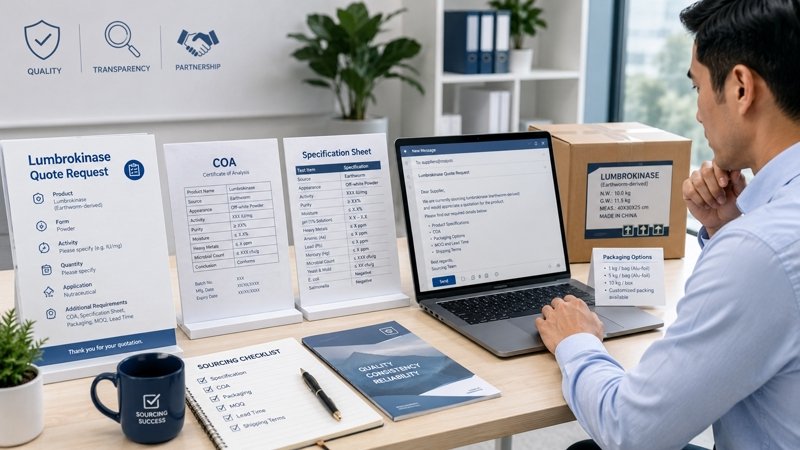
Quick Answer: What Is Needed to Request a Lumbrokinase Quote?
To request a lumbrokinase quote, provide the product requirement, target activity specification if known, preferred activity unit, intended quantity, sample requirement, destination, shipping preference, document requirements, packaging preference, expected timeline, buyer role, and project stage.
A supplier cannot normally prepare a reliable quotation from quantity alone. Specification, packaging, destination, documents, shipping terms, and delivery expectations must also be defined.
Why Quote Preparation Matters for B2B Buyers
An incomplete inquiry often produces an incomplete quotation.
For example, “Please quote lumbrokinase” does not tell the supplier:
- Which activity specification is required
- Whether the buyer needs a sample or commercial quantity
- Whether shipping must be included
- Which documents are required
- Whether standard packaging is acceptable
- Whether the inquiry is exploratory or PO-ready
The supplier may respond with general information, but the quotation may need to be revised once the buyer provides the missing details.
This creates unnecessary email exchanges and may delay internal review. It can also lead buyers to compare offers that are based on different specifications or delivery conditions.
A better approach is to prepare the technical and commercial requirements before requesting the quote.
Early-Stage Supplier Screening vs PO-Ready Inquiry
The amount of information required depends on the buyer’s purchasing stage.
| Inquiry Stage | Buyer Objective | Information to Provide |
|---|---|---|
| Early-stage screening | Determine whether the supplier may fit the project | General application, expected quantity, destination country, required documents, project status |
| Technical evaluation | Review material before testing | Target specification, activity unit, assay expectations, sample requirement, COA and specification sheet |
| Trial-order inquiry | Purchase material for formulation or pilot work | Confirmed quantity, specification, packaging, destination, shipping preference, required timeline |
| PO-ready inquiry | Obtain final commercial terms | Full delivery details, actual quantity, agreed specification, batch-document requirements, packaging and shipping terms |
| Repeat-order inquiry | Confirm continued supply | Previous specification, new quantity, required delivery period, destination and document expectations |
An early-stage buyer does not need to provide every purchase-order detail. However, the inquiry should still be specific enough for the supplier to understand the likely commercial requirement.
What Buyers Should Prepare Before Requesting a Quote
1. Product Requirement
Identify the requested ingredient clearly as lumbrokinase powder and state the intended B2B application.
Examples include:
- Dietary supplement formulation
- Nutraceutical product development
- Enzyme ingredient formulation
- Distributor stock evaluation
- Contract manufacturing project
- Research-related ingredient evaluation
This information helps the supplier understand the type of documents and technical information that may be required.
Buyers who need basic product details before requesting a quotation can first review the Lumbrokinase product page.
2. Target Specification or Activity Requirement
State the target activity requirement when it has already been determined by the buyer’s formulation team, laboratory, customer, or product specification.
Include:
- Required activity value
- Preferred reporting unit
- Whether the value is a minimum requirement
- Whether a specific assay basis must be followed
Lumbrokinase activity may be reported using IU/mg, FU/g, LKU, U, or another laboratory-specific system. These values should be reviewed together with the assay method and reporting basis.
A quotation request does not need to contain a full technical discussion of activity units. However, buyers should avoid asking suppliers to convert one unit directly into another without confirming the substrate, standard, sample preparation, incubation conditions, calculation method, and laboratory protocol.
When the activity requirement is not yet known, the buyer can request available specifications for internal review.
3. Intended Purchase Quantity
Provide the quantity currently being considered.
This may be:
- A 100 g evaluation sample
- A trial quantity
- A small bulk order
- A first commercial order
- Repeat bulk supply
The supplier needs the intended quantity to prepare relevant commercial terms and packaging information.
Buyers should avoid requesting a quotation for a large theoretical volume when the project is still at the sample stage. A realistic quantity produces a more useful quotation.
Detailed purchasing conditions can be reviewed separately in MOQ and Lead Time for Lumbrokinase Bulk Orders.
4. Sample Requirement
State whether a sample is required before purchase.
The quotation request should briefly explain:
- Requested sample quantity
- Testing purpose
- Required specification
- Documents needed with the sample
- Expected testing period
For example, a formulation team may need a sample for internal compatibility testing, while a purchasing team may need third-party activity testing before supplier approval.
The purpose does not need to be described in detail, but it should be clear enough for the supplier to prepare the appropriate sample and documents.
5. Target Market and Buyer Role
State the market in which the finished product is expected to be sold and explain the buyer’s role.
The buyer may be a:
- Supplement brand
- Ingredient distributor
- Contract manufacturer
- Nutraceutical company
- Formulation developer
- Purchasing department
- Research organization
- Trading company
This context helps the supplier understand whether the inquiry is related to formulation, resale, supplier approval, import planning, or immediate procurement.
Smaller companies preparing their first commercial project may also refer to Lumbrokinase Supplier for Small Supplement Brands.
6. Document Requirements
List the documents required at the quotation stage.
Common examples include:
- Certificate of Analysis
- Product specification sheet
- Assay method information
- Country-of-origin information
- Packaging information
- Storage conditions
- Manufacturing and expiry information
- Supplier questionnaire
The buyer should also clarify which COA is required.
A representative COA may be sufficient for initial screening. A sample-batch COA may be needed for laboratory evaluation. Before a commercial shipment, the buyer may need the COA for the actual available batch.
This distinction helps avoid confusion later in the purchasing process.
7. Packaging Preference
State whether standard supplier packaging is acceptable or whether a specific format is required.
Relevant details may include:
- Preferred net weight per bag
- Inner aluminum foil bag requirement
- Fiber drum requirement
- Smaller inner packs
- Neutral label requirement
- Custom label requirement
- Outer-carton preference
Packaging can affect material handling, warehouse storage, production dispensing, and quotation confirmation.
For example, a contract manufacturer may prefer smaller sealed packs to reduce repeated opening during production. A distributor may prefer a different outer-pack format for storage and resale.
Packaging preferences should therefore be communicated before the supplier issues a final quotation.
8. Destination and Shipping Preference
Provide the delivery destination in sufficient detail:
- Country
- City
- State or province
- Postal code
The buyer should also state the preferred shipping arrangement, such as:
- DHL or another international courier
- DDP door-to-door shipping, where available
- Delivery to the buyer’s freight forwarder
- Supplier pickup or another agreed arrangement
A request for DDP should include the delivery location. “DDP to the USA” or “DDP to Europe” is usually too broad for a practical quotation.
The quotation request does not need to become a complete shipping discussion. The purpose is simply to define whether freight and delivery services should be included in the supplier’s offer.
9. Expected Purchase Timeline
Explain when the buyer expects to move forward.
Useful descriptions include:
- Early supplier screening
- Sample testing planned this month
- Trial order expected next month
- Pilot production planned next quarter
- PO expected after internal approval
- Repeat order required before a specified date
The expected timeline helps the supplier check stock, production scheduling, document preparation, and shipping feasibility.
Buyers should distinguish production lead time from total door-to-door delivery time. International transit and customs clearance occur after production or dispatch preparation.
10. Project Stage and Decision Process
A useful quotation request should explain what happens after the supplier responds.
For example:
- Technical team will review documents first
- Sample testing is required before supplier approval
- Purchasing team is collecting three quotations
- Customer approval is needed before the distributor orders
- The project is ready for a purchase order
- The buyer is planning a repeat order under an existing specification
This information helps the supplier provide a response that matches the buyer’s actual next step.
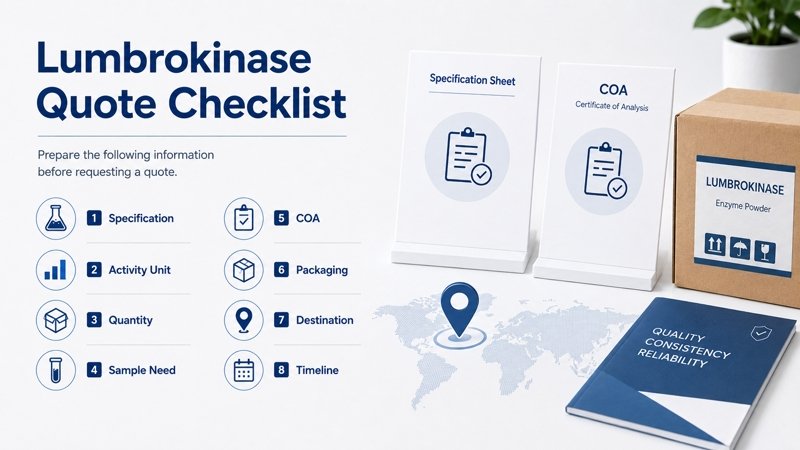
Buyer Checklist for a Lumbrokinase Quote Request
| Information | What the Buyer Should Provide |
|---|---|
| Product | Lumbrokinase powder and intended ingredient application |
| Specification | Target activity requirement or request for available options |
| Activity unit | IU/mg, FU/g, LKU, U, or other unit if relevant |
| Quantity | Sample, trial quantity, small bulk order, or repeat supply |
| Sample | Required quantity and testing purpose |
| Buyer role | Brand, distributor, manufacturer, trader, R&D team, or purchaser |
| Target market | Intended finished product market |
| Documents | COA, specification sheet, assay information, origin or other documents |
| Packaging | Standard packaging or preferred pack size and format |
| Destination | Country, city, state or province, and postal code |
| Shipping | DHL, DDP if available, freight forwarder, or other arrangement |
| Timeline | Sample date, trial-order date, PO schedule, or target delivery period |
| Project stage | Screening, testing, trial order, PO-ready, or repeat purchase |
Weak Quote Requests vs Better Quote Requests
Example 1
Weak:
“What is your price?”
Better:
“We are evaluating lumbrokinase powder for a dietary supplement project. Please provide your available specification, standard packaging, MOQ, COA, specification sheet, and quotation for delivery to Dallas, Texas, USA.”
Example 2
Weak:
“Please quote 10 kg.”
Better:
“We are considering a 10 kg lumbrokinase order for a first commercial production batch. Please quote your available specification with standard packaging, current document availability, expected lead time, and DHL or DDP options to Miami, Florida, USA.”
Example 3
Weak:
“Can you send a sample?”
Better:
“We would like to evaluate a 100 g lumbrokinase sample for laboratory activity testing. Please provide the sample specification, assay basis, COA, specification sheet, sample freight, and expected dispatch time.”
The better examples are not longer for the sake of formality. They simply contain the information the supplier needs to prepare a practical response.
Copy-and-Adapt Lumbrokinase Quote Request Template
Subject: Lumbrokinase Quotation Request for [Project or Quantity]
Dear Sales Team,
We are evaluating lumbrokinase powder for [supplement formulation / nutraceutical use / distribution / contract manufacturing / research-related use].
Please provide a quotation based on the following information:
Product: Lumbrokinase powder
Target specification: [Insert requirement or request available options]
Target activity: [Insert value if known]
Preferred activity unit: [IU/mg / FU/g / LKU / U / Not yet confirmed]
Intended quantity: [Sample / trial quantity / 10 kg / 25 kg / other]
Sample required: [Yes / No]
Sample testing purpose: [Activity / formulation / supplier approval / other]
Destination: [Country, city, state or province, postal code]
Shipping preference: [DHL / DDP if available / freight forwarder / other]
Required documents: [COA / specification sheet / assay information / other]
Packaging preference: [Standard packaging / preferred pack size]
Expected purchase timeline: [Month, quarter, or target date]
Buyer role: [Brand / distributor / manufacturer / purchasing team / other]
Project stage: [Screening / sample testing / trial order / PO-ready / repeat order]
Please also confirm the available specification, packaging, lead time, payment terms, sample conditions, and whether the requested shipping option is available for our destination.
Best regards,
[Name]
[Company]
[Position]
[Contact Information]
Sample-to-Bulk Specification Consistency
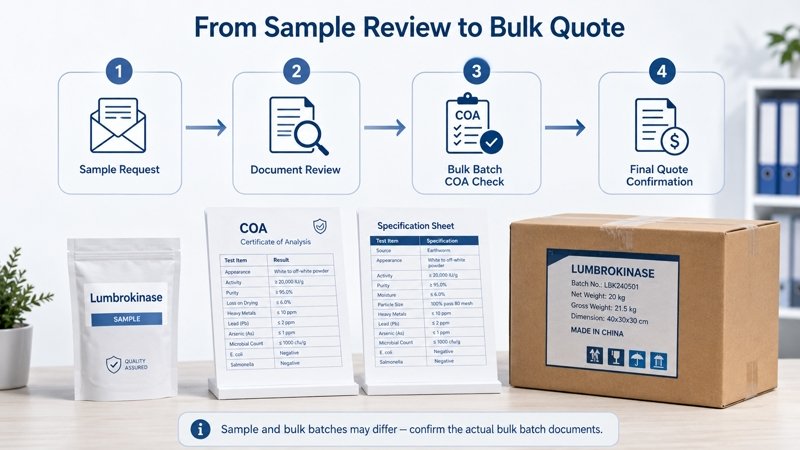
When a quotation follows sample testing, buyers should confirm how the approved sample specification will be applied to the future bulk order.
The sample batch and bulk batch may not have the same batch number, especially when there is a long period between sample testing and PO placement.
If the original sample batch is no longer available, the buyer should review the COA for the actual bulk batch and confirm that it meets the agreed:
- Activity specification
- Assay basis
- Packaging requirement
- Document requirement
- Purchasing conditions
An approved sample does not guarantee that every future batch will be identical. The quotation and purchase confirmation should therefore refer to the agreed specification rather than relying only on the original sample batch number.
Common Buyer Mistakes
Common quotation problems include:
- Asking only for a price per kilogram
- Failing to provide the intended quantity
- Omitting the destination country or postal code
- Requesting DDP without a delivery location
- Requesting a sample without stating the test purpose
- Asking for a COA without identifying the relevant batch type
- Comparing quotations without checking the specification
- Assuming different activity units can be directly converted
- Treating production lead time as total delivery time
- Failing to explain the buyer’s role or purchasing stage
These issues can usually be avoided by using a structured quotation request.
Allworms Supply Notes
Allworms supports B2B quotation requests for earthworm-derived lumbrokinase.
Depending on the specification and available batch:
- COA and specification sheets can be provided for review.
- A 100 g sample may be available for qualified B2B buyers, with international freight normally paid by the buyer.
- The standard MOQ is usually around 1.5 kg, depending on specification, packaging, and destination.
- Small bulk requirements may be discussed according to quantity, packaging, documents, and delivery location.
- Standard lead time is usually 7–15 days after payment.
- DHL may be used for suitable shipments.
- DDP shipping may be available for selected destinations.
General ordering and documentation questions are also covered on the FAQ page.
FAQ
1. Can I request a quote without knowing the exact activity specification?
Yes. Ask the supplier to provide available specifications and assay information for your technical team to review.
2. Why must I provide a postal code?
The postal code helps the supplier check courier coverage, DDP availability, local delivery conditions, and freight requirements.
3. Should I ask for a sample and bulk quotation at the same time?
Yes. State the sample requirement and the expected future purchase quantity so the supplier can respond to both stages separately.
4. Is a representative COA enough for placing an order?
It may be suitable for initial screening. Before shipment, the buyer should review the COA for the actual commercial batch.
5. What should I compare between supplier quotations?
Compare the specification, assay basis, quantity, packaging, document scope, lead time, shipping terms, destination, and payment conditions—not only the price per kilogram.
Request a Lumbrokinase Quote from Allworms
To request a lumbrokinase quote, send Allworms your required specification, quantity, sample needs, packaging preference, document requirements, delivery destination, shipping preference, and expected purchase timeline.
This information allows our team to prepare a quotation that is relevant to your actual B2B project rather than a general price response.
This product is supplied as a B2B ingredient. Final formulation suitability, dosage, labeling, health claims, and regulatory compliance should be evaluated by the buyer according to the intended market and finished product use.