Earthworm protein powder safety standards are not evaluated through a general statement that an ingredient is “safe.” For supplement brands, nutraceutical companies, food ingredient buyers, distributors, formulation teams, and quality assurance departments, safety evaluation requires a documented quality-control process.
Before approving a sample or bulk order, buyers should define their requirements, compare the specification sheet with the batch Certificate of Analysis (COA), examine contamination-related test results, and confirm which batch is actually available. Packaging, storage, supplier communication, and target-market requirements also affect purchasing approval.
This guide explains how to connect these checks into one practical Earthworm Protein Powder quality control and testing system without treating any single test result or document as sufficient evidence on its own.
Quick Answer
B2B buyers should evaluate earthworm protein powder safety standards by reviewing the specification sheet, batch COA, protein content, moisture, ash, heavy metals, microbiology, batch number, manufacturing date, packaging, storage guidance, and supplier quality-control process before approving samples or bulk orders.
The review should be batch-specific and based on written acceptance criteria. Final compliance depends on the buyer’s target market, finished-product category, formulation, labeling, claims, and regulatory requirements.
What “Safety Standards” Mean in B2B Ingredient Sourcing
For an ingredient buyer, safety standards usually mean a controlled system for identifying, documenting, and reducing sourcing risks. The process extends beyond asking whether the powder has been tested.
A practical review includes:
- Supplier qualification and quality communication
- Raw-material and processing controls
- Written product specifications
- Batch-specific test results
- Contamination risk assessment
- Sample verification
- Packaging and storage controls
- Confirmation of the actual bulk batch
- Preparation for import and market entry
These checks help purchasing and QA teams decide whether the material fits a defined application and approval process. They do not establish automatic compliance in every country or product category.
The finished-product company remains responsible for determining whether the ingredient, formulation, dosage, label, claims, and supporting documents meet the requirements of the intended market.
Quality Control Framework for Earthworm Protein Powder
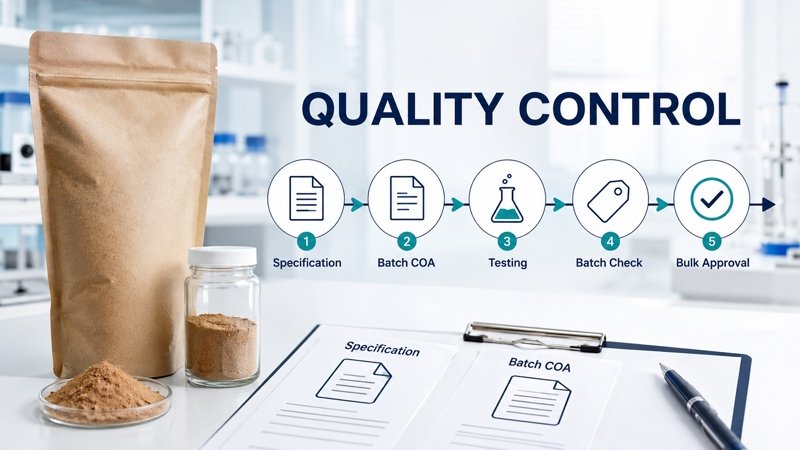
An effective quality-control framework follows the ingredient from supplier qualification to bulk delivery:
- Define the intended application and internal acceptance criteria.
- Review the supplier’s product specification.
- Examine a batch-specific COA.
- Evaluate protein content and contamination-related parameters.
- Test a representative sample where required.
- Record the identity of the tested sample batch.
- Review packaging and storage conditions.
- Confirm the COA for the actual available bulk batch.
- Complete commercial and quality approval separately.
This sequence prevents a common procurement problem: approving the supplier commercially before QA has confirmed the material technically.
Buyers should also ask whether the documents supplied are current, whether the COA is a reference example or represents available stock, and whether any required tests must be completed by an external laboratory. The Earthworm Protein Powder product page provides the current product positioning and general supply information.
Specification Sheet Review
A specification sheet defines the target requirements under which the supplier intends to release Earthworm Protein Powder. It is the reference against which individual batch results should be assessed.
Buyers should review:
- Exact product name and ingredient description
- Target protein content
- Appearance and physical form
- Moisture limit
- Ash limit
- Listed heavy metals
- Listed microbiological indicators
- Packaging format
- Storage instructions
- Shelf life, expiry, or retest information, if provided
The specification should also be compared with the buyer’s written purchasing requirements. A supplier specification may be internally consistent but still omit an item required for the intended country, customer, or finished-product category.
One useful decision criterion is to separate three types of requirements: supplier release specifications, buyer-specific acceptance requirements, and target-market requirements. They may overlap, but they should not be assumed to be identical.
COA Review: Confirming the Actual Batch
A specification sheet defines target requirements, while a COA reports actual results for a specific batch.
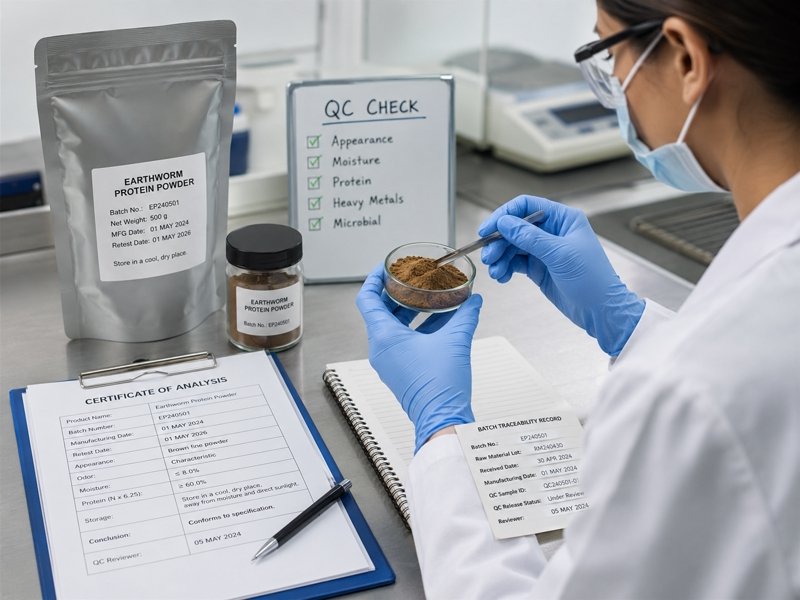
When reviewing an earthworm protein powder COA, check:
- Product name
- Batch or lot number
- Manufacturing date
- Expiry or retest date, if listed
- Protein content
- Moisture
- Ash
- Heavy-metal results
- Microbiological results
- Appearance
- Test methods, where shown
- Approval status or conclusion, if included
Do not accept a COA merely because every row says “Complies.” Determine whether the document provides actual numerical results, reporting limits, or only pass/fail statements. The required reporting format should be decided according to the buyer’s QA procedures.
Buyers needing a document-level review can continue to Earthworm Protein Powder COA Review.
Protein Content Testing
Protein content is an important identity and composition-related parameter for Earthworm Protein Powder, but it should not be assessed in isolation.
Buyers should compare:
- The protein requirement on the specification sheet
- The actual result on the COA
- The stated test method, if available
- Whether the result is reported on an as-is or dry basis
- Whether it supports the intended formulation
The reporting basis is a practical detail that can affect comparisons. Two figures may appear different because one includes the powder’s existing moisture while another is calculated on a dry basis. Buyers should clarify the basis before concluding that one batch or supplier provides more protein.
Higher protein content is not automatically better. The selected level must work with formulation targets, serving size, sensory characteristics, processing needs, and overall quality. Where amino acid profile information is important to the project, it should be requested and evaluated separately rather than inferred from total protein alone.
Moisture and Ash as Quality-Control Indicators
Moisture is commonly reviewed because it can affect powder handling, storage planning, packaging selection, and exposure to humid conditions. Buyers should compare the actual batch result with the agreed specification and consider how the material will be stored after delivery.
Ash represents the inorganic residue remaining after controlled testing. It can help a buyer review composition-related consistency and determine whether a batch meets the supplier’s specification. An unusual value should trigger clarification rather than an immediate conclusion about its cause.
Neither moisture nor ash should be presented as a standalone medical safety indicator. Their value comes from specification compliance, trend review, and interpretation alongside other quality parameters.
Heavy Metals Review
Heavy metals are routinely considered in ingredient sourcing because raw materials, processing conditions, and environmental exposure may influence contamination risk.
Depending on the specification and buyer requirements, the review may include:
- Lead
- Arsenic
- Cadmium
- Mercury
Check which metals are tested, whether the COA gives actual values or only compliance statements, and whether the result meets the agreed specification. Also determine whether the laboratory reports “not detected,” a numerical result, or a value below a stated quantification limit. These expressions are not necessarily interchangeable.
There is no single limit that should be copied into every purchase specification without context. Required limits can depend on the target country, daily ingredient use, finished-product category, and applicable regulations. Buyers should establish appropriate limits through their regulatory and QA teams and arrange additional testing where necessary.
Microbiology Review
Microbiological testing is another routine part of ingredient-level quality evaluation. A supplier specification may include items such as:
- Total plate count or aerobic count
- Yeast and mold
- Coliforms
- Selected pathogen-related items
The appropriate panel is not automatically the same for every supplier or application. It may vary according to processing, buyer requirements, target market, finished-product category, and risk assessment.
Buyers should confirm which tests are performed, how results are reported, and whether the panel covers their own acceptance criteria. If a required organism or count is absent, the buyer should ask whether additional testing is available instead of assuming it was included.

Batch Number, Manufacturing Date, and Retest Information
Safety and quality review must be traceable to a specific batch. A COA without a clear batch number is difficult to connect to a sample, shipment, or investigation.
The buyer should confirm:
- Whether the sample label and COA carry the same batch number
- Whether the manufacturing date is shown
- Whether an expiry or retest date is provided
- How much shelf life will remain upon delivery
- Whether the batch timing fits pilot production and commercial schedules
- Whether the reviewed batch is currently available for purchase
A sample batch and bulk batch do not always need to be identical. If several weeks or months pass between testing and purchase, the original batch may be unavailable. In that situation, the buyer should review the actual bulk-batch COA and compare it with the approved specification before shipment.
For a more detailed transition from sample to purchasing, see Earthworm Protein Powder Batch Consistency.
Sample Testing Before Bulk Approval
Sample testing helps buyers determine whether the ingredient fits their sourcing, QA, and formulation requirements. A sample review may cover:
- Appearance and color
- Odor, where relevant
- Powder condition and visible uniformity
- Agreement between the sample label, COA, and specification
- Formulation compatibility
- Internal laboratory testing
- Third-party verification where required
- Packaging and storage observations
Acceptance criteria should be written before the sample arrives. This reduces the risk of purchasing, formulation, and QA teams applying different standards to the same material.
Sample approval is evidence for one tested sample under specific conditions. It does not guarantee that every future batch will produce identical results. The Earthworm Protein Powder Sample Evaluation explains this verification stage in greater detail.
Supplier Audit and Quality Communication
Supplier qualification should examine both production controls and the supplier’s ability to provide clear, batch-relevant information.
Buyers should ask whether the supplier can explain:
- Available product specifications
- COA parameters and reporting formats
- Sample batch identity
- Actual bulk-batch availability
- Testing items and methods
- Packaging configuration
- Storage requirements
- Lead time and shipping conditions
- Supporting document availability
A useful supplier-audit question is: “Which items are tested for every released batch, and which documents or tests are provided only upon request?” This distinguishes routine controls from optional support.
Buyers should record technical clarifications in writing. Verbal statements about protein level, testing, shelf life, or packaging should not replace an agreed specification or batch document.
Packaging and Storage as Quality-Control Points
Quality management continues after laboratory release. Buyers should assess:
- Inner and outer packaging formats
- Seal condition and tamper evidence where applicable
- Moisture-barrier suitability
- Pack size relative to production use
- Storage instructions
- Warehouse temperature and humidity controls
- Transportation duration and handling
- Procedures after opening
Pack size can create a practical quality risk. If a production team opens a large package repeatedly for small formulation runs, the powder may experience more environmental exposure than material divided into suitable working quantities.
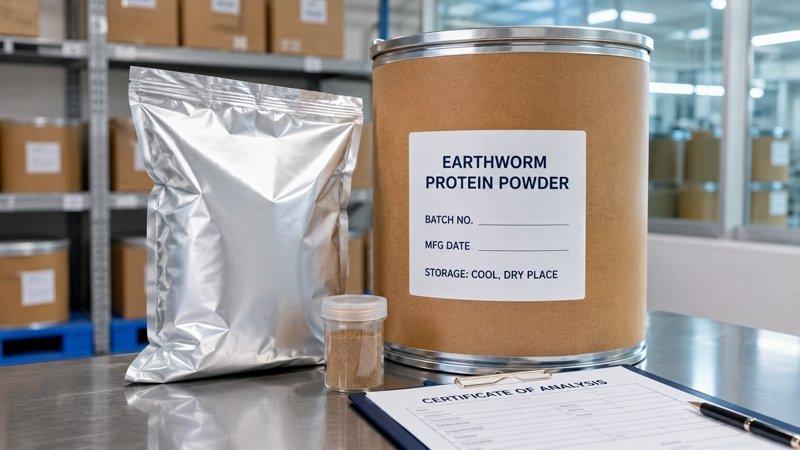
Suitable packaging and storage help reduce quality risk during transportation and after delivery. Specific stability or shelf-life claims should be supported by the supplier’s documentation rather than assumed from the packaging material alone.
Earthworm Protein Powder Safety and Quality Control Checklist
| Review Area | What Buyers Should Check | Why It Matters |
|---|---|---|
| Supplier information | Manufacturer identity, production role, contact details, quality responsibilities | Establishes accountability and traceability |
| Specification sheet | Current approved requirements and reporting basis | Defines the quality target |
| COA | Batch-specific results and release conclusion | Shows the reported status of one batch |
| Batch number | Match across COA, sample label, and shipment documents | Connects records to physical material |
| Manufacturing date | Date shown and consistent across documents | Supports shelf-life and project planning |
| Protein content | Requirement, actual result, method, and reporting basis | Confirms composition and formulation fit |
| Moisture | Actual result versus specification | Supports handling and storage review |
| Ash | Actual result versus specification | Supports composition-consistency review |
| Heavy metals | Listed metals, actual values, and buyer requirements | Addresses contamination-related criteria |
| Microbiology | Included counts or organisms and reported results | Supports routine ingredient-level evaluation |
| Appearance | Color, form, and conformance with specification | Helps identify visible variation |
| Sample testing | Written criteria, internal tests, and third-party tests if needed | Verifies application-specific suitability |
| Packaging | Material, sealing, pack size, labels, and outer protection | Helps protect the material in transit and use |
| Storage | Supplier instructions and buyer warehouse conditions | Supports quality management after receipt |
| Actual bulk batch | Available-batch COA and remaining shelf life | Prevents approval based only on an old sample |
| Supplier communication | Clear answers on tests, documents, lead time, and shipping | Reduces unresolved purchasing risks |
Common Buyer Mistakes
Frequent mistakes include:
- Treating “meets safety standards” as sufficient without reviewing evidence
- Accepting a COA without checking its batch number
- Evaluating protein content while ignoring its method or reporting basis
- Ignoring moisture and ash
- Failing to review heavy metals and microbiology
- Assuming every supplier uses the same test panel
- Not comparing the COA with the specification sheet
- Failing to confirm whether a COA represents the sample or available bulk batch
- Assuming one approved sample guarantees all future batches
- Overlooking packaging, storage, and remaining shelf life
- Using supplier limits without checking target-market requirements
- Choosing a supplier primarily by price
The central mistake is treating quality approval as a document-collection exercise. Effective approval connects each document and test result to a defined purchasing requirement.
Allworms Supply Notes
Allworms is part of the manufacturer-side earthworm-derived ingredient supply system and supports overseas market development and international sales. For available Earthworm Protein Powder batches, a COA and specification sheet can be provided for buyer review.
Sample support may be available for qualified B2B buyers. MOQ, lead time, packaging, and shipping options depend on the required specification, quantity, packaging expectations, destination, and available batch conditions.
Before approval, buyers can request available-batch information and explain their target protein specification, testing requirements, intended application, and document needs. General questions about samples, MOQ, documentation, storage, and international supply are also addressed on the FAQ page.
FAQ
1. What safety standards should buyers check for Earthworm Protein Powder?
Buyers should assess supplier controls, the specification sheet, batch COA, protein content, moisture, ash, heavy metals, microbiology, traceability, sample results, packaging, and storage. The applicable acceptance limits must reflect the intended product and target market.
2. Why should buyers review both the COA and specification sheet?
The specification sheet states the target requirements, while the COA reports the results for a particular batch. Comparing them shows whether the documented batch meets the agreed quality criteria.
3. Why are heavy metals and microbiology important in sourcing?
They are contamination-related review areas used in ingredient qualification. Buyers should confirm what is tested, how results are reported, and whether the supplier’s panel and limits meet their own requirements.
4. Why do moisture and ash matter?
Moisture supports assessment of handling, packaging, and storage conditions. Ash can assist with composition-consistency review. Both should be compared with the specification, but neither should be interpreted as a standalone safety conclusion.
5. Should buyers review the actual batch COA before a bulk order?
Yes. The tested sample batch may no longer be available when the purchase order is placed. Buyers should review the COA, manufacturing date, remaining shelf life, and specification status of the actual bulk batch before shipment.
6. Is sample testing enough to approve a supplier?
No. Sample testing is one verification step. Supplier qualification should also cover documentation, actual batch confirmation, testing scope, packaging, storage, communication, and commercial supply conditions.
7. How does packaging affect quality control?
Packaging affects sealing, moisture protection, handling, transportation, and exposure after opening. Buyers should choose a format suited to their production volumes and warehouse procedures.
8. Who is responsible for final product compliance?
The finished-product company is responsible for evaluating formulation suitability, dosage, labeling, claims, and regulatory compliance according to the intended market and finished-product use.
Review The COA, Specifications, And Available Batch Before Approval
Request a sample, MOQ, lead time, and shipping details today