
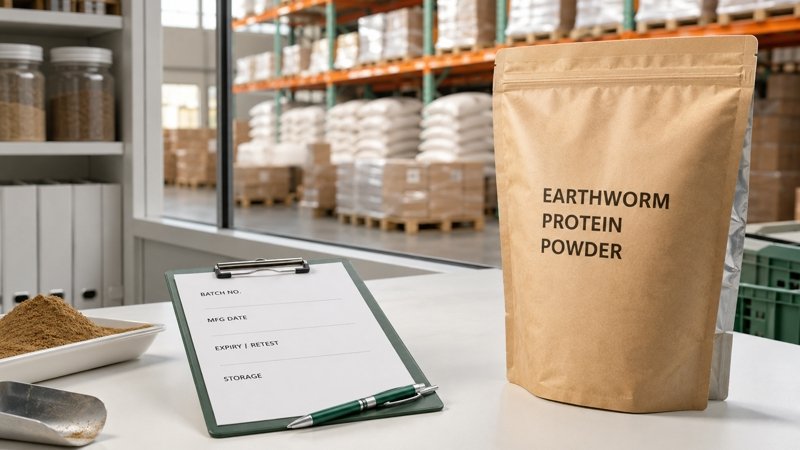
Earthworm protein powder shelf life is not simply a fixed number printed on a product label. For B2B buyers, it affects sample evaluation, production scheduling, inventory planning, warehouse handling and repeat purchasing.
Before approving a sample or bulk order, buyers should review the manufacturing date, expiry or retest information if listed, remaining shelf life, packaging format and recommended storage conditions. They should also consider how the powder will be transported, received, stored and handled after opening.
This guide focuses on managing Earthworm Protein Powder as an earthworm-derived protein ingredient for dietary supplement, nutraceutical, functional food and formulation applications. It explains how purchasing, QA, formulation and warehouse teams can coordinate storage and packaging requirements before supplier approval.
Quick Answer: How Should Buyers Evaluate Earthworm Protein Powder Shelf Life?
B2B buyers should evaluate earthworm protein powder shelf life by reviewing the manufacturing date, expiry date or retest date if listed, remaining shelf life, storage guidance, packaging format and moisture protection. The COA, specification sheet, transportation conditions and warehouse handling plan should also be checked.
Buyers should confirm the actual batch documents and storage requirements before sample approval, bulk purchasing or repeat orders. A stated shelf-life period alone does not show whether the available batch fits the buyer’s production schedule.
Why Shelf Life and Storage Matter in B2B Sourcing
Shelf life and storage are part of quality control and procurement planning. They influence whether an ingredient can be evaluated, received and used within a practical period.
For example, a buyer may need several weeks for sample testing, formulation trials and internal approval. After approval, additional time may be required for purchase-order processing, production, international shipping, customs clearance and warehouse receiving. The remaining shelf life must accommodate this complete timeline rather than only the transport period.
Storage planning also affects:
- When a sample should be tested
- Whether the available batch suits the planned production date
- How much inventory the buyer can reasonably hold
- Whether the warehouse can follow the recommended conditions
- How packaging will be managed during partial use
- When repeat orders should be placed
- How moisture exposure will be controlled during storage and handling
Buyers reviewing the ingredient for the first time can begin with the Earthworm Protein Powder product page and then confirm the available batch details directly with the supplier.
Shelf Life Is Not Just a Fixed Number
Asking “What is the shelf life?” is only the first step. A stated duration has limited value unless it is considered together with the manufacturing date and the status of the actual batch.
Buyers should check:
- Manufacturing date
- Expiry date, if listed
- Retest date, if used
- Remaining shelf life when the goods are expected to arrive
- Recommended storage conditions
- Whether the original package remains sealed
- Whether the batch has been stored according to supplier guidance
- Whether the remaining period fits the formulation and production schedule
An ingredient described as having a certain shelf-life period may already have spent part of that period in production inventory, transit or storage. Purchasing teams should therefore calculate remaining shelf life from the batch information rather than relying only on a general product statement.
Shelf life should be reviewed based on the supplier’s actual documentation, available batch information, packaging condition and storage guidance. Buyers should not assume that every available batch has the same manufacturing date or remaining usable period.
COA and Specification Sheet Review for Shelf Life
The specification sheet and COA serve different purposes in a storage review.
A specification sheet describes target product requirements and handling guidance. Depending on the supplier’s document format, it may include:
- Recommended storage conditions
- Standard packaging information
- Shelf life or retest information, if listed
- Quality parameters such as protein, moisture and ash limits
- General handling precautions
A COA reports results and identifying information for a particular batch. It may include:
- Product and batch numbers
- Manufacturing date
- Expiry or retest date, if listed
- Appearance
- Moisture
- Protein content
- Ash, heavy metals or microbiological results where applicable
In short, the specification sheet describes what the product is expected to meet, while the COA shows batch-specific information and results. Buyers needing a broader document review can refer to Earthworm Protein Powder Supplier Documents Beyond the COA.
The documents should match the product and batch being offered. A COA from a previous or representative batch may support preliminary evaluation, but the actual shipment documents should be confirmed before dispatch.
Moisture Control and Powder Quality
Moisture control is an important part of powder ingredient handling. Buyers should compare the moisture result on the COA, when listed, with the specification limit and then consider how the package will be protected after arrival.
Important review points include:
- The batch moisture result and applicable specification
- Condition of the package seal
- Humidity in the receiving and storage areas
- Time spent with the package open
- Frequency of opening and closing
- Exposure during weighing or material transfer
- Transport conditions and possible package damage
Moisture exposure may affect powder handling and quality risk, so buyers should minimize prolonged exposure to humidity and keep packaging sealed when not in use. However, a brief exposure should not automatically be interpreted as product failure. Any concern should be assessed using the exposure conditions, package status and the buyer’s internal quality procedures.
For a more detailed interpretation of batch test fields, see Earthworm Protein Powder COA Review.
Packaging Format and Protection
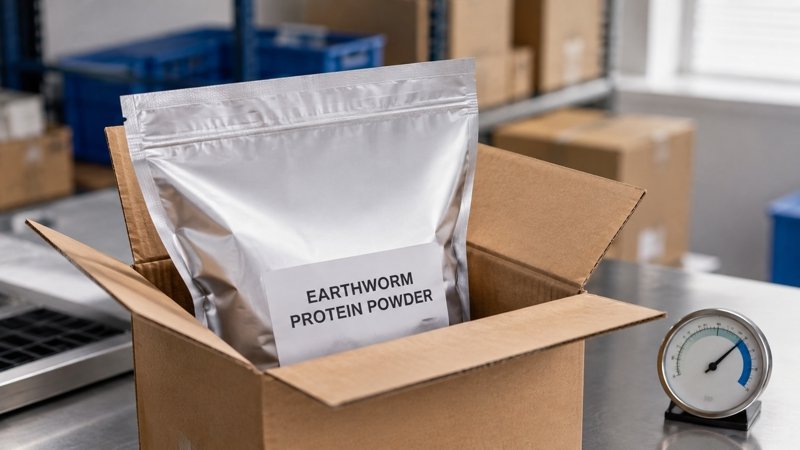
Packaging is part of storage planning rather than merely a shipping detail. A pack size suitable for a distributor may not be the most convenient format for a formulation team using small quantities at a time.
Before ordering, buyers should ask:
- What is the standard pack size?
- What material is used for the inner packaging?
- What outer packaging is provided?
- Is each inner package individually sealed?
- What information appears on the label?
- Can the batch number be traced to the COA?
- Is the format suitable for sampling, trial production or bulk use?
- Will the buyer need to divide or repeatedly reopen the package?
Inner packaging is the primary contact and sealing layer around the powder. Outer packaging supports shipment, identification and warehouse handling. Buyers should confirm both instead of relying on a general statement such as “packed in bags” or “packed in cartons.”
Smaller pack units may reduce repeated opening where the ingredient is used gradually, while larger packs may reduce packaging and handling frequency in continuous production. The appropriate choice depends on the buyer’s consumption rate, weighing process and warehouse workflow.
After partial use, the remaining material should be resealed and stored according to established internal procedures. Packaging performance should not be assumed beyond the supplier’s documented information.
Sample Storage Before Evaluation
Sample handling can influence the usefulness of a supplier evaluation. A sample that remains open or is stored under uncontrolled conditions for an extended period may no longer represent its received condition.
Before testing, buyers should:
- Record the sample receiving date
- Inspect the sample label and package
- Confirm the product name and batch number
- Review the COA and specification sheet
- Keep the sample sealed until testing
- Follow the supplier’s storage guidance
- Avoid direct sunlight and high-humidity environments
- Record any unusual package or powder condition
If different departments will conduct appearance, composition or formulation tests, the sample can be divided under controlled conditions to reduce repeated opening of the main package.
Bulk Order Storage and Warehouse Handling
Bulk storage should be planned before shipment, especially when the order will remain in inventory for several months or supply multiple production runs.
The purchasing, QA and warehouse teams should agree on:
- Acceptable remaining shelf life at receipt
- Required warehouse conditions
- Receiving and inspection responsibilities
- Batch recording procedures
- Package-opening controls
- Inventory rotation
- Handling of partially used packs
At receiving, the warehouse should record the batch number and check the package condition before placing the goods into storage. Where suitable for the buyer’s operation, first-in-first-out inventory handling can help avoid keeping older batches while newer batches are consumed.
Packages should generally remain sealed until required for production or evaluation. Opened packages should be properly resealed according to the buyer’s internal quality system.
These controls help buyers assess sample-to-bulk specification consistency without assuming that sample and bulk shipments must carry the same batch number. More detailed batch comparison considerations are covered in Earthworm Protein Powder Batch Consistency.
Transportation and Receiving Inspection
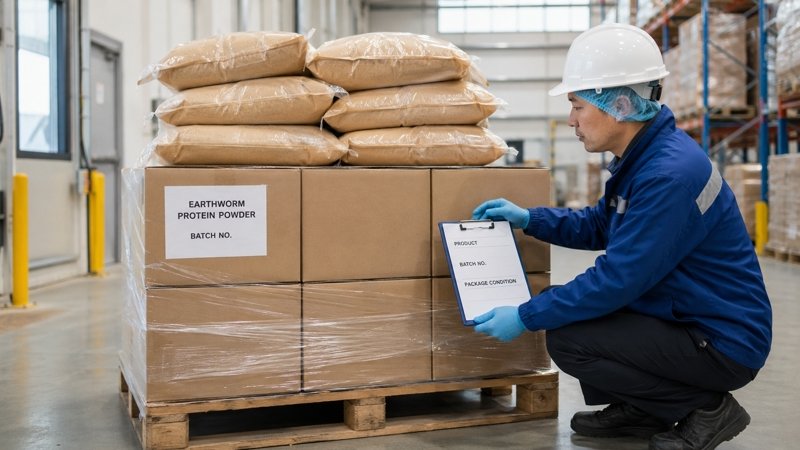
Shipping is part of storage management because the powder may spend several days or weeks outside the buyer’s warehouse.
Before shipment, buyers should discuss:
- Shipping method
- Destination and estimated transit time
- Inner and outer packaging
- Protection during courier or freight handling
- Potential customs-clearance time
- DDP availability where applicable
- Documents accompanying the shipment
- Procedure for reporting serious damage
After arrival, receiving personnel should check:
- The condition of the outer packaging
- Visible signs of opening, crushing, puncture or water exposure
- The inner seal, where inspection procedures require it
- The product name, label and batch number
- Whether the shipment quantity is correct
- Whether the documents correspond to the delivered batch
Serious packaging damage or document discrepancies should be photographed and reported promptly. Buyers should avoid approving damaged goods solely because the product name on the outer carton appears correct.
Opened Package Handling
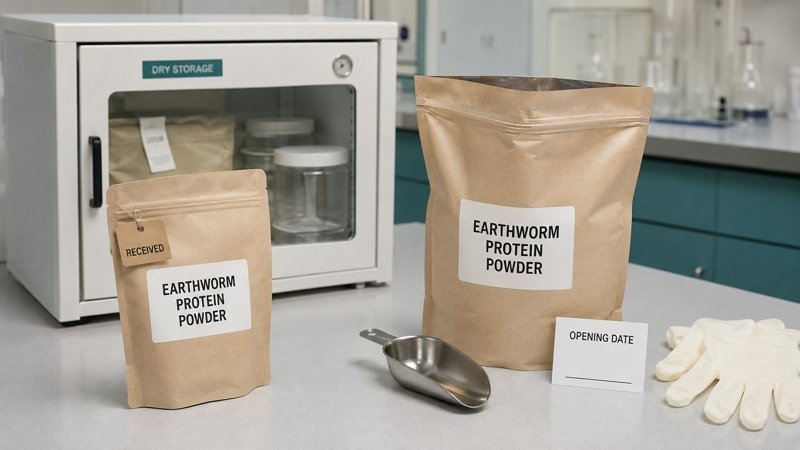
Storage risk changes after a package is opened. Humidity, handling tools, production environments and repeated access become relevant even when the unopened package was received in good condition.
Buyers should consider:
- Minimizing unnecessary opening
- Resealing the package immediately after use
- Using clean and suitable handling tools
- Preventing cross-contamination
- Limiting exposure to humid air
- Recording the opening date when required
- Keeping the original batch label associated with the remaining material
- Following internal QA and warehouse procedures
If a package is too large for the buyer’s normal usage rate, a different pack size may be more practical for later orders.
Shelf Life Planning for Sample-to-Bulk and Repeat Orders
Sample approval and bulk approval are related but separate decisions. If a buyer tests a sample and places a purchase order much later, the original sample batch may no longer be available.
When a newer bulk batch will be supplied, buyers should review its COA, manufacturing date, expiry or retest date if listed, packaging information and storage guidance before shipment. This supports sample-to-bulk specification consistency while recognizing that different batch numbers may be involved.
An approved sample does not automatically guarantee every future batch. For repeat orders, compare:
- Manufacturing date of the new batch
- Remaining shelf life at expected arrival
- COA results
- Packaging format
- Storage guidance
- Transport arrangement
This review is particularly important when order frequency, destination, warehouse conditions or production schedules have changed.
Earthworm Protein Powder Shelf Life and Storage Checklist
| Review Item | What Buyers Should Check | Why It Matters |
|---|---|---|
| Manufacturing date | Date for the offered batch | Establishes the starting point for remaining shelf-life review |
| Expiry date or retest date | Whether either date is listed and how it is defined | Prevents assumptions based only on a general shelf-life statement |
| Remaining shelf life | Time remaining at expected arrival and planned use | Helps coordinate testing, inventory and production |
| COA | Batch number, dates, moisture, appearance and relevant results | Connects storage planning to the actual batch |
| Specification sheet | Storage guidance, packaging and target limits | Defines expected handling requirements |
| Moisture value | Batch result and specification limit, if listed | Supports powder quality and storage-risk review |
| Packaging format | Pack size, sealing and available configurations | Determines suitability for the buyer’s usage rate |
| Inner packaging | Material, seal and direct product protection | Supports moisture and contamination control |
| Outer packaging | Carton, drum or other transport protection | Affects shipping and warehouse handling |
| Label and batch number | Product identity and traceability | Helps match the shipment to its documents |
| Storage conditions | Temperature, humidity and light guidance | Determines warehouse suitability |
| Sample storage | Seal status, receiving date and pre-test handling | Preserves the value of sample evaluation |
| Bulk warehouse handling | Receiving, inspection and inventory rotation | Reduces preventable storage errors |
| Opened package handling | Resealing, tools, exposure and opening records | Manages risk after first use |
| Transportation and receiving inspection | Transit time, package condition and document matching | Identifies shipping-related problems promptly |
Common Buyer Mistakes
Common storage and shelf-life mistakes include:
- Asking only for the shelf-life duration without checking the manufacturing date
- Ignoring the remaining shelf life at the expected arrival date
- Failing to review storage conditions
- Not comparing the COA moisture result with the specification
- Leaving samples exposed during a long evaluation period
- Approving a bulk order without reviewing the packaging format
- Assuming every pack size suits the warehouse or formulation workflow
- Failing to define opened-package handling
- Not inspecting shipping packaging after arrival
- Accepting documents that do not match the delivered batch
- Assuming sample approval guarantees every later batch
- Failing to review remaining shelf life for repeat orders
- Selecting only by price without considering storage and handling requirements
Additional purchasing and product questions are addressed on the FAQ page.
Allworms Supply Notes
Allworms is part of the manufacturer-side earthworm-derived ingredient supply system and supports overseas market development and international sales. For available Earthworm Protein Powder batches, a COA and specification sheet can be provided to support shelf-life, moisture and storage review.
Sample support may be available for qualified B2B buyers. MOQ, lead time, packaging and shipping options depend on the specification, quantity, packaging requirement, destination and available batch conditions. Buyers should request the manufacturing date, available batch information, packaging details and storage guidance before approving a sample or bulk shipment.
This product is supplied as a B2B ingredient. Final formulation suitability, dosage, labeling, claims and regulatory compliance should be evaluated by the buyer according to the intended market and finished-product use.
FAQ
1. What should buyers check for Earthworm Protein Powder shelf life?
Check the manufacturing date, expiry or retest date if listed, remaining shelf life, storage guidance, package condition and actual batch documents. The available period should fit the buyer’s testing, shipping, warehouse and production schedule.
2. Why does moisture control matter during storage?
Moisture exposure may increase powder-handling and quality risks. Buyers should review the moisture specification and batch result, maintain suitable warehouse conditions, minimize prolonged humidity exposure and keep unused material sealed.
3. How should Earthworm Protein Powder samples be stored before testing?
Keep the sample sealed, follow the supplier’s storage guidance, avoid direct sunlight and high humidity, and record the receiving date and batch number. Review the COA and specification sheet before opening the sample.
4. What should buyers inspect after receiving a bulk shipment?
Inspect the outer packaging, seals where applicable, labels, batch numbers and delivered quantity. Confirm that the COA and other shipment documents correspond to the received batch, and report serious damage promptly.
5. Why should repeat-order buyers review shelf life again?
A repeat order may involve a new batch, manufacturing date, remaining shelf life, packaging format or transport arrangement. Previous sample or order approval should therefore not replace a review of the actual batch being purchased.
Share Your Specification, Quantity And Storage Requirements
Request batch documents, packaging details and shipping options