
Lumbrokinase extraction and purification are not only manufacturing subjects. For supplement brands, ingredient distributors, contract manufacturers, and purchasing teams, the production flow can influence enzyme activity consistency, powder appearance, moisture control, batch documentation, and the transition from sample testing to commercial purchasing.
Buyers do not need access to confidential temperatures, processing times, enzyme ratios, or other proprietary parameters. However, they should understand whether a supplier follows a controlled production sequence and can explain how raw material handling, cleaning, freezing, milling, enzymatic processing, filtration, freeze drying, powder finishing, and packaging support consistent output.
This article explains how to evaluate that production logic without turning supplier approval into an academic investigation.
Quick Answer: Why Lumbrokinase Extraction and Purification Matter
Lumbrokinase extraction and purification matter because cleaning, freezing, milling, controlled enzymatic processing, filtration, freeze drying, pulverizing, sieving, and packaging can influence enzyme activity consistency, powder quality, moisture control, batch comparison, and sample-to-bulk specification consistency.
B2B buyers should not judge a supplier only by claims of “advanced technology.” They should review the general production flow together with the specification sheet, actual batch COA, activity assay basis, packaging condition, and supplier explanation of batch control.
Why This Matters for B2B Buyers
A lumbrokinase powder may meet a stated activity requirement while still presenting practical purchasing questions:
- Is the raw material prepared consistently before extraction?
- Is insoluble material adequately controlled before drying?
- Does the powder have a reasonably uniform appearance and particle condition?
- Is moisture managed during drying and packaging?
- Is activity tested under a documented assay method?
- Can the supplier explain differences between production batches?
- Will the actual bulk batch meet the specification approved during sample evaluation?
The production process does not replace laboratory testing. It gives buyers context for interpreting test results.
A COA shows what was reported for a specific batch. The manufacturing flow helps explain how the supplier attempts to produce that result consistently. Buyers evaluating the overall control system can also refer to Quality Control Systems in Lumbrokinase Production for a broader discussion of batch records, testing, retention samples, and release procedures.
Lumbrokinase Extraction and Purification: The Buyer-Relevant Production Flow
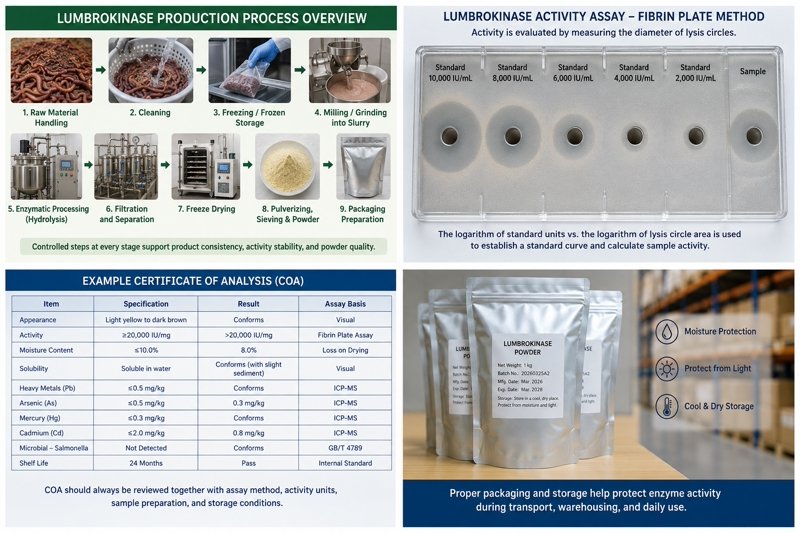
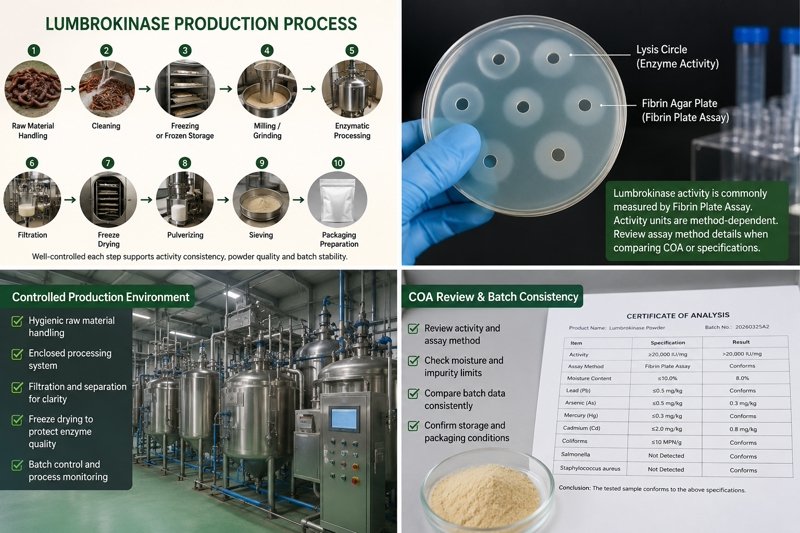
A practical production sequence may include raw material selection, cleaning, freezing or frozen storage, thawing, grinding into slurry, controlled enzymatic processing, filtration, freeze drying, pulverizing, sieving, and packaging preparation.
The presence of these steps alone does not prove quality. What matters is whether the supplier manages them as a connected control system rather than as isolated operations.
1. Raw Material Handling and Cleaning
Production consistency begins before extraction.
Earthworms used for processing should be selected and handled under defined internal requirements. Variation in raw material condition, maturity, contamination level, storage history, or time before processing may increase downstream variation.
Cleaning helps remove soil, feed residue, and other unwanted material before milling. From a buyer’s perspective, this step is relevant to:
- reducing avoidable impurities;
- improving hygiene control;
- supporting more uniform slurry preparation;
- reducing variation in powder color and appearance;
- improving the consistency of downstream filtration.
Buyers do not need a detailed farming manual. They should confirm that the supplier has a stable raw material source and a repeatable pre-processing procedure.
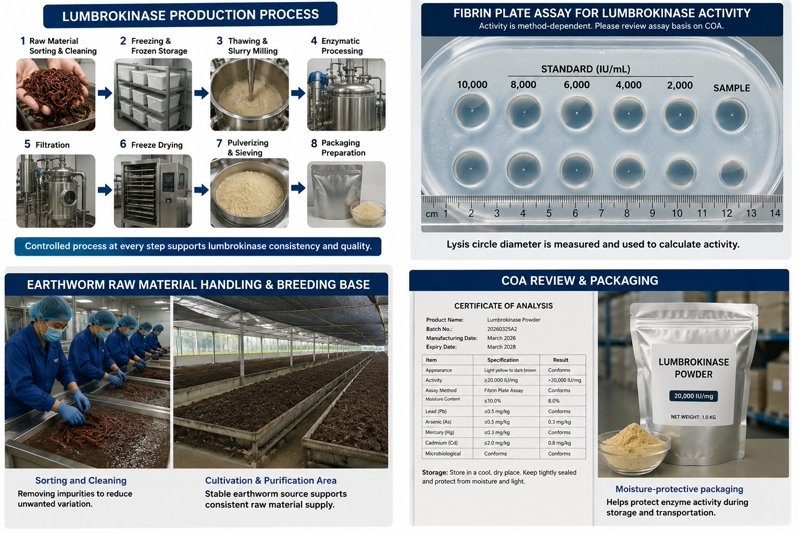
Allworms operates an earthworm breeding base in Conghua, Guangzhou, which supports raw material supply for its earthworm-derived ingredient system. Buyers seeking a general product overview can review the Lumbrokinase product page before requesting batch-specific documents.
2. Freezing and Frozen Material Control
Where freezing is used, it can support production scheduling and help maintain raw material condition between cleaning and extraction.
However, freezing should be understood correctly. It is part of raw material handling and production organization. It does not guarantee that every finished batch will have identical activity.
Buyer-relevant questions include:
- Is the material frozen promptly after preparation?
- Is frozen material identified by batch?
- Is storage exposure controlled?
- Is thawed material processed according to a defined sequence?
- Is unnecessary repeated freezing and thawing avoided?
A supplier does not need to disclose confidential storage parameters, but it should be able to explain the general control logic.
3. Thawing, Milling, and Slurry Preparation
After frozen storage, the raw material may be thawed, cleaned again, and milled or ground into slurry.
Controlled milling supports more uniform batch preparation. If some material remains insufficiently processed while other portions are overprocessed, downstream extraction may become less consistent.
For buyers, the important point is not the machine model or grinding speed. It is whether the supplier aims to create a reasonably uniform processing material before enzymatic treatment.
Uniform slurry preparation can support:
- more consistent contact with processing conditions;
- controlled batch loading;
- more repeatable filtration behavior;
- reduced variation caused by uneven raw material preparation.
4. Controlled Enzymatic Processing
An enzymatic hydrolysis step or controlled enzymatic processing may be used as part of the lumbrokinase manufacturing process.
This stage requires careful explanation because lumbrokinase is an enzyme-related ingredient. Controlled processing conditions may influence protein breakdown, the enzyme-related activity profile, clarification behavior, and final batch consistency.
More hydrolysis is not automatically better. Excessive or poorly controlled processing should not be treated as evidence of higher quality. Buyers should focus on whether the supplier uses a repeatable process and verifies the finished activity through an appropriate assay.
The supplier does not need to publish exact pH, temperature, processing time, enzyme ratio, or yield. Those details may be proprietary. The buyer needs evidence that:
- the step is controlled;
- the finished powder is tested;
- batches are reviewed against an agreed specification.
For more detail on how production control relates to reported enzyme activity, readers can continue to How Lumbrokinase Manufacturers Ensure Consistent Activity.
5. Filtration and Separation
Filtration helps remove insoluble material and clarify the processed liquid before drying.
From a procurement perspective, filtration may affect:
- visible sediment or insoluble material;
- powder appearance;
- downstream drying behavior;
- impurity control;
- batch-to-batch physical consistency;
- handling during sample preparation.
Filtration should not be described as a guarantee of complete purity. Lumbrokinase is an earthworm-derived extract, and finished-product characteristics should be assessed against the supplier’s specification rather than against unrealistic expectations of a completely transparent laboratory reagent.
Buyers should confirm how solubility, visible sediment, appearance, and other physical properties are described in the specification and COA.
6. Freeze Drying
Freeze drying is important for producing a dry powder from enzyme-sensitive processed material.
When properly controlled, freeze drying may help reduce moisture and limit uncontrolled heat exposure during drying. This can support enzyme-related quality and create a powder suitable for packaging, storage, sample evaluation, and international shipment.
However, freeze drying does not guarantee unchanged activity. Buyers should still review:
- activity result;
- assay method;
- moisture or loss on drying;
- appearance;
- storage instructions;
- packaging condition.
An acceptable activity number cannot compensate for unsuitable moisture control or damaged packaging. Likewise, a low moisture value does not independently prove activity consistency.
7. Pulverizing and Sieving
After drying, the material may be pulverized and sieved to produce a more manageable final powder.
These steps can influence:
- particle uniformity;
- visual appearance;
- sampling consistency;
- blending and weighing behavior;
- packaging efficiency;
- usability during pilot formulation.
Sieving does not guarantee perfect particle uniformity, and particle size alone does not determine formulation success. Nevertheless, visibly inconsistent powder may make representative sample preparation more difficult, especially when buyers divide small quantities for laboratory tests.
A practical buyer may compare powder appearance, flow, odor, visible particles, and sample preparation behavior between approved and commercial batches without assuming that minor natural variation represents failure.
8. Packaging Preparation
Process control continues after drying and sieving.
The powder should be transferred into suitable sealed packaging with attention to moisture protection and repeated exposure after opening. Enzyme-sensitive ingredients should be protected from prolonged heat, humidity, direct sunlight, and unsuitable warehouse conditions.
Packaging questions are especially relevant for buyers who intend to divide a bulk package into several production runs. Smaller sealed units may reduce repeated opening of the full quantity, although packaging suitability should be confirmed for each order.
Detailed transport and warehouse considerations are covered in International Shipping and Storage of Lumbrokinase.
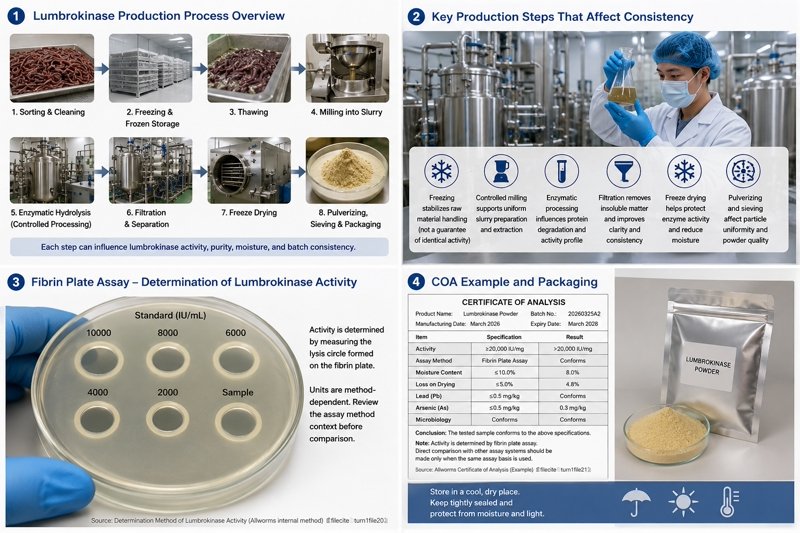
Lumbrokinase Process Steps and Buyer Evaluation Points
| Process Step | Why It Matters | What B2B Buyers Should Check |
|---|---|---|
| Raw material handling | Establishes the starting condition for production | Source stability, batch identification, pre-processing controls |
| Cleaning | Helps remove soil, feed residue, and unwanted material | General cleaning procedure and impurity management |
| Freezing or frozen storage | Supports controlled storage before extraction | Batch control, storage logic, avoidance of repeated uncontrolled thawing |
| Milling or grinding | Creates material suitable for downstream processing | Uniform batch preparation and repeatable production flow |
| Enzymatic processing | May affect protein breakdown and activity profile | Controlled process logic and finished activity verification |
| Filtration | Removes insoluble material before drying | Appearance, sediment description, clarification, impurity control |
| Freeze drying | Reduces moisture while limiting uncontrolled heat exposure | Moisture result, activity result, storage and packaging |
| Pulverizing | Converts dried material into usable powder | Powder condition, sampling behavior, handling consistency |
| Sieving | Supports more uniform final powder | Visible particle consistency and formulation handling |
| Packaging preparation | Protects the finished powder after processing | Seal integrity, pack size, moisture protection, storage guidance |
| COA review | Confirms reported results for a specific batch | Batch number, activity, assay method, moisture, ash and other agreed tests |
| Batch comparison | Supports supplier approval and repeat purchasing | Specification compliance rather than identical numerical results |
How Buyers Should Evaluate Process Consistency
Buyers should evaluate the production flow and batch evidence together.
A supplier explanation is more useful when it connects each major step to a practical control objective. For example:
- cleaning reduces unwanted raw material variation;
- milling supports uniform processing;
- filtration controls insoluble material;
- freeze drying manages moisture and heat exposure;
- sieving supports powder uniformity;
- packaging protects the released material.
Buyers should then verify that the available-batch COA corresponds to the agreed specification.
Activity values such as IU/mg, FU/g, LKU, or U should be reviewed together with the assay method, substrate, reference standard, sample preparation, dilution, incubation time, incubation temperature, calculation method, and reporting basis. No fixed conversion should be assumed between different activity systems.
The goal is not to demand an identical numerical activity result from every batch. The goal is to confirm that each released batch meets the agreed specification under the agreed assay basis.
Process Consistency and Sample-to-Bulk Specification Consistency
The sample batch and final bulk order batch may not always be the same.
This is common when a buyer performs sample testing and places the purchase order several weeks or months later. The original sample batch may have been allocated, sold, or replaced by a newer production batch.
This does not automatically indicate a consistency problem. Before bulk approval, the buyer should request the COA for the actual order batch and confirm:
- agreed activity grade;
- assay method and reporting basis;
- appearance and moisture requirements;
- packaging format;
- quantity and purchasing conditions;
- any market-specific document requirements.
Sample-to-bulk specification consistency means that the actual commercial batch meets the approved specification. It does not mean that sample and bulk must always share the same batch number, and an approved sample does not guarantee that every future batch should be accepted without review.
Small Bulk Order Buyer Perspective
Process consistency is particularly important for 1.5 kg trial orders and 10–25 kg small bulk purchases.
These quantities may be used for:
- laboratory or sample testing;
- pilot formulation;
- distributor evaluation;
- a first commercial batch;
- repeat small-volume production.
Small buyers often have limited material available for repeated testing. A poorly documented batch change can delay supplier approval, while clear communication can allow the purchasing team to decide whether document review is sufficient or whether confirmation testing is required.
For the complete order approval workflow, refer to Lumbrokinase Sample to Bulk Order.
Questions Buyers Can Ask About Lumbrokinase Production Process
- What is the general lumbrokinase production flow?
- How is the earthworm raw material handled before extraction?
- How are cleaning and impurity control managed?
- Is freezing or frozen storage used before processing?
- How is material prepared before controlled enzymatic processing?
- What type of filtration is used at a general process level?
- Is freeze drying used for the finished extract?
- How is activity tested after production?
- Can a COA and specification sheet be provided for available batches?
- How does the supplier compare batches against the agreed specification?
- What should be reconfirmed when moving from sample testing to a bulk order?
- What packaging and storage guidance applies after delivery?
Common Buyer Mistakes and Misunderstandings
Treating “Advanced Technology” as Proof of Quality
Technical wording is not a substitute for batch documents, testing, traceability, and supplier communication.
Focusing Only on the Activity Number
The activity result must be interpreted together with the assay method and reporting basis. A larger number from a different method is not automatically a stronger or more suitable ingredient.
Ignoring Moisture and Packaging
Drying quality can be compromised by unsuitable packaging or prolonged exposure after production. Review moisture, seal condition, storage instructions, and warehouse handling together.
Not Reviewing the Actual Batch COA
A sample COA, typical COA, or previous-batch COA does not replace the COA for the material being purchased.
Expecting Identical Numerical Results
Controlled production aims to keep batches within specification. Natural and analytical variation may occur, so identical numbers should not be the only acceptance criterion.
Assuming the Sample Batch Remains Available
Long delays between testing and purchasing can result in a different bulk batch. Confirm the actual order batch before payment or shipment.
Overlooking Final Powder Handling
Pulverizing, sieving, packaging, and repeated opening may affect practical usability even after extraction and drying are complete.
Confusing Research Procedures with Commercial Capability
Academic chromatography or laboratory purification methods may be useful for identifying individual enzymes or peptides, but they do not automatically describe a scalable commercial manufacturing system. Supplier approval should focus on repeatable production, specification compliance, testing, documentation, and supply capability.
Allworms Supply Notes
Allworms supports overseas B2B buyers as part of a manufacturer-side earthworm-derived ingredient supply system.
For available lumbrokinase batches, a COA and specification sheet can be provided for review. Qualified buyers may discuss a 100 g sample, with international freight normally paid by the buyer. The standard MOQ is usually around 1.5 kg, depending on activity grade, packaging, and destination, while 10–25 kg orders may be arranged for pilot production or small commercial purchasing.
Standard lead time is usually 7–15 days after payment. Final batch documents, packaging, activity specification, assay basis, and delivery arrangements should be confirmed before order approval.
For additional purchasing and product questions, visit the FAQ page.
FAQ
1. Does a more complicated purification process always produce better lumbrokinase?
No. A more complicated process is not automatically better. Buyers should assess whether the commercial process is controlled, repeatable, suitable for enzyme-sensitive material, and supported by batch testing.
2. Why is freeze drying used in lumbrokinase production?
Freeze drying can reduce moisture while limiting uncontrolled heat exposure. It may support enzyme-related quality, but finished activity, moisture, packaging, and storage still require verification.
3. Should every lumbrokinase batch have exactly the same activity result?
Not necessarily. Buyers should expect batches to meet the agreed specification under the same assay basis, rather than requiring identical numerical results in every COA.
4. What documents should be checked before approving a bulk batch?
Review the actual batch COA, specification sheet, activity assay method, batch number, manufacturing information, moisture, appearance, packaging, storage guidance, and any other agreed quality items.
5. Can the bulk order come from a different batch than the approved sample?
Yes. If the original sample batch is no longer available, review the actual bulk-batch COA and confirm that it meets the agreed specification, activity grade, assay basis, packaging requirement, and purchasing conditions.
Request Lumbrokinase Process Details, Batch COA, Specifications, Activity Grade, Packaging, and Sample-to-Bulk Information.
Contact Allworms for sample evaluation, a 1.5 kg trial order, or a 10–25 kg small bulk requirement.