
Introduction
Lumbrokinase consistent activity is an important quality consideration for B2B buyers sourcing earthworm-derived enzyme ingredients. Supplement brands, nutraceutical companies, distributors, and formulation developers usually need more than an activity number when evaluating a lumbrokinase supplier. They need to understand how the manufacturer controls raw materials, manages production processes, evaluates activity, and documents batch quality.
A professional lumbrokinase manufacturer supports activity consistency through multiple control points, including earthworm raw material management, controlled processing, activity testing, batch comparison, COA documentation, and specification management.
The goal of activity consistency is not to make every batch show exactly the same numerical value. Instead, manufacturers should support stable production quality within agreed specifications, allowing buyers to evaluate samples, approve suppliers, and manage repeat orders with greater confidence.
Quick Answer: How Do Lumbrokinase Manufacturers Support Consistent Activity?
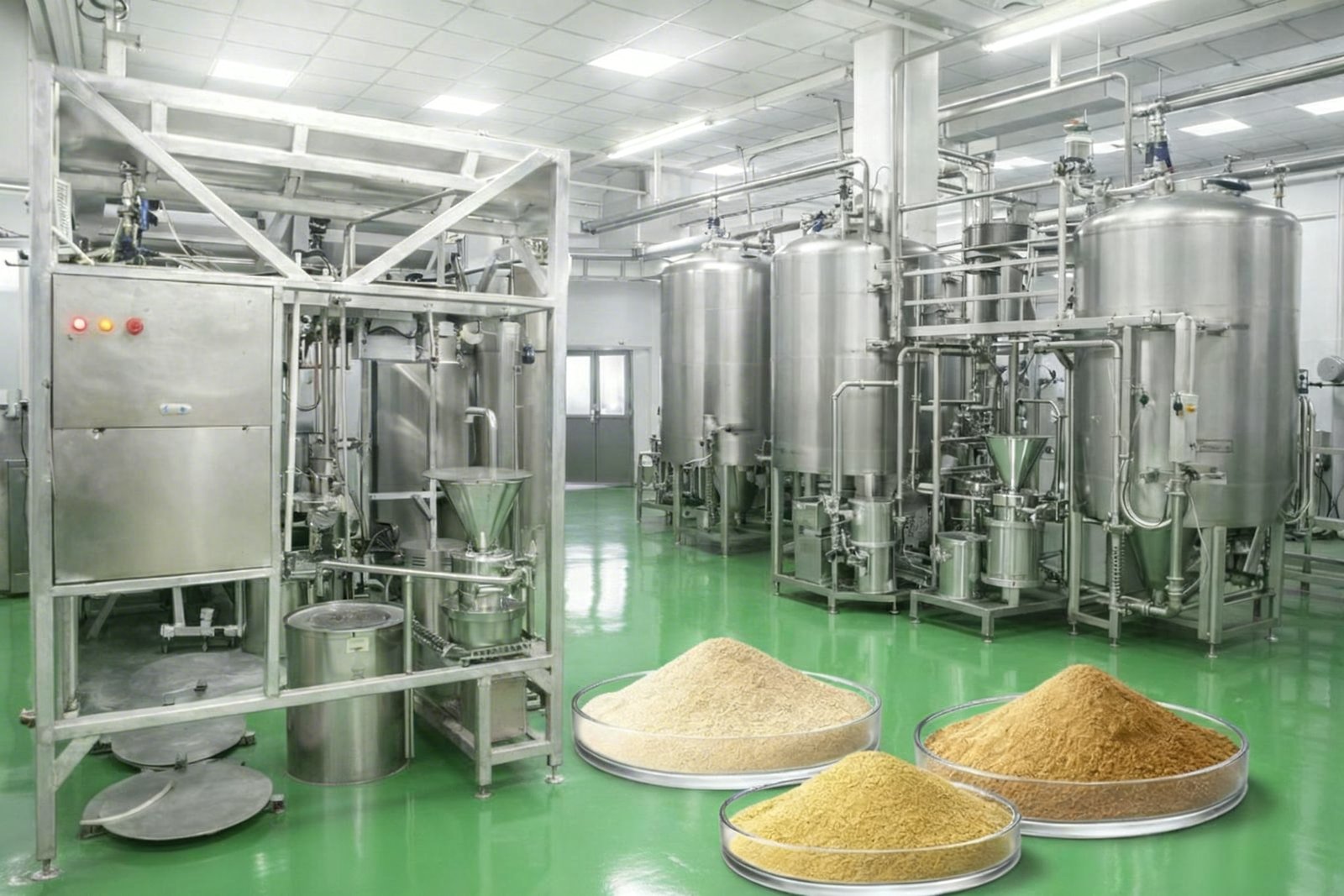
Lumbrokinase manufacturers support consistent activity through raw material consistency control, controlled extraction and processing, activity testing such as fibrin plate assay, batch comparison, COA documentation, packaging control, and sample-to-bulk specification management.
Consistent activity does not mean every batch has identical activity numbers. Enzyme results may vary because of assay methods, testing conditions, and normal batch differences. Buyers should evaluate whether the actual batch meets the agreed specification and purchasing requirements.
Why This Matters for B2B Buyers
For lumbrokinase buyers, activity consistency directly affects supplier approval, formulation planning, and repeat purchasing decisions.
When comparing suppliers, buyers should consider:
- How is the earthworm raw material managed?
- Does the manufacturer have a controlled production process?
- Is the activity test method clearly defined?
- Can the supplier provide batch-specific COA documents?
- Can the supplier explain differences between sample and bulk batches?
A supplier that understands manufacturer-side consistency control can provide more reliable support during:
- sample evaluation
- technical review
- small bulk orders
- repeat purchasing
- formulation development
The key sourcing question is not simply “Which supplier has the highest activity number?” It is whether the supplier can consistently provide material that meets the agreed activity grade and quality requirements.
Raw Material Consistency: The Starting Point of Activity Control
Lumbrokinase is an earthworm-derived fibrinolytic enzyme ingredient, meaning raw material management is an important foundation for production consistency.
Differences in earthworm raw materials may come from:
- species source
- cultivation conditions
- growth stage
- feeding management
- harvesting and pre-processing conditions
A manufacturer with better upstream control can establish more stable raw material conditions for downstream production.
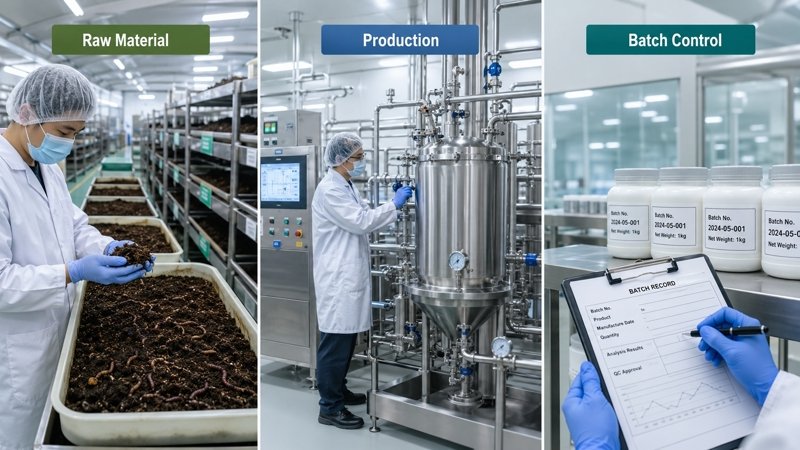
Allworms operates an earthworm breeding base in Conghua District, Guangzhou, Guangdong, supporting the supply of earthworm raw materials for earthworm-derived ingredients. The cultivation system focuses on standardized management, including species management, cultivation stages, purification preparation, and processing preparation.
Raw material control does not mean every production batch will have identical characteristics. Instead, it helps manufacturers reduce unnecessary variation and support more consistent production conditions.
Controlled Extraction and Processing
Consistent lumbrokinase activity also depends on controlled manufacturing procedures.
Important production-side control areas include:
- raw material preparation
- extraction or processing management
- filtration-related control
- drying process management
- powder preparation
- batch identification
- packaging preparation
The purpose of process control is to maintain product characteristics within the agreed specification.
Allworms’ lumbrokinase production system includes confirmed stages such as sorting, washing, freezing and storage, thawing, washing, grinding, processing, filtration, freeze drying, pulverization, sieving, and packaging.
Manufacturers may adjust production details according to product requirements. For B2B buyers, the important factor is whether the supplier has a repeatable process and can provide transparent batch information.
Buyers looking for broader production quality information can review Quality Control Systems in Lumbrokinase Production.
Activity Testing and Fibrin Plate Assay
Activity testing is one of the most important steps for evaluating lumbrokinase consistent activity.
Manufacturers should clearly define:
- activity testing method
- sample preparation basis
- calculation method
- reported activity unit
- batch testing procedure
Fibrin plate assay is a commonly referenced method for evaluating lumbrokinase-related fibrinolytic activity.
Activity values may be expressed using different units, including:
- IU/mg
- FU/g
- LKU
- U
These values should not be compared without understanding the assay method behind them. Different laboratories, substrates, testing conditions, and calculation methods may produce different numerical results.
Allworms provides batch COA documentation with activity information and assay method details. For example, lumbrokinase COA documents may include activity results based on fibrin plate assay together with a note explaining that activity values should be compared under the same assay basis.
For more information about the testing method, buyers can review Fibrin Plate Assay for Lumbrokinase Activity.

Why Consistent Activity Does Not Mean Identical Numbers
A common misunderstanding is expecting every lumbrokinase batch to show exactly the same activity value.
In practice:
- enzyme activity may vary within an acceptable specification range
- assay methods influence reported values
- laboratory conditions may affect results
- production batches may have normal variation
A consistent supplier focuses on:
- meeting agreed specifications
- maintaining production stability
- using a defined testing method
- providing transparent documentation
Therefore, buyers should compare actual batch results with the specification sheet rather than only comparing activity numbers from different suppliers.
The practical question is:
Does the batch meet the agreed activity grade and quality requirements?
Batch Comparison and Documentation Support
Manufacturers may review different production batches through batch records and quality documents.
Key comparison factors include:
| Item | Purpose |
|---|---|
| Batch number | Identifies the production lot |
| Activity result | Reviews enzyme activity level |
| Assay method | Provides testing context |
| COA | Shows actual batch results |
| Specification sheet | Defines product requirements |
| Appearance | Reviews physical consistency |
| Moisture | Supports powder quality evaluation |
| Microbiology | Reviews quality parameters |
Batch comparison is not designed to prove identical numbers between batches.
The purpose is to confirm that different batches remain within the agreed specification.
For buyers reviewing supplier documentation, see Lumbrokinase COA Review.
COA and Specification Sheet Support
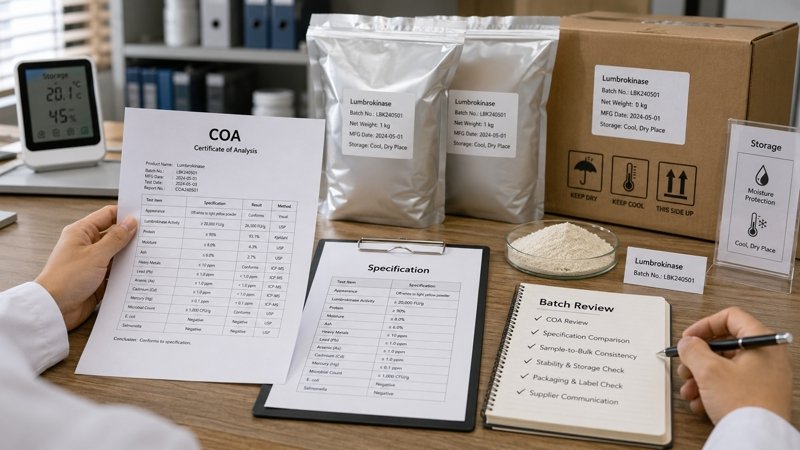
A specification sheet and COA serve different roles.
Specification Sheet
The specification sheet defines the expected product requirements, such as:
- activity grade
- assay method
- moisture range
- appearance
- quality parameters
COA
The Certificate of Analysis reports actual test results from a specific batch.
A COA may include:
- batch number
- manufacturing date
- activity result
- assay method
- moisture
- heavy metals
- microbiological results
Together, these documents allow buyers to compare actual production batches against agreed requirements.
Sample-to-Bulk Specification Consistency
Sample-to-bulk specification consistency is important during supplier approval.
The sample batch and bulk order batch may not always be identical.
This may happen when:
- sample testing takes place months before purchase
- the original sample batch has been consumed
- a newer production batch becomes available
If a different bulk batch is supplied, buyers should confirm:
- Actual bulk batch number
- Bulk batch COA
- Activity grade
- Assay method
- Specification compliance
The goal is not necessarily using the same batch number. The goal is confirming that the actual bulk material meets the agreed purchasing requirements.
For buyer-side approval procedures, see Lumbrokinase Batch Consistency.
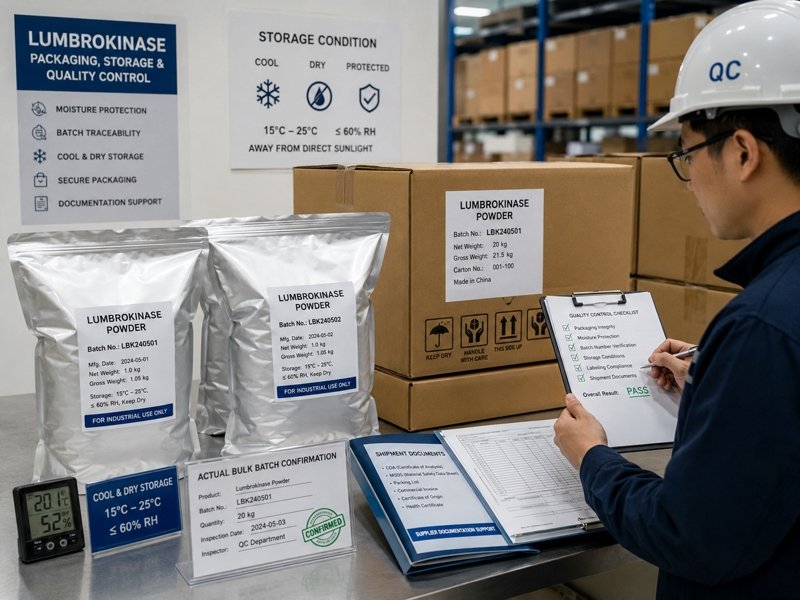
Packaging and Storage Control
Activity consistency is also affected by post-production handling.
Manufacturers should consider:
- sealed packaging
- moisture protection
- suitable storage conditions
- shipping preparation
Lumbrokinase is an enzyme-sensitive ingredient. Prolonged exposure to uncontrolled heat and humidity may increase quality risks.
Suitable packaging, transportation planning, and storage conditions help protect product quality during international supply.
How Buyers Should Confirm Activity Consistency Before Bulk Order
Before approving a bulk purchase, buyers should:
- Review sample COA and specification information
- Confirm required activity grade
- Understand assay method and activity unit basis
- Confirm available production batch
- Request actual bulk batch COA
- Compare bulk results with specification requirements
- Confirm packaging and storage conditions
This approach helps buyers evaluate real manufacturing consistency instead of relying only on previous sample results.
Manufacturer-Side Activity Consistency Checklist
| Control Area | What the Manufacturer Should Manage | What Buyers Should Review |
|---|---|---|
| Raw material consistency | Stable earthworm raw material management | Source and supplier capability |
| Production process control | Controlled processing procedures | Manufacturing transparency |
| Batch identification | Clear batch records | Actual batch number |
| Activity testing | Defined testing method | Test basis and results |
| Fibrin plate assay | Appropriate activity evaluation method | Assay context |
| Activity unit | Clear unit reporting | IU/mg, FU/g, LKU or U basis |
| COA | Batch-specific report | Actual batch results |
| Specification sheet | Product requirements | Agreed specification |
| Batch comparison | Internal quality review | Relevant parameters |
| Packaging | Suitable protection | Packaging information |
| Storage | Recommended conditions | Receiving conditions |
| Bulk confirmation | Confirm available batch before shipment | Actual bulk batch documents |
Common Buyer Mistakes
Expecting identical activity numbers for every batch
Batch variation can exist within acceptable specifications.
Comparing activity values without assay context
Different methods may create different numerical results.
Assuming the sample batch will always remain available
Inventory changes may require a newer production batch.
Ignoring actual bulk batch COA
The bulk batch document is the key reference for shipment approval.
Reviewing COA without specification sheet
COA shows results, while specification defines requirements.
Choosing only by price or highest activity number
Supplier capability, documentation, and production control are also important factors.
Allworms Supply Notes
Allworms is part of the manufacturer-side earthworm-derived ingredient supply system and supports overseas market development and international sales.
For available lumbrokinase batches, Allworms can provide:
- COA
- specification sheet
- batch information
- sample support
A 100 g sample may be available for qualified B2B buyers before bulk order approval, while buyers usually pay international sample freight.
Standard MOQ is usually around 1.5 kg depending on specification, packaging, and destination. Small bulk orders such as 10–25 kg may be discussed according to requirements.
Standard lead time is usually 7–15 days after payment. DHL shipping may be available for suitable shipments, and DDP shipping may be available for selected destinations.
FAQ
1. How do lumbrokinase manufacturers support consistent activity?
Manufacturers support consistent activity through raw material management, controlled production, activity testing, batch comparison, and documentation control.
2. Why does raw material consistency matter for lumbrokinase?
Because lumbrokinase is derived from earthworm raw materials, upstream control helps manufacturers maintain more stable production conditions.
3. Why is fibrin plate assay important for activity consistency?
Fibrin plate assay provides an activity evaluation method. Results should always be reviewed together with assay conditions and reporting basis.
4. Does consistent activity mean every batch has the same number?
No. Consistency means meeting agreed specifications rather than producing identical numerical values.
5. How should buyers compare sample and bulk batches?
Buyers should review the actual bulk batch number, COA, activity grade, assay method, and specification compliance before approval.
Looking for a lumbrokinase manufacturer with consistent activity control support?
Share your target activity specification, order quantity, sample testing status, destination, and document requirements.
Allworms can support COA review, specification confirmation, sample evaluation, available batch information, lead time, and shipping options.
One comment on “How Lumbrokinase Manufacturers Support Consistent Activity: Production and Batch Control”
Comments are closed.