
When sourcing lumbrokinase, activity units are one of the first details B2B buyers review on a COA, specification sheet, or supplier quotation. However, the number alone does not tell the full story. Lumbrokinase activity may be expressed as IU/mg, FU/g, LKU, U, or other method-based units depending on the supplier, laboratory, and assay system.
For ingredient buyers, the key question is not simply which unit looks higher. The more practical question is whether the lumbrokinase activity units are clearly supported by the assay method, testing conditions, COA format, and batch specification. This sourcing-focused guide explains what buyers should ask before sample evaluation, supplier comparison, or bulk order approval.
Quick Answer
The most important lumbrokinase activity units are the ones clearly supported by the supplier’s assay method, COA, specification sheet, and batch testing data. Buyers should not compare activity numbers without method context.
IU/mg, FU/g, LKU, and U may all appear in supplier documents, but they are not always directly interchangeable. When sourcing lumbrokinase, buyers should confirm the assay method, sample preparation, calculation basis, and whether the same testing logic applies to both sample and bulk batches.
Why This Matters for B2B Buyers
For supplement brands, ingredient distributors, OEM buyers, and formulation developers, lumbrokinase sourcing decisions often depend on activity claims. A supplier may quote a high activity value, but without the testing method and COA details, the value may be difficult to compare with another supplier.
This matters because lumbrokinase is an earthworm-derived fibrinolytic enzyme ingredient. Its activity is tested through enzyme-related methods, and small differences in assay conditions may influence the final reported number.
Before selecting a lumbrokinase supplier, buyers should confirm:
- Which activity unit is used
- Which assay method supports the activity value
- Whether the unit appears on both COA and specification sheet
- Whether the result is based on powder weight or protein basis
- Whether sample and bulk batches will use the same specification logic
- Whether the supplier can explain differences if a third-party lab uses another method
For a full explanation of IU/mg, FU/g, LKU, and U, buyers can also review IU/mg, FU/g, LKU and U: Understanding Lumbrokinase Activity Units.
Technical Explanation: Activity Unit Alone Is Not Enough
Lumbrokinase activity units are method-dependent. This means that the same product may show different numerical results if tested under different laboratory methods, substrates, incubation times, dilution ratios, reference standards, or calculation systems.
For example, one supplier may express activity as IU/mg, while another may use FU/g or another unit. A buyer may be tempted to choose the supplier with the highest number, but this can be misleading if the assay basis is different.
When reviewing lumbrokinase activity, buyers should check five details together:
- Activity unit
The COA and specification should clearly state the unit, such as IU/mg, FU/g, LKU, or U. - Assay method
The document should identify the testing method, such as fibrin plate assay or another fibrinolytic activity method. - Testing basis
Buyers should confirm whether the activity is calculated per gram of powder, per milligram of powder, or per milligram of protein. - Sample preparation
Extraction solvent, dilution, substrate preparation, incubation temperature, and incubation time may affect results. - Batch consistency logic
The same activity unit and method should be used when moving from sample testing to bulk order approval.
For buyers reviewing test methods, Fibrin Plate Assay for Lumbrokinase Activity can provide more method-level background.

Activity Unit Questions Buyers Should Ask
| Question | Why It Matters for Sourcing |
|---|---|
| Which activity unit is used? | Confirms whether the supplier reports IU/mg, FU/g, LKU, U, or another unit. |
| Which assay method is used? | Activity values depend on the test method, not only the product itself. |
| Is the unit shown on both COA and specification sheet? | Helps prevent mismatch between batch results and sales specifications. |
| Is the result based on powder weight or protein basis? | “Per mg powder” and “per mg protein” may not mean the same thing. |
| Is the method suitable for comparing suppliers? | Supplier comparison is only meaningful when the testing basis is understood. |
| Can the same unit and method be used for sample and bulk batches? | Supports smoother sample approval and bulk order confirmation. |
| Can the supplier explain differences if the buyer’s third-party lab uses another method? | Helps avoid misunderstanding when external lab results differ from supplier COA. |
How to Review COA and Specification Documents
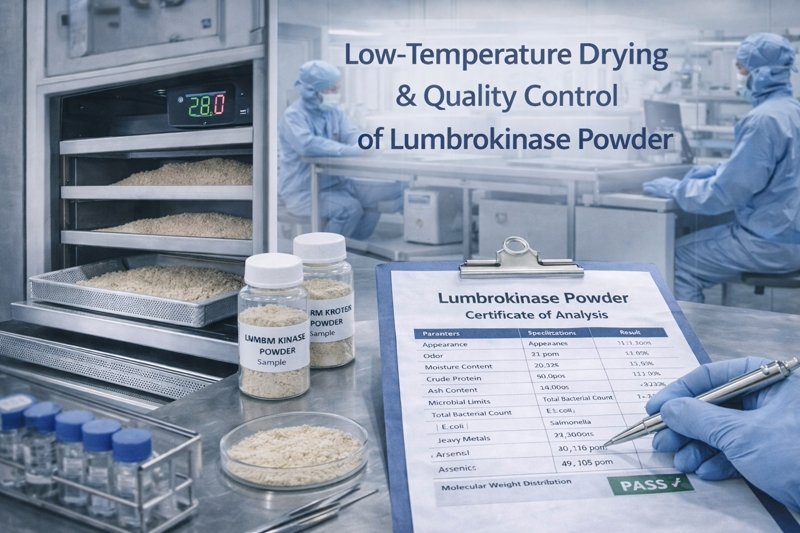
A lumbrokinase COA shows actual batch test results, while a specification sheet defines the supplier’s expected product standard. Buyers should review both documents together.
A sourcing-ready COA should ideally show:
- Product name
- Batch number
- Activity value
- Activity unit
- Assay method
- Appearance
- Moisture
- Ash or residue on ignition
- Heavy metals
- Microbiology
- Storage condition
- Manufacturing or expiry information
A sourcing-ready specification sheet should clearly define:
- Standard activity range or minimum activity
- Unit expression
- Test method
- Appearance
- Physical and chemical parameters
- Microbiology limits
- Packaging
- Storage
- Shelf life
If the COA says one unit but the specification sheet uses another, buyers should ask the supplier to explain the relationship before sample approval. For a deeper document comparison, see Lumbrokinase COA vs Specification Sheet.
Buyer Checklist for Sourcing Lumbrokinase When Activity Units Differ
| Checklist Item | What Buyers Should Confirm |
|---|---|
| Activity unit clarity | The supplier clearly states IU/mg, FU/g, LKU, U, or another unit. |
| Assay method | The test method is named and can be explained. |
| COA consistency | The COA activity result matches the quoted specification. |
| Specification consistency | The specification sheet uses the same activity logic as the COA. |
| Sample testing plan | The buyer knows how the sample will be tested before ordering. |
| Third-party lab method | The buyer checks whether the external lab method is the same or different. |
| Bulk order approval | The bulk batch will be approved using the same activity specification logic. |
| Supplier explanation | The supplier can explain why units may differ across testing systems. |
| Price comparison | Price is compared together with activity, documents, MOQ, lead time, and shipping. |
| Compliance review | Finished product claims and labeling will be evaluated according to local regulations. |
Sample Testing and Bulk Order Approval
Sample evaluation is one of the most important steps when sourcing lumbrokinase. However, a sample result is only useful if the buyer and supplier agree on how activity will be interpreted.
Before testing a sample, buyers should clarify:
- Which activity specification is being evaluated
- Which assay method will be used
- Whether the buyer’s lab and supplier’s lab use the same method
- Whether the result will be judged by supplier COA or third-party testing
- Whether the same specification applies to the future bulk batch
If a buyer tests a sample using a different method from the supplier’s COA method, the result may not directly match the supplier’s reported activity. This does not automatically mean the product is inconsistent. It may mean the assay method, unit system, or calculation basis is different.
For buyers moving from sample to bulk order, Lumbrokinase Sample Evaluation and Lumbrokinase Batch Consistency can help structure the approval process.
Common Sourcing Mistakes
Asking Only for the Highest Activity Number
A high activity number may look attractive, but it is not enough for supplier selection. Buyers should ask how the number was tested, which method was used, and whether the result is shown on the batch COA.
Assuming IU/mg and FU/g Can Be Directly Converted
IU/mg and FU/g should not be treated as automatically interchangeable. Conversion may not be reliable unless the same assay basis, reference standard, and calculation method are used.
Ignoring the Assay Method
The assay method is essential for activity review. Without method context, activity values from different suppliers may not be comparable.
Comparing Supplier COAs Without Checking Testing Conditions
Two COAs may both report lumbrokinase activity, but the testing conditions may differ. Buyers should check substrate, incubation, dilution, calculation basis, and reporting unit where possible.
Accepting a Sample Without Confirming Bulk Batch Specification
A sample should not be approved in isolation. Buyers should confirm whether the future bulk batch will follow the same specification, activity unit, and testing logic.
Choosing Only by Price
Lumbrokinase price should be evaluated together with activity unit, assay method, COA, specification sheet, sample performance, batch consistency, MOQ, lead time, and shipping conditions.
For a broader supplier comparison framework, see How to Compare Lumbrokinase Suppliers When Activity Units Differ.
Allworms Supply Notes
Allworms Bio-Tech Co., Ltd is a manufacturer of earthworm-derived ingredients, including Lumbrokinase. The company has its own earthworm breeding base and production facility in Conghua, Guangzhou, Guangdong, China, and focuses on earthworm-derived raw materials for dietary supplement, nutraceutical, enzyme formulation, and research-related applications.
For lumbrokinase sourcing, Allworms can provide COA and specification sheet for available batches. Buyers may request documents before sample evaluation or bulk order discussion.
Typical supply information includes:
- Product: Earthworm-derived lumbrokinase
- Documents: COA and specification sheet available for available batches
- Activity review: Assay method and activity unit can be discussed before sample testing
- Sample: 100 g sample may be available for qualified B2B buyers
- MOQ: Usually around 1.5 kg, depending on product specification
- Lead time: Usually 7–15 days after payment
- Shipping: International shipping supported; DDP door-to-door shipping may be available for selected destinations
This product is supplied as a B2B ingredient. Final formulation suitability, dosage, labeling, health claims, and regulatory compliance should be evaluated by the buyer according to the intended market and finished product use.
FAQ
1. Which lumbrokinase activity unit is best for sourcing?
There is no single “best” unit for every sourcing case. The most important unit is the one clearly supported by the supplier’s assay method, COA, specification sheet, and batch testing data.
2. Can IU/mg, FU/g, LKU, and U be directly compared?
Not always. These units may come from different assay systems, reference standards, and calculation methods. Buyers should not compare activity numbers unless they understand the method context.
3. What should I check first on a lumbrokinase COA?
Check the activity value, activity unit, assay method, batch number, moisture, ash or residue on ignition, heavy metals, microbiology, and storage condition. The activity unit should be clearly shown.
4. Why does the lumbrokinase assay method matter?
Lumbrokinase activity is method-dependent. Different substrates, incubation conditions, sample preparation methods, and calculation systems may produce different numerical results.
5. Should sample testing and bulk order approval use the same activity logic?
Yes. Buyers should use the same activity specification, unit logic, and testing method as much as possible when moving from sample evaluation to bulk order approval.
Short B2B CTA
Need support reviewing lumbrokinase activity units, COA, or specification documents?
Contact Allworms to request lumbrokinase samples, MOQ, pricing, lead time, and shipping details.
2 comments on “What Activity Units Matter When Sourcing Lumbrokinase?”
Comments are closed.