
Lumbrokinase bioactive enzyme is widely studied because it is an earthworm-derived enzyme system with fibrinolytic activity, a technical characteristic that attracts attention in enzyme research, nutraceutical formulation, and supplement ingredient sourcing. For B2B buyers, however, the key question is not only why lumbrokinase is researched, but how to evaluate it as a commercial raw material.
A reliable review should focus on source, activity specification, assay method, COA, specification sheet, sample testing, storage, and bulk order consistency. This article explains why lumbrokinase is studied as a bioactive enzyme and how ingredient buyers can assess it before sourcing from a lumbrokinase supplier.
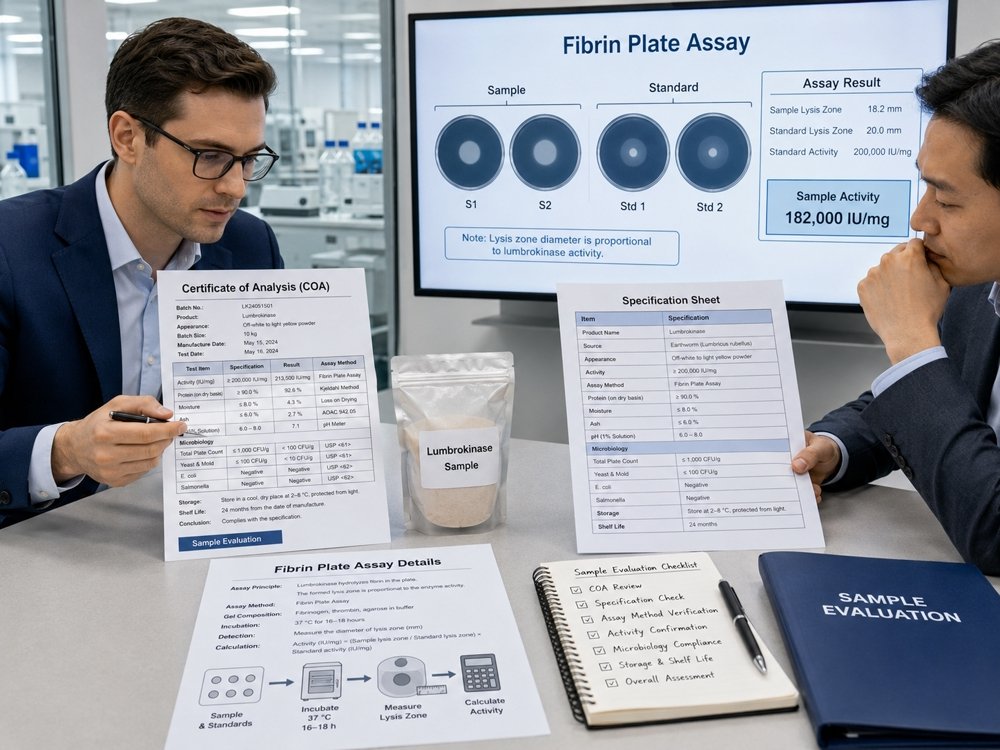
Quick Answer
Lumbrokinase is widely studied because it is an earthworm-derived bioactive enzyme with fibrinolytic activity. This activity makes it relevant to ingredient-level research and supplement formulation discussions.
For B2B buyers, lumbrokinase should be evaluated through its source, assay method, activity specification, COA, specification sheet, sample testing, and supplier consistency. It should not be reviewed as a medicine, treatment, or clinical solution.
Why This Matters for B2B Buyers
Lumbrokinase is not a simple commodity powder. It is an enzyme ingredient, which means its commercial value depends heavily on activity data, testing method, storage condition, and batch consistency.
For supplement brands, nutraceutical companies, OEM factories, distributors, and formulation developers, the main sourcing questions usually include:
- Is the material truly earthworm-derived?
- What activity grade is offered?
- Which assay method is used?
- Is the activity reported in IU/mg, FU/g, LKU, or another unit?
- Does the COA match the specification sheet?
- Can the supplier provide a sample for evaluation?
- Will the bulk batch match the approved sample?
- What are the MOQ, lead time, storage condition, and shipping options?
These questions are practical because enzyme ingredients are sensitive to source, process, test method, and handling conditions. A high activity number alone is not enough for supplier selection.
For a broader product overview, buyers may also review What Is Lumbrokinase? Source, Activity and B2B Supply Guide.
Technical Explanation: Why Lumbrokinase Is Studied as a Bioactive Enzyme
Lumbrokinase refers to a group of fibrinolytic enzymes derived from earthworms. In ingredient-level research, it is studied because enzymes can interact with specific substrates under defined laboratory conditions.
The key technical feature of lumbrokinase is fibrinolytic activity. This does not mean the ingredient should be described with medical claims. For B2B sourcing, it means buyers should understand how the enzyme activity is tested, expressed, documented, and compared.
Lumbrokinase research is often connected with:
- Earthworm-derived enzyme systems
- Fibrinolytic activity testing
- Enzyme activity expression
- Protein-based enzyme characteristics
- Bioactive ingredient research
- Supplement and nutraceutical formulation interest
For commercial purchasing, these research points must be translated into quality-control questions. Buyers should ask for a COA, specification sheet, assay method, and sample evaluation support before placing a bulk order.
Research Interest vs B2B Buyer Evaluation Focus
| Research Interest | B2B Buyer Evaluation Focus |
|---|---|
| Earthworm-derived enzyme source | Confirm material source, species, raw material control, and traceability |
| Fibrinolytic activity | Review activity specification and test method before comparing suppliers |
| Bioactive enzyme properties | Confirm whether the product is positioned as an enzyme ingredient, not a peptide powder |
| Activity units | Check IU/mg, FU/g, LKU, or U carefully because methods may differ |
| Laboratory assay method | Review whether fibrin plate assay or another method is used |
| Stability under handling | Confirm storage, packaging, moisture control, and shipping conditions |
| Batch-level testing | Request COA for available batches and compare with the specification sheet |
| Sample research or evaluation | Test sample under the buyer’s intended method before bulk approval |
| Commercial sourcing | Review MOQ, lead time, shipping route, and supplier production consistency |
Activity Specification and Assay Method Should Be Reviewed Together
Lumbrokinase activity may be expressed in different unit systems, such as IU/mg, FU/g, LKU, or U. These units should not be compared only by number because activity values depend on assay method, substrate, incubation condition, reference standard, and calculation method.
For this reason, B2B buyers should review the activity specification together with the assay method. A COA that lists activity without explaining the method may not be enough for technical comparison.
For more detail, buyers can read Lumbrokinase Activity Units and Fibrin Plate Assay for Lumbrokinase Activity.
COA and Specification Sheet Review
A specification sheet describes the supplier’s standard quality requirements. A COA shows the test result of a specific batch. B2B buyers should review both documents because they answer different questions.
The specification sheet helps buyers understand the intended product standard, including appearance, activity, moisture, ash, heavy metals, microbiology, storage, and shelf life.
The COA helps buyers check whether the available batch meets those standards. For lumbrokinase, the COA should ideally include activity, assay method, moisture, heavy metals, microbiology, and batch information.
For a deeper document comparison, buyers can review Lumbrokinase COA vs Specification Sheet.
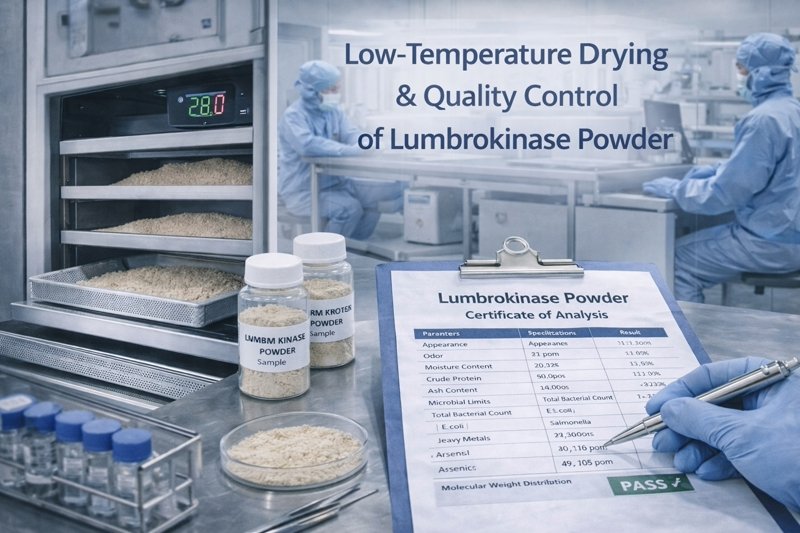
Buyer Checklist for Lumbrokinase Bioactive Enzyme
| Checklist Item | What B2B Buyers Should Review |
|---|---|
| Product source | Confirm it is an earthworm-derived enzyme ingredient |
| Product positioning | Confirm it is lumbrokinase, not earthworm peptide powder or general protein powder |
| Activity specification | Check the declared activity grade and unit expression |
| Assay method | Ask whether fibrin plate assay or another test method is used |
| COA | Review batch-specific test results before sample or bulk approval |
| Specification sheet | Compare standard limits with the actual COA result |
| Activity unit | Review IU/mg, FU/g, LKU, or U carefully; do not compare numbers without method context |
| Sample availability | Request a sample for internal evaluation or third-party testing when needed |
| Batch consistency | Confirm whether the approved sample and bulk batch are from the same or comparable production standard |
| MOQ | Check whether the order quantity matches supplier packaging and production conditions |
| Lead time | Confirm production and dispatch timing before placing a purchase order |
| Storage | Keep sealed in a cool, dry place and protect from moisture and heat |
| Shipping | Confirm whether DDP or other international shipping options are available |
| Documentation | Ask for COA, specification sheet, and assay method details when needed |
Common Mistakes or Misunderstandings
Mistake 1: Treating lumbrokinase as a finished health product
Lumbrokinase supplied as a raw material should be evaluated as a B2B enzyme ingredient. Finished product dosage, label wording, claims, and market compliance are the buyer’s responsibility.
Mistake 2: Comparing activity numbers without assay method
Two suppliers may report different activity values because they use different testing systems. Buyers should compare activity only when the assay basis is clear.
Mistake 3: Confusing lumbrokinase with earthworm peptide powder
Lumbrokinase is an active enzyme ingredient. Earthworm Peptide Powder is produced through enzymatic hydrolysis, but the finished powder is not positioned as an active enzyme ingredient. It is a stable peptide ingredient rather than a fibrinolytic enzyme product such as lumbrokinase.
Mistake 4: Reviewing COA but ignoring the specification sheet
The COA shows batch results. The specification sheet shows the supplier’s standard. Buyers should compare both before approving a sample or bulk order.
Mistake 5: Approving a sample without confirming bulk consistency
Sample evaluation is useful only when the buyer also confirms future bulk supply consistency, batch documentation, packaging, storage, and shipping conditions.
For practical sample review, buyers can read Lumbrokinase Sample Evaluation.
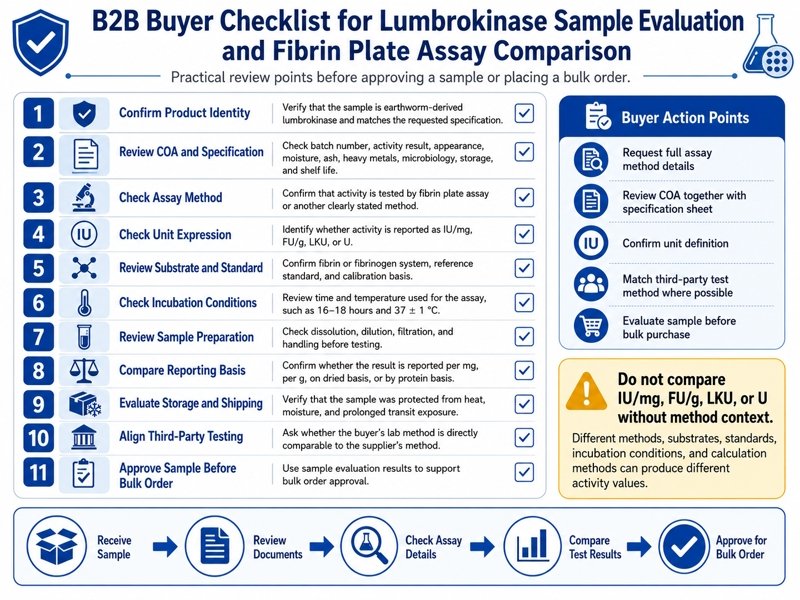
Allworms Supply Notes
Allworms Bio-Tech Co., Ltd. is a manufacturer of earthworm-derived ingredients, including lumbrokinase. The company has its own earthworm breeding base and production facility in Conghua, Guangzhou, Guangdong, China, supporting raw material control and batch-based production management.
For available lumbrokinase batches, COA and specification sheet can be provided. Sample evaluation may be available for qualified B2B buyers. The standard MOQ is usually around 1.5 kg depending on specification. Standard lead time is usually 7–15 days after payment.
DDP shipping may be available for selected destinations. Buyers can contact Allworms to review activity grade, assay method, COA, specification sheet, sample availability, MOQ, lead time, and shipping options.
For product details, visit the Lumbrokinase product page. For broader purchasing questions, see the FAQ page.
Compliance Note
This product is supplied as a B2B ingredient. Final formulation suitability, dosage, labeling, health claims, and regulatory compliance should be evaluated by the buyer according to the intended market and finished product use.
FAQ
1. Why is lumbrokinase widely studied as a bioactive enzyme?
Lumbrokinase is widely studied because it is an earthworm-derived enzyme system with fibrinolytic activity. At the ingredient level, this makes it relevant to enzyme research, activity testing, and supplement formulation evaluation.
2. Is lumbrokinase a medicine?
In this B2B context, lumbrokinase is discussed as an enzyme ingredient for supplement, nutraceutical, and research-related applications. It should not be presented as a medicine, treatment, cure, or clinical solution.
3. What should buyers check before sourcing lumbrokinase?
Buyers should review source, activity specification, assay method, COA, specification sheet, sample availability, batch consistency, MOQ, lead time, storage, and shipping conditions.
4. Why is the assay method important for lumbrokinase?
The assay method affects the reported activity value. Lumbrokinase activity units such as IU/mg, FU/g, LKU, or U may not be directly interchangeable unless the same testing basis is used.
5. Can Allworms provide samples and documents?
Yes. Allworms can provide COA and specification sheet for available batches. Sample evaluation may be available for qualified B2B buyers, and the standard MOQ is usually around 1.5 kg depending on product specification.
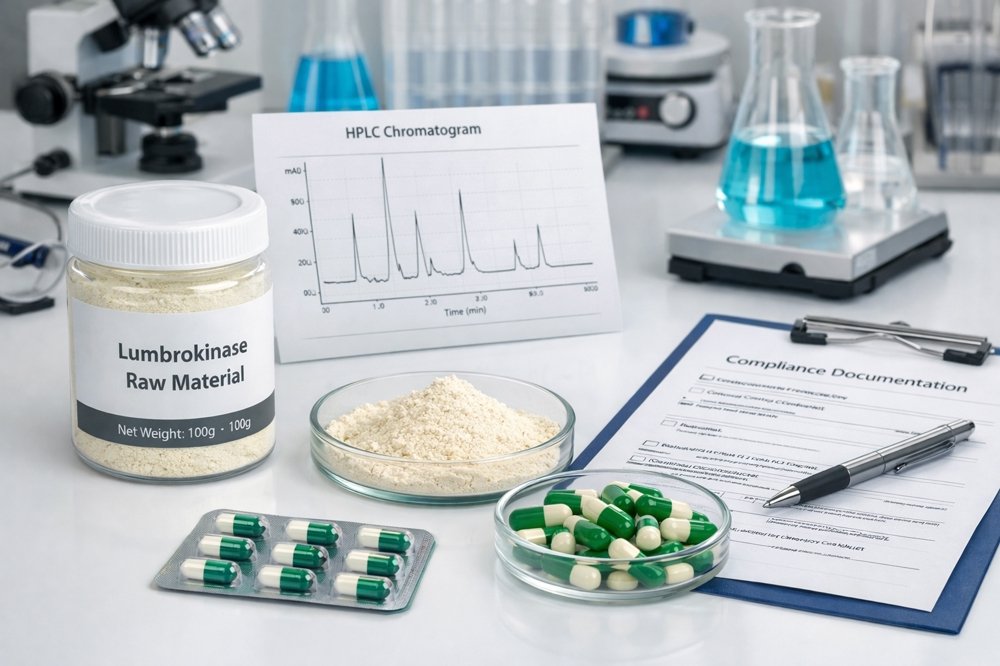
Need a Lumbrokinase Bioactive Enzyme Supplier for Supplement or Nutraceutical formulation?
Contact us to request COA, specification sheet, sample details, MOQ, lead time, and shipping options.