If you’re sourcing earthworm peptide powder in bulk, you’re probably not looking for a trendy ingredient with flashy claims. You’re looking for something much more practical: steady quality, usable specs, clean documentation, and a supplier that won’t suddenly go quiet when it’s time to ship.
That’s really the heart of B2B purchasing, isn’t it? On paper, many suppliers look similar. Same product name. Similar photos. Similar promises. But once samples are tested, formulation work starts, and procurement steps in, the differences show up fast.
Earthworm peptide powder sits in an interesting spot. It isn’t just another commodity protein. It is a peptide-based raw material produced from earthworm protein through hydrolysis, and it is usually positioned for nutraceutical formulations, functional foods, and advanced health-product development. One important point for formulators: the finished peptide powder can be positioned as a non-active enzyme peptide ingredient, meaning it is valued for peptide content and formulation stability rather than active enzyme function. That distinction matters a lot in real product development.
So where should you buy earthworm peptide powder in bulk? Honestly, the best answer is this: buy from a supplier that can prove consistency, not just talk about it.
Let me explain.
What earthworm peptide powder actually is
Earthworm peptide powder is generally made by breaking down earthworm protein into smaller peptides through controlled enzymatic hydrolysis, then converting the material into a stable powder form for formulation and storage. It as a small-molecule bioactive peptide ingredient with protein content above 65%, low fat, and good compatibility in powders, capsules, and beverage systems.
That does not mean every bulk powder on the market is the same. Far from it. A peptide ingredient is only as useful as its process control, raw material handling, and spec consistency.
Why buyers look for it in bulk
Bulk buyers usually fall into a few groups:
- dietary supplement brands
- nutraceutical ingredient distributors
- functional food developers
- health-product manufacturers
And their reasons are usually practical, not romantic.
They may want a differentiated peptide raw material for capsules, powder blends, tablets, sachets, or drink formulations. They may want a small-molecule ingredient with better absorption positioning than ordinary protein. They may want a stable ingredient that is easier to work with than an active enzyme material. Or they may simply want something that helps their product line stand out in a crowded market.
There’s also the sourcing side of it. Once a buyer moves beyond trial scale, they need bulk supply that can support repeat orders, lot tracking, packaging options, and shelf-life management. A peptide ingredient might look great in a brochure, but if lead times drift or batch quality swings, it becomes a headache fast.
So, where should you buy earthworm peptide powder in bulk?
The most reliable route is usually direct from a specialized manufacturer, or from a distributor that has a clear, documented relationship with that manufacturer.
That sounds obvious, but in ingredient sourcing, “obvious” and “common” are not the same thing.
A direct manufacturer or manufacturer-backed supplier is typically the better choice when you need:
- stable raw material sourcing
- consistent peptide profile
- clear production process
- test reports and COA support
- scalable supply for repeat purchasing
- technical communication during sample and spec review
Bulk buyers often care about unstable performance, inconsistent molecular weight distribution, activity loss during processing, and batch variation. Those are real buying concerns, not marketing filler.
In other words, the best place to buy bulk earthworm peptide powder is not “the cheapest website.” It is the supplier that can show you how the product is made, how it is controlled, and how it behaves in actual formulations.
What a strong bulk supplier should be able to show you
Here’s the thing: good suppliers reduce uncertainty.
Before you place a bulk order, the supplier should be able to explain the product in simple, testable terms.
1. Raw material source
You need to know what the source material is and whether it is handled consistently. Fresh earthworm material such as Lumbricus rubellus / Eisenia fetida as source material for peptide production.
That matters because raw material variation often becomes finished-product variation.
2. Process clarity
A trustworthy supplier should be able to describe the production route clearly. The controlled process that includes raw material selection, enzymatic hydrolysis, filtration and purification, spray drying, sterilization, and packaging.
That “spray drying” point is worth pausing on. It is not just a line in a process chart. It connects directly to the product’s positioning as a stable, non-activity enzyme peptide ingredient. For B2B buyers, that means easier handling in storage and finished-product development.
3. Core specification data
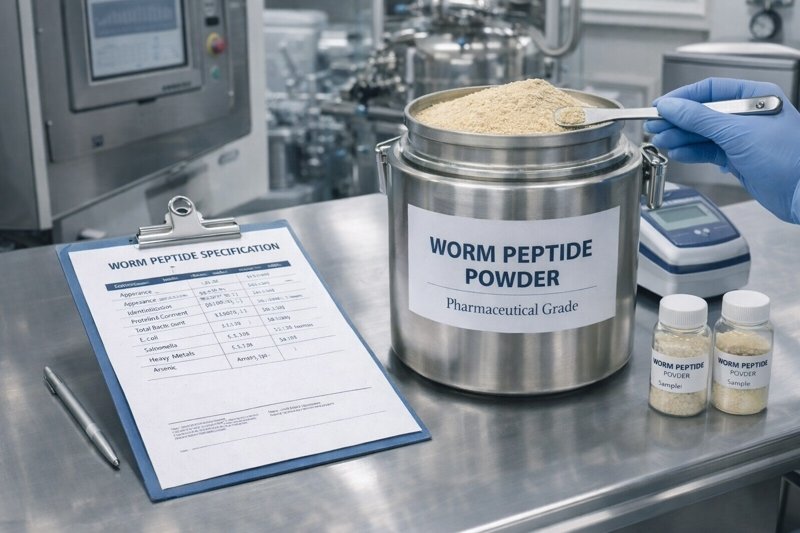
At minimum, bulk buyers should request:
- protein content
- peptide content
- moisture
- ash
- heavy metals
- microbiological limits
- appearance and odor
- shelf life
- packaging format
Our peptide product sheet lists examples such as protein ≥65, peptide content >30, moisture, ash, selenium, arsenic, cadmium, lead, mercury, and key microbiological indicators.
No serious buyer should skip this step. Not ever.
4. Formulation positioning
A good supplier should understand whether the product is being sold as an enzyme, a peptide, or a broader protein-derived ingredient. earthworm peptide powder is clearly positioned as a non-activity enzyme peptide product with no active enzyme content, which is said to improve formulation predictability and storage stability.
That’s important because buyers and suppliers sometimes talk past each other. One side says “bioactive.” The other hears “enzyme.” Then trouble starts.
5. Sample support
Bulk sourcing should almost always begin with sample evaluation. A supplier confident in batch consistency will usually support sampling for testing, especially for B2B qualification workflows.
Why buying from a specialized manufacturer often makes more sense
This is where the conversation gets practical.
If you buy through a general trader, you may get faster initial replies. Sometimes that happens. But once you ask about peptide profile control, heavy metal limits, molecular weight customization, process details, or long-term supply capacity, the chain can get fuzzy.
A specialized manufacturer is more likely to give you direct answers because they control more of the process. They can usually speak more clearly about upstream sourcing, hydrolysis, drying, quality control, and packaging. They also tend to be better positioned for custom spec discussions.
That’s what most experienced procurement teams eventually discover: cheaper doesn’t always mean lower cost. One failed batch, one customs issue, one vague COA, or one unstable formulation can wipe out the savings from a low quote.
What to check before you buy in bulk
Let’s keep this grounded. Before issuing a purchase order, ask for the following.
Check the documents, not just the sales pitch
Request:
- COA
- specification sheet
- microbiological report
- heavy metal report
- packaging and storage details
- sample retention or lot traceability policy
- shipping terms and lead time
If the supplier hesitates, that’s a sign. If they send vague screenshots instead of real documents, that’s also a sign.
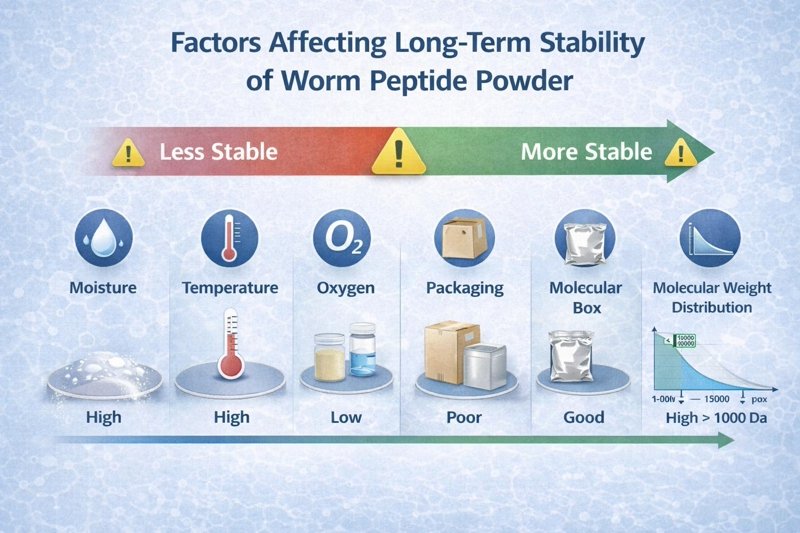
Ask how stable the product is during storage and transport
Earthworm peptide powder is often purchased for export-oriented B2B use. So storage and shipping are not side topics. They’re central topics.
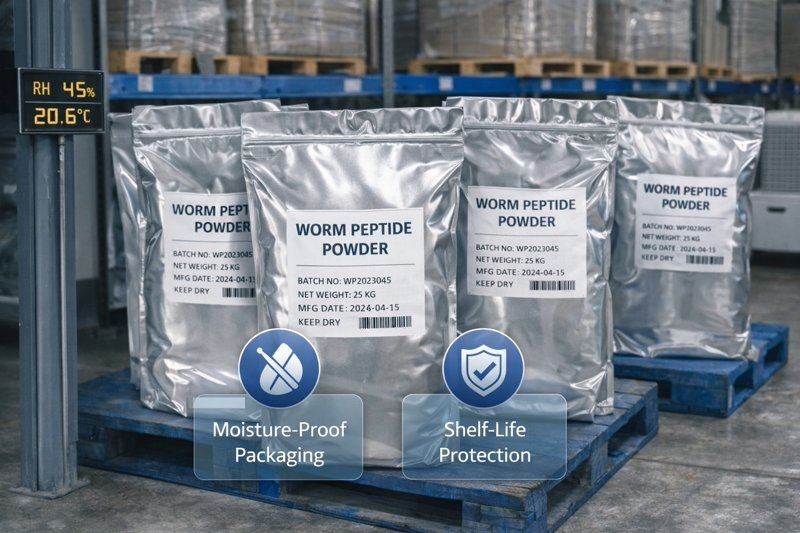
Cool, dry storage conditions, two-year shelf life, and packaging formats such as 1 kg bags and 10 kg cartons. A supplier should be able to discuss how packaging helps protect the powder during transit and warehousing.
Confirm the product’s role in your formula
This sounds basic, but it saves trouble.
Are you buying it as:
- a peptide nutrition ingredient
- a peptide functional ingredient
- a circulation-support formulation component
- a protein-derived ingredient for differentiated positioning
The research points to earthworm-derived peptides as a promising field for antioxidant, ACE-inhibitory, and immunomodulatory exploration. But your commercial product positioning still needs to match your target market’s regulatory and formulation realities.
Ask whether specs can be customized
Some buyers need tighter peptide content targets, different packaging, or particular formulation preferences. A capable manufacturer should be able to discuss this early, not after deposit.
Red flags when buying earthworm peptide powder in bulk
A few warning signs show up again and again:
“Everything is available, everything is premium”
That usually means nothing is defined well.
No distinction between peptide and enzyme products
If the supplier cannot explain whether the product contains active enzyme or is a stable non-enzymatic peptide powder, be careful. That difference can affect formulation, labeling logic, and storage expectations.
No process explanation
A serious supplier should be able to describe hydrolysis, purification, drying, and QC. If the answer is hand-wavy, that’s a problem.
Unrealistically low MOQ with no real supply story
Sometimes very small MOQ claims are used just to open conversations. But bulk buyers need to know what happens after the first order.
Big health claims, weak technical support
This one is common in niche ingredients. Strong suppliers stay close to the spec sheet. Weak ones lean too hard on miracle language.
A practical buying path for B2B teams
If you’re ready to source, a sensible path looks like this:
First, identify a manufacturer or manufacturer-backed supplier focused on earthworm-derived ingredients.
Second, request the spec sheet, COA, and sample.
Third, review the product’s positioning carefully. Is it a stable peptide powder? Is it clearly described as non-enzymatic? Are the composition and QC points usable for your market?
Fourth, evaluate sample performance in your intended system — capsule, powder blend, tablet, or beverage base.
Fifth, confirm lead time, packaging, and repeat-order capacity before scaling up.
That sequence is not glamorous, but it works. And in B2B sourcing, working beats sounding impressive.
Related ingredients buyers often compare
Many bulk buyers looking at earthworm peptide powder also compare it with upstream or adjacent ingredients such as Earthworm Protein Powder and Lumbrokinase. That comparison makes sense.
Earthworm protein powder is closer to a broader protein-rich raw material, while earthworm peptide powder is positioned as a smaller-molecule, easier-to-formulate peptide ingredient. Lumbrokinase, meanwhile, is an enzyme-focused material with a very different sourcing and activity conversation. Your peptide buying strategy should reflect that difference. The peptide product sheet explicitly highlights its stability advantage over enzyme ingredients in formulation settings.
So when asking where to buy in bulk, the real question is not only “Who sells it?” It is also “Which form of earthworm-derived ingredient actually fits my product plan?”
Final thought
The best place to buy earthworm peptide powder in bulk is from a supplier that can support the whole chain: raw material clarity, controlled production, documented specifications, sample testing, and dependable repeat supply.
That usually points to a specialized manufacturer, not a generic reseller.
Because bulk buying isn’t really about finding a powder. It’s about finding a supply partner you won’t have to babysit.
And yes, that sounds a bit blunt. But in procurement, blunt is useful.
FAQs
1. Where can I buy earthworm peptide powder in bulk for nutraceutical manufacturing?
The safest option is to buy from a specialized earthworm peptide powder manufacturer or an authorized bulk ingredient supplier that can provide COA, specification sheets, and stable batch supply for nutraceutical production.
2. What should I check before ordering bulk earthworm peptide powder?
Check protein content, peptide content, heavy metals, microbiological limits, packaging, shelf life, storage conditions, and whether the product is positioned as a non-enzymatic peptide ingredient for stable formulation use.
3. Is earthworm peptide powder the same as lumbrokinase?
No. Earthworm peptide powder is generally sold as a peptide-based formulation ingredient, while lumbrokinase is an enzyme complex with activity-focused specifications. They are different raw materials with different formulation roles.
4. Can I request samples before placing a large earthworm peptide powder wholesale order?
Yes. For B2B sourcing, sample evaluation is strongly recommended before committing to a larger earthworm peptide powder wholesale purchase, especially for formulation compatibility and QC review.
5. Why do buyers prefer direct earthworm peptide powder manufacturers?
Direct manufacturers usually offer better process transparency, more reliable bulk supply, clearer technical support, and greater flexibility on specification discussions than non-specialized traders.