If you’re sourcing earthworm protein powder for dietary supplements, nutraceutical ingredients, pharmaceutical development, or even cosmetics and functional health products, one question shows up pretty quickly: should you buy through a trader, or work directly with a manufacturer?
Honestly, this is not a small decision. It affects quality consistency, lead time, technical support, document flow, cost structure, and even how confidently you can scale later. On paper, both options can look similar. A seller sends a spec sheet, a COA, maybe a few nice-looking photos, and the conversation moves forward. But once sampling, validation, customization, and repeat orders begin, the gap becomes obvious.
Working directly with an earthworm protein powder manufacturer usually gives B2B buyers more control, better visibility, and fewer surprises. And in a specialty ingredient category like earthworm protein, that matters a lot.
A middleman can sell a product. A manufacturer can explain it.
Here’s the thing. Earthworm protein powder is not a commodity in the same way as sugar, maltodextrin, or standard whey ingredients. Buyers often need more than a price. They need context.
They need to know how the raw material is selected. They need to know whether the process favors protein stability. They want to understand particle appearance, odor profile, moisture control, batch variation, and how the material behaves in real formulations. They may also want to distinguish plain earthworm protein from earthworm peptide powder or lumbrokinase-based materials, because those are not interchangeable.
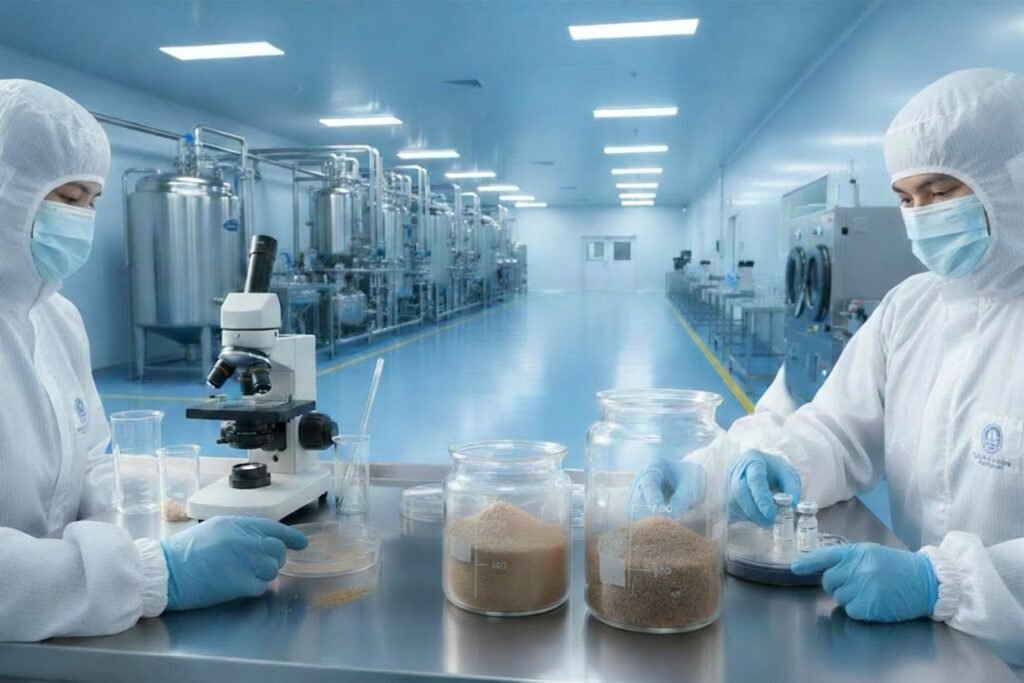
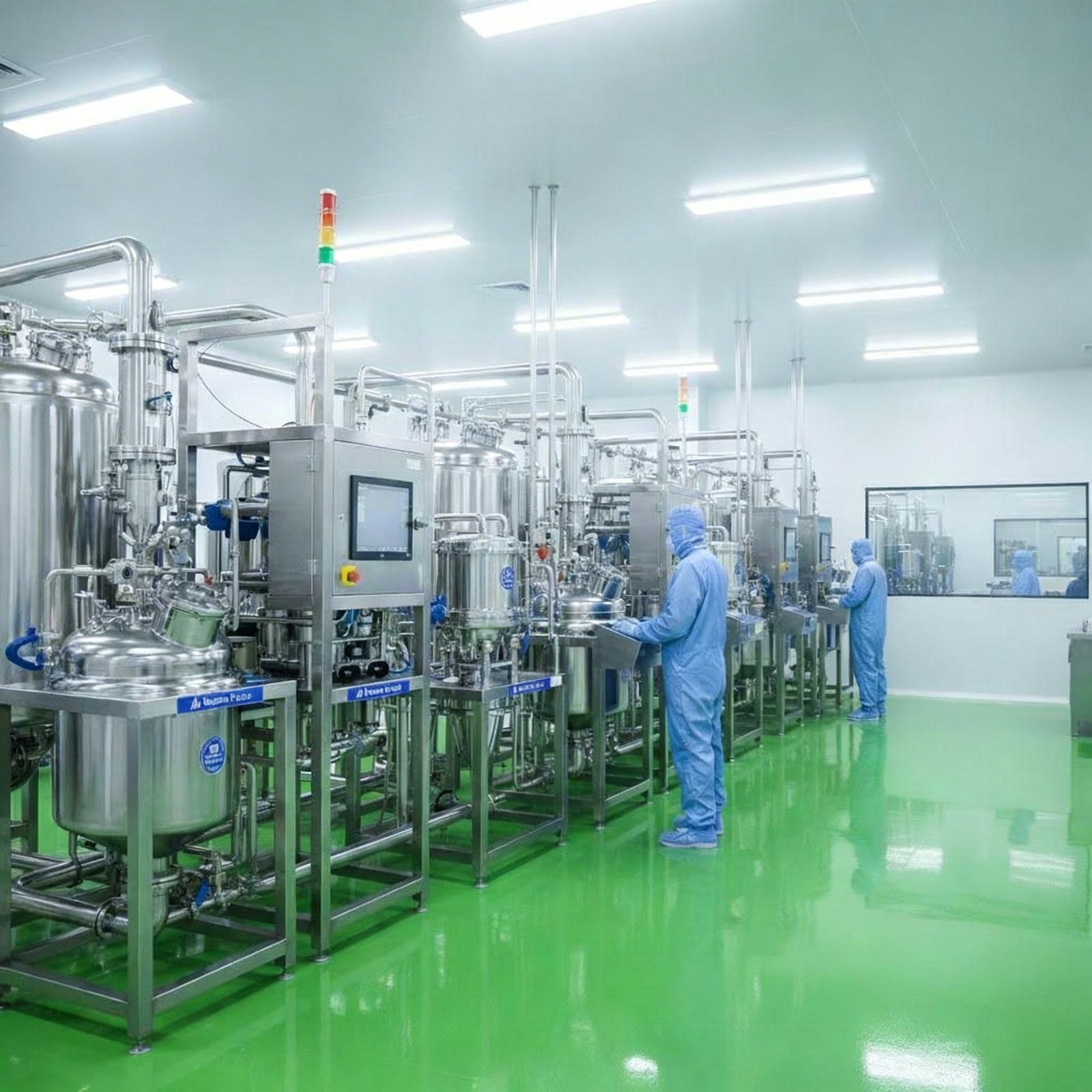
When you work directly with the manufacturer, the answers tend to be faster and more precise because they come from the production side, not from a sales relay chain. In your uploaded production-process file, earthworm protein powder is described as being made through a sequence that includes selection, mechanical separation of soil and impurities, secondary cleaning, washing/hydrolysis, centrifugal filtration, low-temperature drying, milling, sterilization, and packaging. That production visibility is exactly the kind of detail serious buyers want when evaluating a supplier.
And that’s the point. A direct manufacturer does not just sell a powder. They can explain why the powder is the way it is.
Raw material control starts much earlier than most buyers think
A surprisingly large share of product quality is decided before extraction even begins.
If the upstream raw material is unstable, poorly handled, or inconsistently sourced, the finished powder may still pass a simple spec sheet while giving buyers headaches later. Slight shifts in color, smell, protein level, ash, moisture, or microbial performance can turn into formulation trouble, especially in capsules, tablets, powder blends, or functional beverage systems.
Earthworm protein is naturally valued for its strong protein profile. One of the uploaded research papers notes that dried earthworm raw material contained about 60.34% protein before purification, and the purified earthworm protein fraction reached about 96.03% protein with fat reduced to 0.98% through alkali-soluble acid precipitation. Another uploaded study describes earthworm as a protein resource that can range from about 60% to more than 70% protein and highlights its essential amino acid value and potential as a food protein source.
That sounds great, but those numbers only matter when the upstream handling is under control. A direct manufacturer is far more likely to have line-of-sight into sourcing, pretreatment, and production conditions. That makes it easier to keep the finished material more consistent from lot to lot.
For distributors, wholesalers, and private-label brands, that consistency is gold. You may not see it in the first sample. You definitely notice it by the third or fifth commercial batch.
Consistency is a process, not a promise
A lot of suppliers say “stable quality.” Fewer can show where that stability comes from.
In specialty proteins, process discipline matters. The research you uploaded shows that earthworm protein preparation and digestion studies use controlled steps such as pH adjustment, centrifugation, desalting, and drying to produce defined protein or peptide fractions. Your own production summary also emphasizes mechanical separation, cleaning, centrifugal filtration, low-temperature drying, sterilization, and packaging.
Why does this matter to a buyer? Because quality problems rarely arrive as dramatic failures. More often, they show up as quiet friction:
A powder that blends differently this month than last month.
A smell note that is slightly stronger than the retained sample.
A moisture shift that shortens stability in finished packaging.
A protein spec that passes, but the formulation performance feels “off.”
Buying direct reduces the chance that such issues get blurred or delayed through an extra communication layer. When there is a deviation, you want the people who know the raw material, the filtration step, the drying conditions, and the release criteria involved right away.
That is especially important if you are a nutraceutical ingredient buyer, health supplement manufacturer, or pharmaceutical raw material team building repeatable production around one active material.
Direct access to R&D makes the relationship more useful
This part gets overlooked. It shouldn’t.
For emerging or specialized ingredients, technical support is not a bonus. It’s part of the product.
Earthworm proteins points to several bioactive directions that make the ingredient category commercially interesting. One Food Chemistry paper found that gastrointestinal digestion products of earthworm protein showed antioxidant activity, identified thousands of peptide sequences, and highlighted several peptides with particularly strong antioxidant performance, supporting the application of earthworm proteins in health foods. Another study identified seven novel ACE inhibitory peptides from earthworm protein digestion products, with two showing especially strong activity, and concluded that earthworm can serve not only as a nutritional resource but also as a functional food protein source. A third paper reported immunomodulatory effects from earthworm protein autolysates in a cyclophosphamide-induced immunosuppressed mouse model, suggesting earthworm protein hydrolysates may be a source of immunomodulatory peptides.
Now, to be careful and fair, these studies support functional potential and ingredient interest. They do not automatically equal approved end-product claims in every market. But they do show why technical discussion matters.
A direct manufacturer can usually talk more clearly about:
- the difference between protein powder, peptide powder, and enzyme-rich fractions
- which production route fits which application
- what level of customization is realistic
- how to position the ingredient conservatively and credibly for different markets
That saves time. It also helps buyers avoid mixing up adjacent categories that sound similar but behave very differently in production and marketing.
Custom specifications get easier when you speak to the source
Many B2B buyers do not want a one-size-fits-all ingredient. They want a material that fits their product system.
Maybe the target is protein content. Maybe it is appearance. Maybe it is microbial control, moisture, packaging size, bulk density, or a certain testing panel for export. Maybe the buyer needs a specific supporting document set before moving from lab sample to pilot order. None of that is unusual.
And this is where direct manufacturing relationships become practical, not theoretical.
If a trader has to ask a factory every time you request a change in spec, label format, packaging method, or document revision, the cycle gets longer and fuzzier. By contrast, a manufacturer can often tell you quickly what is standard, what is adjustable, and what would affect lead time or MOQ.
Our Earthworm Protein Powder already frames the product in B2B terms: high-protein ingredient, controlled process, use in supplements and functional products, consistent quality, scalable production, and customizable specifications. That positioning works better when the buyer can confirm details with the actual source.
In real business, customization is rarely about making the product exotic. It is about making it fit cleanly into the buyer’s workflow.
Lower cost is nice. Lower total risk is better.
People often assume the biggest benefit of buying direct is price. Sometimes it is. But the bigger win is usually total landed efficiency.
Yes, removing an extra layer can improve the cost structure. But even when the per-kilo difference is modest, direct sourcing can still save money through fewer mistakes, fewer misunderstandings, and faster decision-making.
Think about the hidden costs that pile up when communication is indirect:
- repeated confirmation of specs
- slow answers on technical questions
- mismatched sample and commercial batch expectations
- document revisions moving in circles
- delayed production planning
- unclear responsibility if something goes wrong
That stuff adds up. Quietly, but fast.
For wholesalers and distributors, margin matters. For manufacturers using earthworm protein powder in downstream formulas, downtime matters even more. One delayed or incorrect batch can cost more than any apparent unit-price savings from buying through a chain of intermediaries.
So yes, direct sourcing may help pricing. But the stronger argument is cleaner execution.
Traceability and documents become easier to manage
For ingredient buyers, especially in regulated or semi-regulated categories, documents are part of the product. Sometimes they are half the product.
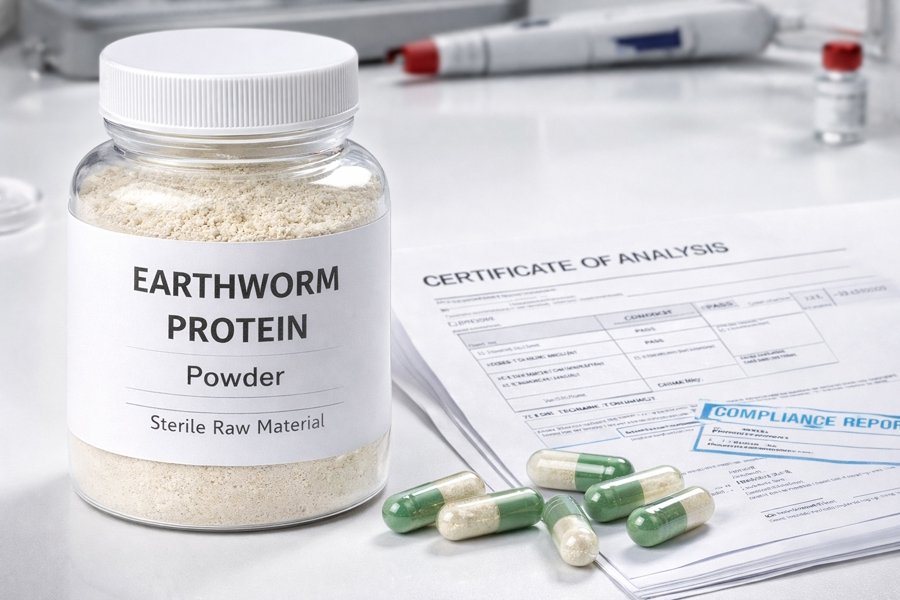
You may need COAs, specification sheets, microbial reports, heavy metal data, allergen-related statements, process descriptions, packaging details, and storage guidance. And depending on the market, you may need these documents revised, reissued, or aligned to the buyer’s internal template.
A direct manufacturer is typically better placed to provide accurate technical documentation because the data originates there. That means fewer situations where a sales agent forwards a file they do not fully understand, or where a buyer asks a simple technical question and waits three days for a relay answer.
Our Earthworm Protein Powder product already presents a supplier-style structure covering appearance, storage, shelf life, packaging, and multiple specification items such as protein, moisture, ash, selenium, arsenic, cadmium, lead, mercury, and microbiological indicators. That kind of spec management is much smoother when the buyer deals with the manufacturing side directly.
For brands building long-term supply, traceability is not just paperwork. It is trust with evidence.
Long-term supply is where direct partnerships really shine
Here’s a mild contradiction: the first order is not the real test. The fifth order is.
Almost any supplier can look responsive when they are trying to win the business. The real question is what happens when forecast demand changes, when your market team suddenly needs new packaging, when customs asks for extra files, or when your R&D department wants a revised sample.
That’s when a direct manufacturer relationship starts to pay off.
A manufacturer can often give more realistic production planning, clearer lead times, and a better sense of which requests are routine and which require schedule adjustments. That matters for importers, wholesalers, and finished-product manufacturers who cannot afford repeated supply disruption.
And in a category like earthworm protein powder, where the ingredient itself is specialized and the number of truly capable suppliers is narrower than in mainstream proteins, stable supply matters even more. Not flashy. Just vital.
For growing brands, this can be the difference between “interesting ingredient” and “reliable product line.”
Who should especially consider buying direct?
Not every buyer needs the same sourcing model. But buying direct is especially valuable for a few groups.
Dietary supplement brands that want repeatable quality and faster document support usually benefit. Nutraceutical ingredient distributors benefit because clearer upstream information makes downstream selling easier. Pharmaceutical or advanced health-product developers benefit because technical dialogue tends to be more precise. Cosmetics and multifunctional ingredient teams can also gain when they need ingredient background, process clarity, and long-term availability.
In short, the more technical your product, the more useful direct access becomes.
If your purchase is tiny, one-off, and purely opportunistic, a trader may feel convenient. But if you are building a market, a brand, a formulation program, or an export channel, direct manufacturing cooperation usually gives you a sturdier foundation.
So, why work directly with an earthworm protein powder manufacturer?
Because the ingredient is too specialized for guesswork.
Because process knowledge matters.
Because consistency matters.
Because documentation matters.
Because scaling matters.
And, maybe most of all, because when issues come up—and in real supply chains they always do—you want to be talking to the people who can actually fix them.
That is the plain answer.
For B2B buyers in supplements, nutraceuticals, pharmaceuticals, and functional health sectors, working directly with an earthworm protein powder manufacturer is usually the smarter route when the goal is not just to buy a material, but to build a dependable product and supply relationship around it.
FAQs
1. Why is buying earthworm protein powder directly from a manufacturer better for B2B buyers?
Working directly with an earthworm protein powder manufacturer usually means better control over specifications, faster technical communication, more reliable documents, and improved batch consistency for long-term purchasing.
2. Can a direct earthworm protein powder manufacturer support custom specifications?
Yes. Many direct manufacturers can discuss protein content targets, packaging formats, testing items, moisture control, and other custom earthworm protein powder specifications more efficiently than a trading intermediary.
3. Is direct sourcing of earthworm protein powder more cost-effective?
Often, yes, but the bigger advantage is lower total sourcing risk. Direct purchasing can reduce delays, communication errors, and quality misunderstandings that increase the real cost of ingredient procurement.
4. What should buyers ask an earthworm protein powder manufacturer before ordering?
Ask about raw material sourcing, production flow, protein range, microbial control, heavy metal testing, packaging, storage, shelf life, document availability, and whether commercial batches match the evaluation sample.
5. Who should work directly with an earthworm protein powder manufacturer?
Dietary supplement brands, nutraceutical ingredient distributors, pharmaceutical developers, health product manufacturers, and functional ingredient wholesalers usually gain the most from direct manufacturer cooperation because they need stable quality and dependable supply support.
Build Your Premium Product Portfolio
Contact us for bulk earthworm protein supply