
Changing lumbrokinase suppliers involves more than obtaining a lower quotation or finding a shorter lead time. Because lumbrokinase is an enzyme-sensitive ingredient, differences in activity units, assay methods, specifications, batch documents, packaging and storage conditions can affect testing, formulation review and purchasing approval.
Supplement brands, contract manufacturers, distributors and QA teams should therefore qualify a replacement supplier against both their internal requirements and the established product from the current supplier. The objective is not to make two suppliers appear identical. It is to identify meaningful differences, determine whether those differences are acceptable and control the transition from sample evaluation to bulk purchasing.
Quick Answer
When changing lumbrokinase suppliers, B2B buyers should compare specification sheets, activity units, assay methods, COA formats, sample results, batch documents, packaging, storage, lead time and supplier communication. They should test a new sample and reconfirm the actual bulk batch before approval. The goal is to avoid quality, documentation, testing and supply-chain risks during the transition—not merely to find a lower-priced source.
Why Changing Lumbrokinase Suppliers Requires Qualification
A supplier change should not be treated as a direct substitution based only on product name. Two materials sold as lumbrokinase may have different activity reporting bases, laboratory methods, moisture limits, packaging formats or storage instructions.
A buyer may also have built internal procedures around the current supplier’s documents and package size. Replacing that material could require updates to:
- Incoming material specifications
- Laboratory test instructions
- Approved supplier records
- Formulation or production documents
- Warehouse handling procedures
- Packaging and sampling practices
- Purchase-order descriptions
- Batch release requirements
Before contacting replacement suppliers, buyers should document the reason for switching. Price pressure, supply interruptions, incomplete documentation, assay disagreement, inconsistent batches, slow communication and new formulation requirements require different qualification priorities.
For example, an assay mismatch requires method-level comparison, while repeated delivery delays require capacity and lead-time verification. Establishing the reason for change prevents the qualification process from becoming a generic document-collection exercise.
Compare the Product Specifications First
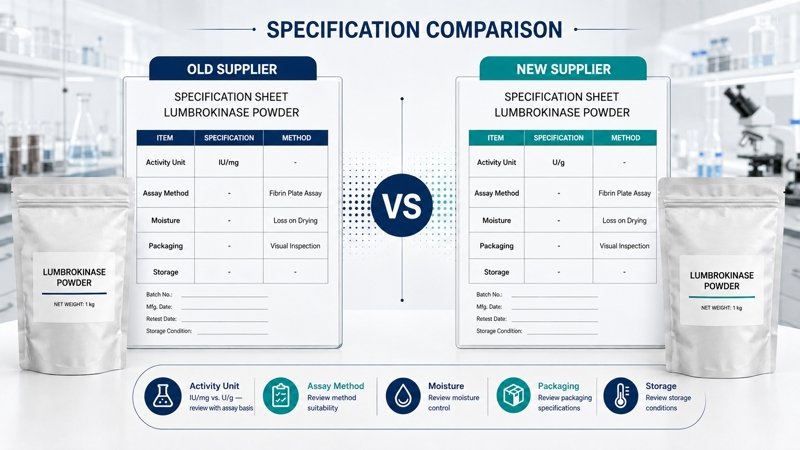
Before approving sample testing or issuing a purchase order, place the old and new specification sheets side by side. Buyers can use the current approved material as a reference, but should also confirm whether the existing specification still reflects their present formulation and QA requirements.
Compare at least:
- Product name and grade
- Activity specification
- Activity unit and reporting basis
- Assay method, if stated
- Appearance
- Moisture
- Ash, if included
- Storage conditions
- Packaging configuration
- Shelf life or retest information, if available
Do not assume that similar wording means identical acceptance criteria. “Store in a cool, dry place,” for example, may appear on both documents while the proposed packaging formats provide different levels of moisture protection.
Buyers should classify differences as critical, reviewable or administrative. An activity-method difference may require laboratory evaluation; a different bag size may require warehouse approval; a different document layout may require only a record update. This change-control approach helps purchasing and QA teams focus on differences that could affect approval.
The Lumbrokinase product page can provide initial product and supply information, but the specification agreed for the replacement material should be recorded in the buyer’s controlled purchasing documents.
Compare Activity Requirements and Assay Methods
Activity comparison is one of the most important—and most easily misunderstood—parts of a lumbrokinase supplier change.
A value expressed in IU/mg, FU/g, LKU or U should not be assessed by number alone. These units may be connected to different assay protocols and reporting conventions. Even when two suppliers use the same unit, their results may not be directly comparable if their laboratories use different procedures.
Buyers should review:
- Activity unit
- Assay method or laboratory protocol
- Substrate
- Reference standard
- Sample preparation and dilution
- Incubation time and temperature
- Calculation method
- Reporting basis, such as per gram of powder
- Buyer or third-party laboratory method
There is no universal fixed conversion between FU/g and IU/mg that can be applied without method evidence. One unit should not automatically be treated as better than another, and the highest reported activity number is not necessarily the best material for an established formulation.
A practical supplier-change control is to prepare a method comparison note before testing. It should identify the old supplier’s method, the proposed supplier’s method and the method used by the buyer’s laboratory. If the protocols differ, the buyer can decide whether to test both materials under one common method, accept the supplier’s declared method or conduct additional correlation work.
Buyers who need to define these requirements before ordering a sample can refer to Lumbrokinase Assay Method Requirements Before Sample Testing.
Compare COAs and Supporting Batch Documents
The new supplier’s documents should be evaluated for comparability and traceability, not simply for their presence.
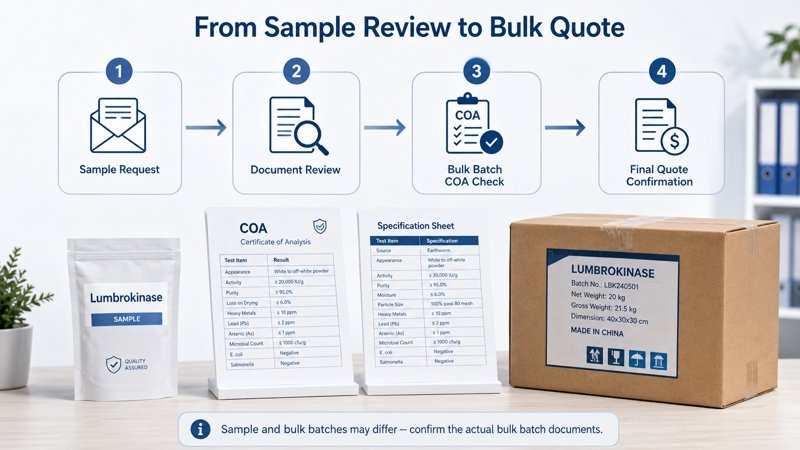
Request the relevant specification sheet and a COA for an actual available batch whenever possible. Review whether the COA identifies:
- Product and activity grade
- Batch number
- Test items and results
- Applicable limits
- Manufacturing date, if available
- Expiry or retest date, if available
- Test methods or method references where relevant
A general or unidentified COA may help explain the supplier’s usual format, but it should not be treated as evidence for the batch being sampled or purchased. Buyers should establish which document belongs to the sample and which COA will be provided for the actual bulk shipment.
Supplier qualification may also require documents beyond the COA, depending on the buyer’s QA system and intended market. Lumbrokinase Supplier Documents Beyond the COA explains how supporting records fit into a broader document review.
Run New Sample Testing Before Switching
Previous experience with lumbrokinase does not remove the need to evaluate a new supplier’s sample. The purpose is to determine whether the proposed material satisfies the buyer’s current acceptance criteria under a defined test plan.
Before testing, confirm:
- Sample quantity
- Sample batch number
- Documents supplied with the sample
- Activity method to be used
- Internal or third-party laboratory responsibilities
- Acceptance criteria
- Retained sample requirements
- Maximum interval between sample approval and PO placement
That last point is particularly important during supplier replacement. If approval remains open indefinitely, the tested batch may no longer be available when purchasing is ready to place an order.
Where appropriate, buyers may also run a controlled comparison between retained material from the current supplier and the replacement sample. Both should be tested under the same protocol when the objective is to evaluate relative performance. The result should be interpreted with the method context rather than compared only with the numbers printed on two supplier COAs.
For qualified B2B buyers, a 100 g sample may be available from Allworms, with international sample freight usually paid by the buyer.
Confirm Sample-to-Bulk Specification Consistency
Sample approval is an important qualification stage, but it does not automatically approve the final bulk batch or every future batch.
The sample batch and final bulk order batch may not be the same, particularly when there is a long interval between testing and PO placement. Buyers should ask whether the sampled batch remains available and how long it can reasonably be reserved. Requiring identical batch numbers in every case may be impractical; the more important requirement is sample-to-bulk specification consistency.
If the original sample batch is no longer available, review the COA for the actual bulk batch before shipment and confirm:
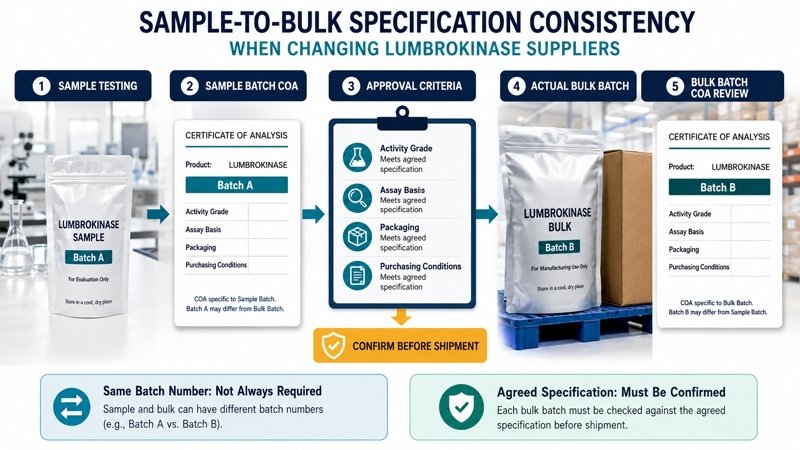
- Agreed specification
- Activity grade and unit
- Assay basis
- Required test results
- Packaging configuration
- Quantity and purchasing conditions
For critical projects, buyers may make the first bulk order subject to document approval or request a pre-shipment sample from the actual bulk batch. This should be agreed before the PO rather than introduced after production.
The transition process should also assign responsibility: purchasing confirms commercial terms, QA approves documents, the laboratory reviews method compatibility and the formulation or production team assesses material suitability. Lumbrokinase Sample to Bulk Order provides further context for managing this approval stage.
Compare Packaging and Storage Requirements
A change of supplier can alter how the material is received, sampled, stored and issued to production.
Compare:
- Unit package size
- Inner bag material
- Seal configuration
- Outer carton or drum
- Label details
- Moisture protection
- Storage instructions
- Warehouse space and handling
- Risk created by repeatedly opening one large package
A package that is larger than the buyer’s normal production requirement may be opened repeatedly, increasing exposure to humidity and handling conditions. Smaller sealed units may reduce this risk but can affect cost, receiving procedures and packaging waste.
Lumbrokinase should be protected from prolonged heat, humidity, moisture, direct sunlight and unsuitable storage conditions. A brief temperature fluctuation does not automatically mean that the material has failed, but prolonged or uncontrolled exposure may increase quality risk. Packaging, transport planning and warehouse controls should therefore be reviewed together.
Review Supply Capacity and Lead Time
A replacement supplier must be able to support more than an initial sample. Confirm whether the supplier can handle the expected commercial pattern, including:
- A small trial order
- An MOQ around 1.5 kg, where applicable
- Expected 10–25 kg small bulk orders
- Current stock or production status
- Production and document preparation time
- Repeat-order planning
- Packaging availability
- International shipment preparation
Lead time should be separated into production, testing or release, document approval and shipping preparation. A single broad estimate may hide the stage most likely to delay delivery.
For Allworms orders, the standard MOQ is usually around 1.5 kg depending on specification and packaging. Standard lead time is generally 7–15 days after payment. DHL or DDP delivery may be discussed for suitable destinations, subject to product details, customs clearance requirements and the final shipping plan.
Check Supplier Communication During Qualification
Communication during qualification is evidence of how the supplier may handle future batch questions or urgent orders.
Observe whether the proposed supplier:
- Explains specification differences clearly
- Answers assay-method questions directly
- Identifies the actual available batch
- Keeps product information consistent across documents
- Confirms packaging and lead time realistically
- Distinguishes sample documents from bulk-batch documents
- Supports communication from sample testing through bulk approval
Repeatedly avoiding questions about method, batch identity or availability is a qualification concern. Buyers should also record agreed requirements in writing instead of relying on informal conversations that may be interpreted differently at order stage.
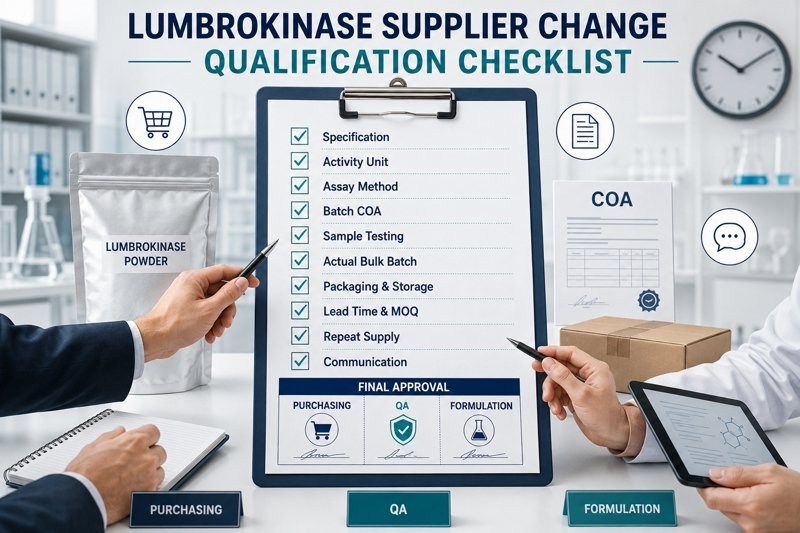
Lumbrokinase Supplier Change Qualification Checklist
| Qualification Area | What Buyers Should Compare | Why It Matters Before Switching |
|---|---|---|
| Old vs new specification | Limits, test items, grade and reporting basis | Identifies changes requiring QA or formulation approval |
| Activity unit | IU/mg, FU/g, LKU, U or other declared unit | Prevents comparison by number alone |
| Assay method | Substrate, standard, preparation, incubation, calculation and reporting | Determines whether results are meaningfully comparable |
| COA | Limits, actual results, methods and document format | Supports batch review and internal approval |
| Sample batch | Batch number, COA and test plan | Connects test results to a traceable material |
| Actual bulk batch | Batch-specific COA and agreed requirements | Confirms the material prepared for shipment |
| Packaging | Unit size, inner seal, outer package and label | Affects receiving, sampling and repeated-opening risk |
| Storage | Temperature, moisture and light protection | Reduces avoidable handling risk |
| Lead time | Production, release, documentation and dispatch | Reveals potential supply interruptions |
| MOQ or trial order | Practical quantity and packaging options | Determines whether qualification can progress commercially |
| Repeat supply ability | Capacity, planning and batch communication | Supports continuity beyond the first order |
| Supplier communication | Accuracy, consistency and response quality | Indicates how future issues may be managed |
| Sample-to-bulk specification consistency | Activity grade, assay basis, specification and packaging | Prevents sample approval from being applied blindly to another batch |
Common Buyer Mistakes When Changing Suppliers
Common mistakes include:
- Switching only because of a lower price
- Comparing activity numbers without assay-method context
- Assuming the same unit means the same laboratory procedure
- Skipping a new sample evaluation
- Accepting only a general COA
- Failing to confirm which batch a COA represents
- Treating sample approval as automatic bulk-batch approval
- Ignoring packaging and storage differences
- Failing to verify realistic repeat-order capacity
- Changing the material without informing QA, formulation or production teams
The strongest risk control is a documented change record showing what differs, who reviewed each difference and what must be reconfirmed for the first bulk order.
Allworms Supply Notes
Allworms supports overseas buyers evaluating lumbrokinase for supplier replacement. A specification sheet and COA can be provided for available batches, and sample or small trial-order arrangements may be discussed according to the required activity grade, quantity, packaging and destination.
Buyers can use the FAQ page to review common purchasing and supply questions before requesting qualification documents.
FAQ
1. Must a replacement supplier match the current specification exactly?
Not necessarily. Differences should be identified and assessed against the buyer’s formulation, testing, QA and regulatory requirements. Any accepted difference should be documented before supplier approval.
2. Can activity values from two suppliers be compared directly?
Only when their units, assay methods and reporting bases are sufficiently comparable. Substrate, standard, sample preparation, incubation conditions, calculation and laboratory protocol can all affect the reported result.
3. Should buyers test a new sample if they already use lumbrokinase?
Yes. Supplier experience with one material does not qualify another supplier’s product. The replacement sample should be assessed using predetermined methods and acceptance criteria.
4. Must the sample and bulk order carry the same batch number?
No. The sample batch may no longer be available when the PO is placed. In that situation, buyers should review the actual bulk-batch COA and reconfirm the agreed specification, activity grade, assay basis, packaging and purchasing conditions.
5. When is a replacement supplier ready for approval?
Approval is appropriate after technical requirements, documents, sample results, actual batch controls, packaging, storage, lead time and repeat-supply capability have been reviewed by the relevant purchasing, QA and formulation teams.
Changing Lumbrokinase Suppliers?
Request Allworms’ specification, available-batch COA and sample details for a controlled supplier comparison
This product is supplied as a B2B ingredient. Final formulation suitability, dosage, labeling, health claims and regulatory compliance should be evaluated by the buyer according to the intended market and finished-product use.