
Lumbrokinase purity is often presented as a simple product-quality claim. For B2B buyers, however, a purity percentage or description has limited value unless the supplier clearly explains what it represents, how it was determined, and how it relates to the product’s activity specification.
Supplement brands, contract manufacturers, distributors, QA teams, and formulation teams should treat purity as one part of a broader procurement evaluation. The review should also cover the assay method, activity reporting basis, COA, specification sheet, batch identity, sample-testing results, intended application, packaging, storage, and supply practicality.
The objective is not necessarily to purchase the highest stated purity level. It is to select a lumbrokinase specification that can be understood, tested, documented, and consistently applied to the buyer’s intended formulation and quality requirements.
Quick Answer
Lumbrokinase purity should be treated as one procurement evaluation indicator, not as a standalone selling point. It does not by itself prove enzyme activity, finished-product performance, or medical efficacy.
Before approving a sample or bulk order, B2B buyers should review purity together with the activity specification, assay method, COA, specification sheet, batch information, sample-testing results, intended application, packaging, storage, and supplier documentation.
Why Purity Matters in Lumbrokinase Sourcing
Purity may help buyers understand the relative composition or concentration of the target enzyme-related components within a lumbrokinase ingredient. Depending on the supplier and analytical approach, the term may refer to enzyme-protein concentration, removal of non-target materials, chromatographic composition, or another internally defined quality basis.
This creates an important purchasing question: what does “purity” mean for the specific product being offered?
A numerical claim is not sufficiently informative unless the definition and testing basis are clear. Two suppliers may use the same word while describing different product types, analytical results, or levels of processing.
Purity information can support:
- Ingredient-quality evaluation
- Comparison against an internal purchasing standard
- Sample and bulk-batch review
- Formulation suitability assessment
- Investigation of unexpected batch differences
- Communication between purchasing, QA, and formulation teams
However, purity is one quality indicator and should not be reviewed alone. It does not directly prove activity, safety, regulatory suitability, or finished-product results.
Buyers reviewing an available grade can consult the Lumbrokinase product page for ingredient-level supply information while requesting the applicable documents for the actual batch.
Lumbrokinase Purity vs Activity
Purity and activity may be related, but they are not interchangeable.
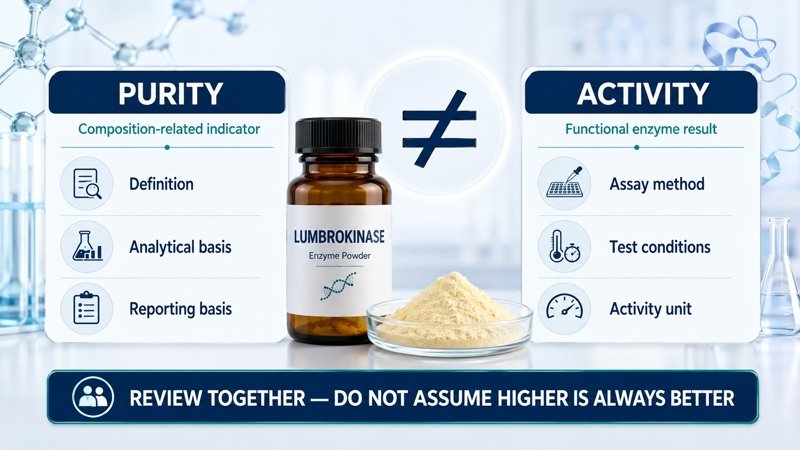
Purity generally describes something about product composition or the relative presence of target components. Lumbrokinase activity describes a functional enzyme result measured under a defined assay procedure.
A more purified product does not automatically produce a proportionally higher activity result. Processing conditions, enzyme composition, assay response, moisture basis, sample preparation, and storage history can all affect how the product is evaluated.
Conversely, a high activity number should not automatically be interpreted as proof of high purity. Buyers need to know what was tested and how the result was calculated.
When IU/mg, FU/g, LKU, or U appears in an offer or document, buyers should avoid comparing the numerical values without method context. These units may be based on different substrates, standards, procedures, and reporting conventions. No fixed FU/g-to-IU/mg conversion should be assumed.
The Lumbrokinase Activity Units article provides further background on unit interpretation. For purity evaluation, the essential point is that composition-related information and functional activity data answer different procurement questions.
Purity and Assay Method Context
A supplier making a lumbrokinase purity claim should be able to explain its basis where that information is available. Buyers should determine whether the figure comes from a defined analytical method, a protein-content calculation, a chromatographic profile, an internal production classification, or another measurement.
The activity test requires a separate method review. Important variables may include:
- Substrate used in the assay
- Reference standard or calibration approach
- Sample preparation and dilution
- Incubation time and temperature
- Buffer and reaction conditions
- Calculation method
- Dry or as-is reporting basis
- Laboratory protocol and result format
These details can materially affect reported activity. Therefore, a buyer should not use an activity number as an indirect purity measurement unless the supplier’s documentation specifically supports that interpretation.
Before sending a sample to a third-party laboratory, the buyer and supplier should establish which method and reporting basis will be used. The Lumbrokinase Assay Method Requirements Before Sample Testing article explains how buyers and suppliers can establish the testing context without assuming that results from different laboratory methods are directly comparable.
How to Review Purity on the COA
Buyers should check whether purity is actually included as a batch-tested item on the lumbrokinase COA. A purity statement in promotional material is not necessarily equivalent to a release specification or batch result.
Useful evaluation questions include:
- Is purity shown as a tested result, a general description, or a product-grade claim?
- What is being measured?
- Is a method or reporting basis identified?
- Is the value connected to a specific batch number?
- Does the result meet the agreed purchasing specification?
- Is the product comparable to the grades offered by other suppliers?
- Is the result reported on an as-is or dry basis?
The COA should also be reviewed for relevant supporting items, such as activity, appearance, moisture, and other agreed quality parameters. The purpose is not to make the COA prove more than it contains, but to determine whether the batch documentation supports the supplier’s purity description.
For a broader document review process, buyers may refer to Lumbrokinase COA Review.
Purity and the Specification Sheet
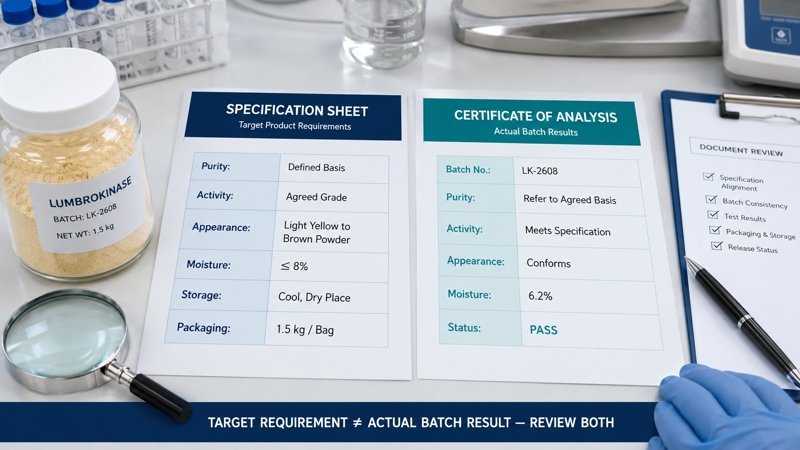
A specification sheet defines the expected product requirements. A COA records the results reported for a particular production batch.
If purity is part of the purchasing requirement, it should be clearly written into the agreed specification instead of remaining an informal statement in an email or product description. The buyer should confirm:
- Defined purity requirement and reporting basis
- Activity specification and activity unit
- Applicable test method or method reference
- Appearance
- Moisture limit
- Storage conditions
- Packaging configuration
- Shelf-life or retest information, when available
This distinction prevents a common approval problem: purchasing accepts a general purity claim, while QA later expects a batch-tested numerical result that was never included in the agreed specification.
Another useful decision point is whether purity is a release criterion or a characterization item. A release criterion must meet an agreed limit before the batch is accepted. A characterization item may provide supporting information without determining batch release. Buyers should clarify this distinction during supplier evaluation.
Purity and Batch Comparison
Purity-related information should be compared only when the documents describe comparable products and testing logic.
Before comparing two batches or suppliers, confirm:
- The same type and grade of lumbrokinase are being reviewed
- Purity is defined in the same way
- Results use the same reporting basis
- The same or a comparable analytical method is used
- Activity results have compatible assay context
- Documents follow equivalent batch-identification logic
Normal manufacturing and analytical variation can occur. Batch consistency does not mean that every purity or activity result must be numerically identical. It means each accepted batch meets the agreed specification and remains suitable for the intended purchasing and formulation requirements.
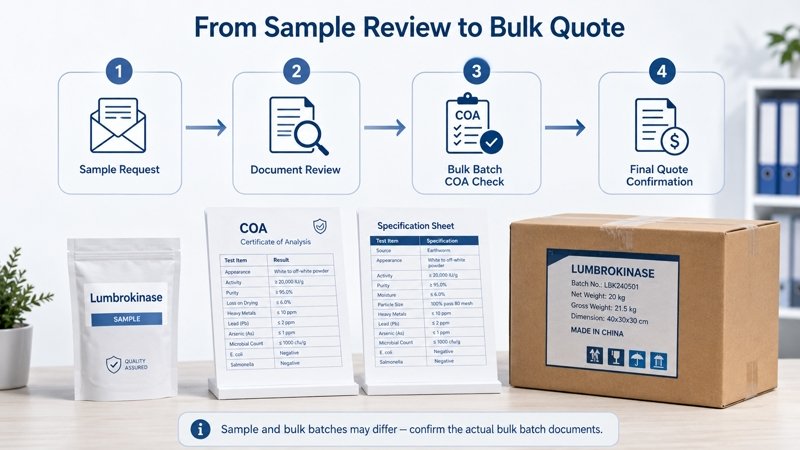
Sample-to-bulk specification consistency is especially important. If a buyer tests a sample and places a purchase order several weeks or months later, the original sample batch may no longer be available. The bulk order does not need to carry the same batch number, but it should meet the specification approved during the evaluation.
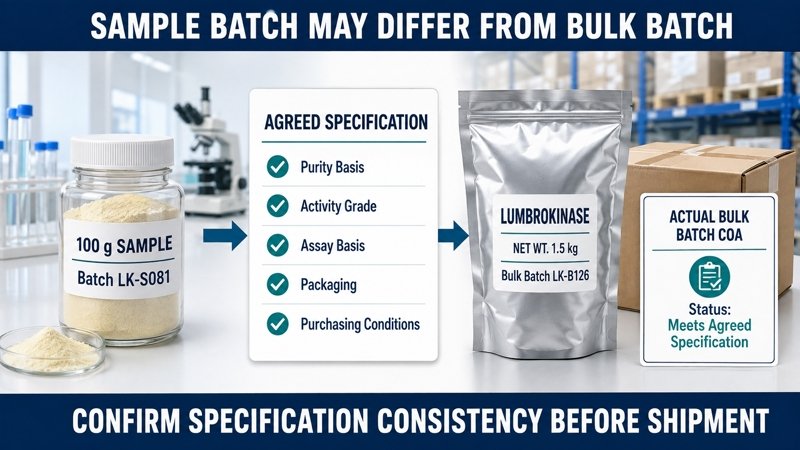
Before shipment, the buyer should review the COA for the actual bulk batch and confirm the agreed purity requirement, activity grade, assay basis, packaging requirement, and purchasing conditions. An approved sample should not be treated as a permanent guarantee for every future batch.
Purity and Intended Application
Different buyers may assign different importance to purity data:
- Supplement brands may prioritize ingredient consistency, supporting documents, and compatibility with the finished-product formulation.
- Contract manufacturers may focus on release specifications, handling characteristics, packaging, storage, and batch traceability.
- Ingredient distributors may require repeatable documentation and an explanation they can communicate accurately to downstream customers.
- Research-related buyers may request more detailed information about analytical methods, composition, sample preparation, or enzyme characteristics.
- QA teams may require a clear pass/fail specification, while formulation teams may be more concerned with activity, material behavior, and inclusion feasibility.
These requirements should be discussed before sample approval. A technically detailed purity figure offers little procurement value if it does not correspond to the buyer’s application, internal standard, or available testing capability.
When Higher Purity Is Not the Only Priority
A higher stated lumbrokinase purity level may involve a different degree of processing, cost structure, availability, or documentation. It is not automatically the most suitable option for every formulation or purchasing program.
Buyers should also consider:
- Required activity specification
- Activity assay method
- Batch consistency
- Supplier documentation
- Sample-testing compatibility
- Product availability
- MOQ and repeat-order feasibility
- Lead time
- Packaging and storage stability
- Cost suitability
- Intended application
- Regulatory responsibility in the destination market
Lumbrokinase is an enzyme-sensitive material. Suitable packaging and storage should minimize prolonged or uncontrolled exposure to heat, humidity, moisture, and direct sunlight. A brief temperature fluctuation does not automatically prove product damage, but poor or uncontrolled conditions can increase quality risk.
The best choice is the product specification that matches the buyer’s intended formulation, quality standard, order size, and regulatory responsibility—not simply the highest purity claim.
Questions Buyers Should Ask About Purity
Before approving a supplier or sample, ask:
- How is purity defined for this lumbrokinase product?
- Is purity included on the specification sheet, COA, or another product document?
- What analytical method or reporting basis supports the claim?
- Is purity a batch-release criterion or supporting characterization information?
- How does the purity description relate to the activity specification?
- Which activity assay method and unit are used?
- Can you provide the COA for the currently available batch?
- Can the actual bulk-batch COA be reviewed before shipment?
- Is the same agreed specification available for repeat orders?
- What packaging and storage conditions are recommended?
Lumbrokinase Purity Evaluation Checklist
| Evaluation Point | What Buyers Should Check | Why It Matters |
|---|---|---|
| Purity claim | Definition, value, basis, and whether it is tested or descriptive | Prevents comparison of undefined marketing claims |
| Activity specification | Required activity grade, unit, and reporting basis | Separates functional activity from composition |
| Assay method | Substrate, standard, preparation, incubation, and calculation | Provides context for interpreting activity results |
| COA | Batch-specific purity, activity, and agreed quality results | Shows the reported status of the supplied batch |
| Specification sheet | Target limits and accepted product requirements | Establishes the basis for approval |
| Batch number | Connection between the document, sample, and supplied material | Supports traceability |
| Sample result | Buyer or third-party result under a documented method | Helps assess specification and testing compatibility |
| Actual bulk-batch document | COA for the batch intended for shipment | Supports sample-to-bulk specification consistency |
| Intended application | Formulation, QA, documentation, and market requirements | Determines which specification is practically suitable |
| Packaging and storage | Moisture protection, temperature control, light protection, and seal integrity | Reduces avoidable quality risks |
| Supplier explanation | Clear answers about definitions, methods, variation, and availability | Shows whether the claim can support a purchasing decision |
Common Buyer Mistakes
Common errors include:
- Assuming higher purity always means a better product
- Comparing purity claims without checking their definitions or methods
- Focusing on purity while ignoring activity
- Comparing activity numbers without assay-method context
- Treating one batch’s COA as evidence for every future batch
- Assuming the sample and bulk order will always use the same batch
- Treating an approved sample as a guarantee for repeat orders
- Overlooking the specification sheet
- Ignoring packaging and storage conditions
- Choosing solely by the highest claim or lowest price
A structured review prevents purchasing teams from approving a persuasive number without confirming whether it has a clear technical and commercial meaning.
Allworms Supply Notes
Allworms supports overseas buyers evaluating lumbrokinase specifications and available batches. A COA and specification sheet can be provided for review, and a 100 g sample may be available for qualified B2B buyers, with international freight generally paid by the buyer.
The standard MOQ is usually around 1.5 kg, depending on the specification, packaging, and destination. Final order conditions—including the activity grade, documents, packaging, lead time, and shipping arrangement—should be reconfirmed for the actual order. Buyers with general sourcing questions may also consult the FAQ page.
FAQ
1. Does higher lumbrokinase purity always mean higher activity?
No. Purity and activity describe different product characteristics. Activity must be evaluated using a defined assay method, while purity requires its own definition and analytical basis.
2. Should purity appear on every lumbrokinase COA?
Only if purity is an agreed batch-tested specification. If it is not listed, buyers should ask whether the claim appears in another document and whether it is a tested result, a characterization item, or a general product description.
3. Can buyers compare purity percentages from different suppliers?
Only after confirming that the suppliers define and measure purity in a comparable way. The product type, method, reporting basis, and batch-document logic should be reviewed first.
4. Must the bulk order use the same batch as the approved sample?
No. The sample batch may be unavailable when the purchase order is placed. Buyers should review the actual bulk-batch COA and confirm that it meets the agreed specification and purchasing conditions.
5. Is the highest-purity grade the best choice for supplement formulation?
Not necessarily. The suitable choice depends on the activity requirement, assay basis, formulation needs, quality standard, documentation, availability, order quantity, cost, and target-market responsibilities.
Evaluate Lumbrokinase Purity With Activity, Assay Context, And Batch Documents
Contact Allworms for the available-batch COA, specification sheet, and sample details
This product is supplied as a B2B ingredient. Final formulation suitability, dosage, labeling, health claims, and regulatory compliance should be evaluated by the buyer according to the intended market and finished-product use.