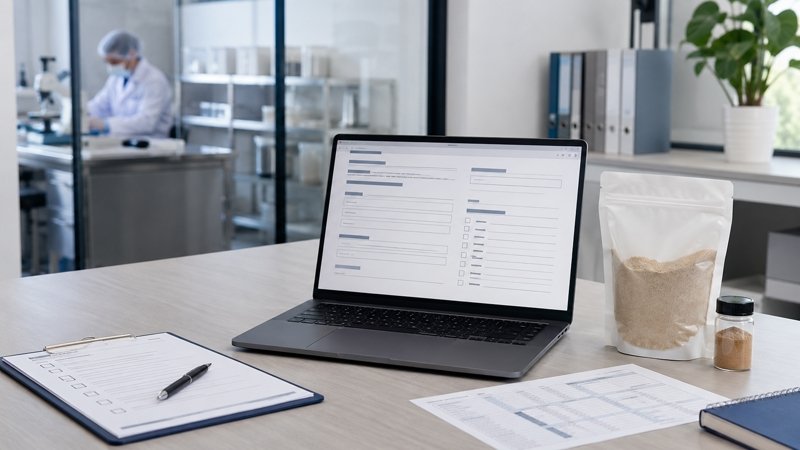
An earthworm protein powder technical inquiry should give a supplier enough information to understand the buyer’s project before recommending a specification, preparing documents, arranging a sample, or calculating shipping. It is more useful than an email asking only for a price or product catalog.
For supplement brands, nutraceutical companies, ingredient distributors, formulation teams, and purchasing managers, a structured inquiry creates a common starting point for technical and commercial discussions. It clarifies the intended application, target protein specification, document requirements, sample evaluation plan, expected order quantity, packaging needs, destination, and timeline. This helps the supplier respond with relevant batch information instead of sending generic documents that may not match the project.
Quick Answer
A B2B earthworm protein powder technical inquiry should include the buyer’s intended application, target specification, protein content requirement if known, document needs, sample testing plan, expected quantity, target market, packaging and storage expectations, destination, and lead time requirements.
The more complete the inquiry, the easier it is for the supplier to provide a relevant COA, specification sheet, sample support, available batch information, and practical purchasing guidance.
Why a Technical Inquiry Matters Before Sourcing
A technical inquiry is more than a request for price per kilogram. Its purpose is to help the buyer and supplier determine whether the offered material, documents, sample, and supply arrangement are appropriate for the same project.
A well-prepared inquiry can clarify:
- Product suitability for the intended ingredient application
- Target specification and internal acceptance requirements
- Documents needed by purchasing, QA, and R&D
- Purpose and scope of sample testing
- Availability of a current production batch
- Packaging and storage expectations
- MOQ and likely future order quantities
- Shipping destination and delivery requirements
This preparation reduces repeated emails, unclear quotations, unsuitable samples, and misunderstandings about whether a document represents a general standard or an actual batch.
Buyers who are still defining their requirements can first review the Earthworm Protein Powder product page for basic product and supply information. The inquiry should then concentrate on the buyer’s specific project.
1. Start with the Buyer’s Company Role
The supplier does not need a long company introduction, but it should understand who is conducting the evaluation.
Relevant roles include:
- Supplement brand or nutraceutical company
- Functional food manufacturer
- Food ingredient distributor
- Contract manufacturer
- Formulation consultant
- R&D or product development team
- QA or supplier qualification team
- Purchasing department
Different roles lead to different questions. A distributor may prioritize repeat supply, resale documentation, standard packaging, and territory-specific logistics. A formulation team may focus on appearance, blending behavior, compatibility, and pilot quantities. A QA team may require batch identification, test items, methods, and document control.
Buyers should also identify whether they are the final ingredient user, a distributor, or an adviser evaluating the material for another company. This helps prevent confusion about who will approve the sample and documents.
2. Explain the Intended Application
The inquiry should describe how the material will be evaluated or used at the ingredient level. One or two sentences are usually sufficient.
Possible contexts include:
- Dietary supplement formulation
- Nutraceutical product development
- Functional food ingredient evaluation
- Protein ingredient exploration
- Pilot formulation
- Distributor product-line review
- Internal R&D testing
The intended dosage form can also be useful. For example, a capsule project may raise different handling questions from a powdered blend or food formulation.
Buyers do not need to disclose a complete proprietary formula. However, indicating the product format and evaluation purpose allows the supplier to provide more relevant information.
Final formulation suitability depends on the buyer’s formula, processing conditions, target market, labeling, claims, and internal quality requirements.
3. State the Target Specification
If an internal specification already exists, the buyer should summarize its most important acceptance criteria. These may include:
- Target protein content and reporting basis
- Appearance or color expectations
- Moisture and ash limits
- Required heavy-metal limits
- Microbiological requirements
- Amino acid profile requirements, if relevant
- Packaging and storage conditions
- Market-specific internal standards
Protein percentage should not be treated as the only quality indicator, and a higher number is not automatically more suitable. The testing method, reporting basis, formulation purpose, and supporting quality parameters also matter.
If the buyer has not established final limits, the inquiry can ask for the supplier’s current standard specification sheet. The buyer’s QA and formulation teams can then determine whether the standard is acceptable or whether further discussion is required.
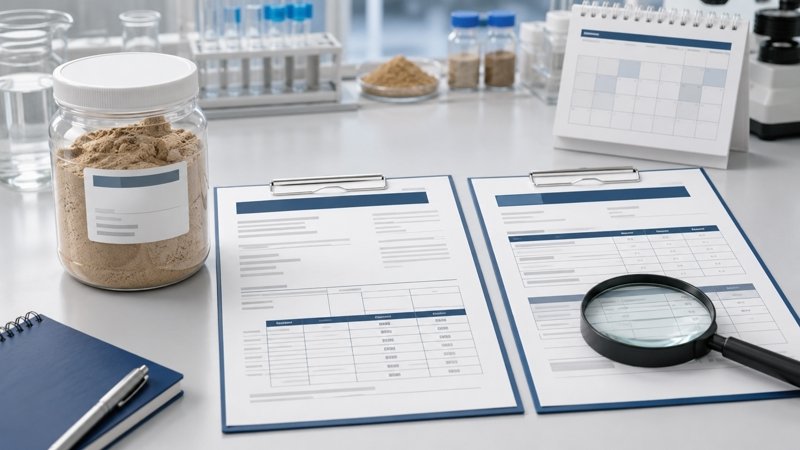
4. Request Both the COA and Specification Sheet
These documents serve different purposes:
- A specification sheet defines the target requirements for the product.
- A Certificate of Analysis reports actual results for an identified batch.
A useful inquiry can ask:
- Can you provide the current specification sheet?
- Can you provide the COA for an available batch?
- Does the COA represent the proposed sample batch, the available commercial batch, or a reference batch?
- Does it include protein, moisture, ash, heavy metals, and microbiology?
Buyers needing a deeper interpretation of individual test fields can consult the Earthworm Protein Powder COA Review. The immediate purpose of the technical inquiry is to identify which documents are needed and which material they represent.
5. Ask About Available Batch Information
Before approving a sample or requesting a small order, ask whether material is already available or will be manufactured after order confirmation.
Useful questions include:
- Which batch is currently available?
- Is a batch-specific COA available?
- What are its manufacturing date and listed expiry or retest date?
- How much material remains available?
- Can that quantity support both sample evaluation and a possible trial order?
- If new production is required, when will its documents become available?
This information supports sample-to-bulk specification consistency. It does not mean the sample and bulk order must always carry the same batch number. It means the buyer should understand whether the bulk batch will be the tested batch or a later batch evaluated against the same agreed specification.
Sample approval also does not guarantee that every future batch will be identical. Repeat-order acceptance should remain tied to written specifications and appropriate batch documentation.
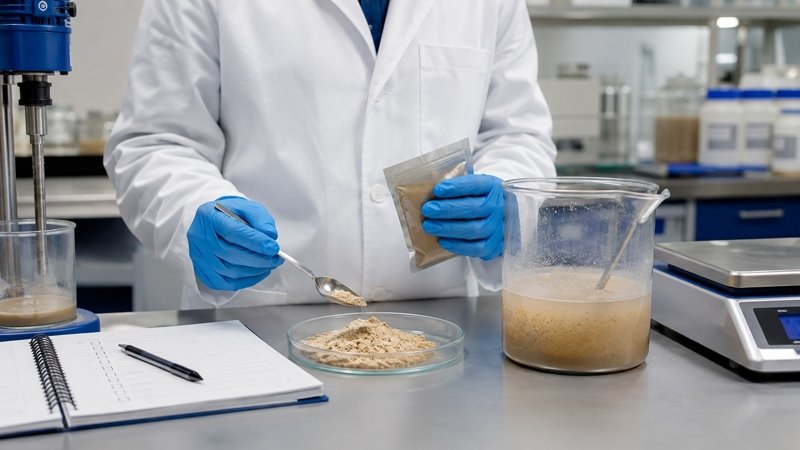
6. Explain the Sample Evaluation Plan
A supplier can provide more useful sample support when it knows what the buyer intends to evaluate.
The inquiry may briefly identify:
- Appearance and odor checks
- COA and specification review
- Protein content review or verification
- Internal formulation testing
- Blending, dispersion, or handling observations
- Third-party laboratory testing
- Expected evaluation timeline
- Written acceptance criteria, if already defined
A practical improvement is to name the team responsible for approval. For example, purchasing may coordinate the request, while QA reviews documents and R&D evaluates formulation behavior.
Detailed testing procedures belong in the buyer’s evaluation protocol. The Earthworm Protein Powder Sample Evaluation provides additional guidance for that later stage.
7. Describe Formulation Testing Needs
Formulation teams should explain the technical context without disclosing unnecessary confidential information. They may ask about:
- Powder appearance and characteristic sensory properties
- Blending or handling expectations
- Dispersion considerations where relevant
- Compatibility information available from the supplier
- Pilot-test packaging format
- Storage and resealing after opening
Suppliers cannot confirm finished-product suitability from an ingredient specification alone. Performance may change according to other ingredients, processing temperature, mixing sequence, particle behavior, moisture exposure, and finished-product format.
The buyer should therefore distinguish between document acceptance and formulation acceptance. A compliant COA does not replace pilot testing.
8. Prepare Quantity and MOQ Questions
Identify the current purchasing stage rather than asking only for the lowest price. The project may involve:
- Sample screening
- Pilot formulation
- Trial order
- Small bulk purchase
- Repeat-order planning
The inquiry should state an approximate expected quantity, even if it is a range. This helps the supplier discuss suitable packaging, available stock, production planning, MOQ, and shipping.
Useful questions include:
- What sample support is available?
- What is the MOQ for the required specification?
- Can the available batch support the anticipated quantity?
- What packaging formats are suitable for a trial or small bulk order?
There is no need to request a firm bulk quotation when the specification and quantity remain undefined. Technical agreement should come first when these factors could materially affect the offer.
9. Provide Destination and Shipping Requirements
A supplier cannot prepare a meaningful freight option without a destination. Buyers should provide:
- Destination country and city
- Postal code, if available
- Preferred courier or freight method
- Whether DDP delivery is requested, if applicable
- Whether the buyer can handle import clearance
- Required shipping documents, if already known
- Target arrival date rather than only the desired dispatch date
The distinction between dispatch date and required arrival date is a useful purchasing detail. It gives the supplier a better basis for discussing production lead time and transit planning.
Shipping and import requirements vary by destination, buyer responsibility, product category, and local rules. Buyers should verify import and regulatory requirements for their own market.
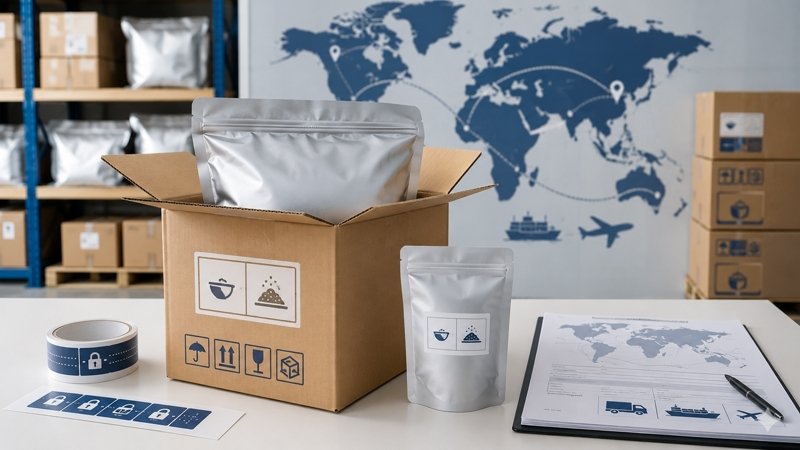
10. Ask About Packaging and Storage
Packaging affects sample handling, warehouse planning, and production use. Buyers may ask:
- What are the standard inner and outer packaging formats?
- Is each inner package sealed?
- Is smaller packaging available for pilot production?
- What storage conditions are recommended?
- How should a sample be stored before testing?
- How should partially used packages be resealed and handled?
- Is batch identification shown on the supplied packaging?
For broader document and handling preparation, the Earthworm Protein Powder Supplier Documents Beyond the COA explains how supporting information can complement batch test results.
11. Clarify Documents Needed for Internal Approval
Rather than asking for “all certificates,” specify the information each internal team needs. Possible requests include:
- Specification sheet
- Batch COA
- Product information sheet
- Packaging information
- Storage guidance
- Sample and batch identification
- Shipping documents where applicable
Some documents depend on the product, batch, intended market, buyer requirements, or supplier availability. A document-request matrix listing the document, reviewing department, and required approval date can prevent delays between QA, R&D, and purchasing.
General questions about samples, MOQ, documentation, storage, and delivery are also addressed on the FAQ page.
Earthworm Protein Powder Technical Inquiry Checklist
| Information to Prepare | What Buyers Should Include | Why It Helps the Supplier Respond |
|---|---|---|
| Buyer role | Brand, distributor, manufacturer, QA, R&D, or purchasing | Directs the inquiry to relevant technical and commercial information |
| Intended application | Ingredient application and finished-product format | Helps assess project relevance |
| Target specification | Main acceptance limits or request for the standard specification | Establishes the technical basis |
| Protein requirement | Target percentage and reporting basis, if known | Avoids unsuitable product recommendations |
| COA request | Batch-specific, sample-batch, available-batch, or reference COA | Clarifies what the results represent |
| Specification request | Current standard specification sheet | Enables requirement comparison |
| Available batch | Batch number, dates, available quantity, and status | Supports sample and order planning |
| Sample plan | Tests, reviewing teams, acceptance criteria, and timing | Helps coordinate suitable sample support |
| Formulation needs | Format, blending, handling, or pilot-test concerns | Makes technical communication more relevant |
| Expected quantity | Sample, pilot, trial, small bulk, or repeat order | Supports stock and production planning |
| MOQ question | MOQ for the required specification and packaging | Prevents commercial mismatch |
| Packaging | Preferred unit size, inner pack, and outer pack | Supports production and warehouse planning |
| Storage | Conditions before testing and after opening | Protects sample integrity |
| Destination | Country, city, and postal code | Enables a practical shipping estimate |
| Shipping preference | Courier, air freight, or DDP request if applicable | Clarifies the requested delivery basis |
| Documents | QA, product, packaging, storage, and shipping information | Supports internal approval |
| Timeline | Sample review date, order target, and required arrival date | Coordinates testing, production, and logistics |
Example Technical Inquiry Template
Subject: Earthworm Protein Powder Technical Inquiry – [Company/Country]
Dear [Supplier Name],
We are a [supplement brand/distributor/functional food manufacturer/formulation team] evaluating Earthworm Protein Powder for [intended application and product format].
Our target protein specification is [requirement], and our other key acceptance criteria are [requirements, if known]. If these have not been finalized, please provide your current standard specification for review.
Could you please share:
- The current specification sheet and COA for an available batch
- Available batch number, manufacturing date, listed expiry or retest date, and available quantity
- Sample availability and identification of the proposed sample batch
- MOQ and packaging options for approximately [expected quantity]
- Recommended storage conditions and opened-package handling
- Standard lead time
- Shipping options to [city, postal code, country], including DDP or courier options if available
We plan to evaluate the sample through [document review, formulation testing, third-party testing, or other checks] within approximately [timeline].
Please also advise what product information, sample support, and shipping documents are available for our review.
Best regards,
[Name]
[Company and role]
Common Buyer Mistakes
Common problems include:
- Asking only, “What is the price?”
- Failing to explain the intended application
- Leaving the target specification undefined
- Requesting a COA but not the specification sheet
- Not confirming whether the COA represents the sample or available batch
- Requesting a sample without explaining the testing purpose
- Omitting the expected trial or bulk quantity
- Asking for freight cost without a complete destination
- Ignoring packaging and storage requirements
- Assuming one approved sample guarantees every future batch
- Failing to retain written technical confirmations
- Confusing Earthworm Protein Powder with Earthworm Peptide Powder or lumbrokinase
Earthworm Protein Powder is a protein-rich ingredient. Earthworm Peptide Powder is a hydrolyzed, peptide-rich ingredient, while lumbrokinase is an enzyme ingredient evaluated using activity specifications. Their technical inquiries should not use the same acceptance criteria.
Allworms Supply Notes
Allworms is part of the manufacturer-side earthworm-derived ingredient supply system and supports overseas market development and international sales. For available Earthworm Protein Powder batches, a COA and specification sheet can be provided.
Sample support may be available for qualified B2B buyers. MOQ, lead time, packaging, and shipping options depend on specification, quantity, packaging requirements, destination, and available batch conditions. Buyers should include these details in the initial technical inquiry so that batch information, documents, sample support, and delivery options can be reviewed together.
FAQ
1. What should buyers include in an Earthworm Protein Powder technical inquiry?
Include the company role, intended application, target specification, protein requirement if known, required documents, sample testing plan, expected quantity, destination, packaging needs, storage expectations, and timeline.
2. Should buyers request both a COA and a specification sheet?
Yes. The specification sheet defines target product requirements, while the COA reports actual results for an identified batch. Buyers should also ask whether the COA corresponds to the proposed sample or currently available material.
3. Why should buyers ask about available batch information?
It helps determine whether the supplier can support the sample, trial order, and expected bulk quantity. It also clarifies whether later purchasing will involve the tested batch or a new batch produced to the agreed specification.
4. Should buyers provide a target protein content?
Provide it when an internal requirement already exists. If it has not been established, request the supplier’s standard specification and review the protein result together with its testing basis and other relevant quality parameters.
5. How can buyers receive a more useful supplier response?
Send one structured inquiry covering technical requirements, documents, testing, quantity, packaging, destination, and timing. Separate mandatory acceptance criteria from preferences so the supplier can identify what is available, what requires confirmation, and what may need adjustment.
Prepare Your Earthworm Protein Powder Technical Inquiry?
Contact Allworms for specifications, COA, samples, MOQ, packaging, and shipping options