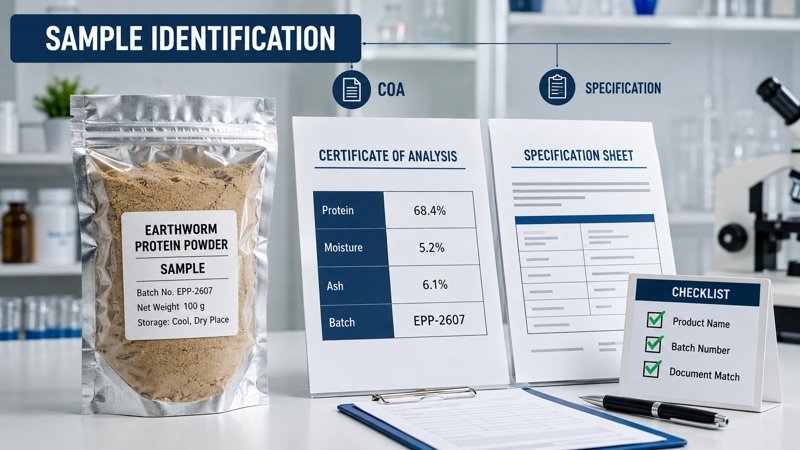
An earthworm protein powder sample evaluation should help a buyer answer a specific purchasing question: is this material suitable for further testing, supplier approval and a possible bulk order?
A useful evaluation goes beyond opening the package and checking the powder’s appearance. Supplement brands, nutraceutical companies, food ingredient buyers and formulation teams should connect the physical sample with its COA, specification sheet, batch identity, intended application and internal testing plan.
The process should also define what happens after approval. A satisfactory sample is an important qualification step, but it does not automatically guarantee that the same batch will remain available or that every future batch will be identical. Buyers therefore need a structured workflow from the initial sample request through actual bulk-batch confirmation.
Quick Answer: How Should Buyers Evaluate an Earthworm Protein Powder Sample?
B2B buyers should evaluate an earthworm protein powder sample through both document review and physical or formulation assessment. The process should cover sample identification, COA review, specification confirmation, appearance, protein content, packaging, storage and compatibility with the buyer’s intended formulation where applicable.
Before bulk approval, the buyer should also confirm whether the COA belongs to the sample batch and what documentation will be available for the actual order. Sample approval supports supplier qualification, but it does not guarantee that every future batch will produce identical results.
Why Sample Evaluation Matters Before Bulk Purchasing
A sample gives the buyer a controlled quantity of material for initial evaluation before committing to an MOQ, pilot-production quantity or larger purchase.
The evaluation can help determine whether:
- The supplied material matches the requested product and specification
- The sample documentation is complete enough for internal review
- Protein content and other relevant parameters meet the project requirements
- The powder is suitable for the proposed processing or formulation system
- Packaging and storage instructions are practical
- The supplier answers technical and purchasing questions clearly
These findings can reduce avoidable problems during pilot production. For example, a sample may meet the protein target but behave differently from expected in the buyer’s powder blend. Alternatively, the physical material may appear acceptable while its COA lacks a batch number or relevant microbiological results.
Sample testing provides evidence for a current purchasing decision. It should not be presented as proof of long-term supplier performance. Ongoing purchasing may still require bulk-batch document review, incoming inspection and periodic supplier reassessment.
Earthworm Protein Powder Sample Evaluation Workflow
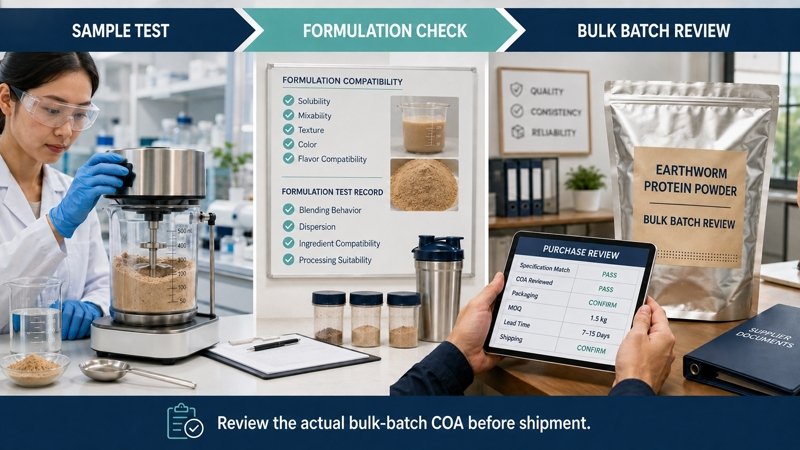
A practical workflow follows seven connected stages:
- Define the intended application and acceptance requirements.
- Request a relevant supplier sample and supporting documents.
- Review the specification sheet and sample-batch COA.
- Verify sample identification, packaging and condition.
- Perform physical, laboratory or formulation testing.
- Record findings and resolve discrepancies with the supplier.
- Confirm the actual bulk batch, commercial terms and shipping plan.
This sequence prevents a common procurement problem: conducting laboratory or formulation work before confirming what material was supplied and which criteria will be used to approve it.
Step 1: Confirm Sample Requirements Before Testing
The buyer should define the evaluation purpose before asking a supplier to send material. A request stating only “Please send a sample” gives the supplier little information about what will determine acceptance.
A more useful request should include:
- Intended application, such as a capsule, powder blend or other ingredient system
- Target protein specification
- Any required amino acid profile information
- Expected commercial order quantity
- Whether the sample is for document review, internal testing or pilot formulation
- Required COA, specification or product information
- Delivery destination
- Packaging expectations
- Planned evaluation timeline
Quantity is especially important. A supplier evaluating a request for a 1.5 kg trial order may provide different commercial information from a project expected to require a larger recurring volume.
Buyers can review the current product and document information on the Earthworm Protein Powder product page before preparing the request.
A useful additional step is to create an internal acceptance sheet before the sample arrives. It can classify criteria as mandatory, preferred or informational. This prevents the purchasing team from treating every observation as equally important after testing has started.
Step 2: Review the COA and Specification Sheet Before Testing
Document review should take place before physical or formulation testing because the documents establish what the sample is supposed to represent.
The specification sheet defines the supplier’s target requirements or acceptance limits. The COA reports actual results for a particular tested batch. Buyers should compare the two rather than treating either document as sufficient by itself.
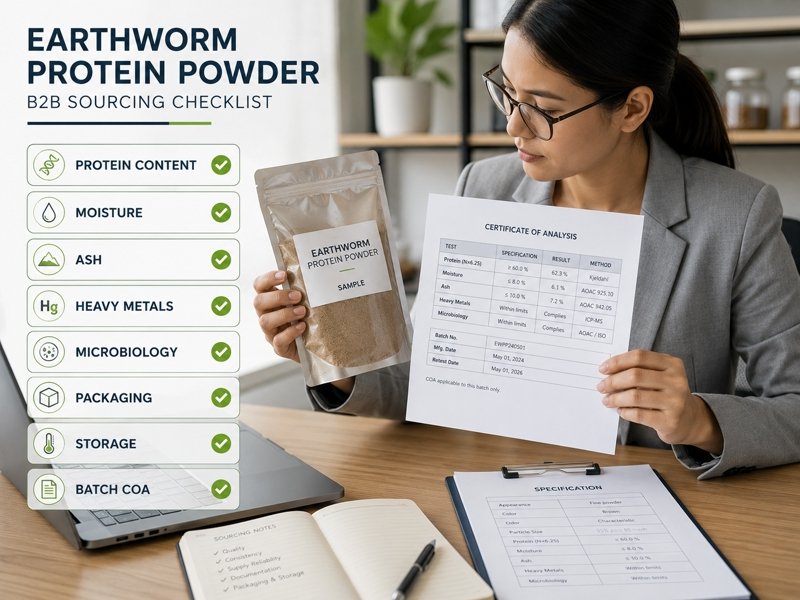
The initial review may cover:
- Correct product name
- Batch or lot number
- Protein content
- Moisture
- Ash
- Heavy metals
- Microbiology
- Manufacturing or expiry information
- Storage requirements
- Test methods where relevant
Protein content is important, but it should not become the only approval criterion. A material that reaches the target percentage may still require review of microbiological limits, moisture, physical handling and formulation suitability.
If the intended product positioning depends on its nutritional composition, the buyer may also request amino acid profile information. Its availability and testing basis should be clarified separately rather than assumed from the total protein result.
For a detailed explanation of batch-document fields, see Earthworm Protein Powder COA Review: What B2B Buyers Should Check. Buyers establishing their target limits can also consult Custom Specifications Available for Earthworm Protein Powder Buyers.
Step 3: Confirm the Sample and Batch Information
Every sample should have enough identification to connect the received material with the supplier’s records. The package label or accompanying information should identify the product and, where available, its batch or lot number.
The buyer should ask:
- Is this sample taken from an available commercial batch?
- Does the supplied COA belong to the sample batch?
- When was the batch manufactured?
- How should the sample be stored?
- Is the same batch likely to be available when evaluation is completed?
The COA should preferably match the sample batch. If the supplier provides a representative COA instead, this should be disclosed so the buyer does not mistakenly treat it as the sample’s actual result.
Timing also matters. A formulation team may require several weeks or months to complete internal testing. By the time approval is issued, the sampled batch may have been sold or may no longer be the most suitable batch for shipment.
This does not mean the sample and bulk order must always come from the same batch. It means the transition must be documented. Before shipment, the buyer should review the COA and specification status of the actual bulk batch and decide whether any additional confirmation is needed.
Step 4: Conduct a Physical Sample Evaluation
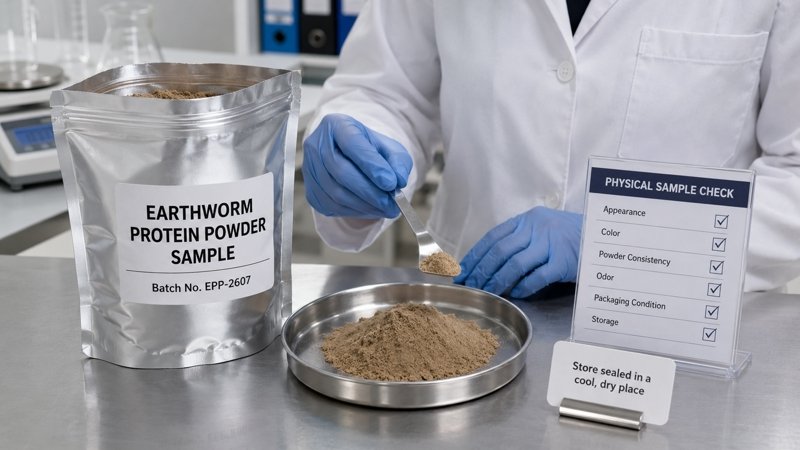
After confirming identity and documentation, the buyer can inspect the received sample. The observations should be recorded under defined conditions rather than described only as “good” or “acceptable.”
Practical checks include:
- Appearance and visible uniformity
- Color
- Powder consistency
- Presence of visible foreign material or unusual agglomeration
- Odor, assessed only as an ingredient-handling observation
- Condition of the inner and outer packaging
- Label completeness
- Evidence of leakage, moisture exposure or damage
- Storage conditions after receipt
These checks should be compared with the specification and the buyer’s handling requirements. They should not be used to make unsupported conclusions about nutritional value or finished-product sensory performance.
Photographing the unopened package, label and powder after opening can create a useful receiving record. Buyers may also retain a sealed reference portion under the stated storage conditions until the evaluation is completed.
Step 5: Perform Formulation Compatibility Testing
For formulation teams, document compliance and physical appearance may not be enough. The powder must also be assessed within the intended product system.
Depending on the application, internal testing may consider:
- Blending behavior with other powdered ingredients
- Distribution through the selected mixing process
- Dispersion characteristics where relevant
- Compatibility with flavors, carriers or excipients
- Response to the intended processing conditions
- Powder handling during filling or pilot production
- Finished-product appearance and stability considerations
Testing should use conditions that reasonably represent the planned formulation. A result from mixing the powder in water, for example, may have limited value if the intended use is a capsule blend.
The buyer should record the sample quantity, formula version, processing conditions and observations. This makes it easier to distinguish a raw-material issue from a problem caused by the formula or process.
Final formulation suitability depends on the buyer’s complete formula, manufacturing conditions, target market, labeling requirements and regulatory review. A supplier sample cannot independently establish finished-product compliance or performance.
Step 6: Review Results and Resolve Discrepancies
A sample evaluation should end with a documented disposition rather than an informal impression. Common outcomes include:
- Approved for the intended project
- Conditionally approved pending additional documents
- Additional testing required
- Alternative specification requested
- Rejected for the current application
If internal results differ from the COA, the buyer should first compare sample identity, test method, preparation method and reporting basis. A difference does not automatically prove that either result is incorrect.
The supplier should receive a precise question supported by the relevant test conditions. “Our result is different” is less useful than identifying the parameter, method, result, acceptance limit and sample batch.
This exchange also provides information about supplier suitability. Clear, timely and technically relevant responses are part of sample evaluation because they indicate how effectively later order questions may be handled.
Step 7: Decide Whether to Move from Sample to Bulk Order
Sample approval is one input in the purchasing decision. Before proceeding, buyers should confirm:
- Specification match
- COA and other document availability
- Sample or formulation suitability
- Actual order quantity
- MOQ
- Packaging format
- Lead time
- Available bulk-batch information
- Storage and shelf-life requirements
- Shipping method and destination
- Supplier response to technical questions
Buyers should also define whether the actual bulk batch requires only pre-shipment document approval or an additional pre-shipment sample. The appropriate approach depends on the project, elapsed time, specification and internal quality procedures.
For the commercial transition after sample approval, Lead Time and Logistics for International Earthworm Protein Powder Orders provides further purchasing context.
Earthworm Protein Powder Sample Evaluation Checklist
| Evaluation Item | What Buyers Should Check | Why It Matters |
|---|---|---|
| Sample identification | Product name, batch number and label details | Connects the material with supplier records |
| COA availability | Whether the COA is batch-specific and complete | Provides results for the identified batch |
| Specification sheet | Target limits and agreed requirements | Establishes the acceptance criteria |
| Protein content | Result, limit and test basis | Confirms the principal composition requirement |
| Moisture | Result against the specification | Supports storage and powder-condition review |
| Ash | Declared limit and batch result | Adds composition and quality-control context |
| Heavy metals | Relevant limits, results and methods | Supports buyer safety and compliance review |
| Microbiology | Required organism and count limits | Supports ingredient acceptance procedures |
| Appearance | Color, consistency and visible condition | Confirms physical conformity |
| Packaging | Seal, label, damage and moisture protection | Protects identity and condition during delivery |
| Storage | Supplier instructions and post-receipt handling | Helps preserve the evaluation sample |
| Formulation testing | Compatibility under intended processing conditions | Tests suitability for the buyer’s actual project |
| Bulk order confirmation | Actual batch COA, MOQ, packaging, lead time and shipping | Connects sample approval to the purchase decision |
Common Buyer Mistakes During Sample Evaluation
Testing Before Defining the Specification
Without predetermined criteria, teams may complete testing but remain unable to make a clear approval decision.
Focusing Only on Protein Percentage
Protein content should be reviewed together with relevant physical, microbiological, chemical and formulation requirements.
Ignoring the COA Batch Number
A COA is most useful when the buyer knows whether it represents the material received.
Assuming the Sample and Bulk Batch Will Be Identical
The sampled batch may no longer be available after a lengthy evaluation. The actual order batch still requires document confirmation.
Failing to Explain the Intended Application
Without application context, the supplier cannot determine which sample information or specification details are most relevant.
Requesting a Quotation Without Quantity Information
Pricing, MOQ, packaging and shipping depend on the expected order quantity and destination.
Treating Sample Approval as Permanent Approval
Future batches may require incoming review or periodic requalification according to the buyer’s quality system.
Selecting a Supplier Only by Price
A lower price does not resolve unclear specifications, missing batch information, unsuitable packaging or weak technical communication.
Allworms Supply Notes
Allworms supports overseas B2B supply of earthworm-derived ingredients. COA and specification sheet information can be provided for available Earthworm Protein Powder batches, and sample support may be available for qualified B2B buyers.
MOQ, packaging, lead time and shipping options depend on the required specification, quantity, destination and available batch conditions. Buyers can review general document, sample and purchasing questions on the Allworms FAQ page before submitting their evaluation requirements.
FAQ
Why should buyers request an Earthworm Protein Powder sample before bulk purchasing?
A sample allows buyers to review the material, documents and formulation suitability before committing to a trial or bulk quantity. It reduces uncertainty but does not prove long-term batch performance.
What documents should buyers review before testing a sample?
Buyers should review the specification sheet, relevant product information and the sample-batch COA where available. Packaging and storage instructions may also affect the evaluation.
Should the sample COA match the sample batch?
Preferably, yes. If only a representative COA is available, the supplier should clarify this before the buyer relies on the document.
What should buyers check in an Earthworm Protein Powder sample?
They may check identity, appearance, color, powder consistency, packaging, storage condition, protein content and other agreed quality parameters. Formulation teams may also evaluate processing compatibility.
Is sample approval enough before placing a bulk order?
No. Buyers should also confirm the actual order specification, batch COA, packaging, MOQ, lead time and shipping arrangements.
Can the sample batch and bulk batch be different?
Yes. The original sample batch may no longer be available when purchasing begins. Buyers should review the actual bulk-batch documents before shipment.
What specifications should buyers confirm before sample evaluation?
The relevant requirements may include protein content, moisture, ash, heavy metals, microbiology, appearance and any application-specific acceptance criteria.
Should buyers test formulation compatibility?
Yes, when the ingredient will be used in a defined formula. Testing should reflect the intended ingredients, processing method and finished-product format.
What information should buyers provide when requesting a sample?
Provide the target specification, intended application, testing purpose, expected quantity, destination, document requirements and packaging expectations.
Request Earthworm Protein Powder Sample Support
Review Sample Documents, MOQ and Shipping Options