When buyers talk about lumbrokinase, the first questions are usually about activity, assay method, batch consistency, price, and lead time. Fair enough. Those are the deal-making questions.
But here’s the thing: sustainability is no longer a side note in enzyme manufacturing. It’s becoming part of the purchasing decision itself. Not always in a loud, flashy way. Sometimes it shows up as a request for traceable sourcing. Sometimes it appears as a question about wastewater handling, raw material losses, or whether a supplier can keep enzyme activity stable without wasteful overprocessing. And sometimes, honestly, it comes from downstream brand pressure. The buyer is being asked by their own customers to prove that the ingredient story makes sense.
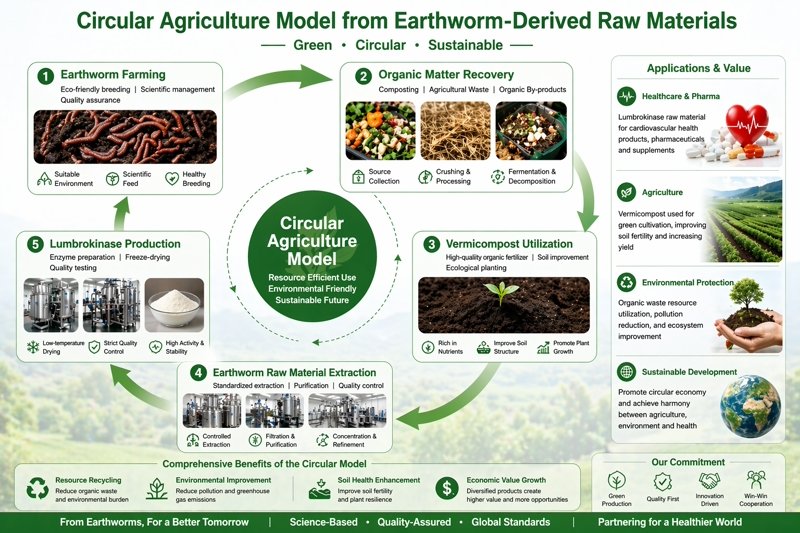
For lumbrokinase manufacturers, sustainability is not just about looking green. It is about building a system that uses raw materials well, keeps losses low, manages water and by-products carefully, and maintains stable quality without burning resources unnecessarily. In earthworm-derived ingredients, that conversation gets even more interesting, because the upstream supply chain can connect to circular agriculture, organic matter recycling, and lower-emission protein systems when managed properly. Research on earthworm protein has pointed out that earthworm culture can offer higher protein conversion efficiency and lower greenhouse gas production than conventional livestock systems, which is one reason the category keeps attracting attention as a functional ingredient source.
Why this topic is getting harder to ignore
A few years ago, many ingredient buyers treated sustainability as a “nice to have.” Now it is edging closer to procurement reality.
Why? Because ingredient brands, supplement companies, and formulation teams are under pressure from several directions at once. Regulations are getting tighter in many markets. Brand owners want cleaner supplier narratives. End users are asking sharper questions. And internal procurement teams are becoming less tolerant of vague claims like “eco-friendly process” with no real detail behind them.
Lumbrokinase sits in an especially sensitive spot. It is a high-value enzyme ingredient, and that means buyers expect technical performance. Yet because it comes from a biological source, they also expect responsible sourcing and clean processing controls. If either side looks weak, confidence drops.
That is why sustainability in lumbrokinase manufacturing should be discussed in plain language. Not as a marketing slogan. As an operating standard.
It starts upstream — with raw material sourcing
Let’s not pretend the extraction room is the whole story. In many bioactive ingredients, a big share of sustainability performance is decided before manufacturing even begins.
For lumbrokinase, the upstream question is simple: where do the earthworms come from, and how are they managed?
A more sustainable model usually includes controlled breeding, defined species selection, cleaner feed inputs, and traceable collection. That matters for environmental reasons, sure, but also for consistency. Uncontrolled raw material sourcing can create quality drift, contamination risk, and uneven enzyme yield. Nobody wants that.
Earthworm-based supply chains also have a natural circular-economy angle when they are built around organic matter conversion. In related project materials, earthworm cultivation is described as part of a broader loop that can help process organic waste streams while generating worm biomass and organic fertilizer outputs. That “worm farming → vermicompost/organic fertilizer → crop planting” structure is one of the clearest sustainability stories in this field, because it connects ingredient production with resource recycling rather than simple extraction and disposal.
That said, a circular model only works when it is managed well. Poorly controlled upstream farming can create temperature stress, unstable output, contamination problems, and inconsistent purity. So yes, circular agriculture sounds great — but it still needs SOPs, monitoring, and supplier discipline.
Efficient use of biomass matters more than people think
Here’s a practical truth buyers appreciate: sustainable manufacturing often begins with yield.
If a processor needs far more raw biomass than necessary to hit a target activity range, that is not only a cost issue. It is a sustainability issue too. Low extraction efficiency means more raw material use, more water, more energy, more waste, and more handling per kilogram of finished ingredient.
A stronger lumbrokinase manufacturing setup aims to do a few things well:
- maintain consistent raw material quality
- improve recovery during extraction and separation
- reduce avoidable activity loss during processing
- limit rework and off-spec batches
- preserve more usable value from the same raw input
That last point is huge. The better the process design, the less the manufacturer has to “brute force” production.
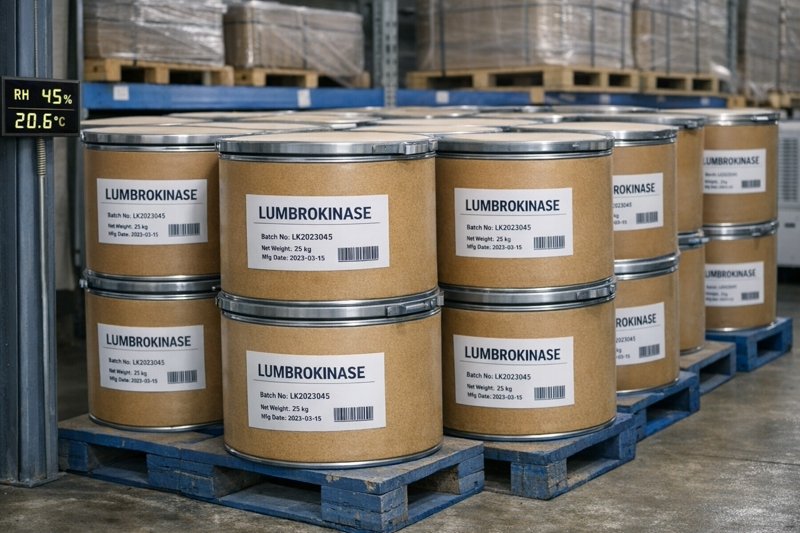
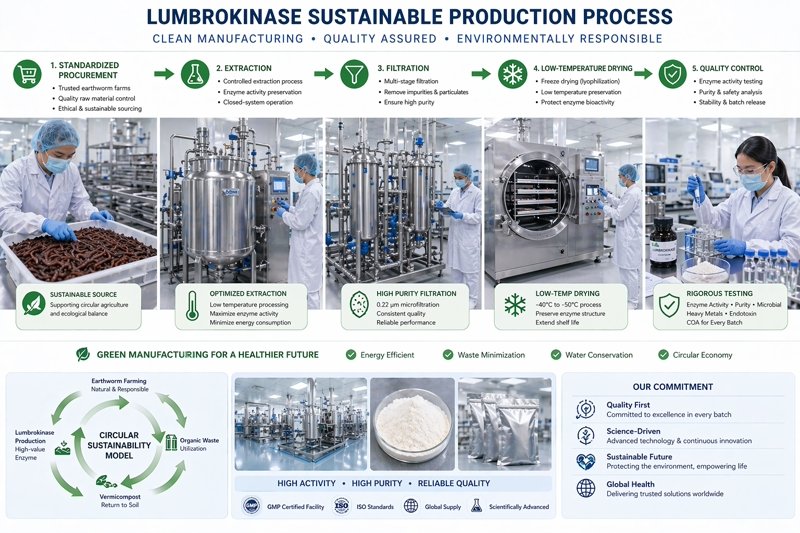
Company materials for lumbrokinase already frame the process around raw material selection, enzymatic extraction, centrifugation and filtration, low-temperature drying, sterilization, and packaging, with controlled processing positioned as essential for activity retention and purity. That is not just a quality story. It is a sustainability story too, because activity retention means fewer wasted batches and less overprocessing to compensate for damage.
The process floor: where sustainability gets real
This is where the conversation stops being abstract.
In lumbrokinase manufacturing, the main environmental pressure points often include water use, filtration losses, drying energy, sanitation load, and waste handling. If the plant is serious, each one gets managed deliberately.
Water use and cleaning cycles
Biological extraction lines use a lot of water. Washing, separation, cleaning, and sanitation all add up. A sustainable plant should be asking: where can water use be reduced, reused safely, or treated better?
This does not mean cutting corners on hygiene. It means designing cleaning schedules, line layouts, and equipment flow so the process stays clean without becoming wasteful. Smart water handling is not glamorous, but it makes a real difference.
Filtration and separation efficiency
Centrifugation and filtration are central in enzyme processing. If those stages are poorly tuned, valuable actives can be lost, and waste loads increase. That is bad for yield and bad for sustainability.
A good manufacturer watches separation efficiency the way a careful chef watches heat — not too much, not too little, and never casually. The goal is simple: keep more of the useful fraction and send less value down the drain.
Low-temperature drying — not just a technical detail
This one deserves extra attention.
Low-temperature drying is often presented mainly as a way to protect enzyme activity, and that is true. But it also has a sustainability angle. Stable drying conditions can reduce degradation, shrink reprocessing needs, and help avoid the waste created by heat-damaged product. The lumbrokinase product material specifically highlights low-temperature drying as part of the controlled process used to maintain enzyme stability.
Now, to be fair, gentler drying is not automatically lower-energy drying. Sometimes it can be slower. Sometimes it needs careful optimization. So the smart goal is not “lowest temperature at any cost.” It is the best balance between activity protection, energy demand, and throughput. That balance is where experienced manufacturers separate themselves from the crowd.
Waste streams should be treated as design problems, not afterthoughts
A lot of factories talk about waste only when customers ask. That is backwards.
In a mature lumbrokinase operation, by-products, wastewater, and residual biomass should be part of the process design from day one. The question is not whether waste exists. Of course it does. The question is whether the manufacturer has a plan.
In broader earthworm-industry planning documents, wastewater treatment, organic fertilizer processing, and reuse pathways are already treated as part of site-level infrastructure, not as side issues. That mindset matters. It suggests a more responsible production model: take what can be reused, treat what cannot, and avoid building a system that depends on constant disposal.
For B2B buyers, this is worth asking about directly. You do not need a glossy ESG booklet. You need real answers:
How is wastewater handled?
Are residual solids repurposed where appropriate?
Is there a clear contamination-control plan?
Does the site have environmental compliance procedures?
Those are sensible questions. Not aggressive ones. Sensible.
Sustainability and quality are not enemies
Some buyers still act as if sustainability and performance sit on opposite sides of the table. In enzyme manufacturing, that is often the wrong way to see it.
A cleaner, tighter, better-controlled process tends to support quality anyway.
Traceable raw materials help reduce variation. Controlled sourcing helps reduce contamination risk. Efficient separation helps preserve activity. Better drying reduces damage. Consistent packaging and storage help hold shelf stability. None of this is romantic. It is operational. But operations are where good ingredients come from.
Lumbrokinase is typically positioned as a high-activity fibrinolytic enzyme complex with dual action: direct fibrin degradation and plasminogen activation. When you are making a material like that, process discipline is not optional. A sloppy plant cannot credibly claim both sustainability and reliable bioactivity. The two have to support each other.
What sustainable lumbrokinase manufacturing looks like in practice
Let me put it plainly. A strong supplier is usually doing most of the following:
1. Controlled raw material sourcing
Not random collection. Not vague origin claims. Controlled sourcing, with stable upstream relationships and traceability.
2. Standardized processing
Defined extraction, filtration, drying, sterilization, and packaging steps — because waste often appears where process variation appears first.
3. Activity preservation without excess rework
If a plant constantly compensates for activity loss later in the process, resources are being burned somewhere.
4. Wastewater and by-product planning
A real plan. Not hand-waving.
5. Stable packaging and storage systems
Well-designed packaging reduces spoilage, shipping loss, and repeat production caused by avoidable damage.
6. Scale with discipline
Bigger is not always better. Rapid expansion without process control can hurt both environmental performance and quality consistency. Several earthworm-farming project documents make the same point in a different way: scale should follow stable operation, not race ahead of it.
What buyers should ask suppliers — without sounding like auditors
Honestly, you do not need to interrogate anyone. But you should ask better questions.
Try these:
- Is your earthworm raw material source controlled or open-market?
- Do you have batch-level traceability from raw material to finished lumbrokinase?
- What are the key steps used to preserve activity during manufacturing?
- How do you manage wastewater and processing residues?
- What part of your process is most energy-intensive, and how do you reduce unnecessary load?
- How do you prevent activity loss during drying, storage, and shipment?
- Can you explain your sustainability approach in operational terms, not just policy terms?
A good supplier will not be annoyed by these questions. A serious supplier will probably welcome them.
The commercial upside is real, too
Let’s not ignore the business side.
Sustainability in lumbrokinase manufacturing can support:
- more stable long-term raw material supply
- fewer batch failures
- stronger buyer confidence
- easier entry into quality-sensitive markets
- better positioning for premium formulations
- a cleaner brand story for downstream customers
That last one matters more than some people admit. Buyers in supplements, nutraceuticals, and functional health products increasingly want ingredient stories that feel technically solid and commercially believable. “High activity” is good. “High activity from a traceable, well-managed, resource-conscious process” is better.
Final thought: sustainability is becoming part of the spec
Not always as a number on a COA. Not yet, anyway. But it is moving in that direction.
For lumbrokinase manufacturers, sustainability should be treated like assay control or microbial management: part of the system, part of the process, part of the promise. When the raw material chain is traceable, the process is controlled, water and waste are managed carefully, and activity is protected efficiently, sustainability stops being a fluffy extra. It becomes part of manufacturing competence.
And buyers notice that. Maybe quietly. But they notice.
If your goal is long-term B2B growth in lumbrokinase, that is the real takeaway: sustainability is not separate from quality, supply stability, or commercial trust. It sits right in the middle of all three.
FAQs
1. Why is sustainability important in lumbrokinase manufacturing for B2B buyers?
Because sustainability affects more than image. In bulk lumbrokinase supply, it connects directly to traceable sourcing, batch consistency, waste control, and long-term supply reliability.
2. What makes an earthworm-derived lumbrokinase supply chain more sustainable?
A more sustainable earthworm-derived lumbrokinase supply chain usually includes controlled breeding, traceable raw material sourcing, efficient extraction, careful wastewater handling, and better use of by-products.
3. Does sustainable lumbrokinase production help maintain enzyme activity?
Yes. In many cases, sustainable lumbrokinase production relies on tighter process control, which can help reduce activity loss, lower rework rates, and support more stable finished-enzyme quality.
4. What process step has the biggest sustainability impact in lumbrokinase powder manufacturing?
There is no single answer, but water management, separation efficiency, and drying conditions are often major factors in lumbrokinase powder manufacturing sustainability.
5. How can buyers evaluate a sustainable lumbrokinase manufacturer?
Ask for practical details: raw material traceability, activity-preservation methods, wastewater treatment approach, packaging controls, and how the supplier reduces waste across bulk lumbrokinase production.
Get Technical Support for Your Formulation
Explore high-stability lumbrokinase solutions